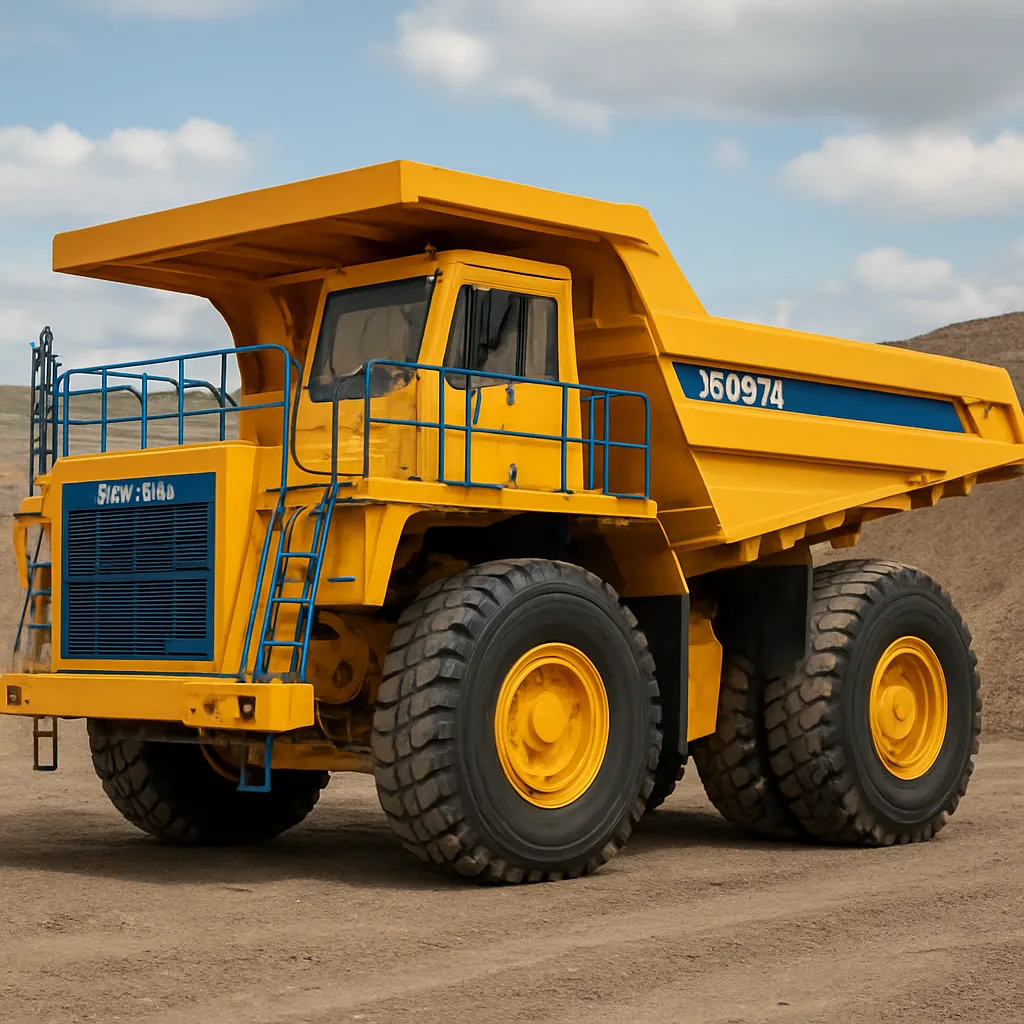
The BelAZ 75570 is a heavy-duty mining dump truck designed to move large volumes of material in demanding open-pit operations. Built by the Belarusian manufacturer BelAZ, this machine combines rugged construction with practical features tailored for continuous, high-intensity work. Below you will find a comprehensive overview of its design, uses, typical specifications, maintenance considerations, and its place in the global market of haul trucks.
Design and technical characteristics
The BelAZ 75570 is engineered as a rigid-frame haul truck intended for short-cycle transport of ore, overburden and other bulk materials. Its structure emphasizes robustness, serviceability and the ability to function in harsh climates and abrasive environments. Key elements of the design include a heavy-duty frame, reinforced dump body, a powerful powertrain and a suspension system designed to handle high loads while preserving stability and safety.
Chassis and body
The truck uses a reinforced welded steel frame sized to withstand frequent loading and unloading cycles. The dump body is constructed from high-strength wear-resistant steels or alloyed plates in critical contact areas to extend service life. The undercarriage is designed for easy access to components and fast replacement of wear items. The vehicle usually has a three-axle configuration (6 wheels) common in this class, with heavy-duty axles and large-diameter wheels and tires designed to distribute weight and resist punctures and heat buildup.
Powertrain and transmission
BelAZ manufactures its trucks with several powertrain options depending on customer requirements and local supply agreements. Typical installations in the 70–100 tonne class include high-displacement diesel engines with outputs in the medium-to-high power range paired with either mechanical (power-shift) transmissions or electric drive systems in some configurations. The truck is engineered to provide a balance between tractive effort at low speeds (required for loaded climbs) and fuel efficiency during long operational shifts.
Cabin and controls
The operator cabin is ergonomically arranged to reduce fatigue during long shifts. Modern variants of BelAZ cabins offer climate control, improved seating with multiple adjustments, and instrument clusters that report critical machine data. Electronic monitoring systems and telematics packages are commonly available from the factory or as dealer-installed options, enabling remote diagnostics and fleet management.
Approximate technical specifications
Typical technical data (approximate and configuration-dependent)
- Payload capacity: ~80–100 tonnes (most commonly cited near 90 tonnes)
- Engine power: ~500–1,000 kW depending on engine and electronic control options
- Configuration: 6-wheel rigid dump truck (3 axles)
- Empty weight: typically in the range of 50–70 tonnes
- Top speed: up to 50–60 km/h unloaded (operational speeds are much lower when loaded)
- Body volume: varies by lining and payload density, typically sized to match payload in tonnes
- Braking: service air brakes with auxiliary hydraulic or retarder systems for downhill control
- Fuel consumption: highly variable—affected by duty cycle, payload, and terrain (operators often track in L/hour or L/tonne)
Note: exact numbers depend on specific submodel, customer options and local configurations. BelAZ and its distributors provide detailed datasheets for each configuration on request.
Applications and operational contexts
The BelAZ 75570 is primarily targeted at the global open-pit mining sector and large construction or quarry projects that require repetitive, high-volume material movement. The machine is suited to a variety of applications:
- Surface mining: transporting blasted ore and overburden from loading points to crushers, stockpiles or dumping zones.
- Quarries: moving processed rock, aggregate and heavy materials over short distances within extraction sites.
- Infrastructure projects: large earthworks where consistent cycles of loading and dumping improve overall productivity.
- Remote and cold-climate operations: BelAZ trucks are engineered to function in extremes of temperature and dust.
Operators often select the BelAZ 75570 for operations that require a balance of high payload, maneuverability and lifecycle cost-effectiveness. In practice, the truck is commonly integrated into mixed fleets that include excavators, wheel loaders, shovels and crushers. Productivity gains come from optimizing cycle times, minimizing downtime and coordinating loading equipment to match the truck’s payload and body shape.
Maintenance, operational costs and reliability
Long-term performance of heavy haul trucks is heavily influenced by maintenance regimes and operational discipline. The BelAZ 75570 has been designed to simplify routine servicing, with accessible service points and modular components that can be replaced on-site. Typical maintenance considerations include tyre management, lubrication schedules, engine servicing, axle and brake inspections, and dump body wear monitoring.
Common maintenance and lifecycle topics
- Tyre life: one of the largest running costs—proper inflation, alignment and loading practices extend tyre life substantially.
- Oil and filter change intervals: depend on engine choice and operating hours; many fleets adopt condition-based oil analysis.
- Brake and retarder systems: regular checks are critical for safety, especially in steep mine ramps where thermal stress is high.
- Wear parts: dump-body liners, cutting edges and suspensions are typical consumables requiring scheduled replacement.
- Telematics: remote diagnostic systems reduce unscheduled downtime and allow predictive maintenance strategies.
From a cost perspective, operators evaluate trucks not only by initial purchase price but also by cost per tonne moved. Factors affecting cost per tonne include fuel consumption, tyre usage, maintenance labor, spare parts consumption and machine utilization. BelAZ provides support through dealer networks and training programs to help operators reduce total cost of ownership.
Safety features and operator comfort
BelAZ has incorporated multiple safety and ergonomic elements into its truck designs. These include reinforced cabins meeting rollover protection standards, multi-point seatbelts, fire suppression systems (optional or mandatory in many mines), and redundant braking systems. Visibility aids such as wide-angle mirrors, rear cameras, and audible alarms help reduce the risk of collisions in congested yards.
Operator comfort is a recognized contributor to safety and productivity. Well-designed cabins reduce fatigue and improve attention: adjustable seats, climate control, noise insulation and logically arranged controls all help operators maintain consistent cycle times with fewer errors.
Market position, history and comparisons
BelAZ has a long history as a manufacturer of off-highway dump trucks and heavy equipment. The 75570 fits into BelAZ’s mid-to-large-size product family, positioned for customers who require substantial payloads but do not need ultra-large machines reserved for the very largest mines. Compared with competitors such as Caterpillar, Komatsu and Liebherr, BelAZ trucks often offer attractive pricing and adaptability to regional maintenance ecosystems. Buyers consider a number of factors when choosing a haul truck brand, including:
- Availability of local service and spare parts
- Fuel efficiency and emissions compliance
- Customization and build options
- Proven reliability under specific operating conditions
In fleet comparisons, the BelAZ 75570 is chosen where a combination of payload, maneuverability and cost-efficiency match site requirements. Larger ultra-class trucks (200 t+) are used in giant copper and iron ore operations, while units like the 75570 often offer better flexibility for medium-scale mines or as part of mixed-size fleets.
Environmental concerns and future developments
Environmental regulations and corporate sustainability goals are pushing the mining industry toward lower emissions and higher energy efficiency. This trend affects haul truck design and fleet strategy in several ways:
- Engine emissions: newer engines meet tighter emission standards (Tier/Stage) and use aftertreatment systems (SCR, DPF) to reduce NOx and particulates.
- Fuel efficiency: design improvements and optimized duty cycles reduce fuel consumption per tonne moved.
- Electrification and hybridization: while full battery-electric haul trucks of this size are in early adoption stages, hybrid or electric-drive variants and trolley-assist systems are increasingly considered for steep-haul applications.
- Recycling and material selection: use of more durable materials and remanufacturing programs lowers lifecycle environmental impact.
BelAZ and other manufacturers are exploring digitalization and electrification pathways—ranging from improved engine controls and telematics to support for autonomous operation and remotely monitored maintenance. Integration with mine-wide energy management and renewable-energy sources (where feasible) forms part of long-term decarbonization strategies.
Operational best practices and productivity tips
To maximize productivity with trucks like the BelAZ 75570, mine operators typically focus on the following areas:
- Matching loading equipment: selecting shovels and loaders whose bucket geometries and cycle times complement the truck’s payload.
- Route optimization: minimizing loaded and unloaded travel distances and smoothing ramp geometry to reduce fuel consumption and brake wear.
- Scheduled maintenance: combining condition-based monitoring with planned downtime to keep unscheduled failures low.
- Operator training: skilled drivers deliver better fuel economy, safer operation and more consistent cycle times.
- Fleet analytics: using telematics data to balance truck-to-shovel ratios, plan shift allocations and pinpoint bottlenecks.
Summary and final observations
The BelAZ 75570 represents a practical option in the medium-to-large class of mining haul trucks: it balances payload capacity, ruggedness and maintainability for demanding open-pit operations. While exact technical specifications vary by configuration and optional equipment, the model is typically associated with a payload near the 80–100 tonne range and robust systems designed for continuous heavy-duty work. Operators considering this truck will weigh factors such as total cost of ownership, service support, fleet compatibility and the machine’s adaptability to their specific mine layout and material characteristics.
For operations focused on improving productivity and reducing operating costs, the BelAZ 75570 can serve as a reliable workhorse when combined with proven maintenance regimes, operator training and modern fleet management tools. As the industry shifts toward lower emissions and smarter fleets, future iterations and upgrades of machines in this class are likely to emphasize efficiency, digitalization and incremental electrification to meet both regulatory and commercial pressures.


)
)