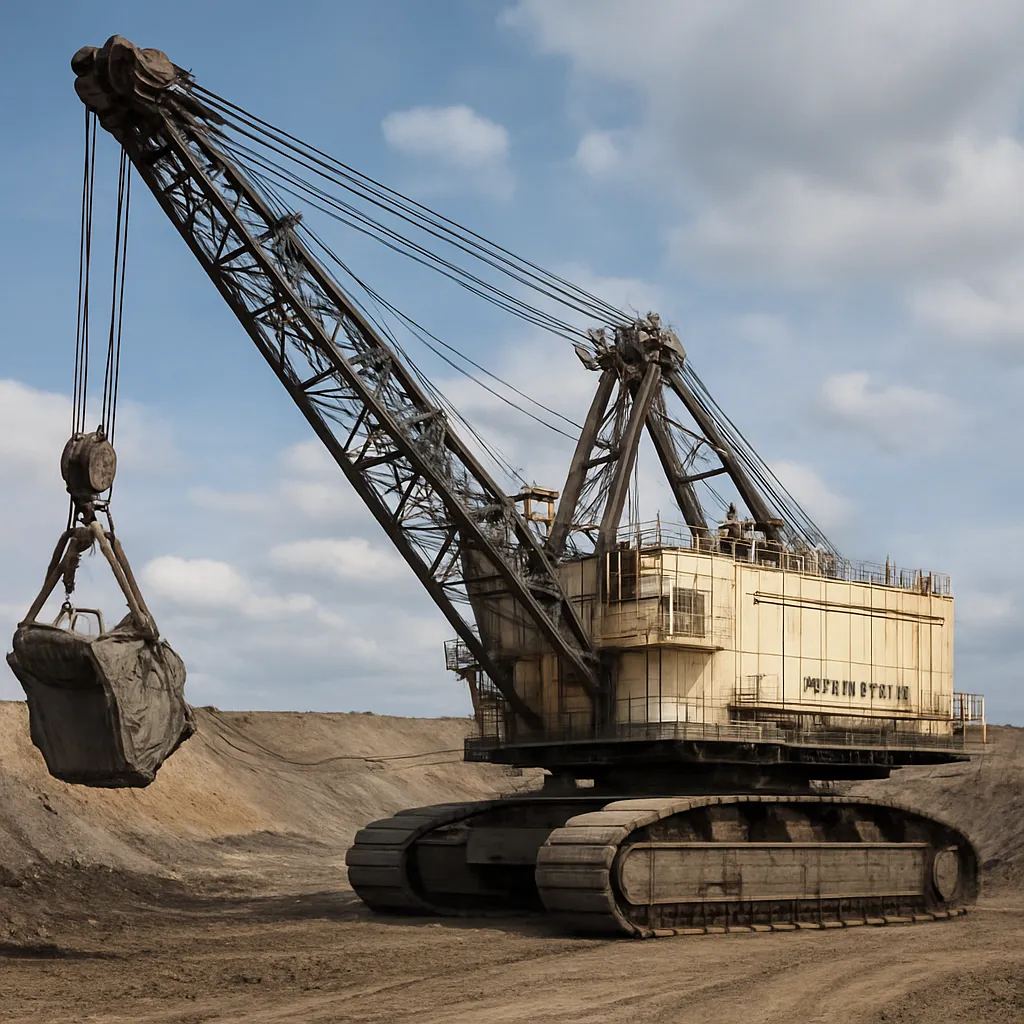
The Giant M-1000 dragline is a representative of the class of large cable-operated excavators that have shaped surface mining and heavy earthmoving for much of the 20th and 21st centuries. In this article we examine the machine’s design principles, typical technical characteristics, areas of application, operational practices, economic and environmental implications, and the trends that are shifting the role of giant draglines like the M-1000 in modern industry. Wherever possible the discussion refers to typical figures for very large draglines and to known historical examples to give context to the M-1000’s capabilities.
Design and core components of the Giant M-1000
At its heart a dragline is a relatively simple concept implemented at enormous scale: a large open bucket is dragged across the ground by a system of cables and then hoisted and swung to dump the load at a desired location. The Giant M-1000 is commonly understood to be a heavy-duty, long-reach dragline optimized for moving large volumes of overburden in open-pit and strip mining operations, where economical removal of soil and rock above mineral seams is critical.
Primary components
- Boom: A very long lattice-structure boom provides the reach needed to cut far from the machine’s footprint. For giant machines the boom may be tens of meters long—often in the range of 50–100+ meters for ultra-large designs—allowing a single machine to access a wide swath of pit without being moved frequently.
- Bucket: The drag bucket is a heavy, reinforced shell designed for repeated abrasion and large volumes. Bucket capacities for large draglines can range from a few cubic meters to more than a hundred cubic meters; the largest historic machines had buckets measured in the low hundreds of cubic meters.
- Hoist and drag winches: Powerful winches control the hoist, drag and positioning ropes. They provide the lifting force to raise the loaded bucket and the drag force to pull the bucket toward the machine during the cut.
- Ropes and sheaves: Wire ropes are a critical component, sized and maintained to carry enormous loads. Sheave assemblies on the boom tip and the machine body guide the ropes during operations.
- Superstructure and undercarriage: The rotating superstructure houses motors, winches, operator cabins and control systems and turns atop a heavy foundation. Many giant draglines use a walking mechanism—pontoons or shoes that incrementally move the machine—rather than continuous tracks, enabling relocation without disassembly.
- Power systems: Historically these machines were powered by large electric motors supplied by mine substations. Modern variants may use hybrid power, and electrical systems remain common due to large continuous power needs.
Operational sequence and mechanical principles
The dragline operates in a cyclical pattern: the bucket is lowered to the cutting face and a drag rope pulls the bucket toward the machine, cutting into the material. Once filled, the hoist rope lifts the bucket, the superstructure swings, and the bucket is dumped at the spoil pile or overburden conveyor. The cycle repeats many times per hour. The design emphasizes reach and volume per cycle rather than high excavation speed per stroke; a single pass of a giant dragline can move many tons of material.
Typical technical parameters (representative ranges)
- Bucket capacity: For very large machines, roughly 20–220 m³ (some historic giants exceeded 150–200 m³).
- Boom length: Roughly 40–100+ meters depending on model and intended reach.
- Operating weight: from several thousand tons to over 10,000 metric tons for the largest historic examples.
- Installed electrical power: a few megawatts up to 10+ megawatts for ultra-large units.
- Typical cut reach (horizontal): often in the tens to over a hundred meters, enabling wide coverage from a single set-up position.
It is important to note that exact specifications for an M-1000 variant depend on the manufacturer’s design choices and intended mining context; published figures for particular machines are best obtained from manufacturer datasheets or mine maintenance records.
Applications and industries that use the M-1000
The Giant M-1000 and comparable large draglines are primarily used where moving large volumes of near-surface material is the main task. This makes them especially valuable in certain industries and applications:
- Coal mining: Historically draglines have been a staple of surface coal mining, removing overburden to expose coal seams. Their low per-bank-cubic-meter cost in long-reach operations has kept them economical in many large coal pits.
- Open-pit mining of other minerals: Large draglines can be used to remove barren strata in metal ore and industrial mineral pits where bench geometry and material characteristics are suitable.
- Quarrying and bulk earthworks: For massive cut-and-fill operations—such as creating huge foundation excavations, constructing canals or large earth dams—draglines can move soil efficiently over long reaches.
- Oil sands and heavy mineral operations: In some oil sands operations and placer-type operations, large draglines or bucket-wheel systems are used for bulk excavation.
- Large-scale reclamation and land reshaping: After mining, draglines can be deployed in reclamation phases to redistribute spoil and reshape terrain as part of environmental compliance efforts.
Because they are optimized for moving many cubic meters per cycle with a long reach, draglines are usually most cost-effective where the material is relatively soft (overburden, unconsolidated soils) and where the pit layout allows a dragline to work from a stable bench or pad. They are less suitable for very hard rock extraction or for highly segmented pit geometries where mobility and trenching precision are required—roles more efficiently filled by hydraulic shovels and excavators.
Operation, crew structure and lifecycle management
Operating a giant dragline is a specialized and crew-intensive task, though automation has reduced some manpower needs over time. Typical aspects of operation and lifecycle include:
Crew and control
- Operators: Usually one or two operators are stationed in a cabin with controls for hoist, drag, swing and walking mechanisms. Modern cabins include ergonomic controls, monitoring screens and remote-control capabilities.
- Support crew: Mechanics, electricians, riggers, and safety officers form the maintenance and support team. Given the scale of the machine, a significant maintenance organization is necessary to sustain reliable operations.
- Shift patterns: Many draglines operate 24/7 in multi-shift patterns, especially in high-capacity mines, requiring robust spare parts and scheduled maintenance intervals to maintain availability.
Maintenance and overhaul
Preventative maintenance is critical. Key routine activities include rope inspection and replacement, gear and bearing checks, structural inspections of the boom and bucket, electrical system servicing, motor and gearbox maintenance, and undercarriage and walking mechanism upkeep. Major overhauls—where motors, winches or components are replaced or rebuilt—can extend a dragline’s service life by decades. It’s not uncommon for large draglines to remain in service for 30–50 years with periodic rebuilds and component renewals.
Typical productivity and availability
Productivity for a giant dragline is often expressed in bank cubic meters per hour (BCM/h) or tons moved per hour. Strong-performing large draglines can move thousands of BCM per day under ideal conditions; annual volumes can reach millions of cubic meters in large mining operations. Availability targets for well-managed operations often aim above 85–90 percent, though real-world availability depends on maintenance practices, the age of the machine and the operating environment.
Economic considerations
Deploying a Giant M-1000 involves large capital and operating expenditures, but the machine can become highly economical in the right scenario due to its ability to move vast quantities of material with few large cycles.
- Capital cost: Purchasing a new large dragline may involve tens to hundreds of millions of U.S. dollars when considering the machine itself plus site preparation, electrical infrastructure and transportation. Many operations opt to buy used or reconditioned machines because of the high initial cost.
- Operating cost: Major cost drivers include energy consumption (electricity), maintenance labor and parts (ropes, gearboxes, motors), and periodic component overhauls. Draglines typically have lower fuel-related costs than diesel excavators if electric power is available at reasonable rates.
- Cost per cubic meter: When conditions are suitable, the dragline’s cost per bank cubic meter moved can be lower than that of fleets of hydraulic excavators and haul trucks, especially over long-life operations where the machine’s reach and cycle volume offset slower single-cycle speeds.
- Depreciation and resale: Because they are long-lived capital assets, draglines depreciate over long timelines. Secondary markets for large draglines exist, but transportation and reassembly costs can be high, and some retired giants have been scrapped due to the high cost of relocation versus residual value.
Environmental and social impacts
Giant draglines have historically been associated with extensive surface disturbance. Responsible mine planning seeks to manage and mitigate environmental and social impacts:
- Land disturbance: Draglines remove topsoil, vegetation and overburden in large strips. Reclamation planning is essential to restore landscapes after mining operations conclude. Techniques include soil segregation, progressive reclamation and recontouring.
- Dust and noise: Massive mechanical operations generate dust and noise. Dust suppression programs, noise barriers and operational timing can reduce impacts on nearby communities and ecosystems.
- Water and runoff: Open-pit operations must manage surface water and groundwater interactions to prevent pollution. Sediment control and water treatment systems are common.
- Socioeconomic effects: Large mining projects create jobs and local infrastructure but can also displace communities or alter local economies. Stakeholder engagement and compensation programs are increasingly required by regulatory frameworks and lenders.
- Reclamation: Reclamation may include reshaping pits, replacing topsoil, re-vegetation and long-term monitoring. Large draglines can assist in reclamation by moving large quantities of material efficiently, though planning must ensure ecological compatibility.
Safety considerations
Given their massive scale, safety systems and practices are rigorous. Typical safety measures include:
- Regular structural inspections to detect fatigue cracks or wear in booms, buckets and pins.
- Rope and sheave monitoring programs to prevent catastrophic failures.
- Operational exclusion zones—no-go areas around the swing radius and walking path to prevent personnel exposure.
- Electrical safety procedures, lockout-tagout systems for maintenance, and redundancy in critical controls.
- Training and competency requirements for operators and maintenance staff, including simulated emergency response scenarios.
Modern trends and the future of large draglines
The role of the Giant M-1000 and its peers is evolving in the face of technological and market changes. Key trends include:
- Automation and remote operation: Advances in control systems, sensors, and telecommunications allow remote operation and semi-automated cycles, improving safety and optimizing fuel/electrical use and cycle timing.
- Digital monitoring and predictive maintenance: Condition monitoring, vibration analysis and predictive algorithms reduce unplanned downtime by anticipating rope wear, bearing failure or gear issues before they develop into faults.
- Electrification and energy management: Improved power electronics and grid integration strategies help manage peak electrical loads and can pair dragline usage with on-site renewable generation or energy storage systems.
- Competition with hydraulic equipment: Hydraulic shovels and electric rope shovels have advantages in mobility and trenching precision. Draglines retain advantages in reach and low cost per bank cubic meter for long continuous cuts, but their role has become more specialized.
- Lifecycle and sustainability thinking: Manufacturers and owners increasingly plan for end-of-life reuse, component recycling and the environmental footprint of manufacturing and disposal.
Notable historical examples and statistics
Historically, some draglines have achieved public attention because of their sheer size. A well-known example is Big Muskie, a giant dragline that operated in the United States in the latter half of the 20th century. Big Muskie’s bucket capacity was reported at roughly 220 cubic yards (about 168 m³), and the machine’s operating weight reached into the tens of thousands of short tons. Such machines exemplify the peak scale that cable-operated excavators achieved during the era when they were the dominant technology for very large-scale surface mining.
Representative statistics for giant draglines (ordered as illustrative ranges rather than precise figures for the M-1000 unless specified by manufacturer data):
- Bucket volumes: commonly 20–220 m³ for very large models; ultra-giants exceed 150 m³.
- Typical boom lengths: 40–100+ meters.
- Operating weights: several thousand to over 10,000 metric tons for the largest machines.
- Installed power: a few to over 10 MW for hoist and drag systems combined.
- Service life: 30–50+ years with periodic rebuilds and good maintenance.
Practical considerations for mines considering an M-1000
Mines evaluating a Giant M-1000 or similar dragline should weigh a set of technical and economic questions:
- Is the pit geometry and bench plan compatible with a long-reach dragline working efficiently from stable pads?
- Are the materials to be moved suitable for cable-bucket excavation (i.e., relatively soft overburden rather than highly competent rock)?
- Can the site provide reliable, affordable electrical power at the scale the machine requires?
- What are the short- and long-term maintenance capacities, spare parts logistics, and uprate/rebuild options?
- How does the machine’s expected cost per bank cubic meter compare to alternatives (hydraulic excavators + haul trucks) across the mine life?
- What reclamation and environmental plans must be met, and how will the dragline’s operations facilitate or complicate those plans?
Interesting operational and logistical notes
Some practical and less-obvious aspects of working with giant draglines include:
- Relocation logistics: Moving a very large dragline between sites can be a major logistical project. Some owners choose to dismantle and reassemble the machine, while others sell to local operators to avoid relocation costs.
- Incremental walkability: Walking mechanisms allow repositioning in small steps without full disassembly; however, the soil-bearing capacity and bench construction must be engineered carefully to support the machine’s enormous weight.
- Component modularity: Many modern rebuild programs focus on modular replacement of drive units, winches and electrical cabinets to minimize downtime.
- Integration with haulage and conveyor systems: For some operations, draglines feed conveyors or other fixed infrastructure to minimize truck haulage distances, reducing overall operating costs and emissions.
Summary
The Giant M-1000 represents a class of machines that combine enormous scale with a simple operational principle—drag, hoist, swing and dump—to move very large volumes of earth efficiently where site conditions allow. Their key advantages are long reach, high volume per cycle and cost efficiency in suitable applications, while disadvantages include high capital costs, logistical complexity and significant environmental footprint if not managed. Modern trends toward automation, predictive maintenance and electrification are extending the useful life and competitiveness of large draglines in select mining and bulk earthmoving roles. For any operation considering an M-1000-class dragline, careful alignment of pit design, power availability, maintenance capability and reclamation planning is essential to realize the machine’s full economic and operational potential.
Key terms highlighted: Throughout the article the most important concepts related to the Giant M-1000—such as dragline, bucket, boom, overburden, mining, productivity, walking mechanism, ropes, automation and reclamation—have been emphasized to help readers quickly identify major topics.


)
)