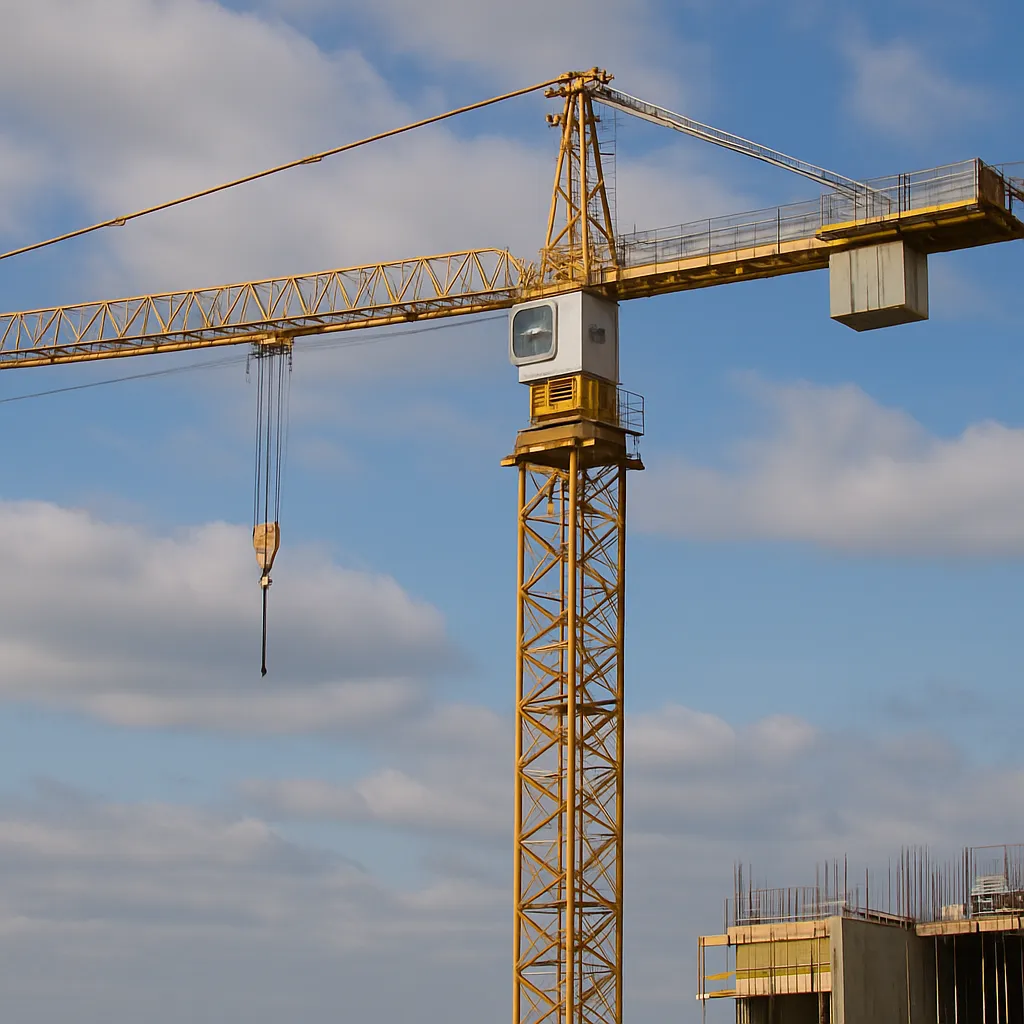
The Liebherr 420 EC-H is a member of Liebherr’s proven range of flat-top tower cranes, designed to meet the demanding needs of modern construction and industrial projects. Combining modularity, robust mechanical design, and advanced electronic controls, the 420 EC-H is engineered for efficient lifting, flexible mounting options, and high operational reliability. In the following sections we explore the crane’s design principles, typical technical characteristics, practical applications, erection and transport considerations, as well as safety, maintenance and economic aspects.
Design and core technical features
The 420 EC-H follows Liebherr’s philosophy of creating cranes that are both adaptable and durable. Its design centers on a rigid, welded tower section, a balanced slewing unit and a lattice jib that can be configured to different lengths. The crane is intended for medium-to-heavy lifting tasks at building sites where a combination of reach and lifting capacity is required.
Structural components and materials
- The tower and jib are fabricated from high-strength steel with attention to weld quality and fatigue-resistant details, ensuring extended service life under repeated load cycles.
- The slewing platform houses the drive and control electronics and provides a robust connection between the tower and the jib, including the slewing bearing and braking system.
- Counterweights are modular, allowing on-site adjustments to match jib length and the required counterbalancing for specific lift charts.
Powertrain and control systems
The crane typically uses electric drives with frequency-controlled motors for hoisting, trolley travel and slewing. The electronic controls include load moment limitation and programmable operating modes that improve efficiency and safety.
Key features often included are:
- Precision hoist control with variable speeds
- Load moment indicator (LMI) to prevent overloads
- Remote diagnostics and fault logging capability in newer control packages
Throughout the machine, emphasis is placed on easy access for service and durable components to minimize downtime and extend on-site productivity.
Typical specifications and performance data
Exact figures for the 420 EC-H depend on configuration, jib length and counterweight setup. Below are representative values and ranges that reflect how this crane is typically specified for construction use. These are indicative; site-specific lifting charts from the manufacturer must be used for planning and operation.
- Maximum load: Typically in the range of 6 to 10 tonnes at the hook, depending on jib and counterweight configuration.
- Maximum load moment: Often between 40 and 64 tonne-metres, configurable by counterweight and ballast selection.
- Jib length: Available in sections so effective lengths commonly range from 40 m up to around 60–65 m.
- Lifting height: Tower sections and tie-ins permit hook heights of 50 m to well over 100 m in mast-climbing or tied-in tower assemblies.
- Hoist speeds: Multi-speed hoists with variable-frequency drives provide precise lifting and lowering, with top speeds often in the order of 80–120 m/min unloaded (configurations vary).
- Rotation (slewing): Smooth, electronically controlled slew with safety braking and typical slew speeds tuned for site requirements.
These performance ranges make the 420 EC-H suitable for a variety of site profiles while allowing crane owners to tailor the machine to lifting tasks and urban site constraints.
Applications and operational use
The versatility of the 420 EC-H lends itself to multiple sectors. It is especially common on urban construction sites where a balance between reach and lifting capacity is essential.
Construction industry
- High-rise and mid-rise residential and commercial buildings — the crane’s modular tower sections and long jib choices suit rising floor heights and dense sites.
- Precast concrete erection — precise hoisting and load control make it effective for placing large precast panels and elements.
- Cladding and facade installation — smooth trolley movement and controlled laying speeds help in delicate façade work.
Industrial and infrastructure projects
- Industrial plant assembly and maintenance — useful for placing heavy equipment or components in factories and processing plants.
- Bridge and civil works — capable of handling segments and reinforcement cages when configured with the appropriate rigging.
Specialised jobs
- Wind turbine component lifts in areas where dedicated erection cranes cannot access — limited by the hook reach but valuable for inner-site assembly tasks.
- Portside and logistics tasks — when mounted with the right jib, the crane can assist in warehouse and handling operations on construction-adjacent sites.
Operators value the 420 EC-H for its predictable behaviour, good operator sightlines (where the cab is specified) and the ability to adapt to restricted urban footprints.
Erection, transport and site logistics
One of the advantages of this model family is modularity, which eases transport and on-site assembly. Sections are sized to fit standard transport vehicles, and the crane can be assembled with either a mobile crane or using self-erecting techniques depending on the site.
- Transport: Mast sections, jib sections, counterweights and the slewing platform are shipped as discrete loads. Typical transport planning requires several heavy truck loads depending on configuration.
- Erection: Assembly sequence commonly starts with the tower base and slewing unit, followed by the jib and counterweights. On taller erections the crane can be climbed using climbing frames or tied into the structure.
- Time on site: A medium-sized configuration can often be installed within a few days with an experienced assembly crew and suitable mobile crane support.
Safety systems and operator ergonomics
Safety and predictable operation are central to Liebherr’s design. The 420 EC-H integrates multiple protective measures to reduce risk and improve on-site productivity.
- Load moment limitation and overload protection to prevent unsafe lifting conditions.
- Redundant braking and safety interlocks across hoist and slewing drives.
- Winch and rope monitoring to detect wear or abnormal conditions early.
- Optional anti-collision systems when multiple cranes operate in the same zone.
- Ergonomic operator cabins or remote-control options to improve visibility and reduce operator fatigue.
Modern control suites may also include data logging and remote diagnostic features that allow fleet managers to monitor usage patterns, maintenance needs and fault reports.
Maintenance, lifecycle and total cost of ownership
Reliability and lifecycle considerations are key when assessing a tower crane purchase or rental. Components such as gearboxes, slewing bearings and hoist motors are designed for long intervals between major service, but preventive maintenance is mandatory for safe operation.
- Scheduled inspections: Regular rope, brake and structural inspections are required to maintain certification and safe operation.
- Parts availability: Liebherr’s global network typically supports spare parts supply, which reduces downtime compared with smaller manufacturers.
- Refurbishment potential: Well-maintained cranes can be rebuilt or upgraded with modern control packages to extend their operational life for many years.
When evaluating total cost, consider fuel/electricity consumption, transport/assembly costs, insurance, inspection regimes and the potential for resale or redeployment across projects.
Environmental and regulatory considerations
Modern tower cranes are increasingly assessed not only for performance but also for their environmental footprint and compliance with local regulations:
- Electric drives reduce on-site emissions compared with diesel-driven alternatives — an advantage on urban sites and in jurisdictions with emissions regulations.
- Noise control through smooth variable-speed drives helps meet local noise ordinances during night or early-morning operations.
- Regulatory compliance: Operators and owners must follow local lifting regulations, certifications and periodic inspection schedules. Factory-provided load charts must be strictly adhered to.
Economic and market perspective
From a market perspective the Liebherr 420 EC-H occupies a segment favored by construction companies that need a crane capable of both moderate heavy lifts and long reaches while maintaining ease of erection and reliable service. Rental fleets often include this class of crane because of its adaptability to a wide variety of building projects.
- Depreciation and rental rates: Rental yards price machines based on lifting capacity, jib length, and additional options such as cabs or advanced electronics.
- Resale value: Machines from established manufacturers with documented maintenance records typically retain value better than lesser-known brands.
Practical tips for procurement and on-site use
When selecting or operating a 420 EC-H, consider these practical points to maximize safety and efficiency:
- Use manufacturer-supplied load charts for the exact configuration. Small changes to jib length, ballast or tower sections significantly change lifting capacity.
- Plan site logistics in detail — counterweight handling, crane assembly area and mobile crane reach must be coordinated well in advance.
- Ensure operators are trained on the specific control package and any optional systems such as remote monitoring or anti-collision.
- Implement a robust preventative maintenance and inspection schedule and keep clear documentation for insurance and regulatory compliance.
Summary and outlook
The Liebherr 420 EC-H is a flexible, robust tower crane platform suitable for a wide range of construction and industrial applications. With modular construction, configurable jibs and counterweights, and modern electronic control systems, it balances performance and ease of use. While exact specifications vary by build and customer configuration, typical machines in this family provide useful lifting capacities and reach for urban construction sites, precast operations, and industrial projects.
Capacity, jib, load moment, lifting height, slewing ring, counterweight, max load, operator’s cabin, frequency converter and safety systems are core elements that determine the crane’s suitability for a given contract. Proper configuration, professional assembly and strict adherence to maintenance regimes ensure that the 420 EC-H delivers reliable performance and favorable lifecycle economics on demanding job sites.


)
)