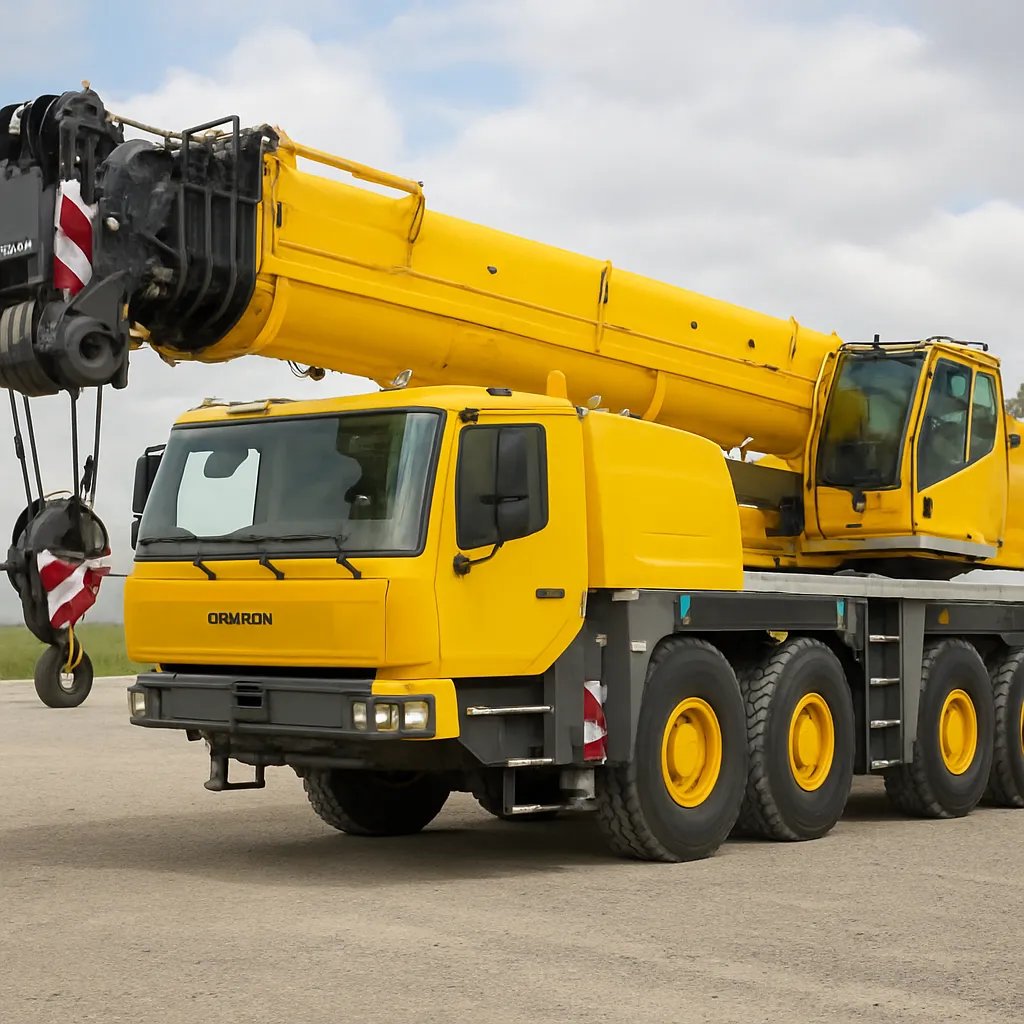
The Grove GMK4100L is a heavy-duty mobile crane designed for demanding lifting tasks across construction, energy, industrial maintenance and infrastructure projects. Combining robust engineering with modern control systems, this crane delivers a balance of mobility and lifting capacity while emphasizing safety and operator comfort. The following article explores its design, applications, technical features, operation considerations and market context, providing practical insights for fleet managers, site planners and crane operators.
Design and principal features
The Grove GMK4100L is built as an all-terrain/mobile crane that integrates a powerful chassis with a telescopic boom and advanced hydraulic systems. Key design priorities are transportability between sites, rapid setup, and the ability to operate on varied ground conditions. The crane is typically equipped with a multi-section telescopic boom, hydraulic luffing or fly systems, and a configurable counterweight system to optimize capacity for different lift charts.
- Chassis and mobility: The carrier (undercarriage) is designed for highway travel at regulated speeds while offering steering axles and suspension suitable for site maneuvering. This enables quick redeployment between urban and remote projects.
- Superstructure and boom: The slewing superstructure contains the engine, winches and operator cab. The boom sections are high-strength steel and use synchronized hydraulic cylinders for extension and retraction, offering a combination of reach and strength.
- Outriggers: Heavy-duty outriggers with extended pads spread load to the ground and enable stable lifting on uneven terrain. Typical setups allow for variable outrigger extension to accommodate space limitations.
- Controls and automation: Modern variants of the GMK4100L incorporate electronic load moment indicators (LMI), anti-two block protection, and microprocessor-based stability management, allowing safer operations near capacity limits.
- Operator cab: Ergonomically designed cabs include climate control, optimized visibility, and joysticks or multifunctional controls that reduce operator fatigue and enhance precision.
Applications and industries
The versatility of the GMK4100L makes it suitable for a wide range of tasks. Its combination of lifting power, boom reach and mobility allows it to serve as a multi-purpose unit on many types of worksites.
Construction and civil engineering
- Concrete panel and precast element erection.
- Bridge construction and beam placement.
- High-rise façade and structural steel installation when access is limited for larger lattice-boom cranes.
Energy and utilities
- Wind turbine assembly and maintenance — particularly for midsize turbines where a mobile crane with a long telescopic boom has advantages.
- Substation equipment installation, transformer placement and transmission tower assembly.
Industrial maintenance and plant shutdowns
- Process equipment lifts in chemical, petrochemical and manufacturing plants where precise placement and minimized downtime are essential.
- Turnaround projects where quick setup and flexibility reduce schedule risk.
Marine and port operations
- Quay and shipyard lifts, including placement of heavy components onto vessels or offshore platforms.
Performance and typical specifications
Exact specifications vary based on options (boom length, counterweight, jib configurations and winch packages). Below are commonly reported figures for the Grove GMK4100L family as implemented by fleet owners; these should be checked against the manufacturer’s datasheet for the specific machine configuration.
- Nominal lifting capacity: approximately 100 tonnes (100 t) at minimum radius — the machine’s capacity reduces with increased radius and boom extension.
- Maximum boom length: typically up to around 60 meters with full extension on the long-boom (L) variant; addition of jibs or fly sections can increase tip height further.
- Jib options: erection and luffing jibs commonly available (up to 20–30 m) to extend reach or allow higher hook heights.
- Engine power: carrier and superstructure engines combined usually produce in the order of several hundred kilowatts (carrier ~200–300 kW; superstructure ~150–250 kW), depending on regional emissions and engine choices.
- Gross vehicle weight: transport weight frequently ranges between approximately 45,000 and 65,000 kg depending on counterweight, fuel, and accessories.
- Outrigger spread: full span often around 9–12 meters, allowing for stable operation in diverse conditions.
- Travel speed: highway travel capability typically 60–80 km/h depending on gearing and legal limits.
Note: These values are indicative. For contractual lifts and lift planning, always consult the manufacturer’s specific load charts and the crane’s serial-numbered documentation.
Operation, safety systems and controls
Modern mobile cranes like the GMK4100L emphasize advanced safety systems to reduce the likelihood of accidents and to maximize operational efficiency.
- Load moment indicator (LMI): Continuously monitors boom angle, extension and load to prevent overload conditions.
- Anti-two block and hook block sensing systems to avoid damage from contacting the boom tip.
- Stability control: Electronic systems manage allowable load based on current outrigger position and ground slope.
- Remote control options: In some operations, remote controls allow the operator to position themselves for the best line of sight, reducing blind-lift risks.
- Maintenance monitoring: Telemetry and engine diagnostics may be included to track engine hours, hydraulic performance and fault codes.
Well-trained operators and riggers, supported by competent lift plans, ground-bearing assessments and qualified signalpersons, remain essential despite advanced onboard safety features. Common safety practices include ground matting under outriggers, use of taglines to control loads, and weather condition monitoring for wind limits.
Logistics, transport and setup considerations
Practical site planning must account for the GMK4100L’s transport footprint and setup needs. Its highway mobility simplifies movement between jobs, but detailed considerations remain:
- Route surveys to check bridge capacities, overhead clearances and turning radii.
- Permitting for overweight or oversized loads when transported with extra counterweights attached.
- Site access planning including slope and ground-bearing capacity assessments to determine required matting or cribbing.
- Outrigger setup space and blocking requirements — limited outrigger extensions can reduce capacity and require alternate lift strategies.
- Time to assemble auxiliary jibs and to configure counterweight packages — these operations influence job scheduling and crane hire costs.
Maintenance, lifecycle and total cost of ownership
Managing the total cost of ownership (TCO) for a GMK4100L includes acquisition, fuel and engine maintenance, hydraulic system upkeep, operator training and periodic inspections. Key maintenance practices include:
- Scheduled engine servicing and emissions system checks to comply with local regulations.
- Hydraulic fluid analysis and filtration replacement to prevent wear and maintain responsiveness.
- Regular inspection of boom sections for material fatigue, corrosion and deformation.
- Winch rope and hook block inspections and replacements at defined intervals or when wear limits are reached.
- Electronic diagnostics and calibration of LMI and safety sensors.
With proper preventative maintenance and reasonable utilization, a mobile crane like the GMK4100L can remain productive for decades, often seeing economic life of 15–25 years in rental fleets, depending on intensity of use and refurbishment cycles.
Market context and statistical insights
The Grove GMK4100L occupies the mid-to-upper tier of telescopic mobile cranes in rental fleets and contractor inventories. While global sales figures for individual models are commercial and variable, several industry trends shape demand for cranes like the GMK4100L:
- Growing emphasis on rapid jobsite mobilization has favored all-terrain cranes that combine highway travel and strong lifting envelopes.
- In renewable energy projects, mid-range mobile cranes (40–150 t classes) are in steady demand for turbine installation and maintenance.
- Infrastructure investment in many regions supports recurring demand for mid-sized cranes for bridge and highway projects.
Typical rental rates and utilization metrics vary widely by region and season. As an illustrative example, utilization rates for mid-range mobile cranes in mature rental markets often range between 45% and 70% annual utilization, influenced by cyclical construction demand. Rental day rates can vary from several hundred to a few thousand US dollars per day depending on the package (operator, transport, ballast). For accurate budgeting, consult local rental houses and fleet operators.
Case studies and practical examples of use
Real-world deployments showcase the GMK4100L’s strengths in tight-access lifts, urban construction and industrial outage support:
- Urban façade installation: The crane’s compact travel dimensions and precise control enabled placement of heavy curtain-wall panels in a downtown high-rise setting with minimal lane closures.
- Wind turbine maintenance: During a mid-season turbine component replacement, the long-boom variant lifted a nacelle subassembly at a radius and height that avoided usage of larger crawler cranes, saving transport and assembly time.
- Industrial turnaround: In a refinery outage, the crane’s quick rigging and high hydraulic capacity reduced turnaround time for replacing heat exchanger bundles, decreasing production downtime.
Environmental and regulatory considerations
Operators and fleet managers must account for emissions standards (Tier/Stage regulations), noise limits and local permitting for heavy lifts. Recent factory options and upgrades often include engines meeting stringent emissions levels and acoustic dampening to reduce impact in urban sites. Additionally, proper disposal or recycling of hydraulic fluids, filters and tires contributes to environmental compliance and sustainable operations.
Buying vs renting: practical guidance
Deciding whether to purchase or rent a GMK4100L depends on utilization forecasts and capital availability:
- Rent if project durations are short or irregular — renting avoids capital lockup and maintenance overhead.
- Buy if utilization is high and long-term cost-per-hour favors ownership; ownership requires investment in maintenance regimes and operator training.
- Consider certified pre-owned units from reputable dealers to reduce acquisition cost while retaining manufacturer support.
Conclusion
The Grove GMK4100L is a capable and flexible mobile crane well suited to a broad set of lifting tasks across construction, energy, industrial and marine applications. Its key strengths are a combination of lifting capacity, telescopic reach, and on-road mobility, backed by modern safety systems and operator-focused design. For any specific lift, detailed planning using the manufacturer’s load charts, site assessments and qualified lift personnel is essential to ensure safety and efficiency. Proper maintenance, regulatory compliance and strategic decisions about ownership versus rental will determine the overall effectiveness and cost-efficiency of deploying the GMK4100L in a fleet.


)
)