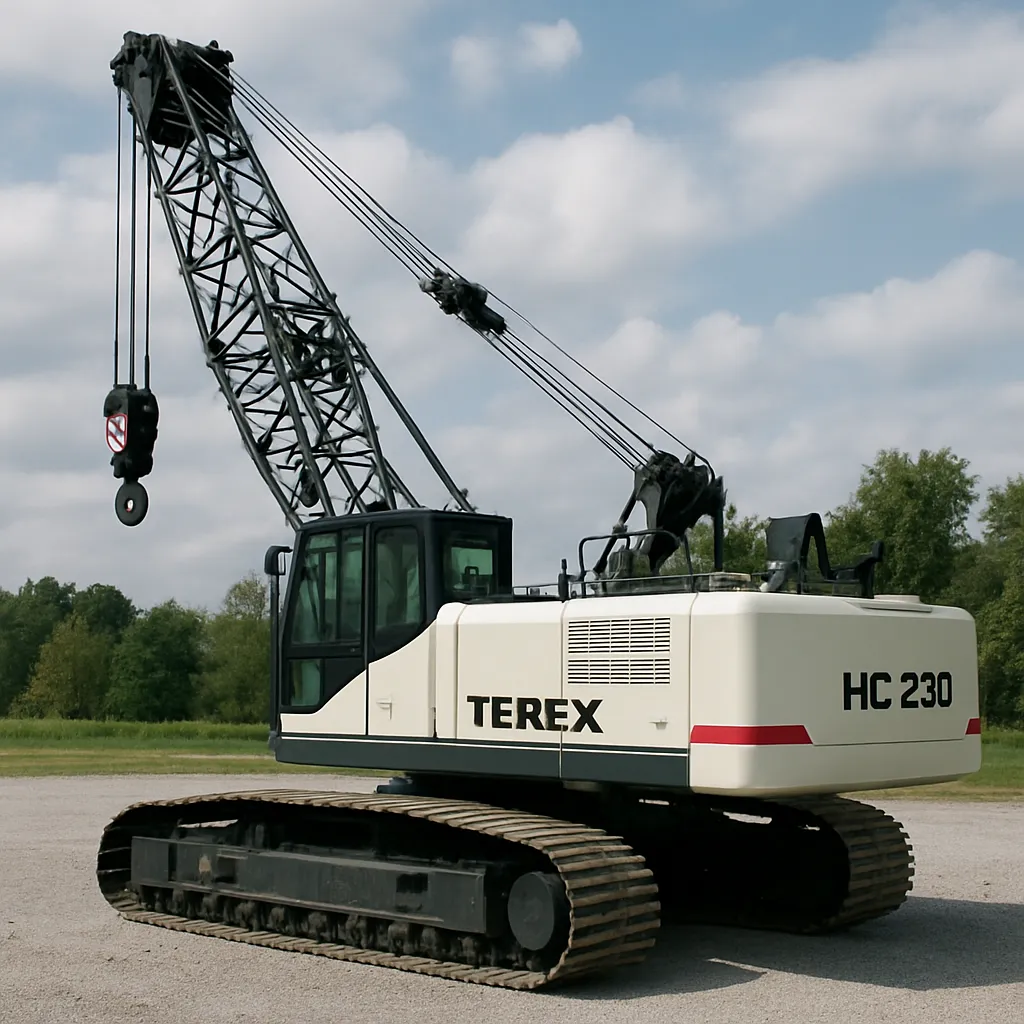
The Terex HC 230 is a versatile heavy-duty crawler crane designed for demanding lifting tasks in construction, infrastructure, and industrial projects. Combining mobility on tracks with a robust lattice boom and reliable powertrain, the HC 230 aims to deliver a balance of lifting capacity, on-site adaptability, and operator comfort. This article explores the machine’s design, typical technical characteristics, common applications, operational considerations, safety and maintenance practices, and the economic and environmental aspects relevant to prospective owners and operators.
Overview and key characteristics
The Terex HC 230 belongs to the family of hydraulic/crawler lattice-boom cranes intended for medium-to-heavy lifting duties. Its designation, HC 230, reflects the crane’s role and nominal lifting class — with a rated capacity class in the region of 230 metric tonnes. Crawler cranes like the HC 230 are particularly valued for their ability to move heavy loads on site without frequent re-assembly, travel over soft or uneven terrain thanks to their tracked undercarriage, and provide excellent stability when lifting with full counterweights.
Basic design features include a lattice main boom (often modular), a lattice or telescoping jib/jib insert options, a hydraulically controlled slewing superstructure, and an undercarriage with wide crawlers. Typical features and benefits you can expect from a machine in this class are:
- Modular boom sections allowing variable boom lengths to match lifting envelopes.
- Counterweight systems that are adjustable to balance reach and capacity.
- Track-mounted undercarriage that provides good flotation on soft ground and reduced reliance on crane mats.
- Operator cab with ergonomic controls, visibility, and climate control for long shifts.
- Integrated load moment and safety systems to protect from overloads and tipping.
Technical specifications and performance
Exact specifications for a Terex HC 230 can vary depending on the model year, market configuration, optional equipment, and whether specific attachments (like lattice jibs or auxiliary hoists) are fitted. Below are representative figures and technical parameters that describe the capabilities of the HC 230 class. Where precise figures vary, values are given as typical ranges.
Rated capacity and lifting envelope
- Nominal rated capacity: approximately 230 metric tonnes (about 253 US tons) at minimum radius with standard counterweight.
- Lifting radius: the charted capacity decreases as radius increases; typical working radii span from ~3 m up to 40–50 m depending on boom/jib configuration.
- Boom length: main lattice boom options commonly range from 20 m up to 50–60 m when multiple sections are used.
- Jib options: fixed or swing-away lattice jibs in the 10–30 m range extend reach or allow higher hook heights.
Power, weight and mobility
- Operating weight: when equipped with full counterweights and extended boom/jib, the total assembled weight often falls in the 80–120 tonne range (varies with configuration).
- Engine and drive: diesel engine in the 200–400 kW class is typical, driving hydraulic pumps for winch, swing and track systems.
- Travel speed: crawler cranes are not built for highway speeds; travel is slow and intended for on-site repositioning. Maximum travel speeds are limited and subject to safe load on tracks.
- Ground pressure: the wide crawler track design reduces ground pressure and permits safer operation on soft soils when combined with mats or track plates.
Hoist, winches and control systems
- Multiple hoist drums (main and auxiliary) with planetary gearboxes and multi-disc brakes for precise load handling.
- Variable-speed hydraulic winches providing smooth load pick-up and lowering.
- Load moment indicators, anti-two-block protection, and optional remote monitoring/telematics for fleet management.
Note: For quotation or procurement, consult the official Terex specification sheet for the precise serial/model configuration you intend to buy or rent. Actual capacities depend on boom length, counterweight setup, and site conditions; lifting charts provided by the manufacturer are the authoritative reference for safe operations.
Common applications and industries
The Terex HC 230 is suited to a wide range of applications where a balance of lift capacity and mobility is required. Its track-mounted design and modular boom system make it especially effective in sites that are constrained, uneven, or where ground preparation is limited.
Key industry uses include:
- Building construction: erection of steel structures, partial and complete lift-in installations, and setting heavy precast concrete elements.
- Infrastructure and civil engineering: bridge component installation, viaduct segment placement, culvert or precast box installation, and heavy formwork handling.
- Industrial maintenance and plant work: installation and replacement of heavy equipment in refineries, power plants, and manufacturing facilities.
- Wind and renewable energy: turbine component installation (tower sections, nacelles, and generators) on mid-sized wind projects where larger cranes are impractical or costly.
- Marine and ports: quay and dockside lifting, placing mooring components and assistance in shipyards.
Because the HC 230 is relatively compact compared to the largest crawler cranes, it often serves as the go-to choice when the project requires significant capacity but also needs access to tighter spaces or reduced transport complexity compared with much larger crawlers.
Transport, assembly and site setup
One of the advantages of the HC 230 class is the modularity that makes transport and assembly manageable for medium-scale projects. Nevertheless, safe and efficient mobilization requires planning.
Transport considerations
- Major components—crawler carrier, superstructure, boom sections, counterweights, and jib sections—are transported separately on low-bed trailers. The HC 230’s size generally permits transport without special escorts in many regions, though permits depend on local regulations and specific component weights or dimensions.
- Site access planning must account for turning radii, height clearances, and surface strength for unloading trailers and positioning crane sections.
Assembly and lifting charts
- Assembly typically requires a smaller assist crane or mobile crane to erect initial boom sections and place counterweights, although some larger crawler installations have self-assembly aids.
- After rigging, the crane must be leveled and the counterweight system configured according to the lift plan. Manufacturers provide detailed load charts that must be followed for each configuration.
Site preparation and ground bearing
- Even with tracks, ground bearing capacity must be verified. Mats, grillages, or temporary platforms are commonly used to distribute loads and prevent subsidence or tilting.
- Environmental constraints like slope, drainage, and proximity to utilities influence platform design and crane placement.
Operation, safety and ergonomics
Modern crawler cranes like the HC 230 emphasize operator safety, machine protection systems, and ergonomic controls. Effective operation is a combination of competent personnel, correct configuration, and adherence to safety standards.
Safety systems
- Load Moment Indicator (LMI): continuously informs the operator of the crane’s load state and prevents overload conditions.
- Anti-two-block devices, limiting switches, and boom angle sensors reduce the risk of mechanical collisions and structural damage.
- Emergency stop systems and accessible safe-exit routes in the cab support operator safety in crisis situations.
Operator ergonomics and visibility
- Contemporary cabs provide climate control, seating that reduces fatigue, and intuitive joystick or lever controllers for precise movements.
- Large windows and optionally camera systems improve site awareness and reduce blind spots—critical for safe operations in congested areas.
Crew requirements and training
- Operators must be formally trained and certified according to regional regulations; familiarization with the specific crane model and manufacturer’s operational manual is mandatory.
- Signalers and rigging crews must be competent in slinging techniques, center-of-gravity calculations, and interpreting lifting plans and load charts.
Maintenance, lifecycle and reliability
Life-cycle cost and uptime are decisive factors when selecting and operating cranes. The HC 230 benefits from straightforward mechanical systems, widely available spare parts for common components, and relatively simple routine maintenance compared to more complex telescopic crawler cranes.
Key maintenance considerations:
- Regular inspection of boom sections for fatigue, cracks, and weld integrity.
- Hydraulic system servicing, including filter and oil changes per manufacturer interval.
- Track and undercarriage wear monitoring—pins, rollers and track shoes require periodic replacement depending on ground conditions and utilization.
- Winch and brake system inspections to maintain reliable holding capacity during lifts.
Proactive maintenance, combined with telematics (where available) for remote monitoring of oil temperature, engine hours, and fault codes, reduces downtime and extends useful life. Typical service intervals and overhaul schedules should follow Terex’s recommendations and be adjusted to the operating environment (e.g., dusty, corrosive, or marine atmospheres require more frequent attention).
Economic considerations: purchase vs rental
Deciding between purchasing a Terex HC 230 or renting one depends on project pipeline, capital availability, and utilization forecasts.
- Purchase advantages: full control over scheduling, customization, and potentially lower cost per hour at high utilization rates. Ownership may be attractive for contractors with steady medium-to-heavy lifting demand.
- Rental advantages: flexibility, reduced capital lock-up, access to modern or specialized configurations for short-term needs, and provider responsibility for major maintenance.
- Total cost of ownership must account for insurance, transportation, crew training, storage, and depreciation. Rental often simplifies logistics but can become expensive over long-term continuous use.
Environmental and regulatory aspects
Environmental performance and compliance have become significant for heavy equipment operators. Key areas relating to the HC 230 and similar crawler cranes include emissions, noise, ground disturbance, and fuel efficiency.
- Emissions: modern diesel engines meet regional emission standards (e.g., EU Stage or EPA tiers) when specified accordingly; retrofits and after-treatment systems can reduce NOx and particulate output.
- Noise: crawler cranes create operational noise from engines and winches; acoustic enclosures, auxiliary power units, or operation scheduling can mitigate impact on nearby communities.
- Ground protection: responsible use of mats and track plates reduces soil compaction and erosion on sensitive sites.
Market positioning, competitors and resale
Within the global crane market, the Terex HC 230 competes with similar capacity crawler cranes from manufacturers like Liebherr, Grove (Manitowoc), Hyundai, and other regional suppliers. Buyers compare machines on the basis of:
- Reliability and service network—availability of local dealers and parts.
- Payload-to-weight ratio and transportability.
- Operator comfort, control systems, and optional safety features.
- Total cost of ownership and resale values.
Resale values depend on machine age, hours, maintenance history, and market demand. Well-maintained HC 230 units with documented service records retain higher resale value, especially when equipped with commonly requested jibs and counterweight packages.
Case examples and typical project scenarios
To illustrate practical usage, here are a few typical scenarios where the HC 230 proves advantageous:
- Urban building site: lifting large precast concrete façade modules into tight downtown locations where larger crawlers cannot be staged due to limited space or where mobilization cost of much larger cranes would be prohibitive.
- Bridge repair: placing replacement bridge beams and girders where a mobile crane can’t access the site and ground conditions require a low-ground-pressure crawler.
- Industrial plant turnaround: setting heavy equipment in an operating plant during scheduled downtime, where precise lifts and minimized ground intervention are required.
Final remarks and practical recommendations
The Terex HC 230 is a strong contender for contractors and project owners seeking a medium-heavy crawler crane that offers a balance of capacity, flexibility, and manageable logistics. Before acquisition or hire, consider the following practical steps to ensure optimal performance and safety:
- Review the manufacturer’s detailed load charts for the specific boom and counterweight configuration intended for your lifts.
- Plan transport routes, site access, and ground preparation well in advance—permits may be needed depending on component sizes and weights.
- Ensure operator and rigging teams are certified and familiar with the HC 230’s control systems and safety features.
- Establish a maintenance and inspection schedule that follows Terex guidelines and accounts for local operating conditions.
- Factor in telematics and aftermarket safety options to improve uptime and tracking of usage for fleet management.
Used thoughtfully in the right projects, the HC 230 provides a dependable combination of strength, maneuverability, and safety. Its modularity and medium-heavy rating make it an attractive option for many construction and industrial lifting tasks where larger cranes would be inefficient or impractical.
)
)