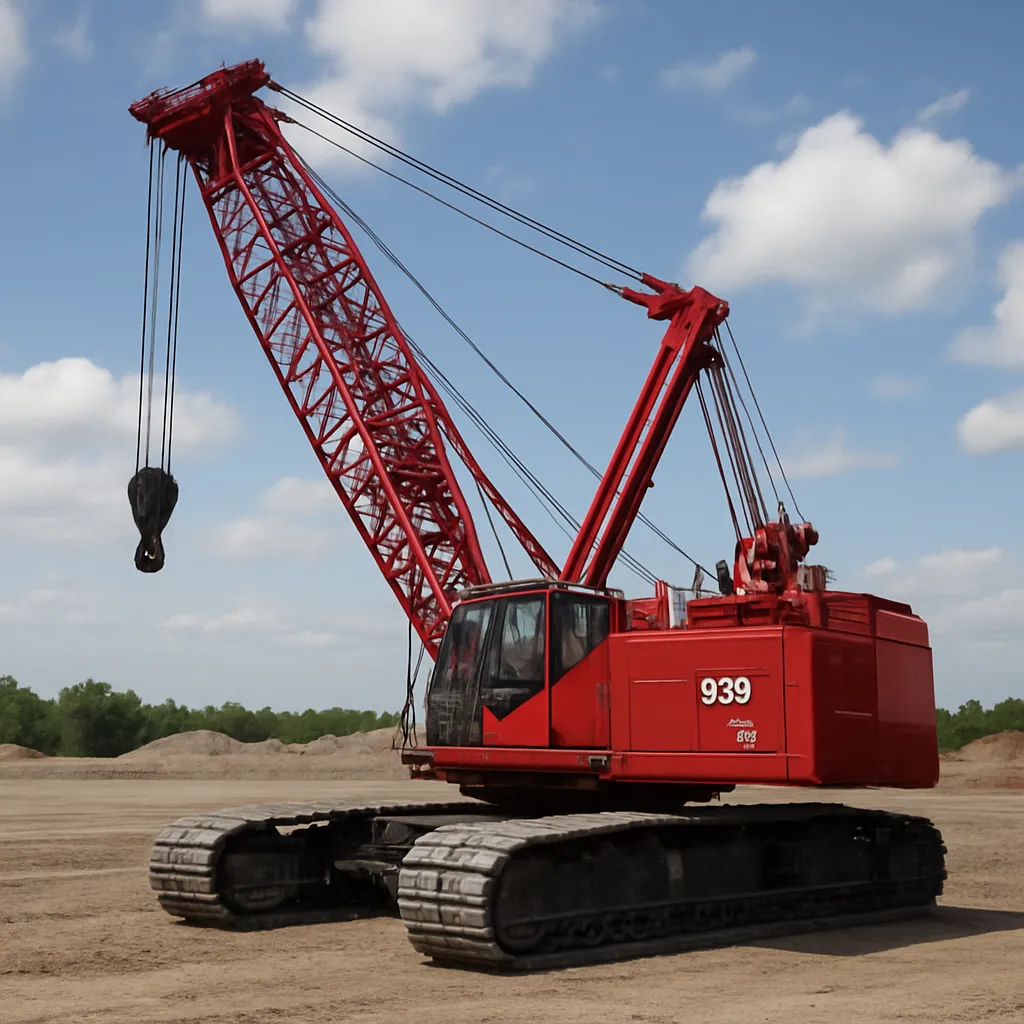
The Manitowoc 999 is a machine that draws attention on heavy construction sites and industrial yards. As a classic example of a lattice-boom crawler crane, it combines powerful lifting ability with the mobility of tracked undercarriage, making it a versatile choice for projects that require both strength and site adaptability. This article explores the design, applications, operational aspects, and practical considerations surrounding the Manitowoc 999, offering useful background and technical context for engineers, site managers, and crane enthusiasts.
Overview and design philosophy
The Manitowoc 999 embodies a long-standing design approach that emphasizes structural efficiency and ruggedness. Unlike telescopic-boom cranes, the 999 uses a lattice boom constructed from a triangulated arrangement of high-strength steel members. This layout yields a favorable strength-to-weight ratio: for a given reach, a lattice boom weighs less than a solid telescopic section, allowing greater lifting capacity without excessive deadweight.
Core components
- Carrier and tracks: The tracked undercarriage provides traction and distributes weight, enabling movement on uneven and soft surfaces without outriggers.
- Upperworks: Houses the engine, winches, operator cab, slewing system and boom-connection interface. The upperworks rotates on the carrier to position loads.
- Boom and jib: A modular lattice boom can be fitted with various jibs (fixed, swingaway, or luffing) to adapt to different reach and height requirements.
- Counterweight: Removable blocks allow the crane’s stability to be tailored to lift charts and site constraints.
- Wire rope and hooks: Designed for high fatigue life and configured for single- or multi-part reeving to increase mechanical advantage.
The 999’s combination of tracks and modular components makes it particularly well suited to job sites where lifts are heavy and mobility across graded terrain is required. Because the machine moves on its tracks rather than relying on outriggers, repositioning between lifts can be faster in many contexts.
Typical applications and jobsite roles
The Manitowoc 999 is used across a broad range of industries. Its primary strengths—lifting power, reach, and site mobility—make it a go-to solution for challenging heavy-lift scenarios.
Common sectors and tasks
- Infrastructure and civil works — bridge girders, precast concrete placement, and major highway projects.
- Power generation — erection and maintenance of turbines, generators, and large transformers.
- Wind energy — assembly of towers, nacelles and blades where long outreach and precise placement are required.
- Oil & gas and petrochemical — module lifts, skidding operations, and heavy equipment installation in refineries and offshore platforms.
- Marine and port operations — installation of quay structures, heavy fendering systems and equipment handling.
- Salvage and heavy transport — recovery of large wreckage and assistance with ro-ro cargo operations.
Beyond these examples, the 999’s modular boom system permits adaptation to unique lifting profiles. On wind farms, for instance, crews often pair the lattice boom with specialized jibs and rigging to achieve the necessary vertical reach while keeping the crane’s footprint manageable.
Technical features and performance considerations
Manitowoc designed the 999 to balance durability and maintainability. While exact specifications depend on the configuration and production year, the following sections outline typical features and performance parameters relevant to buyers and operators.
Powertrain and mechanical systems
- Diesel engine(s) sized to provide reliable power for hoists, slewing and travel functions. Engines typically include provisions for cold-weather starting and emissions controls consistent with their production era.
- Hydraulic and mechanical winches with multiple drum capacities allow variable reeving and controlled lifting speeds.
- Robust slewing ring and bearing assembly designed for continuous duty in heavy-lift cycles.
Lift capacity and reach (general guidance)
Because the 999 has been produced in multiple configurations and has seen aftermarket modifications, exact numbers vary. The safe approach is to consult the manufacturer’s load charts for the exact machine being used. For context, mid- to large-size lattice crawler cranes similar to the 999 commonly have the following approximate ranges:
- Maximum rated lifting capacity: often in the range of several tens to a few hundred metric tons, depending on ballast and boom length.
- Standard main boom lengths: modular sections that permit main boom reaches from tens to over a hundred meters when combined with jibs.
- Jib and swingaway options: used to increase height or outreach for specific lifts; jibs are typically modular and can be fitted with auxiliary hoists.
Again, every lift must be planned with the load chart applicable to the installed configuration, with counterweights and boom length verified before operation.
Stability and counterweight management
Unlike truck-mounted or rough-terrain cranes that depend on outriggers for leveling and stability, the Manitowoc 999 relies on track footprint and ballast for resisting tipping moments. Counterweights are typically assembled from removable blocks that can be staged and installed on site. Rigorous adherence to load chart guidance for counterweight configuration is critical to maintain stability and prevent overturning.
Operation, safety, and crew considerations
Efficient and safe operation of the 999 involves skilled personnel, thorough planning, and disciplined adherence to routines. The machine’s mass and lifting power magnify the consequences of mistakes, so a safety-first culture is essential.
Operator and crew roles
- The crane operator manages the controls, slewing, boom raise/lower, and hoist functions from the cab or a remote-control station when equipped.
- Riggers and signalpersons ensure correct slinging, tag-line control, and communication with the operator.
- The site supervisor or lift planner verifies load calculations, ground bearing capacity, and traffic/security around the lift zone.
Pre-lift planning and checks
- Review the load chart for the installed configuration and confirm counterweight, boom length, and reeving.
- Perform ground-bearing analysis to ensure the soil or pad can accept the track loads. Use crane mats or engineered cribbing where necessary.
- Inspect wire ropes, hooks, hydraulic systems, brakes, and safety devices for wear or defects.
- Establish exclusion zones and ensure qualified personnel control access to the lift area.
Common safety systems
- Rated capacity limiters and anti-two-block devices to prevent overhoisting or hook block contact with the boom tip.
- Limit switches and audible alarms for travel, hoist and slewing operations.
- Remote monitoring for some modern retrofits, allowing supervisors to view parameters such as load moment and boom angle in real time.
Maintenance, lifecycle and reliability
Longevity for a machine like the Manitowoc 999 depends on preventive maintenance and periodic overhaul of critical systems. With correct servicing, lattice crawlers are known to remain reliable for decades, which makes them attractive from a lifecycle-cost perspective.
Routine maintenance checklist
- Daily inspections: fluid levels, visual checks of ropes and pins, and verification of safety devices.
- Periodic greasing of pivot points, slewing ring lubrication, and track tension adjustments.
- Scheduled replacement of ropes and sheaves according to fatigue-life estimates and inspection results.
- Engine, transmission and hydraulic service at manufacturer-recommended intervals.
Because lattice booms use large pins and bolted connections, keeping those joints within spec is essential to preventing fatigue cracking. A documented maintenance history not only increases safety but also preserves resale value.
Transport, assembly and site logistics
The modular nature of the 999 helps simplify transport and assembly but requires planning. Components such as boom sections, counterweights, and jib assemblies are typically moved on flatbeds or low-loaders and staged at the assembly area.
Key logistical steps
- Site preparation: level and compact assembly area, often with timber or steel mats for crane tracks and counterweight staging.
- Component sequencing: assemble the carrier and upperworks first, followed by boom erection using gin poles or auxiliary cranes if necessary.
- Counterweight placement: install blocks progressively as boom sections are mounted to maintain stability.
- Disassembly: plan reverse-sequence to remove counterweights and sections safely, taking account of transport height and weight restrictions on public roads.
Transport permits and route surveys may be required when moving large components, and coordination with local authorities ensures smooth delivery to constrained urban or rural sites.
Economic and environmental considerations
From an economic standpoint, the Manitowoc 999 represents an investment in capability: a single machine can replace multiple smaller cranes for heavy lifts, reduce lift cycles, and speed project timelines. However, this capability comes with higher initial acquisition or rental costs, as well as operational expenses.
Cost factors
- Acquisition vs rental: For short-term projects, renting a 999 or similar crawler may be more economical than purchasing.
- Transport and assembly costs: Larger cranes entail higher mobilization and demobilization expenses.
- Fuel and maintenance: Heavy lifting and travel consume significant diesel; planned maintenance reduces costly downtime.
Environmental impact
Modern crane operations increasingly consider emissions and ground impact. Steps to mitigate environmental footprint include:
- Use of low-sulfur fuels or engines meeting stricter emissions standards.
- Minimizing ground disturbance through track mats and designated travel lanes.
- Optimizing lift plans to reduce idle time and unnecessary repositioning.
Practical tips for procurement and fleet use
When selecting a Manitowoc 999 (or comparable lattice crawler) for purchase or rental, consider the following:
- Match the crane to your typical lift profiles: choose boom and counterweight packages that cover your heaviest lifts without constant overballasting.
- Verify the availability of spare parts and service support in your region—older models may require aftermarket suppliers or remanufactured components.
- Assess operator training needs: experienced lattice crawler operators provide efficiency and safety that justify investment in qualified personnel.
- Factor in total cost of ownership, including mobilization, maintenance, insurance, and expected utilization rates.
Concluding remarks
The Manitowoc 999 represents a class of cranes that remain indispensable wherever heavy, high-reach lifts intersect with challenging ground or logistical constraints. With a modular boom, configurable counterweight, and the mobility afforded by tracked stability, it suits diverse roles—from erecting wind turbines to bridge placement and industrial module handling. Responsible operation demands well-trained crews, rigorous planning, and a disciplined maintenance program to ensure safety and long-term reliability. For exact performance figures and certified load charts, always consult the machine’s specific documentation or the manufacturer’s technical support to confirm the configuration in use and the appropriate limits for each lift.


)
)