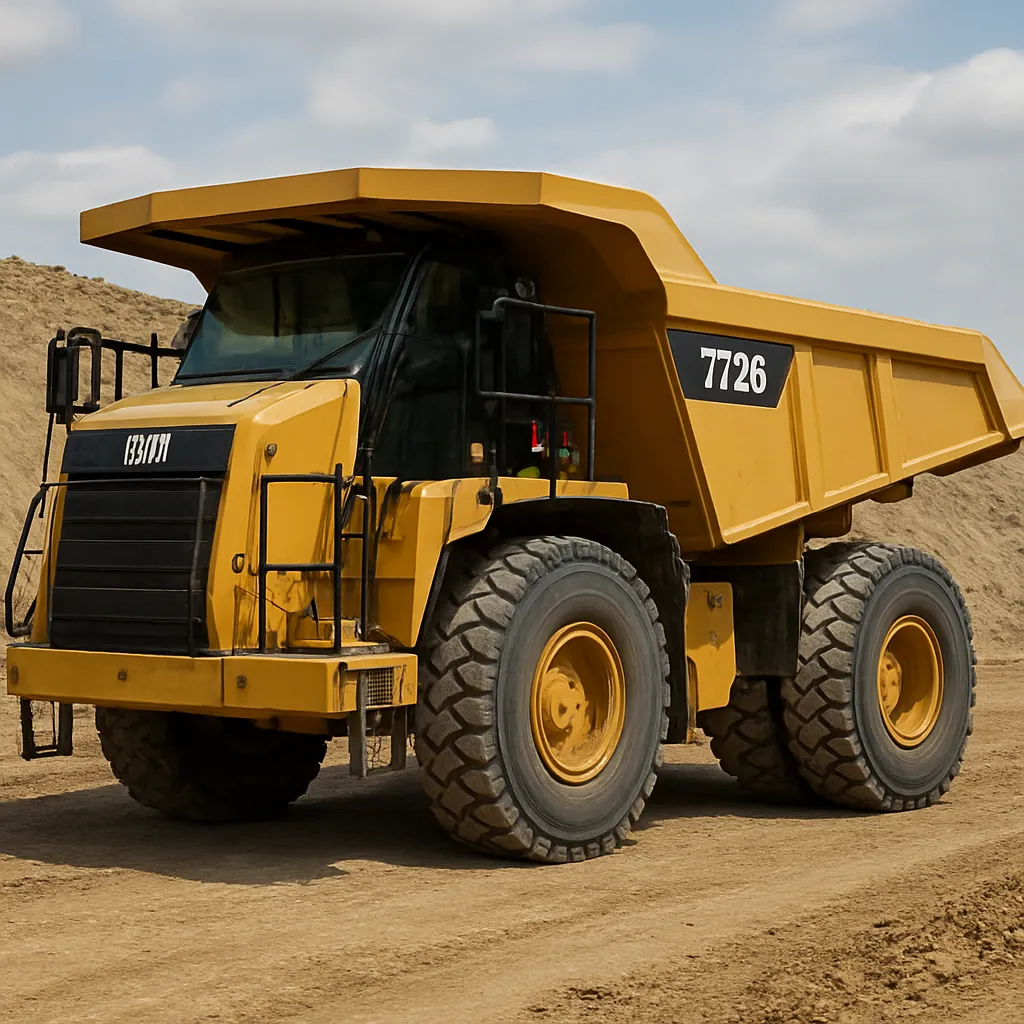
The Caterpillar 772G is a workhorse in the world of heavy civil construction and mining equipment. Known for its rugged design and adaptability, this model of rigid-frame haul truck has been used for decades in various earthmoving, quarrying and mining operations. In the following article you’ll find an overview of the machine’s design, typical applications, performance characteristics, operational considerations and useful statistics and comparisons. The text aims to be practical for fleet managers, operators and anyone interested in heavy equipment.
Overview and historical context
The Caterpillar 772G belongs to a family of large-capacity off-highway trucks designed to move heavy loads in harsh environments. Over the years Caterpillar has developed the 70s-series and associated models to meet the needs of contractors requiring a balance between capacity, maneuverability and lifecycle cost. The 772G has been widely adopted because it strikes a balance between the larger mining-class trucks and smaller site-specific haulers.
Haul truck designs like the 772G evolved to optimize load cycles in open-pit operations, road-building and aggregate production. Compared to larger ultra-class mining trucks, machines in the 772 class typically offer lower initial acquisition cost, easier site access, and simpler logistics while still providing substantial hourly production when used correctly.
Design and construction features
Chassis and body
The 772G is built around a rigid ladder-frame chassis engineered for durability. The frame geometry is optimized to distribute weight across axles and to withstand repetitive loading. The body (dump box) is constructed from high-strength steel and shaped to aid material flow during dump cycles, reducing material retention and improving cycle time.
Powertrain
The machine is driven by a high-torque turbocharged diesel engine paired with a robust transmission and final drives designed for heavy-load duty cycles. The emphasis in the 772G class is on providing consistent torque across a broad RPM range to handle steep ramps and loaded travel. Cooling, air intake and exhaust systems are designed for dusty and hot environments, common in quarry and mine sites.
Suspension and axles
Rigid axles with heavy-duty bearings, planetary final drives and multi-leaf springs or optional suspension systems are used to balance load capacity and ride quality. Brake systems are designed with both service and parking functions capable of handling steep grade retention when the truck is fully loaded.
Operator station and controls
Modern 772G cabs focus on ergonomics, visibility and climate control. Seating, joystick or lever controls and instrument clusters are arranged to reduce operator fatigue during long shifts. Soundproofing and vibration dampening further improve operator comfort, which in turn can raise overall productivity.
Typical technical specifications (approximate)
Specifications vary by year, factory options and regional configurations. Below are typical ranges for machines in the 772G class (values are approximate and should be checked against specific serial-number data for procurement and planning):
- Rated payload: approximately 20–28 metric tonnes (22–31 short tons)
- Operating weight (loaded): typically in the 35–50 tonne range
- Engine power: commonly falls in the 300–420 kW range (400–560 hp) depending on tuning and emissions packages
- Top travel speed (unloaded): often in the 40–60 km/h range (25–37 mph); loaded speed is lower and dependent on grade
- Fuel consumption: widely variable; typical operating burn might be in the range 25–60 L/hour depending on load, cycle time and terrain
- Wheelbase and overall dimensions: compact enough to fit many site entrances—precise dimensions depend on body and axle configuration
These numbers are offered as a planning guide. For procurement, always consult the manufacturer’s data plate and current product documentation to confirm exact ratings and capacities.
Primary applications and industries
The Caterpillar 772G is versatile and finds its primary use in several interlinked industries:
- Quarries and aggregate production — moving blasted rock to crushers and processing areas
- Open-pit and surface mining — transporting ore and waste across benches and ramps
- Bulk earthmoving — major civil works, dam construction and highway projects
- Port and terminal operations — short-haul bulk material movement in stockpiles
- Large construction sites — supporting heavy foundation and mass excavation tasks
Operators value the model for its ability to cycle frequently between loading and dumping points in confined worksites where very large mining trucks would be impractical or uneconomic. The 772G is particularly effective on sites where modular fleet composition and flexibility are required.
Performance, productivity and operating considerations
Cycle time and fleet planning
Maximizing production with a 772G depends heavily on site layout, haul distance and cycle time. Short-haul, high-frequency cycles favor smaller, faster haulers for reduced queueing at loaders; medium to longer-haul cycles can exploit the 772G’s payload. When planning a fleet, match loader bucket size to the truck’s payload to avoid under- or overloading—optimal matching improves per-hour throughput and reduces wear.
Fuel efficiency and emissions
Fuel consumption depends on numerous variables: payload, terrain, operator behavior and machine condition. Modern engine management and optional features such as an automated shutdown or economy modes can reduce fuel burn. Emissions standards (Tier/Stage regulations) in many regions have led to upgraded engine packages; these balance emissions control with fuel economy.
Traction and ground conditions
Traction control, tire selection and correct ballast distribution are important when working on wet benches, steep ramps or loose material. Correct tire sizing and tread pattern can dramatically influence uptime and cost per tonne moved.
Maintenance, reliability and lifecycle management
Routine and predictive maintenance are central to sustaining operations and controlling lifetime costs. Key maintenance points include:
- Regular engine and transmission service intervals (oil, filters, coolant)
- Undercarriage and axle inspections for play, bearing wear and lubrication
- Brake inspections and adjustments to maintain grade-holding capability
- Tire monitoring and rotation to extend life and prevent catastrophic failures
- Electrical and control-system diagnostics to avoid downtime from faults
Investment in condition-monitoring tools—such as oil analysis, vibration monitoring and telematics—can shift maintenance from reactive to predictive, significantly improving reliability and lowering unplanned downtime. Many fleets deploy OEM telematics packages to track fuel use, idle time and maintenance alerts, enabling data-driven decisions and reduced total cost of ownership (TCO).
Safety features and best practices
Safety is paramount when operating heavy haulers. Typical safety features and recommended practices for the 772G class include:
- ROPS/FOPS-certified cabs and secure seat restraints
- Service brakes supplemented by retarders or engine braking systems
- Back-up alarms, cameras and mirrors to mitigate blind spots
- Operator training programs emphasizing correct loading, braking on grades and wheel chocking
- Site traffic management plans to control interaction with other heavy equipment
Safety protocols should also include daily pre-shift inspections, load-documentation procedures and emergency response training. The combination of engineered safety features and disciplined operations reduces both accident frequency and severity.
Environmental and sustainability considerations
Modern operations increasingly focus on lowering environmental impact. Strategies relevant to the 772G include:
- Upgrading engines to meet stricter emissions standards (reducing NOx and particulate matter)
- Implementing fuel-saving operational practices and idle reduction policies to cut CO2 emissions
- Maintaining efficient haul routes and reducing empty travel to lower fuel consumption per tonne moved
- Exploring electrification or hybridization where feasible—hybrid powertrains for large off-highway trucks are under development and may apply to similar classes in the future
Site-level planning that reduces blended haul distances, optimizes loader-truck matching and employs regular equipment tuning contributes to measurable sustainability gains.
Economics and total cost of ownership
When assessing the 772G for purchase or lease, buyers should evaluate both acquisition cost and lifecycle expenses. Major cost drivers include:
- Initial purchase price and financing terms
- Fuel consumption and fuel-price volatility
- Maintenance and parts costs—especially major components like driveline or engine rebuilds
- Tire costs and replacement frequency
- Resale value and market demand for used units
Effective fleet management reduces TCO: implementing telematics, scheduled refurbishments and targeted operator training typically yields a positive return on investment via increased uptime and lower per-tonne costs.
Market placement and comparisons
The 772G sits between smaller site haulers and the very large mining-class trucks. This middle-ground positioning gives it several advantages:
- Better maneuverability and site access compared to ultra-class trucks
- Lower operating and maintenance cost per machine than the largest mining trucks
- Greater payload capacity and stability than smaller articulated trucks in similar footprint
Competitors and analogous models from other manufacturers often occupy similar niches; selection usually comes down to dealer support, parts availability, fleet commonality and specific site needs.
Operator experience and human factors
Operator skill and comfort directly affect the 772G’s productivity and component longevity. Key human-factor improvements include:
- Ergonomic seating and intuitive controls to reduce fatigue
- Clear instrumentation and diagnostic readouts to allow fast troubleshooting
- Climate control and reduced noise to sustain operator alertness
- Training simulators and structured refresher courses to standardize best practices
When fleets invest in training and an ergonomically supportive cab, they typically see reductions in fuel use, decreased instances of misuse and longer component life.
Statistical snapshots and operational benchmarks
While precise statistics vary by region and configuration, some useful benchmarks for planning and performance measurement include:
- Payload utilization: aim for 95–100% of rated payload per cycle to maximize haul efficiency
- Fuel per tonne: well-tuned operations using machines in this class can achieve fuel consumption of 0.02–0.05 liters per tonne-kilometer, depending on haul distance and grade
- Availability: target fleet availability of 85–92% through proactive maintenance and rapid repair policies
- Cost per tonne: dependent on site and fuel prices but often competitive with similar-size rigid haulers when factoring lifecycle costs
Monitoring against these KPIs helps site managers make informed decisions about fleet sizing and replacement timing.
Upgrades, retrofit and lifecycle extensions
Extending the useful life of a 772G can be economical. Typical options include:
- Engine reconditioning or replacement with a more fuel-efficient, lower-emission package
- Transmission and driveline overhaul to restore torque-handling capacity
- Structural repairs and reinforcement for frames and bodies in high-wear operations
- Retrofit of camera systems, telematics and operator-assistance tools
Retrofitting can improve safety, reduce fuel use and postpone replacement costs, making it a common strategy in mature fleets.
Conclusion
The Caterpillar 772G represents a practical balance between capacity, maneuverability and lifecycle cost in off-highway haul applications. Its strengths lie in versatility, robust construction and a design that favors predictable, high-frequency operations typical of quarries, bulk earthworks and mid-sized mining operations. Successful deployment of the 772G depends on good fleet matching, proactive maintenance, operator training and data-driven management of fuel and uptime. With the right support and planning, the 772G remains a dependable choice for organizations that need a heavy hauler without the scale and expense of ultra-class mining trucks.


)
)