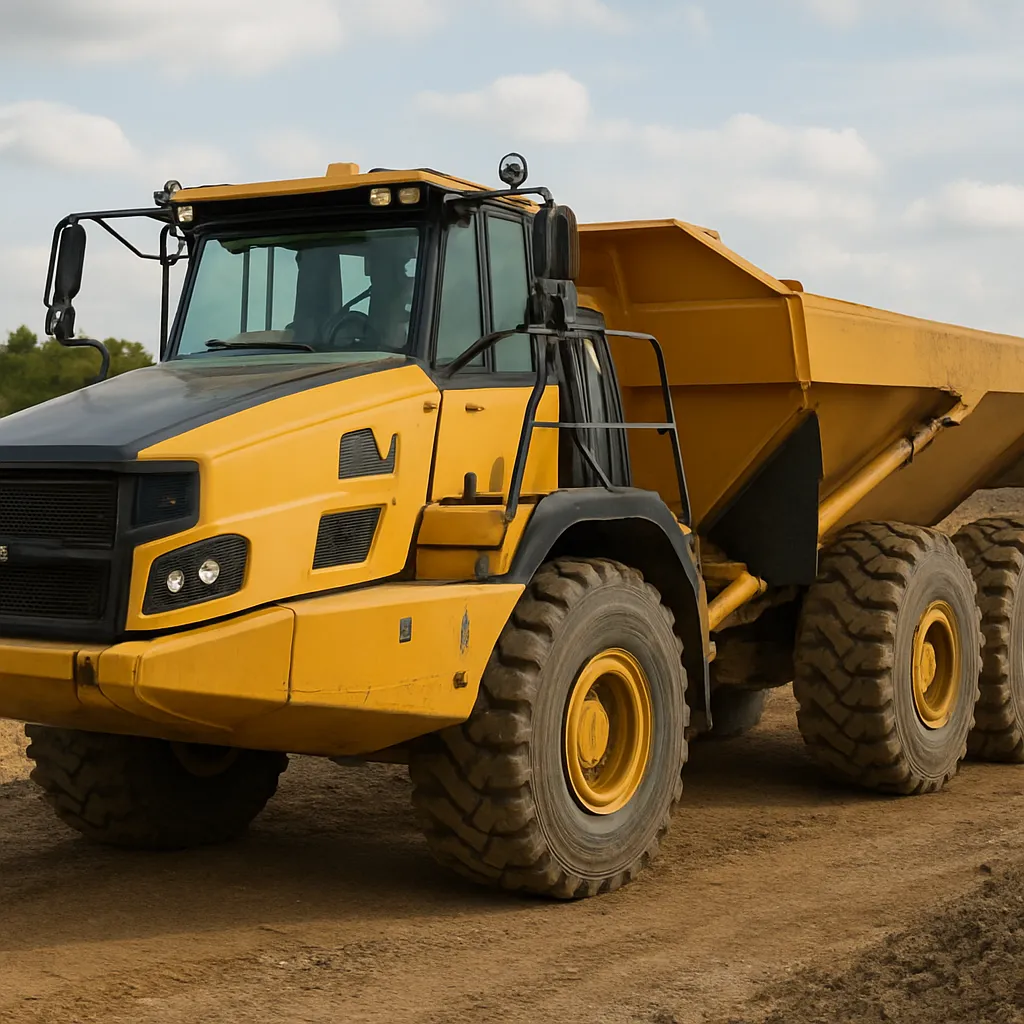
The Bell B40E is a heavy-duty, 6×6 articulated hauler designed for demanding off-road transport tasks. Built by Bell Equipment, this model occupies a prominent place in the mid-to-large-size class of haulers and is widely used where high payload, robust off-road capability and uncomplicated serviceability are required. In the following sections, we explore the machine’s design characteristics, typical applications across industries, operational and performance data, maintenance and safety considerations, as well as environmental and economic aspects that make the B40E a practical choice for many fleets.
Design and technical features
The Bell B40E follows the manufacturer’s established concept of a frame-articulated hauler with fully independent suspension and permanent six-wheel drive. The articulation joint provides superior maneuverability on rough terrain and allows the hauler to maintain tractive effort when crossing uneven surfaces. The vehicle’s architecture emphasizes a balance between durability and service accessibility, with major components accessible from ground level or via simple panels to reduce downtime.
Powertrain and drivetrain
The B40E is typically equipped with a heavy-duty diesel engine from reputable suppliers and an automatic transmission paired with torque converters tuned for off-road hauling. The combination is engineered to deliver steady torque at low engine speeds, which is critical for starting heavy loads on inclines and working in soft or muddy conditions. The drivetrain includes:
- Permanent six-wheel drive with limited-slip or differential locks to maximize traction in variable conditions.
- Robust axles designed for high torque loads and long service intervals.
- Hydraulically controlled transmission and retarder systems to improve downhill control and reduce brake wear.
These systems together ensure the B40E can operate in steep, wet and rocky environments while maintaining stability and safety.
Body, capacity and chassis
The dump body of the B40E is purpose-built for heavy materials such as rock, ore, aggregates and earth. The body is often constructed from high-strength steel with reinforced wear areas to minimize abrasion and impact damage. Typical design points include a shallow slope to aid material discharge and options for heavy-duty liners for abrasive applications.
Key structural features that support performance are strong articulation bearings, reinforced frame rails and a suspension system that balances load distribution across all axles. The combination of these elements improves ride quality, reduces stress on components and supports predictable handling under load.
Applications and industries
The Bell B40E serves a wide variety of sectors that require reliable haulage of heavy materials over off-road conditions. Its versatility stems from the interplay of high payload capacity, off-road traction and relative simplicity compared with rigid dump trucks. Typical applications include:
- Mining — transporting ore, waste rock and blasted materials from extraction faces to crushers or waste dumps.
- Quarrying — moving aggregates, crushed stone and overburden around the quarry site.
- Construction — bulk earthworks, large-scale site preparation, and material movement for dams, highways and major civil projects.
- Infrastructure projects — supplying materials for road and rail projects, including sites where access is constrained.
- Land reclamation and environmental works — hauling dredged materials or fill in coastal or remediation projects.
Outside these primary areas, specialized configurations allow the B40E to serve in military logistics, disaster recovery and forestry operations where high flotation, traction and load capacity are required.
Operational scenarios
In typical operations, B40E machines are deployed in fleets ranging from a handful of units to dozens, coordinated with loading equipment such as hydraulic excavators, wheel loaders and graders. Articulated haulers excel in sites with soft ground or restricted turning circles where rigid-frame trucks would be less efficient or would cause higher ground disturbance. They are also favored where hauling routes include steep gradients, water crossings or rock-strewn tracks.
Operational performance and statistics
When evaluating an articulated hauler such as the Bell B40E, operators consider metrics like payload capacity, fuel consumption, cycle time, uptime and cost per tonne-kilometer. Below are commonly referenced performance characteristics and practical figures that fleet managers use for planning. Note that exact numbers depend on machine configuration, operating conditions and local settings.
Typical specification ranges
- Rated payload: commonly marketed as approximately 40 tonnes (40,000 kg) – core selling point for matching excavator and loading equipment capacities.
- Body capacity (heaped): often in the mid-20s cubic metres range depending on bucket shape and material density; exact volume varies with body specification and industry practice.
- Engine power: typical engines fitted to haulers of this class deliver power in the range of roughly 250–350 kW (335–470 hp), tuned for torque delivery rather than peak speed.
- Travel speed: maximum road-speed capability commonly falls in the range of 50–60 km/h, while loaded traveling speed on site will be lower depending on terrain and safety rules.
- Fuel consumption: site-specific and related to cycle times, load factor and terrain; operators commonly observe fuel burn in the range of 30–55 L/h under heavy duty cycles, though this varies widely.
- Turning radius and articulation: compact turning circle relative to rigid trucks, enabling effective operation in confined environments.
These figures are intended as general guidance; precise technical specifications for a given B40E unit should be taken from the manufacturer’s datasheet or the machine’s plate at the time of acquisition.
Productivity considerations
Productivity for a fleet using the B40E is calculated from payload times cycles per hour, which is a function of loader fill factor, drive speed, distance, waiting times and dumping times. For day-to-day management, small percentage improvements in cycle time or fill factor can translate into significant increases in tonnes moved per shift. The B40E’s design to accept high payloads with stable handling allows matching with loaders in the 5–10 m3 bucket class depending on material density.
Maintenance, safety and operator comfort
One strength of the Bell B40E is the emphasis on straightforward maintenance and operator-oriented features that together reduce life-cycle operating costs. Accessibility is a key design focus, with service points centralized and components engineered for long intervals between routine work.
Maintenance features
- Ground-level service points for daily checks such as fluid levels and filter inspections.
- Modular components and standardized parts to simplify logistics and reduce downtime for repairs.
- Robust lubrication arrangements and optional automatic lubrication systems to extend bearing life.
- Long-life filtration and coolant packages suited to dusty or hot environments.
Preventive maintenance programs and telematics-enabled monitoring further improve uptime by allowing predictive interventions before failures occur.
Safety systems and cab ergonomics
Safety features on the B40E typically include robust rollover protection, seat restraints, operator presence systems and visibility aids such as mirrors, cameras and optional radar-based object detection. The cab design prioritizes operator visibility of the dump body and rear work area as well as control layout simplicity. Air-suspension seats, climate control and noise reduction features are commonly offered to reduce fatigue over long shifts, which improves safety and sustained productivity.
Environmental impact and lifecycle considerations
Modern articulated haulers are subject to emissions regulations and increasingly to client expectations on environmental performance. The B40E can be configured with engines meeting relevant emission stages for the sale market (e.g., Tier/Stage/Euro levels), and retrofit or factory-fitted aftertreatment systems are available where required.
Fuel efficiency and emissions
Fuel consumption is a major component of lifecycle operational costs and an area of continuous improvement through transmission calibration, engine management and machine-matching strategies. While diesel power remains dominant in heavy haulers, manufacturers increasingly offer improvements such as:
- Advanced engine controls for optimized combustion and fuel economy.
- Transmission and retarder improvements to lower energy loss.
- Weight-optimized bodies and components to reduce deadweight and improve payload-to-weight ratio.
These measures contribute both to lower fuel use per tonne moved and to reduced CO2-equivalent emissions over the vehicle’s operational life.
Lifecycle and resale
Articulated haulers like the B40E typically have long operational lives because of their simple and robust mechanical architecture. Key factors influencing lifecycle cost include maintenance management, operating environment (abrasive vs non-abrasive), and whether the machine receives overhaul work at recommended intervals. A well-maintained unit retains residual value in secondary markets for several years, particularly in regions where infrastructure projects continue to demand rugged, dependable haulage solutions.
Configurable options and attachments
To meet diverse operational needs, the B40E is offered with a range of options and attachments that allow fleet managers to tailor the machine to specific tasks. Common options include heavy-duty bodies and liners, heating systems for cold climates, enhanced filtration for high-dust environments, and telematics suites for remote monitoring.
- Material-specific body liners and tailgate options to control spillage and improve load retention.
- Cold weather kits with battery warmers and fuel system heaters for reliable starting in low temperatures.
- Upgraded tires and rim combinations for different ground conditions (soft, mixed, rocky).
- Advanced telematics for fuel monitoring, location tracking and predictive maintenance scheduling.
These options allow the B40E to be used year-round and across seasons without compromising performance.
Economic considerations and fleet integration
From an economic perspective, the Bell B40E is positioned as a machine that provides a competitive balance between acquisition cost, payload capability and operating expense. When integrated into a fleet, managers evaluate the machine’s total cost of ownership (TCO), which accounts for depreciation, fuel, tires, maintenance, insurance and downtime costs.
Factors affecting cost-effectiveness
- Matching machine size to the loading equipment to avoid under- or over-utilization.
- Optimizing loading cycles to reduce wasted running empty or partial loads.
- Implementing telematics to reduce idling time and improve routing and scheduling.
- Adopting planned maintenance to extend component life and avoid catastrophic failures.
When properly matched and maintained, articulated haulers typically show favorable performance in sites with difficult terrain, where rigid trucks face limits or increased wear, making the B40E a financially sensible choice in many circumstances.
Conclusion
The Bell B40E is a reliable and versatile articulated hauler for mid-to-large scale hauling tasks across mining, quarrying, construction and specialized applications. With a focus on ruggedness, serviceability and operator comfort, the B40E delivers predictable performance in challenging environments. Typical specification markers—such as a rated payload of around 40 tonnes, robust drivetrain components, and configurable body options—make it adaptable to a wide range of operating profiles. By emphasizing maintenance access, safety systems and options for environmental compliance, the B40E supports fleet operators aiming to maximize uptime and cost-efficiency in heavy haulage operations.


)
)