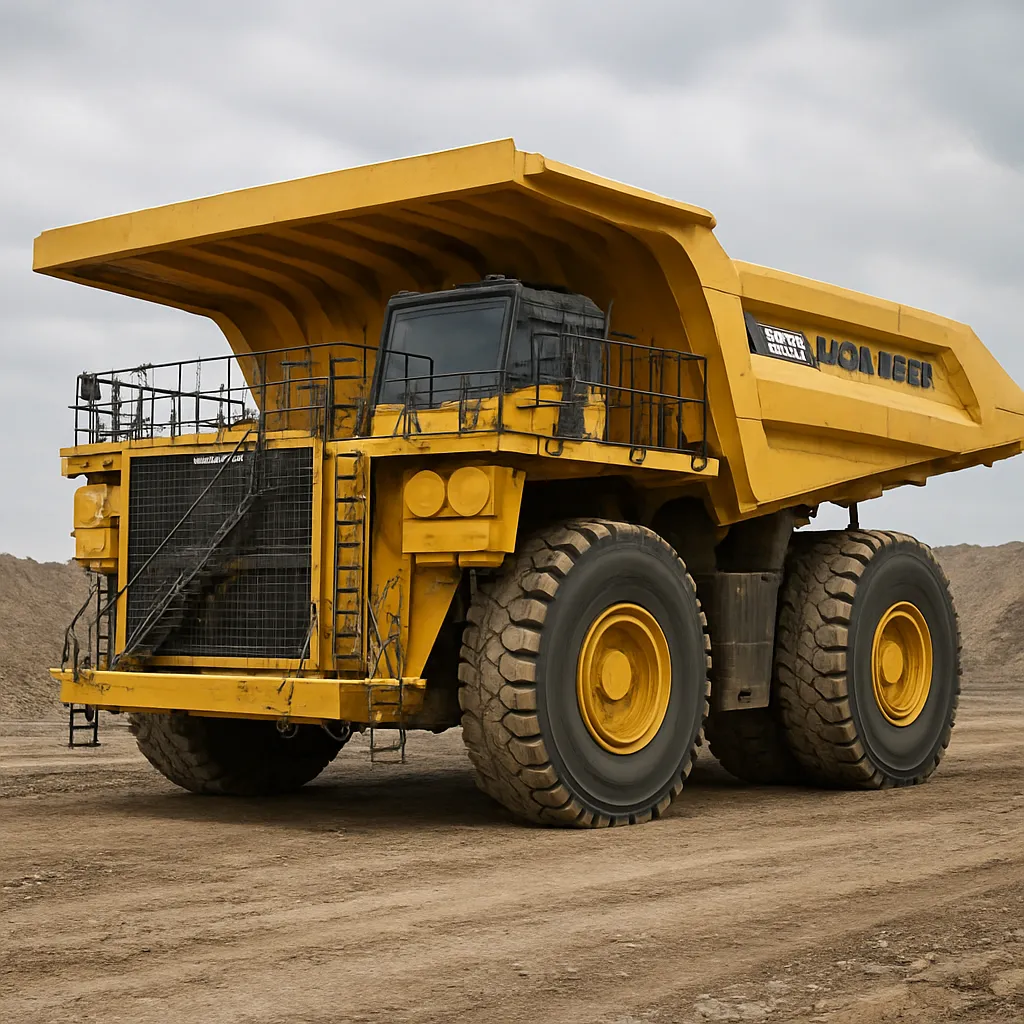
The Komatsu 960E is a flagship large-capacity mining truck built to move massive amounts of material in open-pit operations. Designed for the most demanding hauling tasks, it combines robust structural engineering with modern powertrain and control systems. This article explores the machine’s design, typical applications, operational characteristics, maintenance considerations, and the broader trends affecting ultra-class haul trucks today. The following sections provide both technical insight and practical context for mining engineers, fleet managers, and anyone interested in heavy equipment performance.
Overview and Purpose
The Komatsu 960E is part of the ultra-class family of off-highway haul trucks intended for large-scale mining operations. These trucks are purpose-built to carry high volumes of material per cycle, maximizing productivity in ore extraction, coal removal, and overburden hauling. Compared with smaller rigid dump trucks, the haul truck class that includes the 960E emphasizes payload capacity, stability on steep grades, and durability under continuous heavy-duty use.
What distinguishes an ultra-class truck?
- High single-load payload capacity to reduce unit cost per tonne moved.
- Robust frame and suspension to survive harsh mining environments.
- Powertrain and brake systems optimized for long climbs and frequent cycles.
- Integration with site logistics, including haul roads, shovels, and crusher/reclaim systems.
The 960E is designed to fit into fleets where cycle efficiency, longevity, and integration with modern mine control systems are priorities. It is commonly selected by large mines looking to scale up material movement while controlling operating cost and maintenance windows.
Design and Technical Features
Komatsu’s approach to the 960E centers on a sturdy chassis, advanced powertrain technology, and operator-focused systems. While individual specifications vary by model year and optional equipment, several design themes are consistent across configurations.
Powertrain and drivetrain
- The 960E uses a diesel-driven electric drive system: a large diesel engine drives an alternator which powers traction motors. This diesel-electric architecture offers improved torque delivery at low speeds and simplified power distribution compared with mechanical drivetrains.
- Electric drive enables smoother acceleration and superior braking control through regenerative or dynamic braking, enhancing durability of driveline components.
Chassis and body
The truck’s frame is engineered to resist twisting and fatigue loads inherent in heavy cyclic service. The haul body is made from high-strength steels with reinforced wear zones; depending on the operation the body can be fitted with liners or hardened overlays to extend service life when carrying abrasive ore or rock.
Operator environment and controls
- Cab design emphasizes visibility, ergonomic controls, and climate comfort for long shifts.
- Modern fleet configurations often include telematics and operator-assist features: load monitoring, predictive maintenance alerts, and integration with mine dispatch systems.
- The 960E platform is also compatible with semi-autonomous or fully autonomous retrofit packages, allowing sites to deploy driver-assist or driverless operations for productivity and safety gains.
Safety systems
Given the extreme size of these machines, safety features are comprehensive: anti-slip surfaces, emergency braking systems, object detection and proximity monitoring, and redundant braking circuits. Fire suppression systems and careful routing of electrical and hydraulic lines further reduce risk in high-temperature or high-wear environments.
Applications and Typical Use Cases
The primary role of the Komatsu 960E is in large open-pit mining. However, its usage profile can be detailed by specific tasks and site needs.
Primary applications
- Ore hauling: moving blasted ore from production benches to crushers or stockpiles.
- Coal transport: carrying raw coal to preparation plants or to transfer points for processing.
- Overburden removal: transporting waste rock during pit development, where large cycle volumes reduce total haulage cost.
Operational environments
These trucks operate on engineered haul roads that accommodate their turning radius, grade capabilities, and weight. They are most effective where mine geometry supports long, uninterrupted hauls or where shovels and loaders have the capacity to load the truck quickly and consistently. Typical deployment scenarios include:
- High-production iron ore and copper mines with large-scale shovels.
- Open-pit coal operations where stripping ratios demand high-volume haulage.
- Sites transitioning to autonomous fleets to maximize uptime and safety.
Performance, Economics and Typical Statistics
When assessing an ultra-class truck like the 960E, operators look at productivity metrics, operating costs, and lifecycle performance rather than simply list price. Some of the most relevant indicators include payload per cycle, fuel consumption per tonne moved, and mean time between failures (MTBF). Below are general performance observations and approximate statistics commonly used in fleet planning.
Productivity metrics
- Cycle productivity is driven by a combination of payload capacity, loading time, haul distance, and road grades. The 960E is aimed at high single-pass payloads to minimize cycles per shift.
- On long hauls with efficient loading, ultra-class trucks can move tens of thousands of tonnes per shift; exact figures will vary by site layout and shovel pairing.
Fuel and operating costs
Fuel consumption for a large diesel-electric truck is influenced by payload, grade, and duty cycle. Operators calculate fuel consumption on a per-tonne basis to compare equipment options. The electric drive typically improves energy utilization on heavy-duty climbs, offering a competitive edge over purely mechanical drivetrains in certain profiles.
Availability and maintenance statistics
- High availability (uptime) is a critical performance metric. Well-managed fleets often aim for availability above 90% through planned maintenance, condition monitoring, and parts logistics.
- Mean time between failures and repair time objectives vary with operating conditions — abrasive material, temperature extremes, and cycle intensity all shorten component life if not mitigated by maintenance.
Approximate specification ranges (typical for ultra-class trucks)
Because manufacturers offer model variations and mining sites customize equipment, numbers below are indicative rather than exact model specs:
- Payload capacity: typically in the higher hundreds to several hundred tonnes per truck (ultra-class range).
- Engine and electric drive power: configured to deliver high torque for heavy climbs and frequent starts/stops.
- Top operating speeds: optimized for hauling safety and stability rather than road speed; downhill control and grade-holding are prioritized.
These ranges help planners estimate fleet size, fuel logistics, and shovel matching. For exact model-year specifications, consult manufacturer data sheets and site-specific performance studies.
Maintenance, Repair and Lifecycle Management
Managing a fleet of 960E trucks requires a strategic approach to maintenance that balances preventive servicing, condition-based monitoring, and cost control. Because these machines are capital-intensive, extending component life and reducing downtime are central to operational success.
Preventive vs. predictive maintenance
- Preventive maintenance follows scheduled intervals for oil changes, filter replacement, and inspections. It reduces the chance of unexpected failures but can increase downtime if schedules are overly conservative.
- Predictive maintenance uses telematics and sensor data (oil analysis, vibration, temperature) to forecast component wear and schedule repairs when needed, usually delivering higher availability and lower lifecycle cost.
Key wear items and service tasks
- Tires and undercarriage components — tire selection and management are major cost items for ultra-class trucks due to size and operating stresses.
- Brake systems and retarders — critical for safe descents and long-term durability in high-grade operations.
- Electric drive components and alternator/ traction motors — while robust, they require skilled diagnostics and cooling system maintenance.
Parts logistics and downtime mitigation
Large mines often maintain on-site inventories of high-failure items and strategic spares for major components to reduce MTTR (mean time to repair). Partnerships with OEMs for rapid parts delivery, rebuild programs, and remote diagnostics are common strategies to preserve uptime.
Environmental Impact and Automation Trends
Environmental performance and automation are reshaping the role of ultra-class trucks. The efficiency gains from modern diesel-electric systems and the rise of electrification and autonomy are key themes.
Emissions and fuel efficiency
- Diesel-electric drive configurations often yield better fuel utilization under heavy, stop-start loads compared to mechanical drivetrains, reducing greenhouse gas intensity per tonne moved.
- Mines are increasingly evaluating partial or full electrification — including trolley assist systems and battery-electric trucks — as a way to lower scope 1 emissions. The transition pathway typically includes hybridization and more efficient diesel-electric systems like those found in the 960E class.
Automation and remote operation
Automation provides significant safety and productivity benefits. The 960E platform can be equipped or retrofitted with systems that enable:
- Remote operation for hazardous conditions or to reduce fatigue-related incidents.
- Semi-autonomous dispatch within a fleet using GPS, lidar/radar sensing, and fleet optimization software.
- Full autonomy in tightly controlled mine environments, where safety zones, reliable communications, and geofencing permit driverless operation.
Automation also improves fuel efficiency through optimized acceleration and braking profiles, and it reduces cycle variability — a big advantage in high-throughput mines.
Economic Considerations and Fleet Planning
Choosing to deploy trucks like the Komatsu 960E is both a capital and an operational decision. Factors that influence the economics include mine life, haul distance, material properties, and shovel compatibility.
Matching trucks to shovels
Maximizing truck-shovel efficiency is crucial: the shovel must be able to fill the truck within the target loading time; otherwise, truck capacity is not fully utilized. Engineers use loading cycle analyses to determine the optimum balance between truck payload and shovel bucket size.
Fleet sizing and unit cost
- Unit haul cost (cost per tonne moved) is sensitive to truck utilization, fuel price, maintenance cost, and labor. Ultra-class trucks reduce the number of units and drivers required for a given production target, but they also increase per-unit capital and parts risk.
- Life-of-mine planning evaluates whether fewer ultra-class trucks or more mid-class trucks produce lower total cost, taking into account road construction, pit design, and scheduling flexibility.
Conclusion
The Komatsu 960E represents a class of modern ultra-class haul trucks engineered for high-volume, heavy-duty mining operations. With a diesel-electric powertrain, reinforced structural components, and compatibility with advanced telematics and automation systems, machines in this class are central to efficient, large-scale open-pit mining. Operators considering the 960E or similar machines must balance capital and operating costs, evaluate haul road and shovel compatibility, and adopt maintenance strategies that preserve availability and safety.
Key takeaways:
- The 960E family is optimized for maximum per-cycle payload and robust, continuous operation in harsh environments.
- Diesel-electric drivetrain and modern control systems improve torque delivery, brake control, and operational efficiency.
- Successful deployment depends on fleet integration, predictive maintenance, and alignment with site automation strategies to maximize uptime and lower unit haul costs.
For precise technical specifications—payload figures, engine ratings, dimensions, and tire sizes—consult the manufacturer’s latest data sheets or an authorized Komatsu representative, since configurations and capabilities vary by model year and optional equipment.
Highlighted below are about ten important concepts emphasized in the text to aid quick scanning: Komatsu, 960E, haul truck, payload, diesel-electric, efficiency, uptime, autonomy, maintenance, safety.


)
)