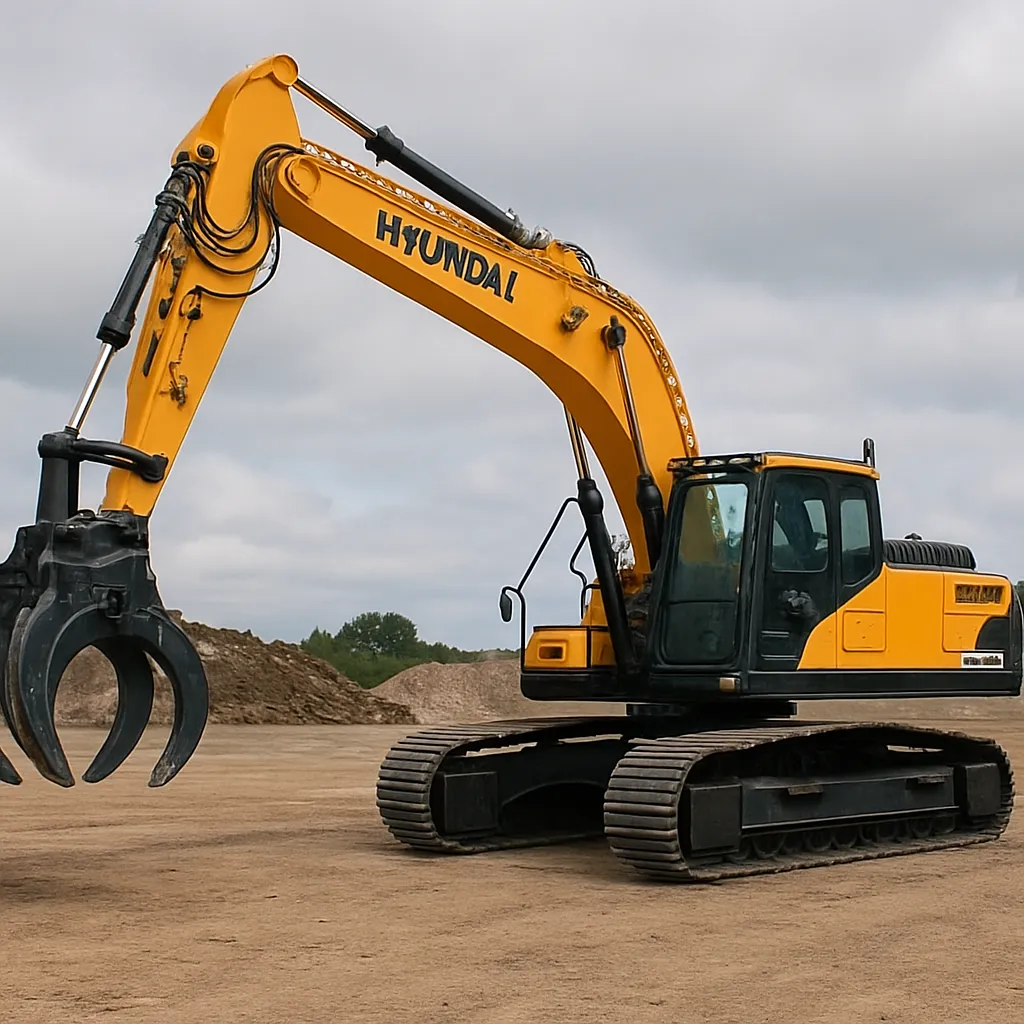
The Hyundai R320LC MH is a heavy-duty crawler-based material handler designed to meet the demanding needs of scrap yards, recycling facilities, ports, demolition sites and bulk-material terminals. Built on the robust platform of Hyundai’s R-series excavators and fitted with specialized booms, counterweights and hydraulic circuits, the R320LC MH combines the strength and stability of a 30-ton-class excavator with the precision and reach required for continuous material handling tasks. This article reviews the machine’s design, typical applications, attachments, operational performance, and maintenance considerations to help buyers, operators and fleet managers understand where the R320LC MH performs best and how to maximize its value.
Design and technical overview
The Hyundai R320LC MH is an adaptation of the R320LC excavator into a dedicated material handling configuration. Key design elements favor sustained lifting, high-cycle operation and operator visibility. The conversion typically includes a high-stability undercarriage, reinforced upper structure, enlarged counterweight and a purpose-built boom and stick combination tailored for reach and lifting geometry rather than heavy digging.
Powertrain and hydraulics
- The machine is powered by a diesel engine tuned for steady torque delivery and reliability in continuous duty cycles. While engine ratings may vary by region and emissions stage, the powerplant is selected to provide ample hydraulic flow and consistent performance under load.
- Hydraulic systems are reconfigured for higher-flow, low-cavitation operation with priority circuits for the boom and attachment functions. This ensures smooth, precise control of grapples, magnets and other tools during repetitive picks and loads.
- Proportional controls and load-sensing hydraulics help optimize response and fuel usage during varied handling tasks.
Chassis, stability and counterweight
Material handler variants like the R320LC MH emphasize lateral and longitudinal stability to cope with off-center loads and extended reaches. Typical modifications include:
- Augmented durability in the upper frame to withstand torsional forces from heavy attachments.
- Substantial counterweight options to balance long-reach booms and heavy picks.
- Heavy-duty undercarriage components for long life under repetitive lateral swing and idle travel.
Operator environment and controls
Operator comfort and visibility are crucial in handling applications. The R320LC MH usually features:
- Elevated or enlarged cab glazing for a clear sightline to the attachment and load.
- Ergonomic joystick controls with optional proportional thumbwheel or buttons for attachment rotation and auxiliary hydraulics.
- Climate control, suspension seat options and reduced-vibration mounting to minimize operator fatigue during high-cycle work.
- Standard or optional cameras and object-detection aids to enhance safety around blind spots.
Primary applications and industry uses
The Hyundai R320LC MH is versatile and finds application wherever large, repetitive material handling is required. Its design makes it especially competitive in operations that demand continuous picks, high reach and precise placement.
Common application sectors
- Scrap yards and metal recycling: Handling cars, steel bundles, sorted scrap and feeding shredders. Grapples and shears are commonly paired with the machine.
- Ports and terminals: Loading/unloading bulk cargo, handling breakbulk, timber, and palletized goods as an alternative to wheel loaders for certain operations.
- Wood processing and sawmills: Sorting and moving logs, loading trucks and organizing stacks with log grapples.
- Demolition and urban dismantling: With the right boom and toolset, the machine can operate as a high-reach handler for removal and sorting of demolition debris.
- Waste transfer stations and recycling plants: Sorting municipal solid waste, baled paper and plastics, where precise handling increases throughput and reduces contamination.
- Steel mills and foundries: Handling scrap feedstock, charging furnaces and moving ingots when outfitted with magnetic or mechanical attachments.
Why operators choose the R320LC MH
- Extended reach with stable lift capacity—important for large piles and loading tall containers.
- Adaptability to multiple attachments, allowing one carrier to serve many roles across the facility.
- Lower ground pressure options via wider tracks to protect working surfaces in indoor or paved areas.
- Ease of maintenance due to excavator-based service points and availability of parts from established dealer networks.
Attachments and configurations
The true versatility of the Hyundai R320LC MH comes from the broad array of compatible attachments and the ability to configure hydraulic and electronic controls for specific tools. Matching the right attachment to the task is critical for safety and productivity.
Typical attachment types
- Orange-peel grapples – For bulk scrap, coarse materials and irregular loads requiring a secure multi-tine grip.
- Demolition grapples – For sorting and handling mixed demolition debris.
- Hydraulic shears – For cutting and preparing scrap for processing or reducing items for transport.
- Electro-permanent or electrical magnets – For fast separation of ferrous metals in yards and yards with electromagnet-equipped booms.
- Clamshell buckets – For bulk materials such as sand, slag or biomass when precise scooping is needed.
- Log grapples and rotators – For forestry and sawmill operations requiring load rotation and accurate placement.
- Quick couplers and dedicated rotators – For rapid changeover and 360-degree orientation of loads without repositioning the carrier.
Hydraulic and control considerations
Attachments for the R320LC MH often require multi-function hydraulic circuits, high flow rates and proportional control for rotators. When specifying a machine:
- Ensure the auxiliary hydraulic flow and pressure match the attachment’s requirements.
- Verify electrical or control interfaces for rotators, magnets or sensors are compatible or available as factory/aftermarket options.
- Consider adding a hydraulic cooler and upgraded filtration for high-duty cycles to maintain system life and performance.
Operational performance and productivity
In handling applications, performance is measured less by digging force and more by cycle time, pick stability and throughput. The Hyundai R320LC MH is designed to optimize these metrics through its hydraulic tuning, operator controls and structural design.
Cycle efficiency and productivity
- Smooth proportional control reduces time wasted on re-adjustments, enabling faster pick-and-place cycles.
- High-flow hydraulic options improve attachment responsiveness, which is particularly important for grapples and rotators.
- Operator aids—such as cameras, load-hold features and auto-idle—help maintain steady productivity across shifts.
Operators and fleet managers routinely report productivity improvements when replacing older, non-specialized excavators or wheel loaders with a dedicated material handler. Documented improvements will vary by facility layout and operator skill, but common benefits include reduced cycle times, fewer tandem handling steps, and better utilization of attachment-specific tools.
Fuel consumption and emissions
Because material handling typically involves many short motions and frequent idling, fuel efficiency depends on engine management systems and operator behavior. Modern engines and hydraulic systems aim to reduce fuel consumption through:
- Load-sensing hydraulics that match flow to demand.
- Auto-idle and auto-shutdown functions to minimize wasted fuel during inactivity.
- Optimized hydraulic circuits that reduce heat and energy loss.
Many R320LC MH units built or retrofitted in recent years comply with current regional emissions standards (for example, Stage V in Europe or Tier 4 Final in North America) either from factory configuration or via approved engine packages.
Maintenance, reliability and total cost of ownership
Reliability and predictable service intervals are key to maintaining uptime in high-throughput environments. The R320LC MH benefits from Hyundai’s excavator service architecture but may require additional attention to specific MH components.
Planned maintenance and uptime
- Regular checks on hydraulic hoses, quick couplers and attachment mounting points reduce the risk of failures during operation.
- Filters, hydraulic oil and cooling systems may require more frequent attention in dusty or abrasive environments like scrap yards.
- Dealer-supported telematics systems (such as Hyundai’s Hi-MATE) provide remote monitoring of hours, fuel usage, fault codes and service reminders to aid proactive maintenance.
Lifecycle and spare parts
Since the R320LC MH is based on a mainstream excavator platform, many common components—such as undercarriage parts, hydraulics and engine service items—are widely available. However, material-handler-specific parts like booms, rotators and specialized counterweights may be less common and should be sourced through authorized dealers or certified aftermarket suppliers.
Total cost of ownership
When evaluating the cost of an R320LC MH, consider the following factors:
- Initial acquisition vs. retrofit cost (new MH vs. converted excavator).
- Attachment investments and their expected lifespan.
- Fuel and consumable usage based on duty cycle.
- Resale value in the specialized material handling market; well-maintained MH variants tend to hold value if they have documented service histories.
Case studies and real-world performance
Across different industries, the R320LC MH has been used to streamline operations and reduce manual handling. Below are generalized examples based on common outcomes reported by operators and fleet managers.
Scrap recycling yard
- Problem: Long loading cycles and inefficient separation leading to bottlenecks feeding the shredder.
- Solution: Replace a multipurpose excavator with an R320LC MH equipped with an orange-peel grapple and rotator.
- Result: Faster picking, more accurate sorting and reduced re-handling—translating into measurable increases in tons processed per hour and lower wear on shredders due to better-prepared input material.
Port terminal
- Problem: Inconsistent handling of timber and irregular cargo causing delays during vessel operations.
- Solution: R320LC MH with log grapple and extended cab visibility, plus heavy counterweight for stability during high lifts.
- Result: Improved vessel turnaround time and safer stacking of materials in the yard.
Demolition recycling center
- Problem: Sorting mixed demolition waste manually was time-consuming and hazardous.
- Solution: High-reach MH with demolition grapple and magnet for ferrous separation.
- Result: Reduced labor, increased throughput and improved separation of recyclable materials.
Environmental and safety considerations
Material handling environments pose unique environmental and safety challenges, and the R320LC MH addresses these through design and options.
- Emissions-compliant engines reduce the environmental footprint and help sites meet regulatory requirements.
- Access platforms, handrails and well-placed service points improve service safety during inspections and routine maintenance.
- Operator visibility enhancements—large glass areas, cameras and mirrors—help prevent collisions and reduce blind spots.
- Optional cab pressurization and filtration systems reduce operator exposure to dust and fumes in recycling or demolition contexts.
Note: Safe operation requires appropriate site planning, properly trained operators and regular inspections of attachment integrity, hydraulic lines and structural members, especially when working with heavy or unbalanced loads.
How to choose the right R320LC MH configuration
Selecting the right configuration depends on the specific application, space constraints and desired throughput. Consider the following when specifying or buying a unit:
- Define duty cycle and peak loads: Will the unit be handling heavy, occasional lifts or constant medium-weight picks?
- Choose the boom and stick length for required reach and height while considering lift capacity at that reach.
- Match hydraulic flow and control options to the most demanding attachment expected to be used.
- Decide between purchasing a factory-built MH vs. retrofitting an excavator. Factory options often include warranty coverage for MH components.
- Verify dealer support and parts availability for MH-specific components in your region.
- Test the machine in site-like conditions where possible and evaluate operator comfort, visibility and control responsiveness.
Statistical perspective and market context
Precise production statistics for a specific model like the Hyundai R320LC MH are influenced by regional market demands and may not be uniformly published. However, some general market trends provide context:
- The global material handling equipment segment has grown in tandem with recycling and port activity, increasing demand for specialized MH machines in the last decade.
- Operators replacing older, generic excavators with dedicated material handlers typically report improved throughput; depending on the operation, efficiency gains frequently range from moderate to substantial due to better attachment matching and reduced re-handling.
- Resale demand for well-maintained MH units remains solid, particularly in markets with expanding recycling regulations and increased scrap exports.
Because published numerical data (production volumes, unit sales, aggregated uptime percentages) varies between manufacturers and regions, it is advisable to consult local Hyundai dealers or fleet managers for recent, localized figures and case-specific metrics.
Buying, leasing and retrofit considerations
Organizations can acquire an R320LC MH through direct purchase, long-term lease, or by retrofitting an existing excavator into an MH configuration. Each route has trade-offs:
- Purchase: Higher upfront cost but full control over configuration and potential lower long-term cost if utilization is high.
- Lease: Lower initial outlay and flexibility to upgrade as technology or needs change, often with maintenance packages available.
- Retrofit: Cost-effective for converting existing assets; retrofit quality and warranty coverage vary, so choose experienced fabricators and verify lifting and structural analyses.
Conclusion
The Hyundai R320LC MH is a capable and adaptable material handling platform for a wide array of industries, from scrap yards and ports to demolition and wood-processing facilities. Its excavator-derived undercarriage and serviceability combined with bespoke booms, counterweights and hydraulic options create a machine that balances efficiency, productivity and operational reliability. When selecting an R320LC MH, careful attention to attachments, hydraulic compatibility, and dealer support will determine how well the machine meets site-specific demands. With appropriate configuration, diligent maintenance and trained operators, the R320LC MH can deliver significant improvements in throughput, safety and lifecycle value in specialized material handling roles.
)
)