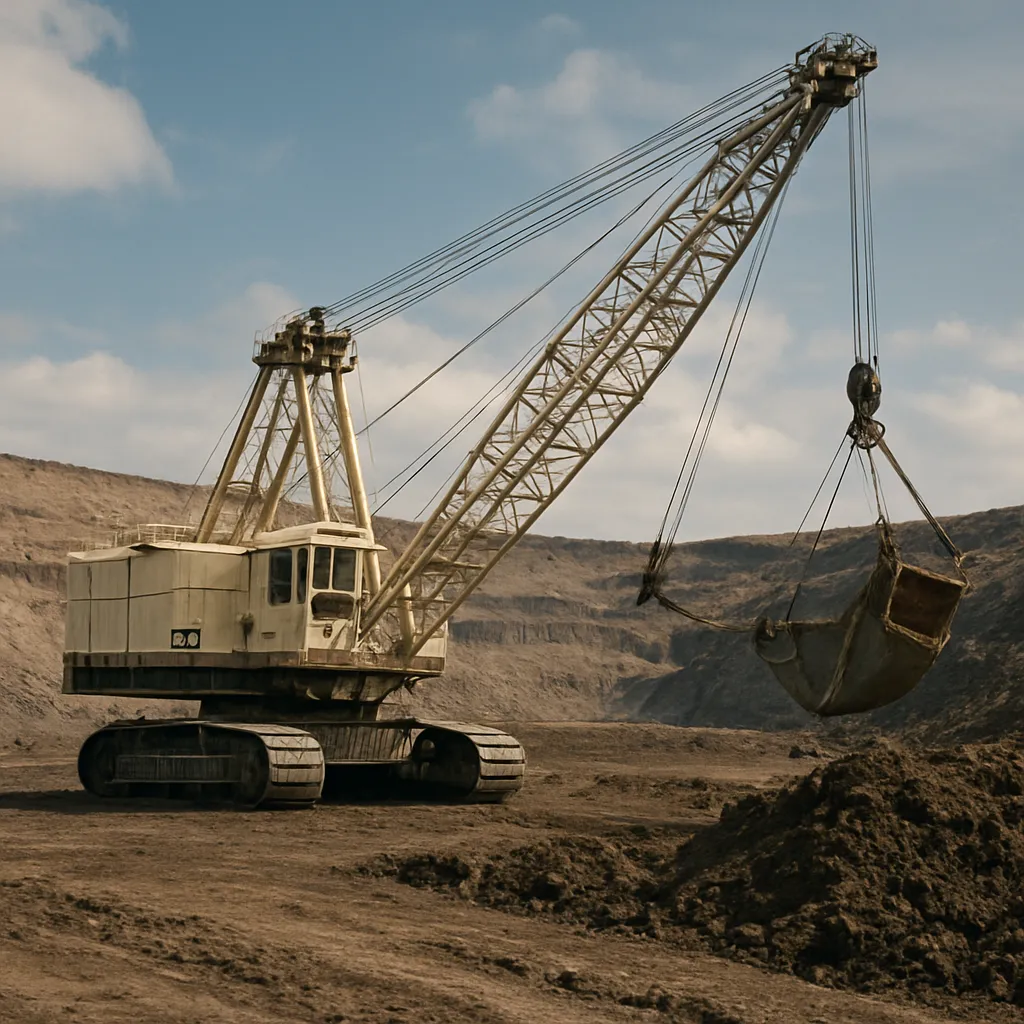
The Marion 7450 dragline is a member of the family of large rope-operated excavators that have been central to high-volume earthmoving in open-pit and strip mining for decades. This article examines the machine’s design, typical applications, operational characteristics, maintenance needs and the broader economic and environmental role of dragline excavators. Where exact published specifications for the Marion 7450 are available they are discussed, and where data are scarce the text presents well-established ranges and comparative figures drawn from machines of similar class. The goal is to provide a practical, technical and contextual overview useful to engineers, mine planners and enthusiasts alike.
Overview and historical context
The term dragline refers to a large, rope-operated excavator with a bucket that is dragged across the ground toward the machine by means of a dragline rope. The Marion 7450 belongs conceptually to the line of heavy-duty draglines developed during the mid-20th century by established manufacturers. These machines were optimized to remove overburden and excavate vast volumes of material quickly and continuously, enabling the growth of large-scale surface mining and bulk excavation projects.
Marion-manufactured machines built a reputation for mechanical robustness and straightforward electro-mechanical systems. Although precise production and deployment records for each model vary by operator and region, the Marion 7450 is best understood within the context of large walking draglines that served coal, lignite, phosphate and tar-sand operations, as well as major civil projects such as dredging, harbor construction, and large-scale earthworks. Over the decades, many draglines originally built by Marion and other manufacturers were rebuilt, reconfigured or retrofitted with updated controls and electrical equipment to extend service life.
Design and principal components
At the heart of any dragline are a few critical components that determine capability and performance:
- Bucket: The dipper or bucket is the working tool. It is connected to a system of ropes that allow it to be dragged across the spoil and hoisted. Bucket capacities for large draglines can vary widely; machines in the class of the Marion 7450 typically employ buckets designed for continuous high-volume excavation.
- Boom: A long lattice or truss boom provides reach and leverage. Boom length determines how deep and far a dragline can place or retrieve overburden without repositioning. The boom also plays a major role in machine stability and swing dynamics.
- Hoist and drag winches: Electric motors power winches for hoist, drag and swing functions. The coordinated operation of these winches controls bucket position and material release.
- House and revolving structure: The upper structure houses the motors, winches, controls and operator cab and rotates on an undercarriage (often a walking mechanism for large units).
- Walking undercarriage: Many large draglines use a “walking” system rather than tracks to reposition the machine. Walking systems lift and advance massive support feet to move the machine short distances without disassembly.
- Electrical system: Draglines of this class are typically electrically powered — either directly from mine-site power grids or via dedicated substations — and use large AC motors and control gear to manage performance.
A key design feature is the interplay between boom length, bucket capacity and rope geometry; together these determine maximum dig depth, reach and cycle time. The Marion family of draglines emphasized rugged mechanical designs and modular components that could be maintained and replaced in the field.
Typical technical characteristics and performance
Published numbers specific to the Marion 7450 can be limited in public literature. However, to provide useful context, the following ranges represent well-documented metrics for large-class rope draglines similar in role and era to the Marion 7450:
- Bucket capacity: Typical large draglines use buckets ranging from roughly 20 to over 200 cubic yards (≈15–150 m³). Many machines used in major coal and lignite operations fall in the 50–150 cubic yard (≈38–115 m³) range.
- Boom length: Common boom lengths vary from about 150 to 300 feet (≈45–90 m) depending on the target reach and depth requirements.
- Digging depth and reach: Effective digging depth (vertical) is influenced by boom geometry but often ranges from 30 to 120 feet (≈9–37 m) for large walking draglines; maximum horizontal reach can exceed 200 feet (≈60 m).
- Machine weight: Overall operating weight for large-class draglines may span several thousand to tens of thousands of metric tonnes, with the largest historical machines weighing in the tens of thousands of tonnes when fully outfitted.
- Cycle time and production rates: A well-maintained dragline with a large bucket capacity can achieve very high in-situ material movement rates — hundreds to thousands of cubic meters per hour — depending on material type, swing distance and operator skill.
- Power demand: Large draglines are energy-intensive. Electrical power requirements commonly range from several megawatts to tens of megawatts for continuous heavy operation, supplied by mine substations and built-in power distribution systems.
These ranges are presented to help translate the working envelope of a Marion 7450-class machine into practical planning values. Exact performance depends on site conditions (material type, fragmentation, strata geometry), bucket fill factor, cycle optimization and availability of electrical supply.
Applications and operational roles
The primary role of the Marion 7450 and its peers has historically been large-scale removal of overburden and bulk excavation where continuous, high-volume removal is preferable to smaller, more flexible excavators. Typical applications include:
- Coal and lignite strip mining: Removing the cover layers above coal seams to expose the coal for subsequent extraction; draglines excel where overburden volumes are very large and the bench heights are suitable for dragline reach.
- Phosphate and potash surface operations: Removing shallow or fractured overburden to expose ore beds over wide lateral extents.
- Tar sands and oil sands mining: Bulk removal and stockpiling where plant capacity matches the continuous feed pattern a dragline provides.
- Civil engineering and reclamation: Harbor and canal dredging, levee construction and large earthworks can benefit from a dragline’s ability to move bulky material without frequent refueling stops.
- Reclamation and spoil handling: Draglines are often used to place spoil for reclamation, sculpt final pit slopes and construct landforms according to environmental closure plans.
Advantages in these applications include long reach, large bucket capacity, continuous operation and low ground pressure compared with certain tracked alternatives. The walking undercarriage and modular construction also allow a dragline to be relocated or refurbished for extended operational life.
Operation, cycle and productivity factors
A typical dragline cycle consists of: lowering the bucket to the dig site, dragging the bucket to fill, raising the bucket, swinging to the dumping location, opening the bucket (or placing material), and returning to the dig position. Key factors influencing productivity include:
- Bucket fill factor and material cohesion — granular, free-draining materials fill more easily than sticky clays.
- Swing distance — shorter swings between dig and dump maximize cycles per hour.
- Operator skill and control system optimization — coordinated hoist, drag and swing actions reduce wasted motion.
- Electrical and mechanical availability — unplanned downtime has a large negative effect on total output due to high hourly capacity when running.
In practice, a properly configured and operated dragline can be the most cost-effective solution for operations requiring continuous removal of large volumes of overburden across broad lateral areas.
Maintenance, refurbishment and lifecycle management
One of the hallmarks of large draglines like the Marion 7450 is long potential service life when maintained properly. Maintenance strategies that operators commonly follow include:
- Proactive rope and hoist inspection and replacement programs, since ropes are critical safety components and wear is wear-rate dependent on loads, cycles and environment.
- Lubrication and inspection regimes for bearings, slew rings and walking jacks to prevent catastrophic failures.
- Electrical system modernization — many older draglines received retrofits such as variable frequency drives (VFDs), improved motor protection and PLC-based control upgrades to enhance efficiency and reliability.
- Bucket and wear-part remanufacturing — replacing lip segments, teeth and reinforcing structures as part of scheduled downtime.
- Structural integrity inspections — non-destructive testing (NDT) and fatigue analysis of the boom, pins and house structure to identify and repair stress damage before failure.
Refurbishment projects are common; cost-benefit analyses often favor rebuilding a proven dragline rather than purchasing a brand-new machine, especially when capital budgets are constrained and site power is already engineered for large electric excavators. Rebuilds can include new cabs, upgraded controls, reconditioned gearboxes and modern safety systems, which collectively extend service life by decades under proper stewardship.
Economic and environmental considerations
From an economic perspective, draglines deliver low cost per cubic meter of material moved when used in the appropriate contexts. Major advantages include:
- High hourly material movement capacity for continuous operations.
- Lower personnel requirements compared with equivalent fleet sizes of trucks and shovels for some overburden-removal tasks.
- Long equipment life that spreads capital costs over many years of operation.
Environmental and social considerations are critically important in modern mining operations. Draglines contribute to some environmental impacts, and operators must plan and mitigate accordingly:
- Large surface footprint during operation; however, effective mine planning and progressive reclamation can reduce long-term ecological impacts.
- Energy consumption and associated greenhouse gas emissions — electrified draglines shift emissions to power generation sources; sourcing renewable or lower-carbon power reduces lifecycle emissions.
- Noise and dust — mitigated using water sprays, enclosures, operational scheduling and buffer setbacks from sensitive receptors.
- Reclamation capability — draglines can be very effective at reshaping landforms and replacing overburden to achieve post-mining land uses when used as part of a reclamation plan.
Notable examples, preservation and legacy
Large draglines have become iconic in mining history. While the Marion 7450 itself may not be as widely publicized as the very largest machines built by a variety of manufacturers, models of this class have often been rebuilt and transferred between sites and countries. Preservation efforts for historically significant machines have occasionally resulted in museum displays or static restorations where economically feasible.
As the mining industry evolves, some draglines are retired and scrapped, others are preserved in parts or donated to technical museums, and a few remain operational after major modernizations. Their legacy includes generations of mining personnel trained on rope-operated excavators and an engineering heritage of large-scale electro-mechanical systems.
Modern trends and future outlook
While rope draglines remain valuable in many contexts, certain trends are shaping their future role:
- Automation and digitalization — retrofit control systems, tele-operations and optimization software can enhance cycle efficiency and safety.
- Energy efficiency improvements — modern drive systems and better power management reduce energy intensity per cubic meter moved.
- Integration with mine planning software — dragline reach and productivity models are used in pit scheduling to maximize the economic benefit of draglines relative to truck-and-shovel fleets.
- Environmental constraints and permitting — where environmental or social constraints preclude large surface operations, other mining technologies may be favored, reducing the number of sites suitable for draglines.
Despite these trends, draglines like the Marion 7450 retain relevance in operations where long reach, large bucket capacity and continuous operation provide overall economic advantages. Ongoing innovation in controls, power electronics and predictive maintenance continues to extend their competitiveness.
Summary and practical guidance for operators
For mine planners and operators considering the Marion 7450 or comparable draglines, the following practical guidance can help align machine selection with operational goals:
- Match bucket capacity and boom length to the specific overburden thickness and bench geometry to avoid under- or over-specification.
- Assess site power availability and costs; electrified draglines require reliable grid or dedicated generation capacity sized for megawatt-class loads.
- Prioritize refurbishment and rope management programs to maximize uptime and extend asset life.
- Use accurate production modelling to understand the dragline’s role relative to truck-shovel alternatives and to optimize pit sequencing for continuous feed and minimal repositioning.
- Plan progressive reclamation and environmental mitigation early, leveraging the dragline’s ability to place large volumes of material efficiently during closure activities.
In conclusion, the Marion 7450-class dragline represents a potent tool for large-scale excavation and overburden removal. Its enduring strengths — long reach, high per-cycle capacity and suitability for continuous operations — make it an asset in the right mine contexts. Thoughtful maintenance, modernization and operational planning can keep such machines productive and cost-effective for decades.
Key terms highlighted
- Marion 7450
- dragline
- bucket
- boom
- excavation
- mining
- surface mining
- capacity
- electric
- maintenance


)
)