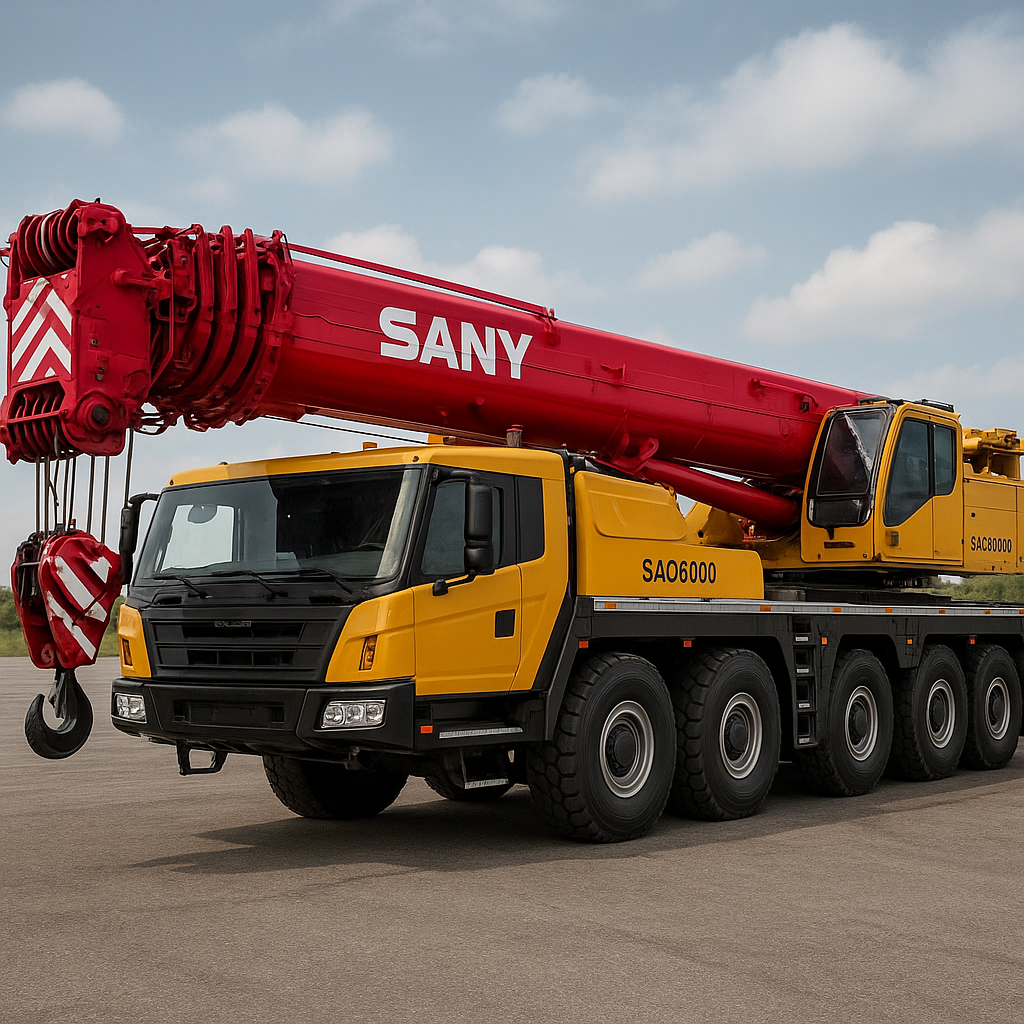
The SANY SAC6000 represents a modern solution in heavy lifting: a robust, versatile, and mobile all-terrain machine that combines road travelability with powerful lifting performance. Designed for demanding construction, energy, and industrial projects, this crane emphasizes a balance of mobility, power and operator-oriented safety. In the following sections we examine its design, typical specifications, practical applications, operational features, and market context — providing a comprehensive look at where and how the SAC6000 can deliver value.
Overview and design philosophy
The SANY SAC6000 is built to address complex lifting tasks that require both on-road transport and off-road capability. As an all-terrain crane, it combines features of truck-mounted and rough-terrain cranes: a multi-axle carrier for long-distance mobility and a crane superstructure with telescopic or lattice boom systems for heavy lifts. The design philosophy centers on providing high lifting capacity while maintaining fast setup, reliable operation in varied ground conditions, and high overall efficiency during project cycles.
Key design elements include a reinforced multi-axle chassis that supports heavy counterweights and boom equipment, a telescopic main boom engineered for high stiffness and low deflection, and advanced hydraulic systems that deliver precise control. The operator cabin is ergonomically arranged to reduce fatigue and increase situational awareness, featuring modern controls and instrumentation. Modular counterweight systems and optional extension jibs make the SAC6000 adaptable to a wide range of lift profiles, from short, high-capacity lifts to long-reach installations.
Technical specifications and performance characteristics
While exact specifications may vary by configuration and market, the SAC6000 is typically classed as a 600-metric-ton crane. The manufacturer’s configurations and optional packages influence final numbers, but some commonly reported performance characteristics include:
- Rated lifting capacity: approximately 600 tonnes (metric) at the basic radius (varies with boom and counterweight setup).
- Main boom: telescopic sections offering substantial reach; typical maximum main boom lengths for cranes in this class range from around 60 m to 80 m depending on configuration.
- Auxiliary jib / lattice boom: modular jibs can extend reach significantly, often allowing reach beyond 100 m in certain setups with appropriate counterweight and rigging.
- Axle configuration: multi-axle carrier (commonly 7–9 axles in the 500–700 t class) to distribute weight for highway transport and comply with road regulations in many regions.
- Power unit: high-output diesel engine(s) driving both the carrier and crane functions, coupled with advanced hydraulic pumps for responsive boom extension and hoisting.
- Travel speed: designed for efficient relocation on public roads; travel speeds depend on local regulations and carrier gearing.
- Counterweight system: modular blocks permit tailoring of counterweight to the lift profile, balancing transport weight and lifting needs.
- Control systems: computerized load monitoring and stability aids provide real-time feedback on load moment, radius, and safe working limits.
These general figures represent the scale and capability of the SAC6000 class. For contract bidding and lift planning, operators consult the detailed load charts supplied by SANY for the exact configuration used on site — those charts specify capacity at radius, boom length, and any applicable derating for attachments or environmental conditions.
Primary applications and industry uses
The SAC6000’s combination of high capacity and road-legal mobility makes it a prime choice in several sectors:
- Construction: erection of structural steel for high-rise buildings, placement of heavy prefabricated modules, and installation of rooftop mechanical equipment.
- Energy and utilities: installation of wind turbine components (nacelles, towers and blades), substation equipment placement, and work on power transmission infrastructure where long reach and heavy capacity are needed.
- Oil, gas and petrochemical: lifting of heavy pressure vessels, heat exchangers, and modular process skids during plant construction and maintenance.
- Industrial maintenance and heavy assembly: movement and installation of large machinery in shipyards, factories, and assembly yards.
- Infrastructure and civil engineering: bridge girder erection, placement of precast segments, and handling of large concrete elements.
Because it can travel between sites under its own power and then perform heavy lifts without the extensive setup of crawler cranes, the SAC6000 often reduces cycle time on projects that require several lift points over a geographically spread area.
Operational features, controls and safety systems
Modern all-terrain cranes like the SAC6000 incorporate electronic and hydraulic systems to improve safety and make operations more predictable:
- Electronic Load Moment Indicator (LMI): continuously monitors the load moment and alerts the operator if the crane approaches critical limits.
- Automatic safe-guarding features: interlocks that prevent unsafe combinations of boom angle, extension and hoist line when the rated chart is exceeded.
- Stability control: sensors and software that monitor chassis inclination, outrigger position and ground contact pressures to ensure the crane remains within safe parameters.
- Advanced hydraulic systems: proportional controls yield smooth boom extension and hoist operation, reducing shock loads on rigging and structure.
- Operator ergonomics: climate-controlled cabs, adjustable seats, high-visibility glazing and clear instrumentation improve operator performance during long shifts.
- Remote control options: some configurations allow remote operation of certain crane functions for improved line-of-sight during sensitive lifts.
Routine features like outrigger pads, load-sway damping and redundant safety circuits further reduce the likelihood of incidents. Proper operator training and compliance with manufacturer-specified rigging and lift plans remain essential for safe operation.
Transport, setup and logistics considerations
One of the core advantages of the SAC6000 is its transportability. The multi-axle chassis permits legal highway movement in many jurisdictions with reduced need for disassembly. That said, large cranes still require permit planning, route surveys, and occasional escort vehicles depending on local rules.
Setup time is another cost element: compared with crawler cranes that must be assembled and ballasted on site, an all-terrain crane typically arrives, deploys outriggers, installs target counterweight, and is ready to lift in a shorter timeframe. Modular counterweights and quick-hitch systems further reduce on-site labour. However, the operator must account for ground preparation under outrigger pads, space for counterweights, and lift-path clearance — especially in constrained urban environments.
Maintenance, lifecycle and total cost of ownership
The total cost of ownership for a heavy crane includes purchase price, financing, scheduled maintenance, spare parts, insurance, operator training and downtime risk. SANY emphasizes a global service network and parts availability to reduce downtime. Regular maintenance focuses on hydraulic systems, wire ropes and hoists, boom inspection for signs of fatigue, and engine service. Predictive maintenance tools and telematics can provide advanced warning of component wear and allow fleet managers to plan service with minimal disruption.
- Scheduled inspections: boom and structural inspections at manufacturer-prescribed intervals.
- Hydraulic and hoist system checks: sealing, pump performance, and line integrity.
- Wire rope and sheave maintenance: replacing ropes when wear limits are reached to avoid failures.
- Software updates: updating onboard safety and control software to latest releases to benefit from improved functionality and diagnostics.
Market reception, comparisons and statistical context
SANY has grown into one of the major global manufacturers of construction equipment, including mobile and all-terrain cranes. The SAC series, including the SAC6000, was introduced as part of that strategic push to compete with established European and Japanese brands in the high-capacity all-terrain segment. Market reception has generally praised the value proposition: high capacity for investment cost, strong factory warranty and improving after-sales networks in many regions.
Statistical and market-oriented observations include:
- Global demand for heavy lifting equipment remains tied to construction, energy and infrastructure investment cycles. Regions with strong wind, petrochemical, and large-scale urban construction projects show the highest demand for 500–1000 t class all-terrain cranes.
- Fleet owners often balance between owning cranes like the SAC6000 and hiring specialist heavy-lift contractors who maintain their own fleets. The decision depends on utilization rates: cranes with regular heavy-duty projects justify ownership more readily.
- SANY’s investment in R&D and production capacity has increased its share in some markets, and competitive pricing relative to long-established brands has made models like the SAC6000 attractive to cost-sensitive buyers.
Case studies and typical project scenarios
Real-world use of a 600 t-class all-terrain crane highlights its advantages:
- Wind-farm installation: Because of the need to lift heavy nacelles and long tower sections at height, a crane like the SAC6000 — especially when coupled with a long jib — can erect many types of turbines. Quick re-assembly and travel between turbine locations reduces mobilization time.
- Industrial plant turnaround: During scheduled shutdowns, heavy machinery must be replaced quickly; the SAC6000 provides fast setup and high-capacity lifts in constrained plant environments where crawler cranes may struggle to relocate.
- Bridge segment placement: For precast segmental bridge construction, the combination of high lift capacity at relatively moderate radii and the ability to reposition on site enables efficient placement with minimal additional rigging equipment.
Environmental and regulatory considerations
Modern acquisition and operation decisions increasingly factor in environmental impacts. Diesel engines and heavy machinery have emissions, so fleet managers consider fuel efficiency, emissions control packages and newer engine options to comply with regional regulations. The SAC6000’s efficient hydraulics and optimized powertrains can reduce fuel consumption per lift compared to older machines. Additionally, transportability reduces the need for heavy disassembly and reduces the number of heavy truck movements for assembly, which can lower the project’s overall environmental footprint.
Purchasing, rental and financing considerations
For contractors evaluating a crane like the SAC6000, the decision drivers typically include:
- Projected utilization rate: owning becomes attractive when utilization is high across multiple projects.
- Availability of rental alternatives: access to reputable rental fleets can obviate the need to own in markets where short-term demand dominates.
- Resale and residual value: a global market presence and brand recognition can influence future resale value.
- After-sales support and parts availability: extensive service networks reduce downtime and operating risk.
- Financing and leasing terms: manufacturers and financial institutions often offer specialized leasing and financing programs for heavy equipment to spread capital expenditure.
Conclusion
The SANY SAC6000 is an example of a high-capacity all-terrain solution that targets heavy industrial, construction and energy markets where mobility, quick setup and significant lifting capacity are required. Its combination of modern hydraulic controls, modular counterweight systems, and multi-axle carriage design make it suitable for projects demanding both power and flexibility. While specific technical numbers and load charts should always be reviewed for each configuration and contractual lift plan, the SAC6000 stands as a compelling option for fleet operators seeking to balance performance and lifecycle cost in demanding lifting environments.


)
)