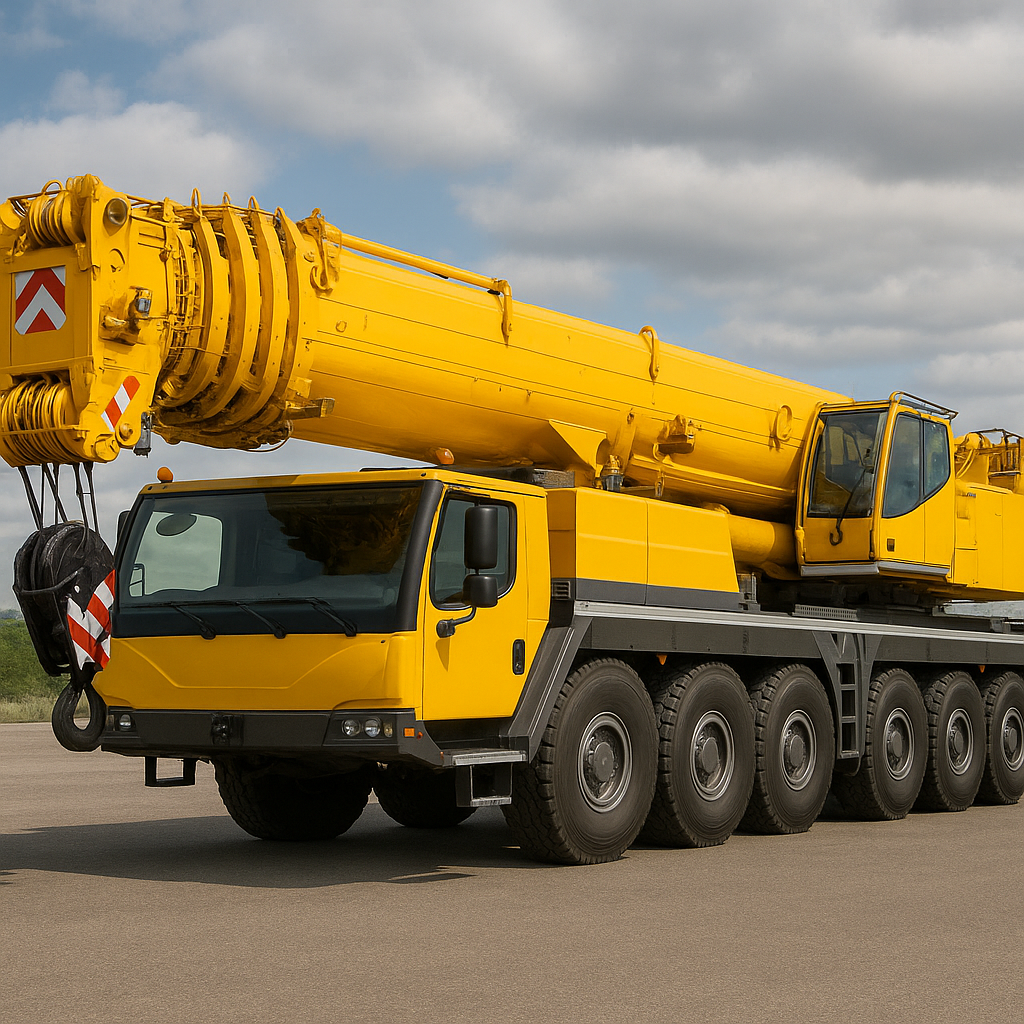
The Liebherr LTM 1500-8.1 is a flagship all-terrain mobile crane designed to combine exceptional lifting performance with on-road mobility and versatility. In this article we explore the machine’s technical features, typical applications across industries, operational advantages, safety and control systems, transport and setup considerations, and practical aspects such as maintenance, economics and environmental impact. Wherever possible we highlight measurable parameters and real-world uses to give a practical picture for owners, operators and planners.
Overview and technical highlights
The Liebherr LTM 1500-8.1 is part of Liebherr’s series of heavy-duty, multi-axle all-terrain cranes. It is built to deliver high-capacity lifts while still being roadable without specialized transport in many regions. Key characteristics that make this machine notable include an 8-axle carrier, an electronically controlled telescopic boom, modular lattice extensions for extreme heights, and advanced crane control and safety systems.
Core specifications (typical values)
- Rated lifting capacity: up to 500 tonnes (metric tonnes) in standard configurations
- Carrier configuration: 8-axle chassis for stability and road mobility
- Telescopic boom: main boom length typically around 60 metres (with multiple telescopic sections)
- Luffing and lattice jib options: modular extensions that can increase tip height well beyond the main boom length, enabling tip heights exceeding 100 metres in certain setups
- Control system: Liebherr’s LICCON electronic crane control and load moment monitoring
- Stability system: VarioBase® or equivalent variable outrigger management for optimized lifting on restricted footprint
- Drive and mobility: robust multi-axle drive providing good road speeds for a crane of its class, subject to local legal limits and permit requirements
The combination of telescopic and lattice components allows operators to adapt the crane precisely to job requirements, balancing lift capacity against reach. The LTM 1500-8.1 is engineered so that typical heavy lifts—such as setting turbine nacelles, placing large transformers, or erecting steel modules—can be accomplished with minimal need for auxiliary lifting equipment.
Primary applications and industries
The LTM 1500-8.1 is widely used in sectors where very heavy lifts and significant reach are required while access and transportability remain important. Its versatility makes it suitable for projects where the alternative would be multiple lifts, extensive assembly of lattice cranes, or higher logistical complexity.
- Wind energy: Erection of turbine towers, installation of nacelles and blades. The boom and jib configurations allow reaching hub heights on modern onshore and near-shore installations. The ability to reposition quickly between sites makes it attractive for multi-turbine projects.
- Power generation and utilities: Installation of large transformers, generators, boilers and other heavy equipment in power plants and substations. The crane’s capacity and precision allow for safe placement of delicate, heavy items.
- Oil & gas and petrochemicals: Module handling and plant revamps where heavy skids, vessels and pipe racks must be lifted and positioned, often in confined industrial yards.
- Bridge and civil engineering: Launching and placing bridge segments and precast concrete elements where large lifts and long reaches are needed.
- Heavy industry and shipbuilding: Handling hull sections, engine blocks and other extremely heavy components in shipyards and heavy fabrication yards.
- Infrastructure and modular construction: Lifting prefabricated modules for buildings, hospitals, data centers and large mechanical rooms.
Across these uses, the LTM 1500-8.1’s combination of road mobility and on-site lifting power reduces the need for multi-crane lifts and lowers overall project logistics. Projects that demand repetitive heavy lifts—such as assembling a wind farm—benefit from its relatively fast setup and strong performance envelope.
Design features that improve productivity
The LTM 1500-8.1 integrates a number of design solutions aimed at maximizing uptime and reducing complexity on site. These features are essential for creating value on projects where delays are costly.
Telescopic boom and modular extensions
The telescopic boom provides rapid and flexible reach, allowing operators to extend and retract sections hydraulically to position loads with precision. For exceptional heights or long-radius lifts, lattice jib and insert sections can be mounted to achieve greater tip heights. This modularity lets contractors choose a configuration optimized for the lift instead of being forced into a single-purpose configuration.
Advanced control and safety systems
- LICCON control system: Liebherr’s electronic control and load monitoring suite provides dynamic load charts and operator guidance. It calculates safe working loads in real time based on boom length, angle, outrigger position and wind.
- VarioBase®: This variable outrigger system allows the crane to use non-symmetrical outrigger layouts while still providing valid and safe load chart calculations, increasing flexibility on constrained job sites.
- Sensor integration: Load moment indicators, angle sensors and electronic steering/suspension assistance contribute to safe operation and easier setup.
Carrier and chassis engineering
The 8-axle carrier is designed to distribute weight to meet road axle load regulations in many countries while providing a long wheelbase for on-site stability. Features such as hydropneumatic suspension, steerable axles and powerful drivetrains improve mobility on public roads and maneuverability on complex sites. The crane’s design also emphasizes operator comfort and visibility from the superstructure cab, which aids precise load handling.
Transport, setup and site considerations
Even though the LTM 1500-8.1 is a mobile crane, planning for transport and setup is critical due to its size and weight. Proper route surveys, permits and ground preparations can mean the difference between a smooth job and major delays.
Transport logistics
- Despite its roadability, transporting the crane between distant sites can require escort vehicles and permits depending on local regulations; axle load distribution helps minimize special transport needs.
- Some components (like long lattice jib sections or counterweight elements) may be transported separately as modular loads; coordination of multiple transport units is common on large projects.
On-site setup and outrigger planning
To achieve rated capacities, the crane must be set up on appropriately prepared ground. The LTM 1500-8.1’s VarioBase allows non-symmetric outrigger positions, but the ground bearing pressure and pad sizing still need to be carefully calculated. Typical site tasks include:
- Soil assessment and installation of outrigger pads or load-spreading mats to ensure safe pressure distribution
- Planning for crane swing radius and exclusion zones to protect personnel and equipment
- Consideration of underground utilities and proximity to structures for outrigger deployment
Safety, regulations and operator training
Safety is central to the operation of any heavy crane. Modern systems on the LTM 1500-8.1 provide real-time limits, but skilled operators and site coordinators are still essential.
- Load moment limitation: Continuous monitoring enforces safe loads and prevents tipping.
- Wind and environmental limits: The crane’s load charts include wind thresholds; operators must monitor conditions and cease lifts when thresholds are exceeded.
- Operator qualification: Certification requirements vary by country, but operators typically need formal training on both general crane operation and the specific control systems (LICCON, VarioBase) used on Liebherr cranes.
- Rigging and taglines: Proper rigging practices and use of taglines for suspended loads reduce swing and prevent collisions with adjacent structures.
Maintenance, lifecycle and total cost of ownership
The LTM 1500-8.1 is designed for long operational life with regular maintenance. Total cost of ownership considerations for owners include initial capital cost, operating hours, maintenance intervals, parts availability and resale value.
Maintenance considerations
- Routine inspections of hydraulic systems, wear parts on boom sections, wire ropes, sheaves and brakes are essential.
- Scheduled major inspections for the superstructure, carrier and safety systems help extend service life and retain residual value.
- Liebherr’s global service network and availability of OEM parts are strong advantages when planning long-term fleet reliability.
Economic factors
While the upfront acquisition cost of a 500-ton class all-terrain crane is significant, the machine can generate value by:
- Reducing the number of lifts or separate crane assemblies required on complex jobs
- Lowering mobilization time through rapid setup and road mobility
- Serving a wide range of sectors due to its flexible configuration options
Resale values for well-maintained large Liebherr cranes typically remain strong compared with other brands, largely because of the manufacturer’s reputation, spare parts support and the global used-crane market dynamics.
Environmental and operational efficiency
Operators and contractors increasingly consider environmental impact. The LTM 1500-8.1 aims to be efficient in fuel use relative to the work performed and offers features that reduce idle time and unnecessary repositioning.
- Efficient hydraulic systems and optimized engine operation during lifts conserve fuel
- Ability to perform large lifts without assembling larger or more numerous cranes reduces overall project fuel consumption and emissions
- Proper planning and modern controls shorten lift cycles and minimize idle time
In addition, fewer truck movements for assembly-equipment and fewer auxiliary machines on site reduce the carbon footprint of a lifting campaign when a single powerful mobile crane can replace several specialized units.
Operational case studies and typical performance examples
While each project has unique requirements, the LTM 1500-8.1 has been utilized in numerous scenarios illustrating its strengths.
Wind farm erection
For onshore wind projects with hub heights in the 80–120 metre class, the combination of the telescopic main boom and a lattice head/jib allowed contractors to erect nacelles and tower sections without assembling a giant lattice crane. The reduced setup time and ability to reposition between turbines on short notice are decisive economic benefits.
Power plant component installation
Large transformers and generator stators—often weighing several tens to hundreds of tonnes and requiring careful alignment—are well within the capabilities of the LTM 1500-8.1. The crane’s precise control and stable lifting platform reduce risk when handling delicate heavy equipment.
Accessories and customization options
To meet diverse operational needs, the crane can be equipped with multiple optional items and attachments:
- Various lattice jib lengths and folding jib systems for increased tip height and reach
- Different counterweight packages to optimize capacity vs. transport weight
- Auxiliary winches for tandem lifts or to provide additional hoisting arrangements
- Specialized load handling fixtures and spreader beams for bulky, irregular loads
- Telematics and fleet management systems to track usage, service intervals and location
Comparison with alternative lifting solutions
When selecting lifting equipment for a heavy project, decision-makers often weigh several options: erecting a large crawler crane, using multiple smaller mobile cranes in a tandem or synchronized lift, or deploying a powerful all-terrain such as the LTM 1500-8.1.
- Vs. crawler cranes: Crawlers can offer higher capacities at extreme radii and better stability on unprepared ground, but they have higher mobilization times and transport complexity. The LTM 1500-8.1 trades some ultimate capacity for faster deployment and road mobility.
- Vs. multiple smaller cranes: Using several cranes increases rigging complexity, coordination risk and often overall time and cost. A single capable crane simplifies logistics and safety oversight.
- Vs. larger all-terrain models: Where even greater capacity is required, larger units exist, but they often have heavier transport requirements and are less flexible for road travel.
Practical recommendations for planners and operators
To get the most out of a Liebherr LTM 1500-8.1, consider the following:
- Perform route and site surveys early to identify permit needs and ground preparation
- Coordinate counterweight and jib options with the specific lifts to minimize transport and setup time
- Use manufacturer load charts combined with site-specific factors (wind, ground condition, proximity to structures)
- Ensure operators are trained on LICCON and VarioBase systems and on the unique aspects of high-capacity mobile crane safety
- Leverage telematics to track utilization and schedule preventive maintenance to avoid costly downtime
Key operational metrics such as lift cycle time, average fuel consumption per lift, and time to set up vary by job complexity, but many contractors report significant efficiency gains on multi-lift campaigns when a single 500-ton class all-terrain crane is used in place of more complex assemblies of equipment.
Conclusion
The Liebherr LTM 1500-8.1 represents a powerful blend of heavy lifting capability and on-road mobility. Its typical 500-tonne capacity, 8-axle carrier, telescopic boom with modular extension options and sophisticated control systems (such as LICCON and VarioBase) make it an excellent choice for industries that demand reliability, speed and flexibility. From wind-turbine installation to power-plant component placement, bridge construction and heavy industrial lifting, the crane’s versatility helps reduce overall project complexity and cost. Proper planning, qualified operators and diligent maintenance maximize the return on investment, while the machine’s design minimizes transport complexity compared with larger, less mobile lifting solutions.


)
)