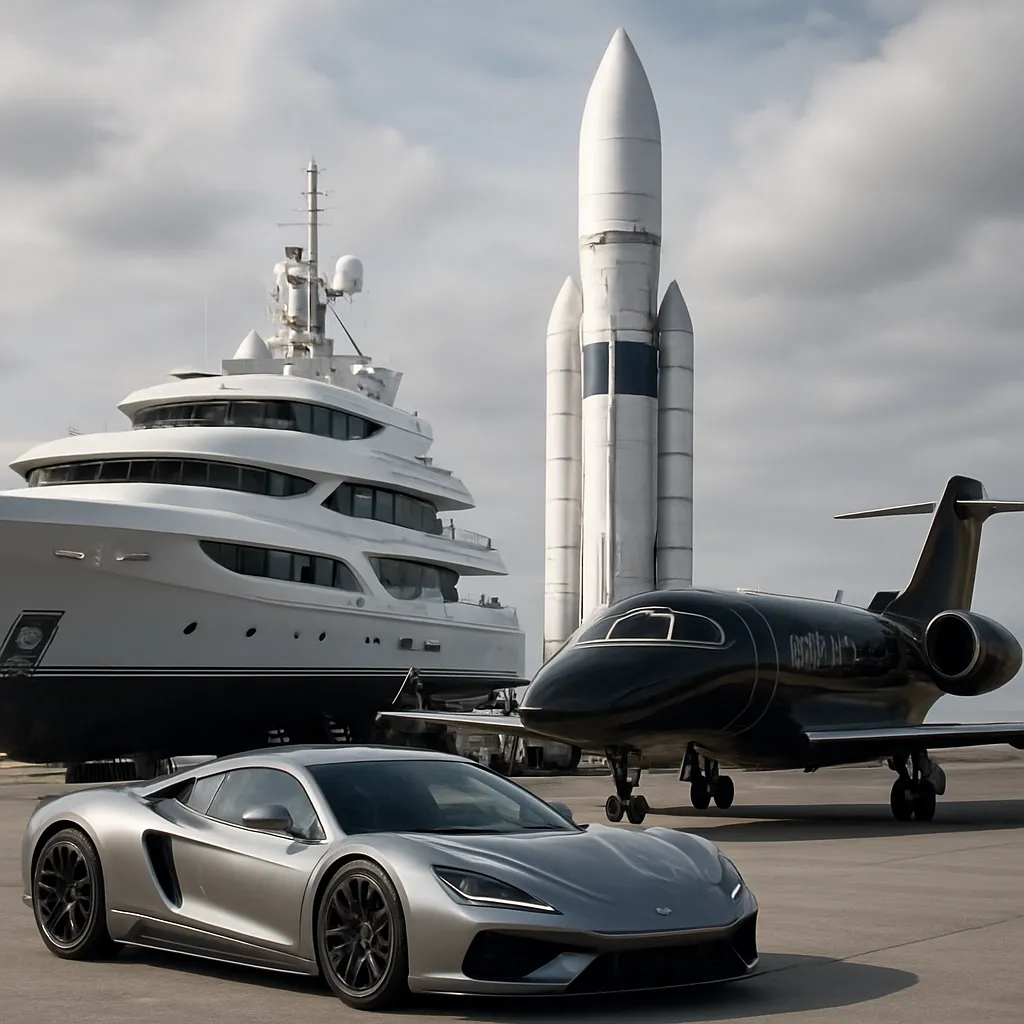
From colossal tunneling giants that carve through bedrock to leviathan sea platforms that float on the waves, the world of industrial machinery showcases some of the most awe-inspiring feats of human engineering. These behemoths are not merely symbols of human ambition; they represent leaps in technology, massive investment, and relentless pursuit of precision in the heart of our most demanding industries. Beyond their staggering price tags, these machines redefine what is possible in sectors ranging from underground excavation to deep-sea drilling, from aerospace assembly to fundamental physics research.
The Rise of High-Cost Industrial Equipment
The momentum behind the manufacture of ultra-expensive machines gathered pace during the late 20th century, as advances in materials science, computer-aided design, and control systems converged. Companies discovered that for large-scale projects—whether constructing a cross-continental railway tunnel or harvesting hydrocarbons in remote oceanic regions—off-the-shelf equipment proved insufficient. Custom solutions, built to exacting specifications, quickly outstripped conventional machinery in both capability and cost. Governments and corporations, driven by the promise of increased efficiency and strategic advantage, poured billions into the development and procurement of bespoke machines that blurred the lines between mechanical marvel and technological wonder.
Take, for example, the evolution of tunneling machines. Early tunnel-boring machines (TBMs) could manage only a few meters per day through soft soil. Today’s giants can grind through solid rock while installing concrete lining rings in a continuous process, delivering both speed and structural integrity. Achieving such integration demands extensive research, complex hydraulics, and advanced computing—all ingredients that drive up the final price tag into the hundreds of millions of dollars.
Key Factors Driving Machine Prices
Understanding why certain machines command astronomical prices requires an appreciation of the multiple variables at play:
- Customization: Machines built for unique environments or tasks must be engineered from the ground up.
- Research and Development: Prototyping, testing, and refining novel components can take years and cost vast sums.
- Materials: Specialized alloys, composites, and radiation-hardened electronics come with premium costs.
- Certification: Rigorous safety, environmental, and performance standards can add legal and engineering overhead.
- Logistics: Transporting behemoth parts to remote sites often involves chartering heavy-lift vessels or building custom roads.
- Installation and Training: On-site assembly, commissioning, and workforce training are integral parts of the budget.
Each factor multiplies the baseline manufacturing expense. For instance, welding a single tunnel segment may be trivial in a factory environment, but transporting and installing that segment under an active city street elevates the challenge—and the cost—to a completely different order of magnitude.
Notable Examples of the Most expensive Machines
Bagger 293
Regarded as the world’s largest terrestrial vehicle, Bagger 293 is a walking dragline excavator used in German mining operations. Weighing almost 14,000 tons, its bucket alone can scoop over 200 cubic meters of soil in one pass. The total cost, including customization for continuous operation and dust suppression systems, reaches upwards of $100 million.
Large Hadron Collider
Located beneath the Franco-Swiss border, the Large Hadron Collider (LHC) is the crown jewel of particle physics research. Spanning 27 kilometers of superconducting magnets cooled to near absolute zero, its construction cost is estimated at around $10 billion. This machine’s mission: probing the most fundamental particles of the universe.
Airbus A380 Final Assembly Line
While individual A380 jets each cost roughly $400 million, the actual assembly complex—a network of automated production cells, precision jigs, and robotic arms—is a multibillion-dollar investment. This sprawling facility exemplifies how plant infrastructure can rival the value of the machines it outputs.
Prelude FLNG Platform
The world’s largest floating liquefied natural gas facility, Prelude FLNG, measures 488 meters in length and cost approximately $12.6 billion. Equipped with cryogenic processing trains, storage tanks, and dynamic positioning systems, it extracts and processes gas directly at sea, eliminating the need for lengthy pipelines.
IBM Roadrunner
Once the fastest supercomputer on Earth, Roadrunner combined standard Opteron processors with custom IBM CELL chips to surpass a petaflop of processing power in 2008. With development, installation, and energy infrastructure costs, its price soared above $100 million. Its legacy continues to influence designs in high-performance computing.
The Impact on production and innovation
When industries deploy these leviathans, the ripple effects are profound. In mining and tunneling, faster excavation rates translate into shorter project timelines and reduced labor costs. In energy extraction, platforms like Prelude FLNG open previously inaccessible reserves, reshaping geopolitical dynamics. High-end supercomputers accelerate breakthroughs in drug discovery, materials research, and climate modeling. Across sectors, these machines form the backbone of modern manufacturing, enabling levels of throughput and consistency unreachable by human hands alone.
Moreover, the presence of such equipment spurs complementary industries. Suppliers of advanced sensors, software firms specializing in predictive analytics, and specialized maintenance providers all thrive in ecosystems built around these titans. This network effect amplifies the original investment, creating clusters of innovation and employment around major projects.
Future Trends in High-Cost Machinery
Digital Twins and IoT Integration
The next wave of expensive machines will feature fully realized digital twins—virtual replicas that mirror every aspect of a machine’s performance and wear in real time. Coupled with Internet of Things (IoT) sensors, operators can predict failures, optimize workflows, and schedule maintenance long before any physical fault arises.
Advanced Materials and Additive Manufacturing
Breakthroughs in 3D printing now allow components with complex lattice structures to be fabricated from high-performance alloys, reducing weight while maintaining strength. These materials, once prohibitively expensive, are becoming integral to aerospace and energy sector machinery, further driving up initial costs but lowering lifecycle expenses.
Autonomy and robotics
Fully autonomous heavy machinery, from self-driving haul trucks in open-pit mines to robotic arms that assemble spacecraft modules, is rapidly moving from concept to reality. These systems require elaborate sensor suites, fail-safe controls, and AI-driven decision engines, each contributing to the multi-million-dollar price tags.
Sustainability and Energy Efficiency
As environmental regulations tighten, future platforms will integrate green technologies—hybrid powertrains, carbon capture modules, and renewable energy interfaces. While the R&D overhead is immense, these features will become standard in next-generation equipment, redefining the calculus of long-term project viability.
In sum, the saga of the most expensive machines ever manufactured is not only a testament to human ingenuity but a window into the evolving landscape of industry itself. These behemoths, though few in number, serve as cornerstones for the world’s largest projects and as catalysts for the next era of technological progress.