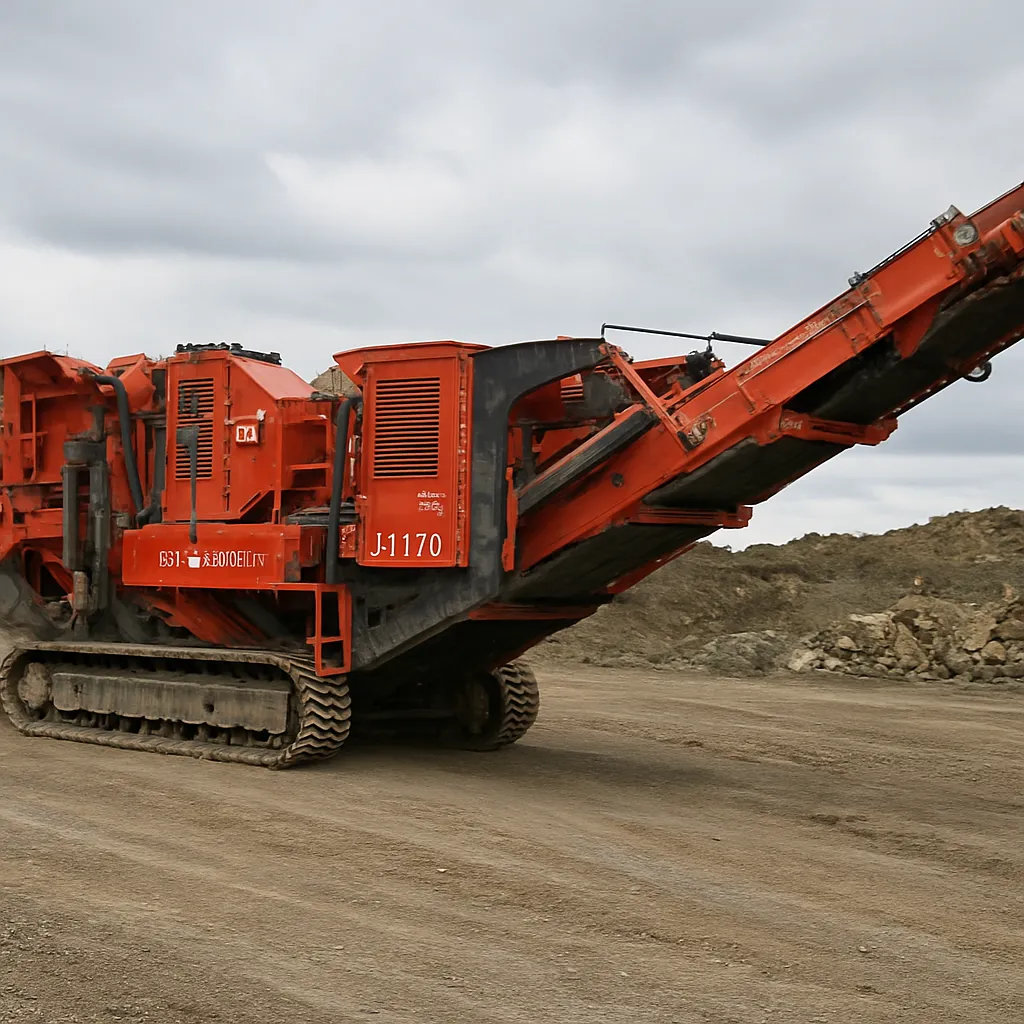
The Terex Finlay J-1175 is a widely recognized example of a purpose-built, tracked **mobile crusher** designed to bring high-capacity primary crushing to sites where mobility, rapid setup and operational flexibility are required. Combining robust jaw technology with a proven chassis and user-friendly controls, the J-1175 is used across a broad range of industries — from quarrying and mining to demolition and recycling. This article explores its design, applications, performance characteristics, maintenance needs, environmental and economic aspects, and practical advice for operators and fleet managers.
Overview and key features
The Terex Finlay J-1175 is engineered as a compact but powerful primary jaw crusher, offering on-board screening and feeding systems that make it a self-contained unit ready for immediate deployment. The machine is often described as compact yet powerful mobile jaw crusher, capable of handling hard rock, aggregate, and concrete with minimal site preparation.
- Mobility: The J-1175 is track-mounted, allowing it to move around sites under its own power. This reduces the need for heavy lifting equipment and shortens setup times.
- Versatility: It can be used in quarrying, mining, recycling, and construction demolition, often switching between applications with minor adjustments.
- Productivity: Designed to deliver high throughput while maintaining consistent product size and quality.
- Reliability: Built with proven jaw crushing geometry and durable wear components to withstand abrasive materials and heavy-duty use.
- Ease of maintenance: Accessible service points, hydraulic functions for setting adjustments, and modular components make routine maintenance straightforward.
The machine typically integrates a heavy-duty vibrating grizzly feeder, a large jaw chamber, a hydraulic drive system for the conveyor and feeder, and a folding conveyor for discharge. Optional features frequently include a prescreen or fines conveyor, magnetic separation, and dust suppression systems.
Primary applications and industry uses
The J-1175’s design lends itself to a range of site environments and operational goals. Typical applications include:
- Quarrying—primary crushing of blasted rock to produce a primary aggregate fraction for further processing.
- Construction and demolition recycling—processing concrete, masonry and asphalt for reuse as base material or recycled aggregate.
- Small to medium mining operations—as a first-stage crusher for extracting workable aggregate from ore-bearing materials.
- Road building and civil engineering—producing consistent feed for secondary screens and crushers on site, enabling quicker project progress.
- Remote or temporary operations—where portability and rapid redeployment minimize logistics and downtime.
Because the unit is self-contained, it is particularly suitable for operations where space is limited, access is constrained, or the job requires frequent relocation. Contractors working on urban demolition projects or infrastructure upgrades often value the machine’s ability to reduce haul-away costs by converting demolition material into reusable aggregate on site.
Technical specifications and performance characteristics
Exact specifications vary by production year and optional configuration, but several performance characteristics are commonly cited for the J-1175. These should be treated as representative ranges that depend on material hardness, feed gradation, setting adjustments, and on-site conditions:
- Feed opening / jaw size: Commonly in the range of approximately 1,100 mm x 750 mm (approx. 43″ x 30″)—sized to accept sizeable rock and demolition rubble.
- Throughput: Typical production rates can range widely, roughly from 100 to 350 tonnes per hour depending on material type, feed size and jaw setting. Applications with softer material and wider settings often reach the higher end of this band.
- Reduction ratio: Jaw crushers like the J-1175 commonly provide first-stage reduction ratios of up to 6:1, producing a nominal product suitable for secondary processing.
- Engine power: Mobile units of this class are commonly powered by diesel engines in the 150–300 kW range (approximate), providing the necessary torque for crushing and conveyors while balancing fuel consumption.
- Stockpile height: Folding conveyors and optimized discharge angles typically allow stockpiles of several meters in height, enabling efficient material management on site.
- Weight and transport dimensions: The tracked chassis keeps overall transport weight within a mobility-focused class, allowing transport on a low-loader without extensive disassembly in many cases. Exact weights fall into the medium mobile crusher category and depend on options fitted.
Operational parameters that directly influence performance include the jaw setting (which controls finished product size), feed gradation (smaller and consistent feed yields higher throughput), and the degree of prescreening (a fines conveyor or prescreen can remove clay and dust to prevent choking). The machine’s hydraulically adjustable feed system and automated controls help operators maintain optimal performance.
Design details that influence on-site performance
Several design decisions in the J-1175 focus on maximizing uptime and simplifying operation:
- Heavy-duty jaw box and toggle arrangement for even load distribution and long life of wear parts.
- Vibrating grizzly feeder with variable speed control to optimize feed rates and reduce blockages.
- Hydraulic jaw setting adjust for rapid changeover between product sizes without manual shimming.
- Wide feed inlet and robust hopper design to accept large, irregular feed material.
- Quick-release jaw die retention systems on many units to reduce time needed for replacements.
Operation, best practices and safety
To achieve reliable performance and safe operation with a J-1175, the following practices are widely recommended:
- Conduct a thorough pre-start inspection: check hydraulics, tracks, jaw chamber, conveyors, and emergency stops before each shift.
- Choke-feed the jaw where possible: steady, even feeding minimizes shock loads and enhances the quality of the crushed product.
- Use prescreening to remove fines: a prescreen or fines conveyor reduces dust, prevents overloads and increases throughput efficiency.
- Keep clearance and safety zones: ensure personnel are trained on safe distances around operating machinery and on emergency procedures.
- Log operating hours and maintenance activities to track wear part replacement intervals and plan preventive maintenance.
Operational controls on modern J-1175 units may include remote control systems, automated overload protection, and intuitive operator panels that simplify monitoring of engine parameters, hydraulic pressures, and belt speeds. Such systems increase safety and give operators the tools to make on-the-fly adjustments that align performance with changing site conditions.
Maintenance, wear parts and common issues
Wear on jaw dies, cheek plates, toggle assemblies and conveyor belts represent the most frequent maintenance considerations. Key points for maintenance planning:
- Jaw dies: Monitor liner wear patterns and replace in matched pairs to maintain crusher balance and product quality.
- Toggle and bearings: Inspect regularly for fatigue and lubrication issues; bearings under high loads need scheduled attention.
- Belts and idlers: Ensure belt tracking is correct and idlers rotate freely; foreign material build-up can accelerate wear.
- Hydraulic lines and cylinders: Check for leaks, abrasions and proper hose routing to prevent sudden failures.
- Undercarriage and tracks: Regular inspection and tension adjustments extend track life and reduce downtime.
Preventive maintenance schedules typically tie to operating hours or production tonnage. Many operators keep spare jaw dies, toggle plates, belts and hydraulic hoses on site to limit downtime in the event of wear or damage. Periodic inspections of frame welds and chassis components are also prudent when operating in highly abrasive quarry environments.
Environmental and economic considerations
Using a mobile crusher like the J-1175 can have both environmental and economic advantages when deployed appropriately.
- Recycling and waste reduction: Crushing demolition material on site reduces the need for landfill disposal and cuts transport-related emissions, while producing recycled aggregate for reuse.
- Lower logistical costs: On-site crushing reduces truck haul distances and associated costs, potentially shortening project timelines.
- Fuel consumption and emissions: The diesel engine is a significant operating cost. Balancing engine load and using engines with modern emissions controls can reduce fuel costs and environmental impact.
- Noise and dust mitigation: Fitted dust suppression and strategically placed acoustic measures lower the environmental footprint and improve neighbor relations on urban sites.
Economically, the return on investment for a J-1175 will depend on utilization rate, cost of wear parts, fuel prices and how much material processing it replaces or reduces. In many recycling or demolition scenarios, savings from reduced haulage and purchase of virgin aggregate can justify the machine rapidly.
Options, attachments and upgrades
Terex Finlay and aftermarket suppliers offer a number of options to fit the J-1175 to specific tasks:
- Prescreen and fines conveyor—removes material below a chosen size before it reaches the jaw, improving throughput and product control.
- Magnetic separator—extracts rebar and ferrous contaminants from recycled concrete.
- Dust suppression systems—fixed or mobile spray systems to reduce airborne particulates.
- Variable speed conveyors—allow operators to match belt speeds to material flow and stockpile needs.
- Remote control and telematics—provide easier operation and remote machine monitoring for fleet management and preventive maintenance.
Enhancements that improve uptime and reduce operational costs, such as quick-change jaw die systems and improved hydraulic filtration, are commonly selected to optimize lifecycle economics.
Market availability, buying and renting considerations
The J-1175 is offered both new and used through Terex Finlay dealers and a broad secondary market. Key considerations when acquiring or renting:
- New vs used: New units offer the latest emissions controls and warranty coverage; used units can be significantly less expensive but require careful inspection for wear and maintenance history.
- Resale value: Well-maintained units from established manufacturers like Terex Finlay have comparatively strong resale value due to dealer support and parts availability.
- Rental market: The J-1175 is popular in rental fleets for projects needing short-term crushing capacity. Hourly or daily rental can be cost-effective for intermittent work.
- Total cost of ownership: Consider fuel, wear parts, transport, and operator training when calculating lifecycle costs.
When inspecting a used unit, review service logs, check jaw and conveyor wear, and confirm that electronic or remote systems are functioning. A factory or certified dealer inspection can uncover hidden issues and provide negotiation leverage.
Case studies and practical examples
Real-world deployments highlight the machine’s adaptability:
- A demolition contractor in an urban environment used a J-1175 to crush concrete and brick on site, converting material into base course for road resurfacing. This reduced truck movements by 60% and cut material disposal costs substantially.
- A small quarry operator employed the J-1175 as a primary crusher during peak seasons, pairing it with a secondary cone crusher. The mobility allowed for rapid repositioning between excavations and saved several days of downtime during seasonal moves.
- A municipal road works program used a J-1175 for asphalt and rubble processing on multiple short-term projects, relying on the unit’s quick setup and foldable conveyors to operate efficiently in tight city locations.
These examples illustrate that the greatest operational benefit is realized when the machine’s mobility and on-board systems are matched to site logistics and material characteristics.
Summary and practical recommendations
The Terex Finlay J-1175 represents a balanced solution for operators needing a mobile, dependable, and relatively compact primary jaw crusher. Its strength lies in its mobility, strong primary crushing performance and adaptability through a range of optional configurations.
- For best results: match jaw settings and feed gradation to your desired product and secondary crushing needs.
- Invest in prescreening where fines and dust are significant—this will improve throughput and reduce wear.
- Maintain a spare parts inventory of high-wear items to minimize downtime in remote operations.
- Consider telematics and remote monitoring to maximize uptime and optimize maintenance scheduling.
When evaluating the J-1175 for purchase or rental, weigh the operating environment, expected tonnage, and the balance between capital expenditure and operational savings. Properly specified and well-maintained, the J-1175 can deliver robust, flexible crushing capability that supports efficient project delivery and material recycling efforts.
Mobility Versatility Productivity Jaw Throughput Feed Hydraulically Reliability Fuel Maintenance


)
)