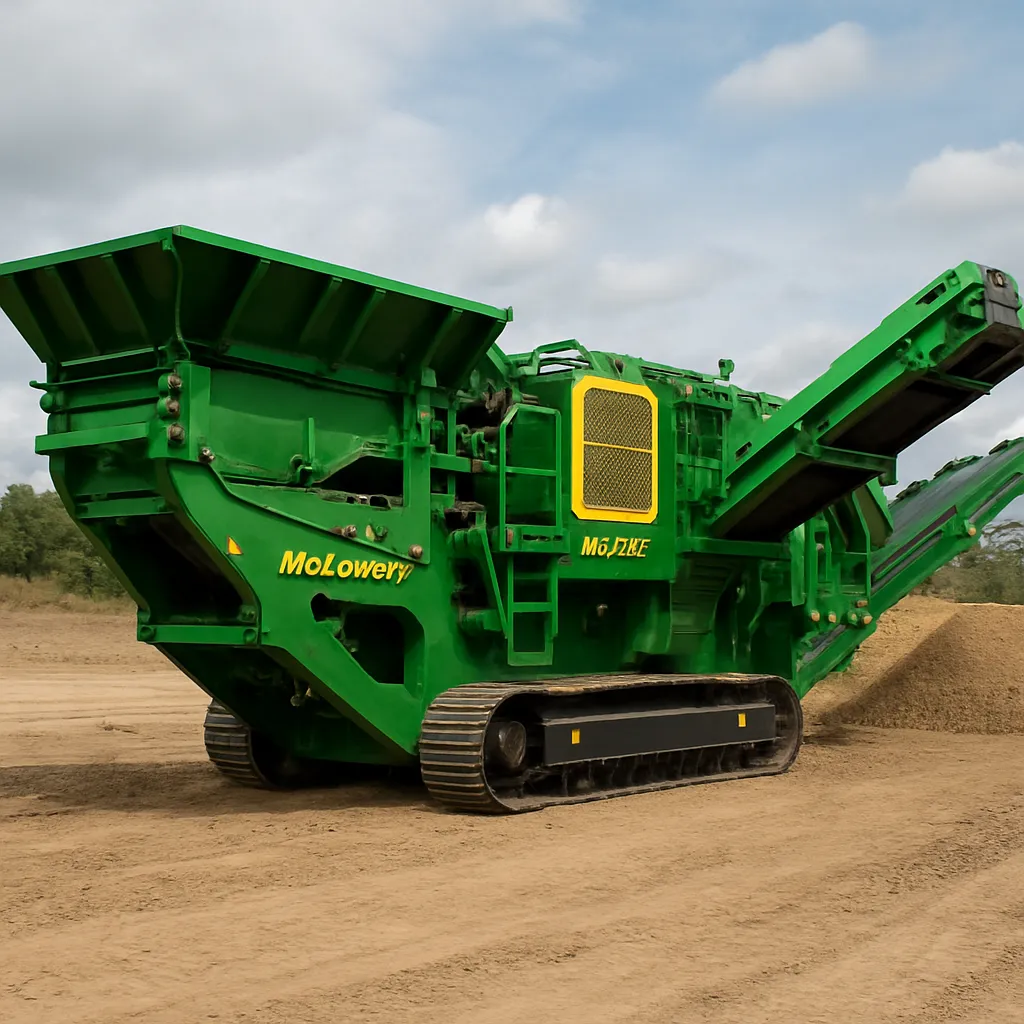
The McCloskey I44v3 is a compact yet powerful mobile impact crusher designed to meet the needs of quarrying, recycling, and contract crushing operations. Combining modern engineering, improved hydraulics and user-friendly controls, this machine aims to deliver consistent product quality while maximizing uptime and operational flexibility. Below you will find an in-depth overview of the machine, its typical applications, main technical considerations, operational tips and market context.
Overview and design philosophy
The I44v3 is part of McCloskey’s line of impactors optimized for medium-to-large scale jobs where product specification and on-site flexibility are essential. The design philosophy prioritizes a balance between mobility, durability and ease of service. The unit is built as a tracked, self-contained plant that can be transported between sites with minimal site preparation. Key elements of the design include a robust impact crusher chamber, recirculating conveyor and integrated screening or pre-screening options to produce a range of final products.
Primary applications and use cases
Because of its impact-style crushing action, the I44v3 is particularly well suited to the following applications:
- Aggregate production — crushing limestone, sandstone, and other aggregates to produce various size fractions for construction use.
- Recycling — processing concrete and asphalt demolition material to recover reusable aggregate and reduce disposal costs.
- Secondary and tertiary crushing — producing shaped, cubical products for high-spec concrete and asphalt blends.
- Quarry infill and remediation projects where flexible, mobile equipment is preferred over fixed plants.
- Specialty materials — where impact crushing yields desirable particle shape and fines characteristics compared to compression crushing.
In recycling and demolition work the I44v3 shines because of its ability to accept contaminated feed (rebar, reinforcing mesh) if pre-sorted, and because the impact chamber can produce a high percentage of cubical, saleable material. Many contractors rely on the I44v3 for on-site concrete recycling, allowing re-use of material and reducing transport costs and environmental impact.
Key features and technical highlights
The I44v3 introduces improvements over earlier generations to enhance performance and serviceability. The following technical highlights describe what operators and fleet managers typically value:
- Impact chamber design — engineered to provide consistent reduction and particle shape; wear parts (blow bars and impact aprons) are designed for quick replacement to minimize downtime.
- Variable rotor speed (on many configurations) — allows operators to tune product gradation and capacity depending on feed material and desired product.
- Recirculating conveyor — improves control over final product size by allowing oversized material to pass back to the crusher for further reduction.
- Integrated pre-screen options — reduce fines entering the impact chamber, improving efficiency and lowering wear part consumption.
- Hydraulic folding conveyors and compact transport dimensions — ease site setup and reduce transport costs between jobs.
- User-friendly controls — remote or cab-mounted control panels that enable on-the-fly adjustments and diagnostic checks for quicker troubleshooting.
- Robust chassis and undercarriage — designed for tough jobsite conditions while maintaining mobility and stability during operation.
Performance and operational statistics (typical ranges)
Performance of any impact crusher is highly dependent on feed material, feed gradation, desired product specification and operator settings. Below are typical performance ranges for a machine of this class; these should be treated as indicative rather than absolute figures.
- Typical throughput: 150–450 tonnes per hour (material-dependent; harder or sticky materials tend to reduce throughput).
- Feed size capability: typically up to 600–700 mm maximum single piece size in many working configurations, although recommended maximum feed is often smaller for efficient operation.
- Final product sizes: adjustable via rotor speed, blow bar selection and gap settings — commonly producing product sizes from 0–75 mm across various fractions when used with screening / recirculating options.
- Fuel consumption: varies by engine option and working intensity — typical diesel fuel usage for this class under load is in the region of 20–60 L/h, depending on engine size and application.
- Typical weights and transport dimensions: mobile impactors like the I44v3 often weigh in the range of 25–40 tonnes and are engineered for highway transport with folded conveyors; exact figures depend on options and attachments.
These ranges reflect what operators experience in mixed conditions. In softer or more friable materials, throughput may be at the higher end; with abrasive or highly recycled mixed demolition material, throughput and wear life will be lower.
Maintenance, wear parts and lifecycle costs
One of the most critical aspects of operating an impact crusher is management of wear parts and planned maintenance. The I44v3 emphasizes fast access for service to reduce downtime and lifecycle costs. Important considerations include:
- Blow bars and impact aprons — primary wear parts; material selection (e.g., martensitic vs. other alloys) impacts wear life and product quality. Having an inventory of common blow bars on-site is recommended for rapid replacement.
- Rotor maintenance — regular inspection for balance and wear; small unbalanced conditions can lead to vibration and premature bearing wear.
- Hydraulic system checks — ensure hoses, filters and fluids are changed at recommended intervals to avoid unexpected failures.
- Conveyor belt and pulley life — belts should be inspected for tracking, wear and splicing integrity; pulleys and idlers must be kept clean of buildup to avoid premature failure.
- Pre-screen decks and under-pan clearing — keeping the feed area free of contamination avoids choking and reduces wear in the impact chamber.
Operators who implement preventative maintenance schedules and monitor wear consumption typically see lower total operating costs compared to reactive-only maintenance. McCloskey and authorized dealers usually provide maintenance packages and recommended spare parts lists tailored to operating conditions.
Safety, controls and operator ergonomics
Modern mobile plants like the I44v3 integrate safety features and ergonomic design to protect workers and simplify operation. Common safety and control aspects include:
- Emergency stop systems and lock-out procedures to protect service personnel during maintenance.
- Guarding around moving parts, with easy-to-open access panels for authorized maintenance.
- Remote start/stop and diagnostics — reducing the need for operators to be close to moving machinery during setup and adjustment.
- Clear sightlines and access walkways — designed so technicians can reach wear components without awkward positioning.
- Intuitive control consoles — providing load and performance data that helps operators optimize throughput and minimize wear.
Environmental considerations and recycling benefits
The I44v3 supports sustainability goals in several ways. Using mobile impact crushers on demolition sites enables immediate on-site recycling of concrete and asphalt, significantly reducing the need to transport waste to landfill or remote crushing facilities. Benefits include:
- Lower transport-related emissions by reducing truck movements and enabling direct reuse of crushed material on-site.
- Reduction in virgin aggregate demand by generating high-quality recycled aggregate suitable for many construction applications.
- Efficient separation of fines and inert material when paired with screening, which can improve material reuse rates.
- Option for dust suppression systems and compliant exhaust controls to minimize site-level environmental impact.
Contractors and municipalities increasingly favor mobile crushers as part of circular-economy strategies that keep materials in use and reduce resource extraction.
Operational tips for maximizing performance
Experienced operators can significantly improve machine productivity and lifespan by following a few practical tips:
- Feed the crusher with evenly distributed material and avoid large surges that cause blockages or shock loading.
- Use pre-screening to remove fines and organics that consume unnecessary wear life for the impact chamber.
- Match blow bar profiles and rotor speed to the target product — coarser blow bars and lower rotor speeds often produce more cubical product with less fines for certain materials.
- Maintain consistent feed gradation — variable feed sizes reduce predictability and efficiency.
- Keep a log of wear part consumption and operating hours — over time this helps predict service intervals and plan spare parts procurement for cost savings.
Comparisons with alternative crushing approaches
When selecting equipment, it is useful to compare impact crushers like the I44v3 with jaw and cone crushers. Main comparative points:
- Impact crushers generally produce more cubical-shaped product and are preferred where particle shape is critical (e.g., asphalt, high-spec concrete).
- Jaw crushers are robust for primary reduction of very hard, abrasive rock but often produce more elongated particle shapes, requiring further processing for high-spec aggregate.
- Cone crushers are efficient for secondary and tertiary crushing of hard rock, offering fine gradation control but typically costing more per tonne to operate in certain recycling scenarios.
- Impactors offer greater versatility for processing mixed and recycled materials and can combine crushing and shaping in one unit when properly configured.
Market context and practical deployment examples
Mobile impact crushers have grown in popularity across construction, demolition and quarrying because they reduce the need for fixed plants, accelerate project timelines and allow contractors to react to site-specific challenges. Typical real-world deployments for the I44v3 include:
- Road construction projects where recycled asphalt and concrete crushed on-site are re-used as base or sub-base.
- Urban demolition sites where tight logistics and environmental constraints make on-site crushing the most cost-effective option.
- Aggregate producers using a mobile impactor to produce shaped products for specialty markets without investing in a full stationary plant.
Case studies from operators commonly report that using a mobile impact crusher reduces material handling costs, shortens supply chains and can result in payback periods measured in months rather than years when used intensively on large projects.
Purchasing considerations and aftermarket support
When evaluating an I44v3 or similar machine for purchase or hire, consider:
- Scope of dealer and manufacturer support in your region — prompt parts and service availability is vital to keep uptime high.
- Warranty and service packages — many suppliers offer extended support plans that can be financially attractive for high-hour operations.
- Availability of wear parts and the ability to retrofit or update components — look for modular parts that simplify field replacement.
- Transport and setup costs — confirm transport dimensions and whether special permits are necessary between sites.
- Resale value — machines from established manufacturers with good service records typically retain higher resale values.
Final notes on suitability and return on investment
The McCloskey I44v3 is a strong choice where versatility, product quality and mobility matter. Companies that extract the most value from such a machine generally combine disciplined maintenance practices, skilled operator training and good logistical planning. While exact financial returns depend on local material values, transport costs and utilization rates, typical users find that on-site crushing with a mobile plant can substantially lower overall project costs by reducing haulage, enabling material reuse and increasing control over final product grading.
Useful checklist before deploying an I44v3
- Confirm feed material type and expected maximum lump size.
- Decide on required product gradation and whether pre-screening is needed.
- Ensure planned site layout accommodates feed hopper truck access and discharge conveyors.
- Plan for wear part stocking and a maintenance schedule based on expected operating hours.
- Verify emissions and noise requirements for the jobsite and confirm that the machine configuration meets local regulations.
The McCloskey I44v3 combines mobile convenience with the crushing characteristics of a high-performance impactor, making it a popular tool for contractors, recyclers and quarry operators who need a flexible, serviceable and efficient solution. With informed selection, careful operation and proactive maintenance, the machine can be a central asset in delivering consistent, saleable material while supporting sustainable, on-site recycling practices.


)
)