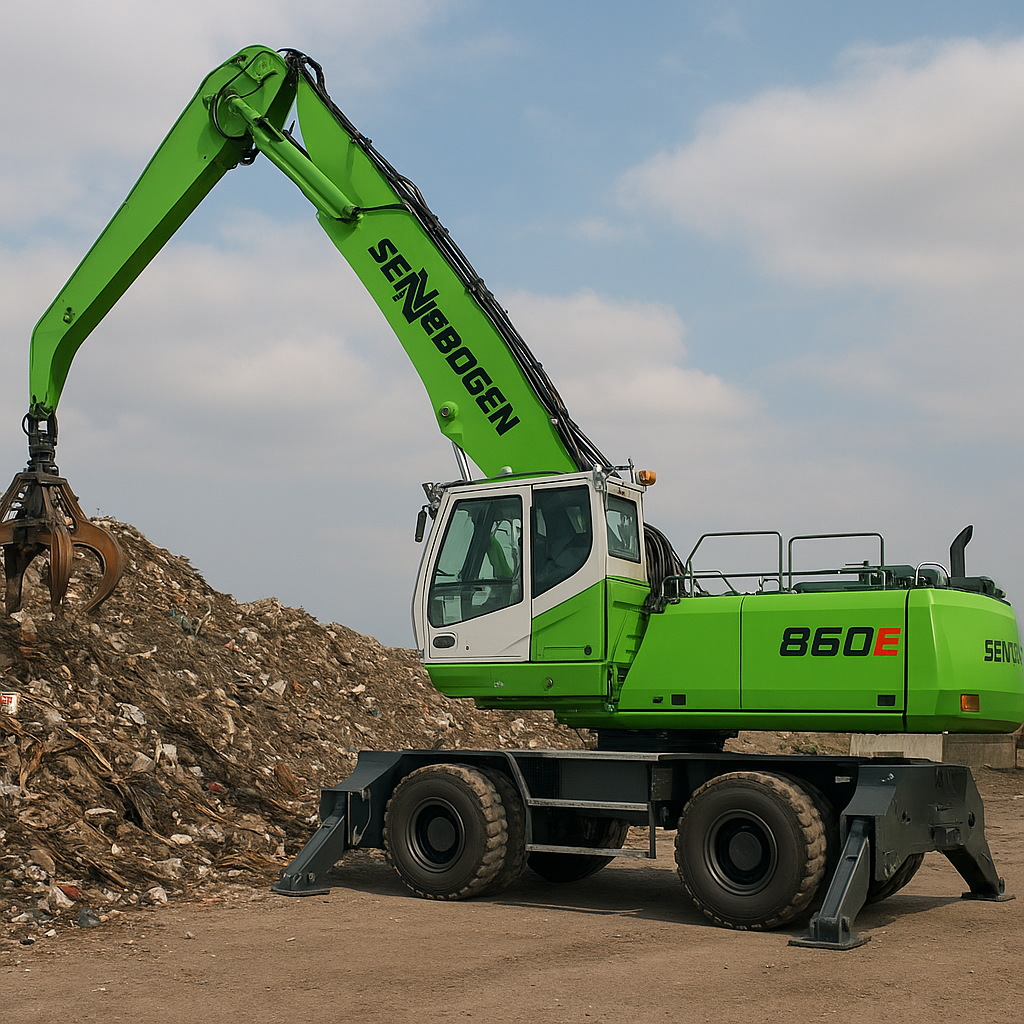
The SENNEBOGEN 860 E is a versatile and robust material handler designed to meet the demanding requirements of ports, scrap yards, recycling facilities and heavy bulk handling operations. Combining proven SENNEBOGEN construction with options for advanced powertrains and a wide range of attachments, the 860 E delivers high productivity, long reach and operator-focused ergonomics. This article describes the machine’s technical characteristics, common applications, operational benefits and practical considerations for owners and fleet managers.
Design and technical features
The SENNEBOGEN 860 E belongs to the family of large-purpose-built material handlers engineered for continuous heavy-duty work. Although exact specifications depend on configuration and attachments, the 860 E is typically offered with a choice of undercarriages (crawler or carrier), multiple boom and stick combinations to vary reach and lifting characteristics, and diverse attachment options such as grapples, clamshell buckets, magnets and shears.
Powertrain and driveline
- The 860 E is available in diesel-powered and electrically driven variants depending on market requirements and site infrastructure. The “E” in the model name is commonly associated with SENNEBOGEN’s emphasis on efficiency and, in some markets, electric or hybrid drive options.
- Diesel configurations typically use Tier 4 / Stage V compliant engines from established manufacturers, tuned for high torque and stable performance during continuous loading cycles.
- Electric or hybrid variants reduce on-site emissions and noise when connected to a power supply or when used as plug-in solutions in port and indoor environments where low emissions are essential.
Hydraulics and control systems
Hydraulics are a key element of the 860 E’s performance. The machine uses robust piston-pump systems and optimized hydraulic circuits for smooth, precise control and high breakout forces required for handling heavy scrap, bulk materials and containers. Modern control electronics provide load sensing, power management and automatic functions that improve cycle times and reduce fuel consumption. Typical control features include:
- Load-sensing hydraulics to deliver power only where needed
- Proportional valve control for fine movement and low-speed precision
- Integrated telematics options for remote monitoring of machine hours, fuel use and maintenance alerts
Chassis, boom and reach
The chassis options (crawler or wheeled carrier) determine mobility and site suitability. Crawler undercarriages provide excellent stability for heavy lifts and rough terrain, while carrier undercarriages allow faster repositioning on paved port aprons or industrial yards. Boom and stick combinations are modular, enabling configurations that prioritize reach or lift capacity. Typical ranges for machines in this class are:
- Working reach: commonly between 10 m and 20 m (varies with boom/stick choice)
- Lifting capacity: higher at short radii (often several tonnes) with decreasing capacity at maximum reach
- Operating weight: generally in the medium-to-large material handler class (depending on attachments and ballast)
Cab and operator ergonomics
Operator comfort and visibility are crucial for productivity and safety. The 860 E features a field-proven cab layout with panoramic glazing for clear sightlines, ergonomic seat and joystick controls, HVAC, and sound insulation to reduce operator fatigue during long shifts. Modern cabs often include:
- Multi-function joysticks with programmable attachment controls
- High-resolution displays for camera feeds, diagnostics and system information
- Integrated operator-assistance systems such as overload protection and work area limiters
Applications and industries
The SENNEBOGEN 860 E is tailored to tasks where precise, continuous material movement and handling of heavy or awkward loads are required. Key sectors include:
Ports and container terminals
In port operations the 860 E is used for bulk cargo handling, palletized goods, scrap loadouts, and container handling when fitted with specialized attachments. The machine’s reach, stability and optional electric operation make it ideal for quayside work where emissions and noise restrictions may apply. Typical tasks include loading/unloading ships, moving bulk aggregates, and placing cargo onto trucks and stockpiles.
Scrap yards and metal recycling
Scrap handling is a principal application for the 860 E. Equipped with powerful grapples or orange-peel attachments, the machine efficiently sorts, stacks and loads ferrous and non-ferrous scrap. Key advantages in scrap yards are its heavy-duty construction, reliable hydraulics and excellent visibility for safe material picks. When fitted with a magnet, the 860 E is capable of fast, high-volume ferrous separation operations.
Waste and recycling facilities
In municipal and industrial recycling centers the 860 E facilitates the movement of bulky waste streams, oversize loads and baled materials. Low-emission electric variants are particularly useful in enclosed or noise-sensitive environments. The machine’s precision allows operators to pick and place materials efficiently for downstream processing.
Demolition and salvage
Material handlers are often preferred for selective demolition tasks where reach and controlled movements are more important than brute tearing force. With demolition attachments such as shears and grapples, the 860 E can deconstruct structures, process demolition debris and load trucks for removal.
Bulk materials and aggregate handling
The 860 E can be used in bulk terminals, aggregate yards and power plants for coal, wood chips, sand, gravel and similar materials. Clamshell buckets and large-capacity grapples allow effective management of stockpiles and ship loading or unloading tasks.
Attachments and modularity
One of the 860 E’s strengths is the broad range of available attachments and easy interchangeability, enabling operators to adapt the machine to changing tasks during a shift. Standard and specialized attachments include:
- Orange-peel grapples (multiple- and single-piece designs)
- Demolition grapples and shears for structural processing
- Electro and permanent magnets for ferrous separation
- Clamshell buckets for bulk loading and unloading
- Sorting grapples and pallet forks for port and logistics tasks
Quick-coupler systems reduce downtime when switching tools, and dedicated hydraulic circuits ensure consistent performance across different attachment types.
Performance, efficiency and statistics
While precise performance numbers for a specific SENNEBOGEN 860 E depend on the chosen configuration, attachments and working conditions, there are general performance expectations for machines in this class:
- Cycle times: optimized hydraulics and operator assistance systems can shorten loading cycles compared with older generation machines, improving tons-per-hour throughput in loading and sorting tasks.
- Fuel and energy consumption: modern diesel configurations benefit from improved fuel mapping and fuel-saving modes; electric or hybrid variants can drastically reduce local emissions and offer lower operating costs where electricity is competitively priced or provided on-site.
- Maintenance intervals: SENNEBOGEN designs emphasize accessibility for routine servicing—filters, hydraulics and greasing points are grouped to reduce downtime. Telemetry options enable predictive maintenance based on actual usage data.
Available industry data (general trends rather than model-specific figures):
- Material handlers converted to electric operation in port applications have demonstrated significant reductions in local particulate emissions and noise; in several documented installations, operators report noise reductions of 5–10 dB and elimination of on-site diesel exhaust.
- When replacing aging diesel models with modern, electronically controlled machines, fuel savings of 10–30% are commonly reported depending on duty cycle and operator technique.
- Telematics adoption across large material handler fleets has improved uptime and maintenance planning, reducing unplanned downtime by an estimated 15–25% in some operations.
Note: these figures are indicative and will vary according to configuration, site, and application. For precise specifications, consult local SENNEBOGEN dealers or the machine’s technical datasheet.
Safety and operator assistance
Safety is integral to the design of the 860 E. Important safety and assistance systems found on contemporary SENNEBOGEN handlers include:
- FOPS and ROPS cab structures for protection against falling objects and roll-over
- Load moment indicators (LMI) and stability monitoring to prevent dangerous overloads
- Rear and side cameras, 360° camera systems and ultrasonic detectors to increase situational awareness
- Automatic engine and hydraulic inhibitors for emergency interventions
- Anti-slip steps, handrails and well-lit service points for safe maintenance
These systems combine to reduce accidents, protect personnel and extend the life of the machine by preventing damaging overload events.
Maintenance, serviceability and lifecycle costs
Lifecycle costs are an important consideration for owners. The 860 E is built to allow simplified servicing and long component life, which reduces total cost of ownership. Key maintenance features include:
- Centralized maintenance points for daily checks (easy access to filters, filler points and grease nipples)
- High-quality hydraulic components and hose routing to reduce wear
- Modular components for easier replacement of wear parts and attachments
- Remote diagnostics through telematics for proactive maintenance planning
To maximize uptime, operators should follow manufacturer-recommended service intervals, use OEM parts where possible and implement operator training programs to reduce wear caused by improper use.
Environmental and regulatory considerations
Environmental performance is increasingly important for heavy equipment used in urban, port and industrial settings. The 860 E addresses these concerns in several ways:
- Electric variants eliminate tailpipe emissions and significantly reduce noise, making them suitable for enclosed or near-populated areas
- Improved diesel engine emission controls (meeting Stage V / Tier 4 Final regulations in many markets) reduce NOx and particulate emissions
- Efficient hydraulic systems reduce fuel consumption and associated CO2 emissions
Operators in regulated environments (low-emission zones, port emission control areas) will find the 860 E’s options beneficial for compliance and community relations.
Operational tips and best practices
- Match boom and stick configuration to the predominant tasks—longer reach increases flexibility but reduces lifting capacity at radius.
- Choose the right undercarriage: crawlers for rough terrain and heavy lifts; carriers for mobility on paved surfaces.
- Prioritize operator training—experienced operators can significantly improve throughput and reduce wear.
- Use telematics to monitor fuel use and idling time; set policies to reduce unnecessary idle time.
- Implement scheduled preventive maintenance to prevent costly unplanned repairs.
Purchasing considerations and return on investment
Buying or leasing a SENNEBOGEN 860 E should be evaluated against expected productivity gains, operating costs and regulatory needs. Considerations include:
- Application match: ensure the machine’s lift capacity and reach match your highest-demand tasks
- Attachment costs and flexibility: the ability to change tools quickly increases utilization
- Powertrain choice: electric options may have higher upfront costs but can lower operating costs and meet emissions targets
- Residual value: SENNEBOGEN machines generally hold good resale value when well maintained
- Financing, warranty and dealer support options offered by local distributors
Well-managed material handlers often pay back their acquisition cost through productivity gains, reduced cycle times and lower per-ton handling costs—especially in high-throughput environments like ports and scrap yards.
Comparisons and market positioning
In the market of heavy material handlers, the SENNEBOGEN 860 E competes with machines from other specialized manufacturers. Its strengths lie in build quality, comprehensive attachment options and a focus on operator comfort and serviceability. For buyers prioritizing low-emission operation, SENNEBOGEN’s electric and hybrid developments in the E-series present a strong value proposition compared with traditional diesel-only machines.
Case studies and real-world examples
Though exact project references vary regionally, typical successful deployments of the 860 E include:
- Quayside bulk handling installation replacing older diesel handlers with an electric 860 E to meet port emission regulation while improving throughput during loading of aggregates.
- Scrap yard modernization program where a fleet of 860 E handlers equipped with magnets and hydraulic grapples increased daily processed tonnage by optimizing picking sequences and reducing truck turnaround times.
- Recycling facility retrofit where an 860 E with specialized sorting grapple reduced contamination in feed streams and improved material flow to downstream processors.
Summary and final remarks
The SENNEBOGEN 860 E is a purpose-built machine for heavy, continuous handling tasks across ports, recycling centers, scrap yards, demolition sites and bulk terminals. With a focus on efficiency, modularity and operator comfort, it accommodates a wide range of attachments and powertrain options including low-emission electric variants suitable for sensitive environments. While specific technical data depends on exact configuration, prospective buyers should evaluate reach, lifting capacity, undercarriage type and attachment compatibility against their most frequent tasks. When properly specified and maintained, the 860 E can deliver significant gains in productivity, lower lifecycle costs and improved environmental performance for demanding material-handling operations.
)
)