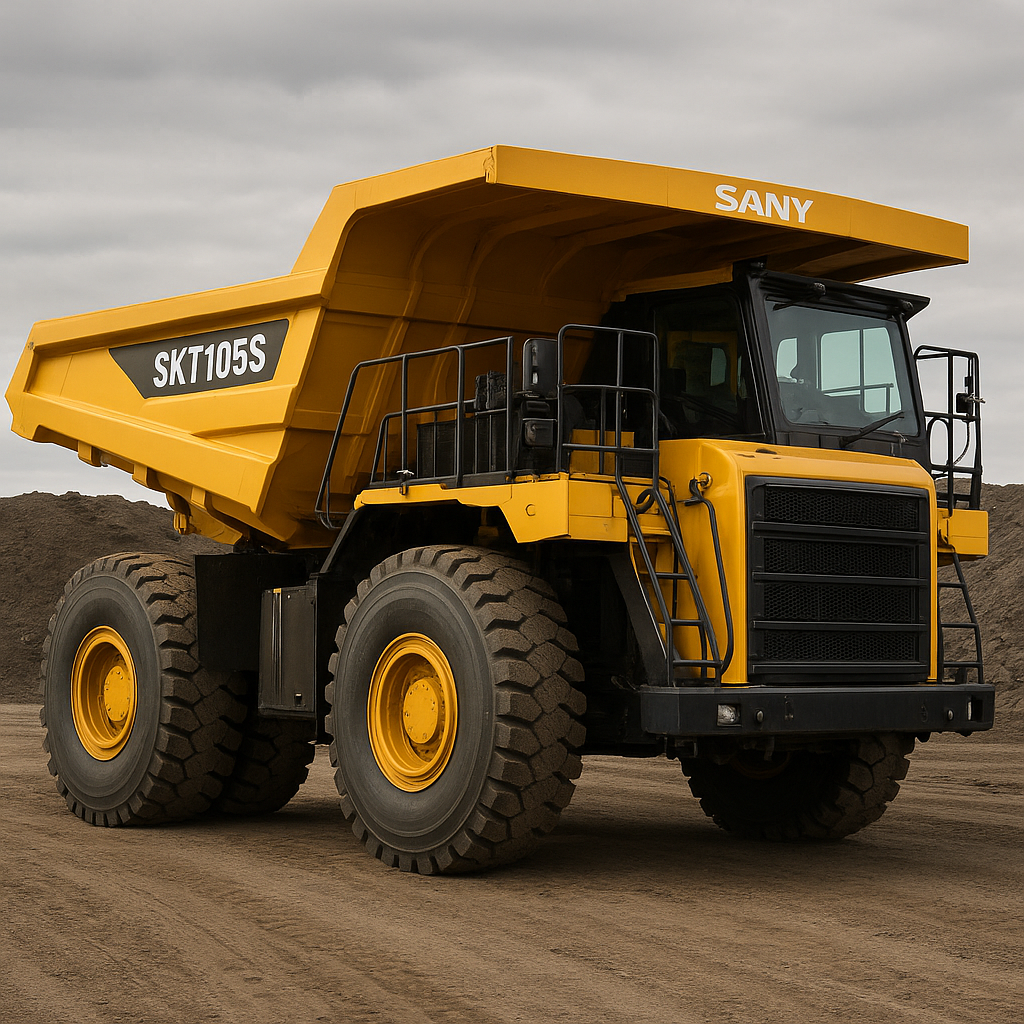
The SANY SKT105S is a purpose-built, high-capacity rigid dump truck designed for heavy-duty operations in mining and large-scale earthmoving projects. Combining robust structural design with modern powertrain and control systems, the SKT105S aims to deliver high productivity, operational resilience and cost-effective lifecycle performance. This article explores the machine’s design philosophy, typical technical characteristics, practical applications and the operational considerations that make it a competitive choice for mining fleets worldwide.
Overview and design philosophy
The SANY SKT105S was developed to meet the rigorous demands of surface mining, open-pit quarrying and large civil earthworks where bulk material must be moved reliably and efficiently. As part of SANY’s range of mining vehicles, the SKT105S emphasizes structural integrity, ease of service and adaptability to different site conditions. Its design balances high payload capability with an emphasis on operator comfort and on-board systems that support uptime and safety.
SANY has leveraged experience from other heavy-equipment product lines to create a truck that targets total cost of ownership reduction through improved component longevity and simplified maintenance. The truck’s chassis, suspension layout and body are engineered to withstand repetitive heavy loading, abrasive material and harsh environmental conditions frequently encountered in mining operations.
Key technical characteristics and typical specifications
Exact specifications for the SKT105S can vary by market and configuration, as SANY often offers engine, axle and body options tailored to regional requirements and customer preferences. Below are commonly quoted or typical values for the model class to give an approximate technical picture:
- Payload: Approximately 105 tonnes — the model number SKT105S denotes its nominal payload class, making it suitable for medium-to-large mining operations.
- Body capacity: Typically in the range of 55–75 m3 (heaped), depending on material density and body geometry.
- Engine: Multi-supplier options are common (e.g., internationally recognized diesel engines or regional equivalents). Typical power outputs for trucks of this size range from roughly 500 kW to 800 kW (670–1,070 hp), depending on emission standard, turbocharging and rating chosen.
- Drive and transmission: Heavy-duty power shift or torque-converter automatic transmissions, often coupled to robust axle assemblies optimized for high gross combination loads and steep grade capability.
- Operating weight: Empty (curb) weight and gross combination weight vary, but operating systems are engineered for repeated heavy-duty cycles; gross vehicle weight typically ranges in accordance with the 105-ton payload class.
- Suspension: Purpose-built heavy-duty suspension with reinforced components to resist fatigue, often incorporating multi-leaf springs or mechanical/hydraulic systems depending on configuration.
- Braking: Service brakes with retardation assistance — such as engine braking, exhaust braking or retarder systems — and multiple redundant circuits for safety in high-mass operation.
- Cabin: Ergonomically designed operator station with HVAC, adjustable seating, straightforward controls and visibility aids (mirrors, optional camera packages).
- Telematics and monitoring: Optional or factory-integrated fleet management systems for real-time diagnostics, fuel monitoring and preventive maintenance scheduling.
These figures serve as general guidance. Precise parameters such as maximum gradeability, turning radius, tire specification and axle ratios are provided by SANY in detailed product datasheets and can be tailored through optional packages.
Primary applications and operational roles
The SANY SKT105S is primarily intended for heavy hauling tasks in environments where continuous movement of large volumes of material is required. Typical applications include:
- Open-pit mining — transporting blasted ore and waste rock from loading zones to crushers, stockpiles or waste dumps across extensive haul roads.
- Quarrying — carrying aggregate, limestone, granite and other quarried materials within a production site.
- Large civil engineering projects — such as dam construction, major earthworks and reclamation projects that require high-volume material transport.
- Bulk handling logistics — temporary or semi-permanent heavy haul operations where modular fleets are advantageous for throughput scaling.
Because of its payload size and rugged construction, the SKT105S is best deployed on sites with appropriate haul-road design standards and support infrastructure (fueling, parts, trained technicians) to maximize utilization.
Performance, productivity and fleet integration
Productivity drivers
Performance for large haul trucks like the SKT105S is evaluated by cycle time, payload utilization and uptime. Key elements that influence productivity include:
- Payload optimization — ensuring the bed is matched to material density to avoid underloading or overloading, which affects cycle count and fuel consumption.
- Powertrain tuning — selecting engine and transmission ratings that match site gradients and haul distances to reduce fuel burn and improve cycle throughput.
- Maintenance strategy — proactive parts replacement, oil analysis and condition-based maintenance improve availability and reduce unplanned downtime.
- Operator training — skilled operators reduce wear, optimize fuel use and maintain consistent cycle times.
Fuel efficiency and emissions
Fuel consumption depends on site profile, payload, operator behavior and engine selection. Advances in engine controls, transmission efficiency and vehicle management systems can yield meaningful reductions in diesel use versus older designs. For operations where emissions regulations are strict, SANY and engine suppliers commonly offer engines compliant with local emission tiers (e.g., Stage V, Tier 3/4 final equivalents in some regions) or the option to include after-treatment systems.
Telematics and fleet management
Modern SKT105S units are frequently equipped with telematics platforms that provide:
- Real-time vehicle location and utilization metrics
- Engine and drivetrain fault codes
- Fuel consumption trends and idling data
- Maintenance alerts driven by operating hours and component-life counters
These systems enable mining operators to implement predictive maintenance, optimize dispatch and extend component life, which together improve the overall economic performance of the truck within a fleet.
Durability, safety features and operator ergonomics
Durability is at the core of mining truck design. The SKT105S uses reinforced structural elements in high-stress zones such as the frame rails, axle hubs and body supports. Wear surfaces are engineered for abrasion resistance, and service points are located to reduce downtime during maintenance tasks.
- Safety systems: Multi-layer braking systems, seatbelt interlocks, ROPS/FOPS-certified cabs (where applicable), automatic fire suppression options and backup alarms/cameras are commonly integrated or available as options.
- Visibility and awareness: Large windows, well-positioned mirrors and optional camera packages improve situational awareness at loading and dumping locations.
- Operator ergonomics: The cab layout is designed to reduce fatigue with comfortable seating, climate control, vibration dampening and logically grouped controls to improve long-shift performance.
- Service accessibility: Ground-level service points, hydraulic tailgates with lockouts and modular components simplify routine inspections and part replacement.
When combined with robust training programs and site-specific safety procedures, these design choices help reduce incidents and support continuous operations in challenging environments.
Maintenance, lifecycle costs and parts support
For mining operations, maintenance strategy is as important as initial acquisition cost. The SKT105S is positioned with features that support efficient servicing:
- Component commonality with other SANY machines and common global suppliers helps reduce spare parts inventories and simplifies logistics.
- Condition monitoring via telematics can predict failures before catastrophic breakdown, enabling planned parts replacement and avoiding costly downtime.
- Field service network: SANY’s global dealer network typically provides regional support, training and parts distribution — critical for uptime in remote sites.
- Remanufacture and rebuild options: Major components such as engines, transmissions and axles can often be remanufactured, which extends service life and lowers total ownership cost.
Operators should evaluate the lifecycle cost model — including fuel, parts, labor, rebuild cycles and resale value — when selecting the SKT105S for long-term fleet deployment.
Market positioning and competitive considerations
The SKT105S is aimed at the segment of the market that requires a balance of high payload capacity and operational flexibility. Compared to ultra-large haul trucks (200+ tonnes payload) it offers:
- Lower capital outlay per unit while still enabling significant material movement.
- Greater maneuverability and suitability for pits and sites where road grades and geometry limit larger truck use.
- Potentially lower operating complexity and infrastructure requirements (e.g., smaller shop capacity, reduced fueling volume constraints).
When selecting a truck like the SKT105S, mine planners consider haul profile, loading equipment compatibility (shovel bucket size or wheel loader capacity), crew structure and long-term material throughput targets. Comparative evaluations include lifecycle cost per tonne moved, parts availability and support, and interoperability with existing fleet telematics and maintenance systems.
Environmental considerations and sustainability
Mining companies increasingly demand equipment that supports sustainability objectives. The SKT105S can contribute to these goals through:
- Improved fuel efficiency and powertrain options that reduce CO2 output per tonne-kilometer.
- Emission-compliant engines tailored to local regulations, including after-treatment where necessary.
- Operational practices enabled by telematics that reduce idling and optimize routes, thereby reducing emissions and fuel use.
- Potential for future electrification or hybridization: While the SKT105S is fundamentally diesel-powered, modular drivetrain designs and collaborations between OEMs and suppliers create pathways for hybrid assist systems or trolley-assisted operation on steep hauls where electrification is feasible.
Adopting these strategies helps operators meet regulatory requirements and corporate sustainability targets while often reducing operating expenses over time.
Purchasing considerations and deployment best practices
Procurement of heavy mining trucks requires careful total-cost assessments and operational alignment. Recommendations when evaluating the SKT105S include:
- Match the truck’s payload to shovel or loader productivity to avoid bottlenecks.
- Specify engine and transmission options based on the most frequent haul profiles (distance, grade, cycle count).
- Invest in telematics and training to ensure rapid return on investment through improved uptime and fuel savings.
- Plan parts inventory and establish dealer service agreements before the first unit arrives on site.
- Consider resale and trade-in markets for mid-life replacement planning to optimize capital deployment.
Well-executed deployment and operational discipline can significantly enhance the SKT105S’s value proposition for medium-to-large mining enterprises.
Conclusion
The SANY SKT105S represents a solid option for operations requiring a reliable 105-ton class rigid dump truck. Its design focuses on a combination of structural resilience, manageable lifecycle costs and modern operational aids that together serve to maximize material movement efficiency in demanding mining and quarrying environments. While exact specifications and performance outcomes depend on configuration and site conditions, the SKT105S’s emphasis on durability, fuel efficiency, maintenance support and safety make it a compelling candidate for fleets seeking to balance capacity and cost-effectiveness. Integrating the SKT105S with robust fleet-management practices and appropriate support infrastructure will be key to unlocking the machine’s full productivity potential.
)
)