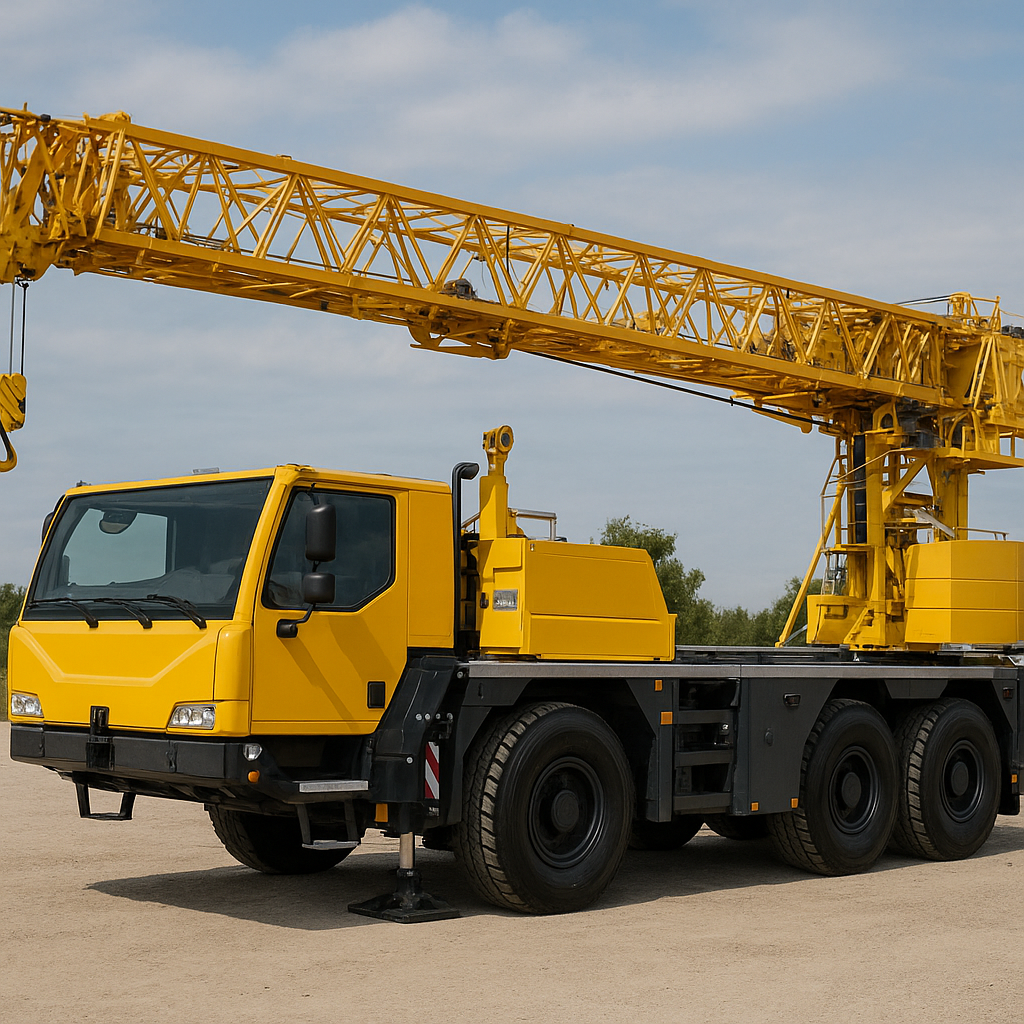
The Liebherr MK 140 is a modern example of a mobile tower crane designed to combine the lifting performance of classic tower cranes with the mobility and flexibility required on urban and constrained construction sites. Its compact footprint, rapid assembly and disassembly, and aptitude for operation in narrow streets and building courtyards make it a practical choice for contractors, rental companies and municipal projects. In the text below you will find an overview of the machine’s design principles, typical applications, operational advantages, safety and maintenance considerations, and other useful background information that helps explain why this model is popular in many markets.
Design and technical concept
The Liebherr MK 140 belongs to a family of cranes often described as truck-mounted mobile tower cranes or mobile tower cranes with a telescopic or folding lattice mast. The core idea behind such machines is to deliver the height and reach benefits of a tower crane while retaining the ability to relocate quickly without the need for long erection sequences or large auxiliary equipment. The MK 140 is engineered for short setup times, relatively small transport dimensions and flexible configuration options to suit a wide variety of jobsites.
Key structural features
- Mast and jib: The crane uses a lattice or hybrid mast system that gives a high stiffness-to-weight ratio. The jib is designed to provide a balance between reach and lifting moment, enabling effective work at medium radii commonly found in refurbishment and residential construction.
- Base and carrier: Mounted on a rigid truck or carrier chassis, the MK 140 is designed for road transport without special permits in many regions (depending on local regulations). The carrier provides the mobility advantage over fixed-base tower cranes.
- Outriggers: Foldable hydraulic outriggers stabilize the crane during operation, offering a small footprint with strong support so the unit can work from sidewalks or narrow zones.
- Powertrain and controls: Modern iterations are fitted with efficient diesel engines and advanced hydrostatic or electric drive systems for slewing, hoisting and trolley motions. Integrated electronic control systems provide load monitoring, safe working limits, and precise positioning.
Performance characteristics (typical)
While exact figures depend on the specific configuration and regional variant, mobile tower cranes similar to the MK 140 typically exhibit the following performance envelope:
- Effective working heights often ranging from moderate heights up to several dozen meters when mast sections are extended.
- Horizontal jib reaches designed for medium-radius tasks, making them suitable for inner-city building façades, service installations, and rooftop deliveries.
- Lift capacities that vary with radius and configuration; mobile tower cranes emphasize versatility rather than very high single-point lifts, enabling multiple tasks at different radii rather than extreme maximum loads.
Typical applications and sectors
The strengths of the MK 140 translate into broad applicability across several sectors. Its mobility and compact dimensions are particularly advantageous where space is constrained and frequent repositioning is needed. Below are the primary fields where this crane finds the most use.
Urban construction and renovation
- Residential refurbishments: Replacement of roof trusses, façade elements, and window units where access is limited to courtyards or narrow streets.
- Historic building restoration: Low-impact setup and precise lifting help protect sensitive surroundings and foundations.
- Inner-city infill projects: Construction of small to medium multi-story buildings where a full-size tower crane would be disproportionate or impossible to erect.
Services and installations
- Installation of HVAC, chillers and rooftop units — tasks that require careful maneuvering and placement on high but limited-space rooftops.
- Assembly of prefabricated components such as stairwells, balconies and lift shafts in tight city plots.
- Utility and municipal works — tree care, streetlight replacement, and bridge maintenance where fast setup and precise lifts are required.
Rental fleets and contractors
Because of their multi-role capability and relative ease of transport, machines of this class are frequently a staple in rental fleets. Contractors benefit from:
- Short mobilization times resulting in lower project overhead.
- Flexibility to move between sites without heavy lifting equipment or cranes for erection.
- Lower personnel requirements for setup and operation compared with larger tower cranes.
Operational advantages and limitations
Understanding both the advantages and the limitations of the MK 140 helps in selecting the right crane for a job. Below are the most important operational considerations.
Advantages
- Rapid deployment: Reduced assembly time compared with traditional tower cranes — often possible within a few hours depending on site conditions.
- Road mobility: Ability to travel on public roads to the next jobsite without requiring a separate transport arrangement for disassembled components.
- Small footprint: Outriggers and a compact chassis allow operation from confined areas, reducing the need to close entire streets or large parts of a site.
- Versatility: Performs a range of tasks — from lifting construction materials to precision placement of installations — making it cost-effective for short-term and varied work.
- Operator ergonomics: Modern cabins, remote-control options and intuitive control systems improve precision and reduce operator fatigue.
Limitations
- Lift capacity and reach: Although versatile, these cranes do not match the absolute capacity or reach of large stationary tower cranes and heavy-duty mobile cranes. Project planners must ensure that the expected maximum loads fall within the crane’s load charts for the required radii.
- Wind sensitivity: Like all tower cranes, operations at higher elevations and longer reaches are sensitive to wind conditions, limiting use in adverse weather.
- Terrain requirements: Outriggers require stable ground. While the unit has good adaptability, extremely uneven or soft ground may require additional ground preparation or mats.
- Regulatory variations: Transport and operation rules vary by country and region — weight, length and axle load restrictions can affect how and where the crane is moved on public roads.
Safety systems and operator support
Safety is central to the design of contemporary cranes like the MK 140. Liebherr and similar manufacturers integrate multiple redundant systems and smart features to protect personnel, equipment and surroundings.
Load monitoring and limiting
Electronic load moment indicators continuously assess the load, boom angle, and radius to prevent lifts that would exceed safe working conditions. Automatic cut-offs intervene if a lift would place the crane in an unsafe configuration.
Stability and outrigger management
Outrigger sensors confirm correct deployment and warn operators of unsafe ground conditions. Some systems provide real-time feedback on ground pressure, enabling safer operation in constrained environments.
Remote operation and positioning
Remote control units are increasingly common, allowing the operator to choose elevated or ground-level vantage points for better visual control during complex lifts. This enhances safety and precision, particularly when the operator’s line of sight to the load is obstructed.
Maintenance diagnostics
Integrated diagnostic systems track engine hours, hydraulic system performance and maintenance intervals. Predictive maintenance features can alert fleet managers to wear patterns or potential failures before they escalate, improving uptime and safety.
Maintenance, lifecycle and cost considerations
Proper maintenance and lifecycle management are essential to maximizing the return on investment for a mobile tower crane. The following points summarize typical practices and financial considerations.
Scheduled service and inspections
- Routine inspections of critical components (wire ropes, sheaves, hydraulic hoses, structural welds) should follow manufacturer recommendations and local regulations.
- Regular lubrication, filter and oil changes are necessary to keep hydraulic and powertrain systems operating reliably.
- Comprehensive annual or biannual inspections by certified technicians ensure safety compliance and extend the lifecycle.
Lifecycle and resale
Well-maintained machines kept to schedules often retain strong resale value in the rental and second-hand markets. Periodic refurbishment, GPS tracking and full-service histories are features that enhance resale prospects.
Operational costs
Operational expenses include fuel or energy consumption, scheduled maintenance, insurance, permits for transport, and operator training. Deployment speed and the crane’s versatility tend to lower overall project costs when compared to larger cranes that need longer mobilization and greater support services.
Environmental and regulatory factors
As environmental regulations tighten worldwide, manufacturers and fleet operators are adapting to reduce emissions, noise and site disturbance. Mobile tower cranes like the MK 140 can be adapted with low-emission engines, hybrid drives or options for electric operation in city centers.
Noise and emissions
- Diesel engines are typically the standard drive source, but many manufacturers offer quieter, lower-emission engines or electric drive alternatives for inner-city work where noise and air quality are critical.
- Operational practices — such as limiting idling times and scheduling noisy operations during designated hours — help meet municipal requirements.
Permitting and site constraints
Minor roadways, pedestrian areas and historical quarters often require special permits. Advance planning, coordination with local authorities and well-documented risk assessments reduce delays and ensure compliance.
Comparisons and market position
When compared with other lifting solutions, the MK 140 and similar mobile tower cranes occupy a niche between small mobile cranes (spider cranes, mini-cranes) and full-size tower cranes. They deliver:
- Greater height and reach than most small mobile cranes while being easier and faster to deploy than full tower cranes.
- Higher capacity and better stability than compact crawler cranes in many configurations, with the advantage of road mobility.
- Lower setup complexity than lattice boom crawler cranes and lower transport needs than sectional tower cranes.
For rental companies and contractors handling diverse urban projects, this middle ground represents a compelling compromise between capability and cost-efficiency.
Case studies and typical jobsites
Examples of situations where machines like the MK 140 have demonstrated value include:
- Inner-city condominium construction where crane footprint and street disruption needed to be minimized while still lifting façade elements and concrete panels.
- Historic building roof restoration requiring careful placement of slate, timber trusses and glazing without heavy scaffolding or large cranes that would risk structural impact.
- Commercial rooftop HVAC replacement projects where quick mobilization and precise placement under tight time windows are essential.
- Local authority maintenance tasks such as replacement of bridge parapets, street-level installations and tree removal near buildings where access is constrained.
Training, certification and operator considerations
Competent operators are essential to safe and productive crane use. Training programs cover machine-specific controls, understanding of load charts, site setup, rigging practices and emergency procedures. Many regions require formal certification and documented training hours before an operator may run tower-type cranes on public works or commercial sites.
Best practices for operators
- Always consult the specific load chart for the crane configuration and radius of operation before lifting.
- Use a qualified rigger and follow approved rigging practices for slings, shackles and load balancing.
- Perform daily pre-start checks and log any irregularities; report defects immediately and do not operate with known safety-critical issues.
- Maintain clear communication with signalers or banksmen when working in confined or noisy environments.
Conclusion
The Liebherr MK 140 represents a class of mobile tower cranes that strike a balance between mobility, precision and adequate lifting performance for a wide variety of urban and constrained-site tasks. Its design favors fast setup, a small operational footprint and flexible deployment, making it an attractive tool for contractors, rental firms and municipal operators seeking to complete complex lifts without the cost and disruption associated with larger cranes. While it does not replace the very large capacity of heavy-duty tower or crawler cranes, it fills an important niche where versatility, speed and minimal site impact are decisive.
When considering the MK 140 (or any similar model), project teams should carefully review the machine’s load charts for the intended configurations, confirm local transport and permitting rules, and ensure operators are fully trained and certified. With proper planning and maintenance, the MK 140 can be a highly efficient and safe asset on many modern construction sites.
)
)