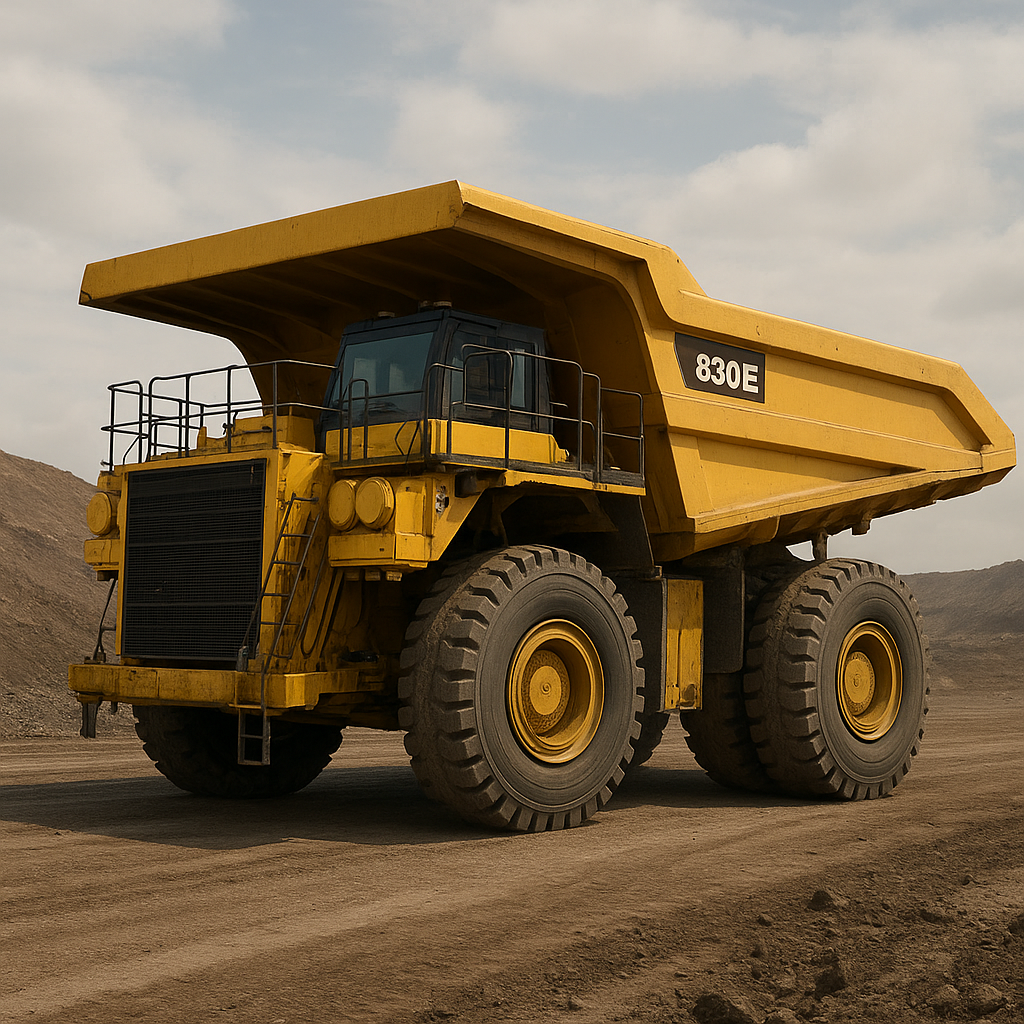
The Komatsu 830E is a flagship heavy-haul mining truck that has been widely used in large surface mines around the world. Designed for high productivity in the demanding environments of open-pit mining, this machine pairs Komatsu’s proven engineering with a diesel-electric drive system to move massive loads of ore, overburden, and other materials. In this article we explore the machine’s design, typical applications, technical characteristics, operational economics, and the practical considerations that make the 830E a mainstay in modern mining fleets.
Overview and design
The Komatsu 830E belongs to the family of large rigid-frame haul trucks developed for the mining industry. Unlike traditional mechanical-drive haul trucks, the 830E uses a diesel-electric drivetrain: a diesel engine drives an electric generator that feeds traction motors on the wheels. This architecture delivers high torque at low speeds, smooth power delivery, and reduced mechanical complexity in the transmission and driveline.
Key design features include a robust rigid chassis, heavy-duty suspension components, and a high-strength steel dump body tailored for abrasive materials. The cab is designed for operator comfort and safety with ergonomically arranged controls, climate control, and modern instrumentation. Many fleets fit additional telematics and monitoring systems to enable fleet management, preventative maintenance, and remote diagnostics.
Throughout its production life Komatsu has released a number of updates and variants of the 830E platform, improving electronics, cooling, cab ergonomics, and powertrain control. The truck is part of Komatsu’s broader strategy to provide electric-drive haul solutions across a range of payload classes, and it is commonly grouped in the roughly 200‑tonne payload class used by many large mines.
Applications and operational use
The primary use-case for the Komatsu 830E is in large-scale open-pit mining operations. Typical applications include:
- Ore hauling: transporting blasted ore from the pit to crushers and primary processing facilities.
- Overburden removal: moving waste rock during pit development and expansion.
- Haul-road intensive operations: long-distance hauling where diesel-electric efficiency and torque are advantageous.
- High-cycle short-haul: where rapid loading/unloading cycles and durability are required.
The 830E is used globally in diverse geological and climatic conditions — from dry, dusty deserts to humid tropical sites. Operators appreciate the truck’s consistent tractive performance on steep ramps, its relatively straightforward maintenance (compared with complex mechanical transmissions), and the adaptability of the electric drive to harsh service schedules. In many mines the 830E is a core element of multi-truck fleets that include larger and smaller machines to optimize cycle times and payload matching to shovels and loaders.
Technical features and typical specifications
While specific specifications vary by model year and configuration, several technical characteristics are common to the 830E series:
- Drivetrain: diesel engine coupled to an electric generator; AC or DC traction motors depending on variant and model year.
- Payload class: typically in the ~200‑tonne range (this places it in the medium‑large end of ultra-class haul trucks used in many mines).
- Frame and body: heavy‑duty rigid frame and high-capacity dump body forged or welded from wear-resistant steel.
- Tires: fitted with large off‑road mining tires (sizes and constructions vary by operator choice and mine conditions).
- Cooling and filtration: oversized radiators and advanced filtration packages for dusty and high-heat environments.
Typical numerical data (approximate ranges and depending on optional equipment):
- Nominal payload: around 200 tonnes (class varies with model and configuration).
- Operating weight: substantial — the empty or operating weight runs into the hundreds of tonnes when body, fluids, and basic equipment are included.
- Engine/generation output: diesel prime mover coupled to generator sets sized to provide traction power and auxiliary loads; power ratings vary by variant.
- Top speed: modest — haul trucks are optimized for gradeability and torque rather than high speed; typical loaded speeds on haul roads are managed for safety and tire life.
It is important to note that Komatsu offers a range of optional equipment packages: different engine calibrations, air or hydraulic retardation assistance, larger or smaller bodies depending on loading equipment, and a suite of electronics including GPS-based fleet management and payload weighing systems. These choices affect the truck’s nominal statistics and on-site productivity.
Advantages of the electric-drive architecture
The Komatsu 830E’s diesel‑electric system delivers distinct operational benefits over traditional mechanical drivetrains:
- High low-speed torque: Electric traction motors provide immediate torque at low speeds, improving gradeability and hauling under heavy loads.
- Simplified mechanical components: Eliminating complex multi-speed transmissions reduces mechanical wear points and on-vehicle maintenance complexity.
- Regenerative braking potential: Some systems can capture braking energy or reduce wear on friction brakes, improving brake life and thermal control on long descents.
- Enhanced control: Electronic torque and traction control systems enable improved traction on slippery or uneven haul roads.
- Better fuel utilization in many cycles: Depending on duty cycle and load profiles, diesel-electric systems can provide favorable fuel economy compared with mechanical drivetrains.
These advantages help mines lower lifecycle operating costs, extend component life, and maintain higher average availability — critical metrics in large bulk material operations where downtime directly reduces throughput.
Operational challenges and limitations
No machine is without trade-offs. Common challenges that operators and engineers manage include:
- Tire costs and management: Large mining tires are one of the biggest consumable expenses for haul trucks. Optimizing tire usage, pressure, and haul road maintenance is essential.
- Initial capital cost: Large electric‑drive trucks typically command significant purchase prices; total cost of ownership analysis is required to justify acquisition.
- Weight and road infrastructure: The sheer mass of the machine and full payload requires robust haul roads, bridges, and maintenance of pit infrastructure.
- Specialized maintenance skills: Electric-drive systems and high-voltage components require trained technicians and appropriate safety protocols.
- Environmental factors: Dust, mud, extreme temperatures, and abrasive materials increase wear on components and filtration systems.
Maintenance, lifecycle and fleet economics
Minimizing total lifecycle cost — rather than simply purchase price — is the key driver when mines select haul trucks. The 830E is often evaluated on metrics such as:
- Availability: percentage of scheduled operating hours the truck is able to work.
- Cost per tonne moved: factoring fuel, tires, consumables, maintenance labor, and downtime.
- Mean time between failures (MTBF): how often major repairs are required.
- Component reman and rebuild strategies: many fleets implement in‑house or vendor remanufacturing for major components like traction motors, alternators, and wheel ends.
Planned maintenance programs for 830E fleets typically include predictive analytics via onboard telematics, scheduled overhauls of high-wear components, and tight control of consumables. Major costs that fleets actively manage are tire consumption (a function of haul road quality and operator behavior), fuel usage, and rebuild cycles for traction hardware. Because the truck uses an electric drive, some mechanical components that wear rapidly on mechanical-drive trucks are either eliminated or shifted to electric motor service and power electronics service.
Safety, operator comfort and technology
Modern units of the 830E incorporate a suite of safety and operator-focused features:
- Enhanced visibility: optimized cab placement, camera systems, and large mirrors.
- Noise and vibration control: engine mounting and cab insulation to reduce operator fatigue.
- Advanced controls: electronic throttle and torque management for smoother operation.
- Fleet integration: telematics systems for dispatching, payload monitoring, fuel reporting, and maintenance alerts.
- Collision avoidance and proximity detection: many mines fit radar or RFID systems to reduce collision risk in congested pit areas.
Operator performance and safety are also improved through training programs specific to electric-drive haul trucks, as the characteristics of starting, braking, and torque delivery differ from mechanical transmissions.
Comparisons, competitors and placement in the market
The Komatsu 830E competes with haul trucks from other major manufacturers such as Caterpillar and Liebherr in the 150–250 tonne payload class. Each vendor emphasizes different strengths: some offer slightly larger or smaller payload variants, others focus on specific fuel- or maintenance-efficient technologies. The 830E’s key market positioning is its mature electric-drive platform, proven reliability in diverse global operations, and the availability of Komatsu service and parts networks.
In fleet planning, mines often deploy a mix of machines: larger ultra-class trucks for maximum payload, and medium-class trucks like the 830E where shovels, benches, and pit geometry make that size optimal. Matching shovel dipper size, bucket capacity, and truck payload is essential for maximizing shovel‑truck system efficiency.
Sustainability and emissions considerations
As global focus on mining emissions increases, haul truck selection and operation take on environmental significance. The 830E’s diesel-electric architecture can contribute to lower fuel consumption per tonne moved in some duty cycles, indirectly reducing CO2 emissions. Additional sustainability practices applied to fleets include:
- Engine tuning and waste heat recovery: optimizing fuel efficiency and exploring auxiliary power recovery.
- Alternative fuels: use of bio-blends or lower-carbon diesel alternatives where feasible.
- Electrification of mine fleets: integration with trolley assist lines (overhead catenary systems) in some mines to further cut diesel consumption on uphill hauls — electric-drive trucks are readily compatible with trolley systems.
- Operational efficiency improvements: route optimization, reduced idling, and improved loading practices to minimize unnecessary fuel burn.
Many mines are assessing broader electrification, including battery-electric equipment and trolley systems for haul trucks. The 830E, by virtue of its electric traction motors, can integrate into such strategies more easily than fully mechanical-drive trucks.
Notable operational statistics and lifecycle expectations
While statistics vary widely by site, some operational norms for trucks in this class include:
- Typical life between major overhauls: measured in thousands of operating hours; with effective maintenance many trucks serve for a decade or more before major rebuilds.
- Hourly operating costs: driven by fuel, tire, and maintenance consumption; a careful fleet manager will track cost-per-tonne and truck utilization intensively.
- Availability targets: large mining operations often benchmark availability targets in the high 80s to 90s percent for productive fleets.
Specific figures for fuel consumption, availability, and lifecycle costs are heavily dependent on haul road geometry, payload matching, operator behavior, and local environmental factors. For that reason, mines conduct pilot deployments and collect real-world telematics data to build accurate operating models prior to large-scale fleet purchases.
Future developments and final remarks
The Komatsu 830E exemplifies the evolution of haul truck design toward electric-drive systems that emphasize torque control, reliability, and integration with digital mine platforms. Future developments likely to affect trucks in this segment include broader adoption of trolley-assist systems, greater remote operation or autonomy, expanded use of predictive maintenance driven by machine learning, and experimentation with lower-carbon fuels or electrified powertrains.
Operators considering the 830E evaluate factors such as matching truck size to shovel and pit geometry, total cost of ownership, availability of local support and parts, and how the truck fits within a broader mine electrification and sustainability plan. When configured and maintained correctly, the Komatsu 830E can be a highly productive element of a mining fleet — offering robust hauling capability, durable construction, and the operational flexibility that electric-drive systems provide.
Key takeaways
- The Komatsu 830E is a heavy-duty haul truck optimized for open-pit mining with a diesel‑electric drivetrain that boosts efficiency and low-speed torque.
- It commonly operates in the ~200‑tonne payload class and is engineered for high availability, ease of integration with fleet telematics, and robust serviceability.
- Operational economics depend on tire management, fuel consumption, availability, and effective maintenance strategies; electric-drive design often contributes to lower lifetime costs in many duty cycles.
- Compatibility with electrification strategies such as trolley-assist and digital fleet systems positions the 830E well for mines pursuing reduced emissions and improved productivity.
)
)