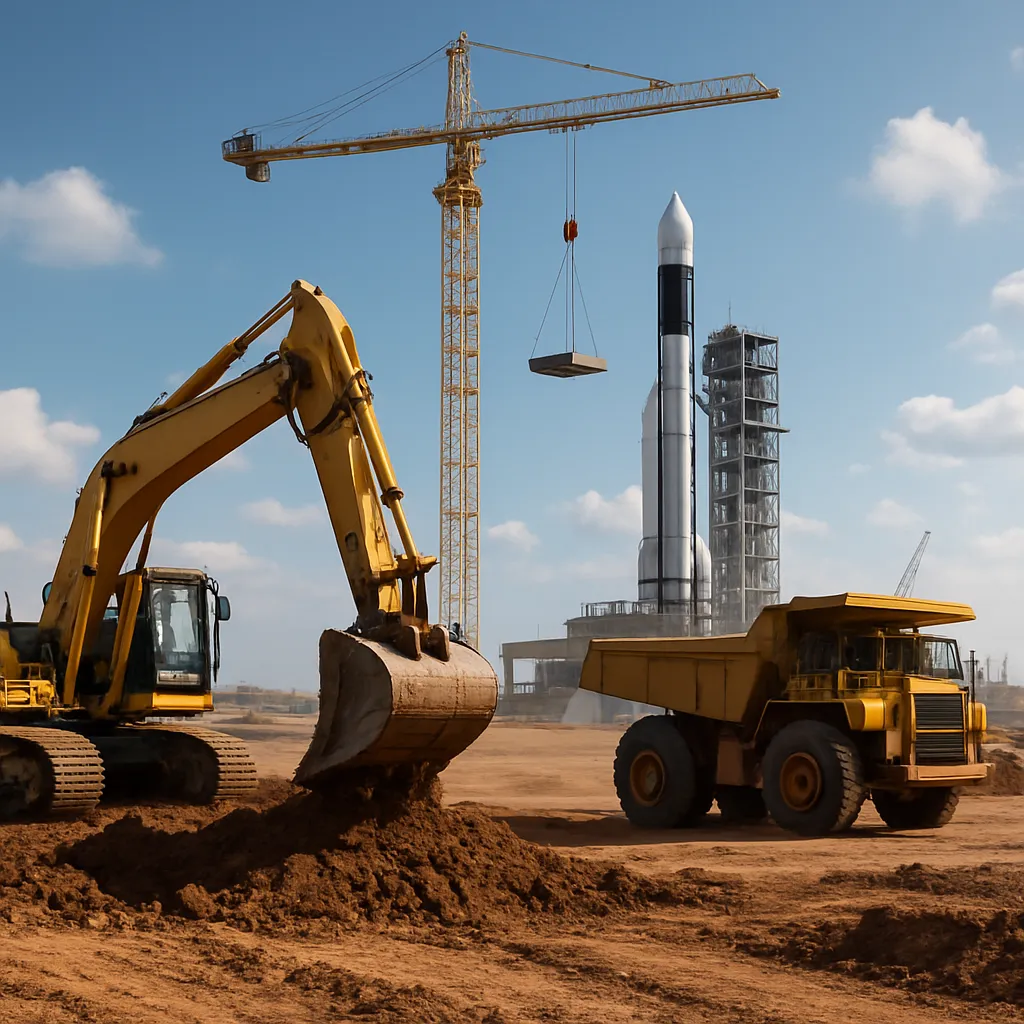
Building a launch facility on the frontier of space exploration demands more than human skill alone. Cutting-edge machines and intelligent systems now take center stage, transforming raw terrain into meticulously crafted, resilient platforms ready to support rocket liftoffs. In this article, we explore how evolving technologies integrate with traditional engineering to redefine construction workflows at modern spaceports.
Building Robust Foundations with Robotics
Excavation and ground preparation rank among the most labor-intensive tasks in spaceport construction. Advanced robotics offer automated digging, leveling, and soil compaction, ensuring that each square meter of foundation meets rigorous load-bearing specifications. Unlike manual methods, robotic excavators maintain consistent performance across demanding shifts and harsh environmental conditions.
Equipped with laser-guided sensors and real-time feedback loops, these machines achieve unprecedented precision in depth control and gradient alignment. Autonomous bulldozers follow preprogrammed blueprints, adjusting on the fly to variations in soil composition. As a result, project managers can track progress through centralized dashboards that display weekly excavated volumes, remaining tasks, and predictive maintenance alerts.
Another critical innovation involves the use of self-propelled drilling rigs fitted with automation modules. These rigs can bore deep pilings in uniform patterns, significantly reducing the margin for error in foundational support. When combined with autonomous cranes, the workflow becomes a seamless sequence of drilling, reinforcement placement, and concrete pouring— all coordinated via an integrated control network.
By delegating repetitive, heavy-duty operations to machines, crews can focus on oversight, quality assurance, and adaptive troubleshooting. This synergy not only enhances overall productivity but also raises workplace safety by reducing human exposure to potentially hazardous environments.
Prefabrication and Modular Assembly
Prefabrication stands out as a game-changer for constructing spaceport terminals, hangars, and service towers. Offsite factories manufacture modular components— from structural steel frames to insulated wall panels— under tightly controlled conditions. Each piece undergoes rigorous inspection before shipment, guaranteeing that on-site assembly unfolds with minimal surprises.
Upon arrival, automated gantry cranes and robotic welders swing into action. Precut beams slot into position with guide pins, and robotic weld heads execute continuous seam welding. The unified workflow accelerates erection schedules, enabling massive structures to rise in mere weeks rather than months.
With drones providing aerial overviews and thermal imaging, engineers can monitor welding integrity and detect hotspots or misalignments. Drone-captured data feeds into AI-powered analysis tools that flag deviations from design tolerances, prompting immediate corrections. Such a closed-loop system dramatically cuts rework costs and timelines.
Meanwhile, containerized control rooms, power units, and utility pods arrive ready for connection. Field technicians follow color-coded interfaces and plug-in schematics, ensuring each module integrates seamlessly with central command systems. The result is a cohesive complex assembled faster, cheaper, and with higher consistency than traditional stick-built methods.
Advanced Material Handling and Logistics
Efficient movement of materials is vital for large-scale construction sites. Automated guided vehicles (AGVs) shuttle aggregates, pipe sections, and reinforcement bars from stockpiles to work zones. These driverless units navigate via embedded floor markers or beacon-based telemetry, dynamically rerouting around obstacles or changing priorities.
Conveyors and robotic palletizers transform bulk handling as well. Cement bags, mechanical fittings, and electrical components move along synchronized conveyor belts to staging areas, where robotic arms stack them in precise configurations. Just-in-time delivery algorithms ensure that the right materials arrive at the right place exactly when needed.
Inventory management leverages RFID tags and IoT sensors. Every crate, barrel, or spool of cable broadcasts its location, quantity, and optimal usage window. Project leads consult real-time dashboards that forecast shortages and trigger automated reorders, circumventing costly delays.
Beyond ground-level operations, autonomous aerial systems transport light payloads across vast site perimeters. These drones deliver urgent tools or inspection instruments to remote corners, cutting internal transit times from hours to minutes and minimizing idle labor.
Safety, Monitoring, and Quality Control
Spaceport infrastructure must adhere to stringent safety and performance standards. Integrated sensor networks attached to cranes, scaffolds, and earthmovers collect continuous streams of structural and environmental data. Vibration sensors on frameworks detect resonant frequencies, while air monitors gauge particulate levels during concrete curing.
Safety-critical tasks, such as high-altitude welding or tower installation, now benefit from remotely operated platforms. Technicians control robotic arms from protected command booths, eliminating fall risks and hazardous exposure. Augmented reality (AR) helmets overlay digital schematics during inspection, highlighting weld seams or bolt torques that require attention.
Quality assurance protocols employ machine vision systems to scan surfaces for microcracks, weld porosity, or misaligned bolts. Combining high-resolution cameras with AI-based defect detection, these platforms achieve inspection rates impossible for manual surveys.
All data converges on a unified project management system, enabling cross-disciplinary teams to interpret insights, assign corrective actions, and validate compliance with aerospace construction codes. Such a comprehensive, data-driven approach elevates both the speed and the reliability of each build phase.
Future Innovations in Spaceport Construction
Looking ahead, emerging technologies promise even deeper integration of machine intelligence. Adaptive AI frameworks will refine construction sequencing based on live environmental and operational feedback. These systems could autonomously reschedule tasks to avoid sandstorms, volcanic ash fall, or shifting winds— optimizing for both safety and efficiency.
Incorporating sustainability goals, next-generation heavy machinery may run on hydrogen fuel cells or bio-derived synthetics, slashing carbon footprints on remote builds. Additive manufacturing robots could 3D-print structural elements on-site using local regolith, reducing dependency on long-haul logistics.
Moreover, collaborative robotics platforms will allow human specialists to guide multi-limbed robotic crews through complex assembly routines, using voice commands or gesture controls. These hybrid teams will tackle unprecedented challenges, erecting habitats, launch towers, and fuel depots in record time.
The synergy between human ingenuity and machine prowess paves the way for a new era of spaceport development— one where modular, innovation-driven approaches transform barren landscapes into launch-worthy complexes, accelerating our journey to the stars.