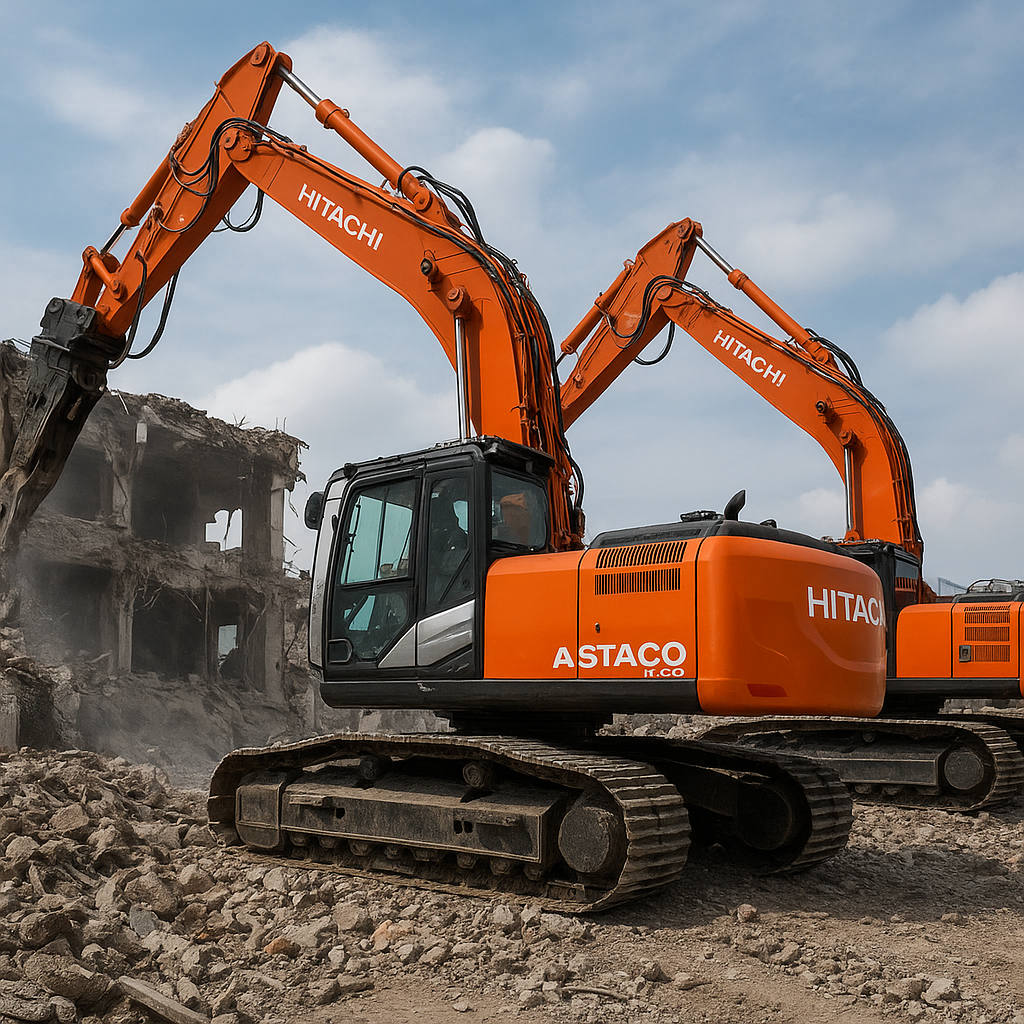
The Hitachi Astaco NEO represents a class of specialised machines designed for the most demanding tasks in structural dismantling and site clearance. Combining robust engineering with advanced hydraulics and operator-focused features, the Astaco NEO family—particularly in its heavy, dual-arm configurations—addresses complex challenges where precision, safety and throughput are paramount. This article explores the machine’s design philosophy, typical applications, technical characteristics, operational advantages and broader implications for demolition contractors and infrastructure projects.
Design and Technical Features
The Astaco NEO series, as adopted in heavy, dual-arm demolition variants, is characterised by purpose-built components intended to withstand intense cyclical loads and abrasive environments. At the heart of its design is a reinforced upper structure and a specialised undercarriage that supports extended working reach and offers enhanced stability during high-impact operations. The combination of structural rigidity and refined hydraulics enables these machines to carry heavy attachments while maintaining precise control.
Structural layout
Dual-arm machines differ from conventional single-boom excavators primarily by incorporating an additional articulated arm or stabiliser arm. This layout permits simultaneous performance of multiple tasks — for example, holding and stabilising a structure with one arm while breaking or cutting with the other. The Astaco NEO’s upper frame is often engineered with extra placings for counterweights and reinforcement plates to manage the shifting centre of gravity when lengthy arms and substantial tools are in use.
Hydraulic systems and powertrain
One of the distinguishing elements of the Astaco NEO is its high-capacity hydraulic system. The pumps, valves and circuits are sized for continuous duty and designed to feed demanding attachments such as crushers, pulverisers, high-capacity shears and vibratory grabs. Hydraulic oil cooling and filtration systems are optimised for dusty and debris-filled demolition environments so that performance is maintained over long shifts with minimal degradation.
The engines powering these machines prioritise torque and reliability. Emissions-compliant diesel units combined with electronic engine management allow for a balance of power and fuel economy. Many operators benefit from integrated automatic modes that adjust hydraulic flow and engine output according to the task, reducing unnecessary fuel consumption while improving cycle times.
Operator station and controls
Operator ergonomics and visibility are major design considerations. The Astaco NEO typically features an elevated cab with reinforced glazing, offering a panoramic view of the demolition zone. Controls are often programmable and can be fine-tuned for specific attachments to give smooth, predictable response. Several safety and monitoring systems—such as load moment indicators, camera packages and alarm systems—are commonly integrated to assist the operator during complex sequences.
Applications and Use Cases
The heavy dual-arm configuration of the Astaco NEO is suited to a wide variety of demolition and heavy-handling applications. Its configuration is not only about raw power but also about enabling tasks that demand simultaneous coordination and stability.
- Building demolition: Selective and full demolition of multi-storey buildings where controlled dismantling minimizes collateral damage and allows material segregation for recycling.
- Bridge dismantlement: Deconstruction of bridge sections and related infrastructure where precise cutting and safe lowering of large elements are required.
- Industrial plant decommissioning: Removal of heavy machinery, tanks and structural supports in factories and power plants, often in confined or hazardous environments.
- Urban redevelopment: Demolition in dense urban areas where vibration control, noise management and strict safety perimeters are necessary.
- Salvage and recycling: Sorting, shearing and handling of concrete and steel components to optimize recycling streams.
Because it handles both demolition and material handling tasks effectively, the Astaco NEO is frequently used on projects where time-sensitive removal and staged dismantling are necessary to maintain adjacent operations or to comply with tight site logistics.
Attachments and Configurations
A major strength of the Astaco NEO platform is attachment versatility. Appropriate selection and rapid interchange of tools mean the machine can transition between different demolition phases without requiring multiple specialised machines on site.
- Hydraulic breakers — for primary fracturing and breaking of concrete and rock.
- Concrete crushers and pulverisers — to reduce structural elements into transportable sizes and to separate rebar.
- Hydraulic shears — for cutting steel members and sectioning larger elements.
- Rotating grapples and grabs — for precise handling of debris and selective sorting for recycling.
- Telescopic or multi-piece booms — to increase reach while retaining strength and control.
- Specialist demolition heads — that combine several functions, such as shear/pulveriser heads for combined metal cutting and concrete crushing.
Quick-coupler systems and standardised hydraulic interfaces reduce downtime during tool changes. Some configurations incorporate remote monitoring of attachment wear and hydraulic performance, enabling predictive replacement and reducing unexpected downtime.
Safety, Durability and Environmental Considerations
For demolition contractors, safety is a top priority. The Astaco NEO’s design contributes to safer workflows not only by reducing the number of people required in hazardous zones but also by offering advanced electronic monitoring. Cameras, laser scanners and load sensors help ensure that operators maintain safe distances and avoid overload conditions.
Structural protection and resilience
Cabin protection packages—such as FOPS/ROPS-rated frames, mesh shields and reinforced glass—are standard options for heavy demolition machines. These protections are essential when performing tasks with falling debris risk. Additionally, reinforced undersides and sealed components reduce the risk of damage from flying fragments and abrasive dust.
Environmental performance
Modern Astaco NEO machines incorporate features to lower environmental impact: selective catalytic reduction (SCR) or other emissions after-treatment systems reduce NOx and particulate emissions, while efficient hydraulic systems and engine controls lower fuel consumption. Noise reduction measures—such as acoustic cab insulation and muffler designs—help projects comply with urban noise restrictions. Material handling attachments support on-site segregation, improving recycling rates and reducing landfill disposal.
Operator Experience and Maintenance
Machine uptime is a critical metric for profitability on demolition projects. The Astaco NEO addresses this through several practical features aimed at streamlining maintenance and enhancing the operator experience.
- Accessible service points: ground-level access to filters, pumps and key fluid reservoirs reduces service time and safety risks during routine checks.
- On-board diagnostics: integrated systems monitor engine, hydraulic and electronic parameters and report anomalies early to avoid failure cascades.
- Modular component design: commonly replaced parts are grouped to facilitate quicker repairs and reduce parts inventory complexity.
- Comfort features: adjustable seats, climate control and noise damping minimize operator fatigue, improving attention and reducing error rates across long shifts.
Periodic maintenance schedules, coupled with proper training and OEM-recommended inspection intervals, can extend service life and maintain operational efficiency. Contractors often follow condition-based maintenance powered by telematics to ensure that servicing occurs when necessary rather than strictly at fixed intervals.
Market Data and Performance Trends
While specific production and sales figures for the Astaco NEO line may vary by market and model year, the global trend toward larger, more capable demolition machines is clear. Urbanisation, infrastructure renewal and increased emphasis on recycling have driven demand for machines that can safely and efficiently deconstruct complex structures. Industry surveys indicate that contractors value machines that reduce cycle time and personnel exposure to hazards.
Observable performance patterns reported by operators include improved throughput on large-scale projects thanks to dual-arm capabilities that enable multitasking. Contractors commonly report lower overall project durations when employing specialised demolition rigs compared with smaller, general-purpose excavators performing the same tasks. Telematics data from fleets operating heavy demolition machines typically show high utilisation rates on long-term contracts, reflecting the machines’ role as core assets for demolition firms.
From an economic perspective, higher initial acquisition cost is often offset by reduced rental of auxiliary equipment, faster project completion, and improved recycling yields. Many companies perform site-specific cost-benefit analyses that demonstrate payback periods within several months to a few years depending on workload intensity and attachment use.
Real-World Case Examples
Urban high-rise selective demolition
On projects involving multi-storey concrete buildings in dense urban areas, the Astaco NEO’s dual-arm arrangement enables operators to perform piece-by-piece deconstruction. One arm secures or stabilises sections while the other performs controlled cuts, allowing safe dismantling without uncontrolled collapse. This approach is particularly valuable when adjacent structures remain occupied or when utilities must be preserved.
Bridge and viaduct removal
For bridge removal, heavy dual-arm machines can hold large spans while progressive cuts are made. Integrated lifting capacities reduce the need for separate cranes for many segments. The result is a lower logistical footprint and reduced traffic disruption on infrastructure removal projects.
Industrial plant dismantling
In decommissioning chemical or energy facilities, operators benefit from the machine’s protected cabin and remote monitoring. The ability to manipulate heavy components while maintaining operator distance from hazardous materials reduces risk and accelerates project timelines.
Future Developments and Technological Directions
Several trends will shape the evolution of heavy demolition machines like the Astaco NEO:
- Increased electrification and hybridisation to reduce on-site emissions and noise.
- Advanced automation and teleoperation features to enable remote or semi-autonomous demolition tasks in hazardous environments.
- Enhanced attachment intelligence with integrated sensors to monitor wear, forces and material type for better tool selection and scheduling.
- Greater integration with jobsite digital platforms for material tracking and recycling optimization.
These developments will likely make demolition operations even safer, more efficient and more environmentally sustainable. For contractors, investing in machines that are adaptable and upgradeable becomes a strategic advantage as regulations and client expectations evolve.
Summary
The Hitachi Astaco NEO in its heavy, dual-arm demolition configuration is a purpose-built solution for complex deconstruction tasks. Its combination of rugged structural engineering, high-capacity hydraulic systems, versatile attachments and operator-focused features make it suited for projects ranging from urban selective demolition to large-scale industrial dismantling. Emphasis on safety, durability and maintainability ensures that this class of machine addresses both productivity and lifecycle cost concerns. As the industry moves toward lower emissions and greater automation, platforms such as the Astaco NEO will continue to adopt innovations that further enhance their role in modern demolition, salvage and recycling workflows.
)
)