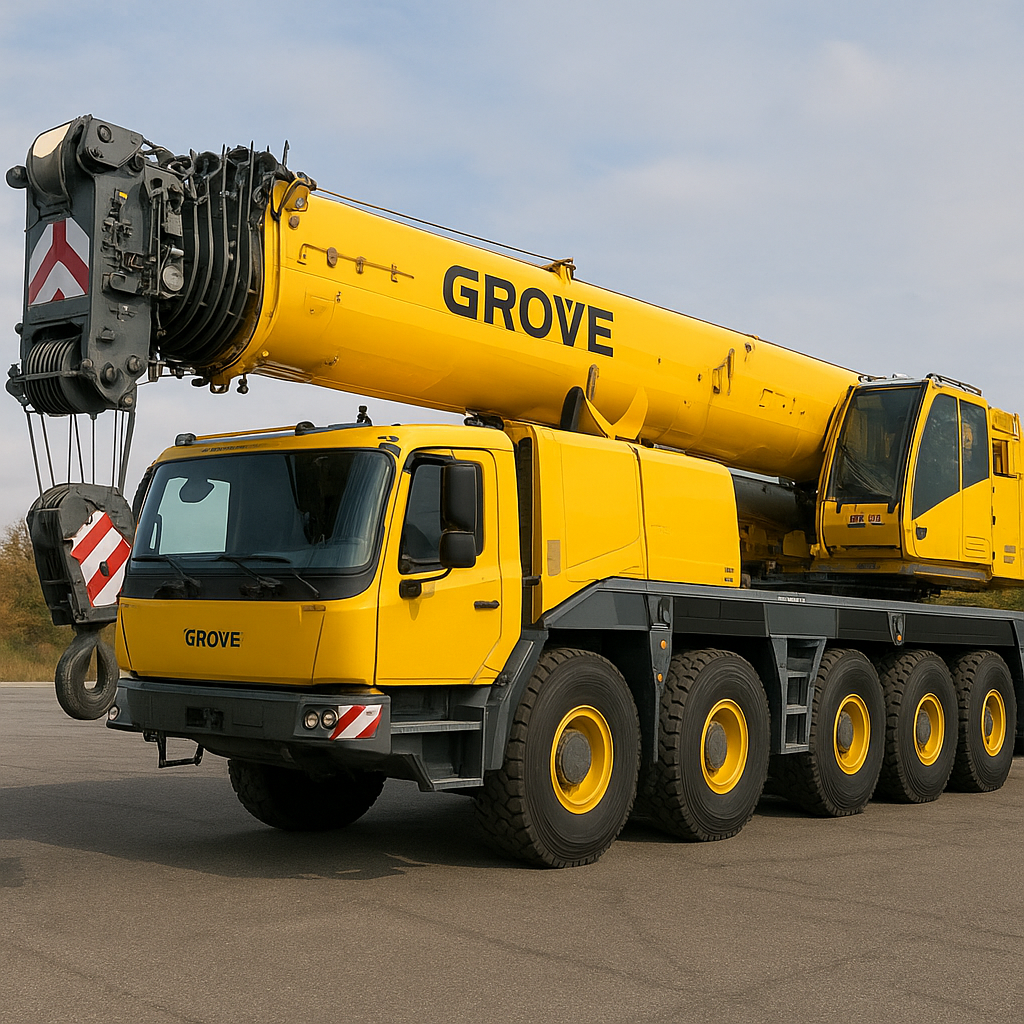
The Grove GMK6300L is a heavy-duty all-terrain crane that combines mobility, modularity and advanced engineering to serve a wide range of lifting tasks across industries. Designed to operate on public roads and in demanding off-road conditions, the GMK6300L targets projects that require substantial lifting capacity together with fast setup times and flexible configurations. This article examines the machine’s design philosophy, practical applications, technical highlights and real-world considerations for operators, fleet managers and project planners.
Design philosophy and key features
The Grove GMK6300L was developed to meet the demand for a crane that balances high capacity with highway transportability and robust off-road performance. The chassis and superstructure are engineered to provide a stable platform for heavy lifts while remaining compliant with international transport regulations. Key design priorities include modular counterweight systems, a powerful powertrain, and a long telescopic boom with flexible jib options.
Chassis, suspension and mobility
The carrier of the GMK6300L features a multi-axle layout optimized for load distribution and maneuverability. High-torque drive systems and steering axles allow the crane to navigate construction sites and public roads without the need for specialized transport equipment. Enhanced suspension and tyre options improve traction and reduce ground pressure, enabling the crane to work in softer subgrades and on uneven terrain. These features make the GMK6300L particularly suited to projects where frequent repositioning is required, such as wind farm installation or urban construction.
Superstructure and lifting gear
The upperworks integrates a robust slewing ring, efficient hydraulics and a control cabin positioned for excellent visibility. The main telescopic boom is built from high-strength steel and designed for smooth extension and retraction. Boom sections and lattice extensions are engineered for quick assembly and compatibility with optional jibs, allowing the crane to be adapted from heavy, short-radius lifts to high-reach, long-radius operations. Integrated load monitoring, moment-limiting systems and electronic stability support are standard to ensure safe and precise lifts.
Modularity and transportability
One of the GMK6300L’s strengths is its modular approach to counterweight and accessory configuration. Counterweights can be added or removed in sections to optimize setup for a given lift, minimizing the need for transport of unnecessary mass. The crane’s components are sized to fit legal road-transport dimensions in many regions, reducing the need for escort vehicles and permitting faster mobilization between sites.
Technical specifications and performance (typical ranges)
Specifications vary depending on configuration, optional equipment and regional variants. The figures below present typical ranges and capabilities associated with the GMK6300L platform. Where precise manufacturer data is required for planning, always consult the official product documentation or local dealer.
- Approximate maximum rated lifting capacity: in the range of 200–350 tonnes (metric) depending on configuration and boom/jib setup.
- Main boom reach: typical telescopic main boom lengths range from about 40 to 60 metres without jib; with lattice or swing-away jibs the tip height and reach can be extended substantially.
- Hydraulic system: high-flow proportional hydraulics with load-sensing capability for smooth boom control and winch operation.
- Travel speed and mobility: highway-capable top speed (when road-limited by regulations) and multiple steering modes for tight-radius maneuvering on site.
- Counterweight system: modular ballast blocks allowing a range of counterweight configurations to suit different lifts and lift radii.
- Slewing and hoist performance: variable-speed slewing and multi-speed hoists with planetary gearboxes to balance speed and torque for heavy lifts.
- Outrigger spread and stabilization: hydraulically extendable outriggers with load-sensing interlocks to deliver a wide and stable footprint on varied ground conditions.
These performance elements combine to give the GMK6300L the flexibility to execute both heavy, short-reach lifts (where high capacity at short radius is required) and extended-reach lifts (when height or radius are critical). The machine’s instrumentation typically includes load moment indicators (LMI), boom angle sensors and real-time capacity charts to ensure each lift remains within safe parameters.
Common applications and industry sectors
The Grove GMK6300L finds roles across numerous sectors where substantial lifting power and mobility are needed. Its design allows it to operate efficiently in environments from dense urban centers to remote industrial sites.
Wind energy
Wind farm construction and maintenance frequently demand cranes capable of lifting heavy nacelles, hubs and tower sections to significant heights. The GMK6300L’s combination of reach, hoisting capacity and quick setup makes it suitable for onshore wind projects, particularly during phases where turbine components are delivered in sections and require frequent repositioning between turbine locations.
Industrial construction and petrochemical plants
Refinery turnarounds, power plant construction and heavy industrial projects often involve large, heavy modules and equipment that must be lifted and precisely placed. The GMK6300L’s capacity and fine control enable safe and efficient placement of such items in constrained spaces.
Infrastructure and bridge work
Bridge erection, span replacement and infrastructure repairs can require cranes that combine road mobility with strong lifting capability. The GMK6300L can be used to lift precast elements, girders and mechanical units into place, while outriggers and ballast arrangements provide the necessary stability for wide-span lifts.
Marine and port operations
Although dedicated harbour cranes are often preferred for continuous port handling, the GMK6300L is useful for project-based lifts at quaysides, shipyards and offshore loadouts. Its ability to travel on public roads and lift substantial weights makes it a practical choice for transporting and lifting heavy marine components during ship repair or installation work.
Operation, safety systems and operator experience
Modern all-terrain cranes like the GMK6300L integrate sophisticated electronic and hydraulic systems to support safe and efficient operation. Critical safety and operational features typically include:
- Load moment indicator (LMI) and rated capacity limiter to prevent overloads;
- Electronic stability and anti-two-block systems to detect and mitigate dangerous boom or hoist conditions;
- Multi-mode control interfaces, often with joystick and touchscreen elements, enabling precise control of boom extension, luffing and hoist speeds;
- Centralized diagnostics for hydraulic, engine and electrical systems to reduce downtime and simplify troubleshooting;
- Advanced cab ergonomics and visibility aids, such as cameras and mirror systems, to improve operator awareness on congested sites.
Operator training is central to safe crane use. Specialist training organizations and manufacturer-certified courses are typically recommended to ensure familiarity with the GMK6300L’s load charts, outriggers and unique configuration behaviors. Routine pre-shift checks — including hydraulic lines, hoist ropes, brakes and safety interlocks — are vital to maintaining safe operation and prolonging component life.
Ergonomics and remote operation aids
Cab layouts are designed to reduce operator fatigue and improve precision. Many units are equipped with climate control, adjustable seating and multi-function controls. Increasingly, cranes in this class are fitted with remote-control or assisted-lift capabilities, allowing the operator to position themselves where they have the best view of the load rather than being confined to the cab during complex lifts.
Transport, setup and site logistics
Efficient transport and quick setup are major advantages of all-terrain cranes. The GMK6300L supports fast deployment through a combination of road-legal carrier dimensions (in many configurations), modular counterweights and hydraulically deployed outriggers. Considerations for fleet managers and logistical planners include:
- Advance route surveys for tall or wide loads, including assessment of road weight limits, bridge capacities and overhead obstructions;
- Pre-assembly of ballast and jibs at staging areas to minimize site setup time;
- Coordination with rigging crews to ensure slings, spreader bars and lifting accessories are prepared and certified for the planned lifts;
- Ground preparation and crane pad requirements to evenly distribute loads from outriggers and reduce settlement risk;
- Permitting and escort requirements for over-dimensional transports in local jurisdictions.
When deployed to remote or constrained sites, creative logistics planning — such as pre-positioning ballast or using smaller auxiliary cranes to assist with assembly — can substantially reduce on-site time and cost. The GMK6300L’s roadability reduces the need for complex disassembly compared to crawler cranes, which often require heavy-duty transporters and extended assembly periods.
Maintenance, lifecycle and operational costs
A responsible maintenance program is essential to maximize uptime and reduce lifecycle costs for a machine like the GMK6300L. Regular maintenance activities typically include engine servicing, hydraulic oil and filter changes, wire rope inspection and replacement, slewing ring lubrication, and scheduled checks of outriggers and structural elements.
Planned maintenance and diagnostics
Many operators use manufacturer-recommended maintenance schedules combined with condition-based monitoring to detect early signs of wear. Onboard diagnostic systems and telematics can help monitor engine hours, hydraulic temperatures and usage patterns, enabling predictive maintenance that minimizes unexpected breakdowns and optimizes parts inventory.
Cost considerations
Operating costs for all-terrain cranes are influenced by fuel consumption, parts and labour for maintenance, tyre and brake wear, and insurance. The GMK6300L’s fuel-efficient engines and hydraulic systems are designed to reduce fuel consumption per lift, but actual costs vary with duty cycle, lift profile, and travel distances. When comparing crane options, lifecycle cost analysis should consider acquisition, maintenance, transport and opportunity costs related to setup time and jobsite flexibility.
Attachments, customization and auxiliary equipment
The flexibility of the GMK6300L is enhanced by a wide range of attachments and accessories. Frequent options include:
- Fly jibs and lattice extensions to increase reach and create higher tip heights;
- Specialised hooks and block systems for multiple-line hoisting and tandem lifts;
- Load spreaders and lifting beams for handling irregular or oversized modules;
- Remote cameras, anti-collision systems and software upgrades for complex multi-crane lifts;
- Custom ballast configurations and transport frames to match local logistics and permit constraints.
Customization allows operators to adapt a single crane platform to a diverse set of contracts, improving fleet utilization. Manufacturers and dealers frequently provide tailored packages to meet regulatory or site-specific needs, such as noise-reduction kits for urban environments or cold-weather packages for operations in arctic conditions.
Market position and comparative advantages
Within the all-terrain crane market, the Grove GMK6300L occupies a segment that emphasizes a balance of high capacity and mobility. Its primary advantages over larger crawler-mounted cranes include reduced transport complexity and faster repositioning, while compared to smaller all-terrain models it offers substantially greater lifting capacity and reach. The decision to deploy a GMK6300L versus alternatives typically hinges on lift weight, radius, site access and project tempo.
Fleet managers report that the availability of modular ballast systems and the crane’s ability to work within road-transport constraints can significantly lower project mobilization time and cost. In multi-crane lift scenarios, electronics-driven interlocks and lift-assist features reduce coordination complexity and improve safety outcomes.
Case examples and practical considerations
Real-world deployments demonstrate where the GMK6300L adds value:
- Wind-turbine installations where the crane lifts nacelles and tower sections across multiple turbine sites, benefiting from rapid repositioning and high reach options;
- Industrial module lifts during refinery upgrades, where heavy prefabricated skids must be lifted into constrained plant environments;
- Bridge replacement projects where precast segments and girders require precise placement along narrow corridors;
- Emergency recoveries or salvage operations that demand high-capacity lifts with fast arrival to site.
Practical considerations for project planners include planning for sufficient ground bearing capacity, ensuring certified rigging is available for the required load paths, scheduling assembly crews familiar with the GMK6300L’s configuration sequences, and arranging for any necessary permits and escorts for oversized transport segments.
Environmental and regulatory considerations
Modern crane design and operations increasingly respond to environmental and regulatory pressures. The GMK6300L platform typically incorporates engines that meet applicable emissions standards for the regions in which they are sold, and manufacturers offer retrofit and alternative fuel solutions to improve environmental performance. Noise reduction measures, such as engine covers and low-noise hydraulic components, help reduce community impact during early-morning or late-night operations in urban settings.
Operators must also be cognizant of local regulations regarding transport permits, working hours, and site safety requirements. Compliance with these regulations is essential to avoid fines and operational delays, and to maintain good relations with local stakeholders.
Summary and final observations
The Grove GMK6300L stands out as a versatile, road-travelling heavy crane that combines strong lifting capabilities with operational flexibility. Its strengths include modular counterweight systems, a robust telescopic boom, advanced hydraulics and on-board safety systems. These features make it well-suited to wind energy installations, industrial construction, infrastructure works and specialized project lifts. Effective use of the GMK6300L depends on careful planning: selecting the optimal configuration, ensuring trained operators and riggers, and performing diligent maintenance and site preparation.
For accurate specification sheets, load charts and configuration advice tailored to a given project, consult the manufacturer’s official documentation or an authorized dealer. Real-world performance and costs will vary based on configuration, site conditions and operational tempo.
)
)