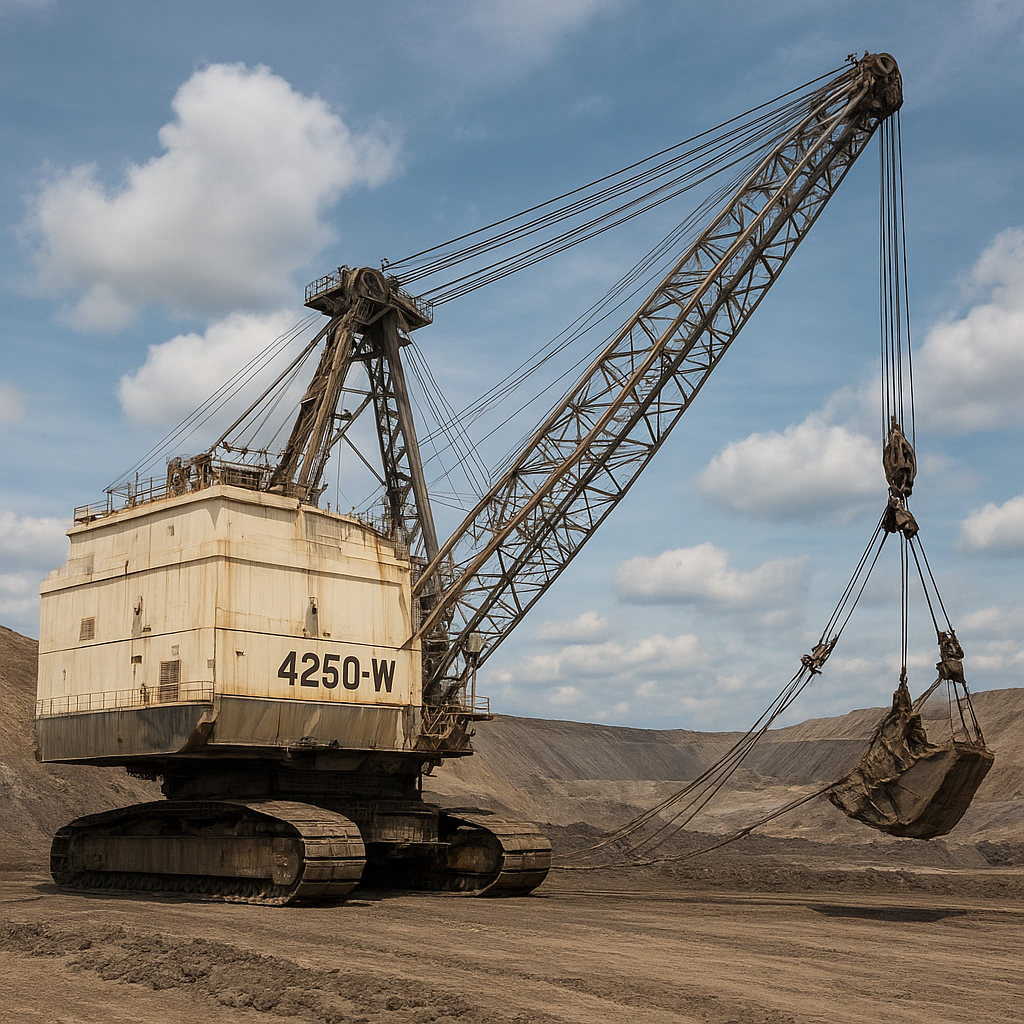
The Big Muskie 4250-W stands as one of the most iconic and awe-inspiring pieces of heavy equipment ever built. This monumental dragline symbolized a particular era of industrial-scale surface mining, where size and mechanical reach redefined how earth and rock were moved. Below is a detailed exploration of the machine’s history, design, applications, environmental and social impacts, and the legacy it left behind.
History and context
The Big Muskie was a product of the late 1960s wave of industrial gigantism in mining. Constructed by the renowned mining-equipment manufacturer Bucyrus-Erie, it was delivered to the Central Ohio Coal Company to serve in large-scale surface coal operations. At the time of its construction, the machine represented the peak of dragline design—both in sheer physical scale and in the ambition to reduce operating costs by moving enormous amounts of material per scoop.
Big Muskie’s emergence must be seen in the broader context of the post‑war expansion of energy production and the demand for coal. Companies invested in ever-larger machines to lower unit costs of overburden removal and to expose coal seams more rapidly than smaller equipment could. The machine became an emblem of that period: a physical manifestation of industrial power and technological optimism, and later a subject of controversy as public and regulatory views on mining and environmental restoration evolved.
Design and technical characteristics
The dragline design is deceptively simple in concept: a large bucket suspended from a boom by wire ropes and controlled by a system of winches and hoists. In practice, however, building a machine at the scale of Big Muskie required solutions to enormous engineering challenges—structural stresses in the boom, power delivery for large electric motors, rope and hoist reliability, and the logistics of assembly and transport to a remote mining site.
Key technical features
- Manufacturer: Bucyrus-Erie
- Model: 4250-W
- Type: single-bucket dragline
- Primary use: overburden removal in surface coal mining
- Power: typically large electric motors fed from dedicated high-voltage supply or on-site generation
- Mobility: walking mechanism (pontoons/“shoes”) rather than continuous tracks, enabling the machine to reposition itself slowly across the mine floor
Among the most frequently cited specifications for Big Muskie is its bucket capacity. Commonly reported figures list a bucket holding approximately 220 cubic yards (roughly 168 cubic meters). A bucket of this size allowed each scoop to remove an enormous volume of material, dramatically increasing the productivity of routine overburden removal compared with smaller draglines or conventional shovels.
Other physical characteristics often associated with machines of this class include a boom measuring well over 200 feet in length, multiple walk‑in levels and operator platforms, and an operational height of many stories. The machine’s total mass—understood to be in the thousands of tons—meant that foundations, ground bearing capacity, and transport of components were critical planning considerations prior to installation.
Operation and crew
Operating Big Muskie required a skilled team: electricians, riggers, mechanics, and operators. The machine’s control systems coordinated the hoist ropes, drag ropes, and swing mechanisms to cut and fill the mine face efficiently. A typical work cycle involved lowering the bucket, dragging it through the overburden, hoisting the filled bucket, swinging the boom to the spoil area, and dumping the load. The size of the bucket reduced the number of cycles needed to move the same volume of material compared with smaller machines, but each cycle placed greater mechanical stress on ropes and winches, increasing the importance of preventive maintenance.
Applications and operational advantages
The primary application for Big Muskie was in large-scale strip mining and surface coal operations where removing thick layers of overburden was necessary to access coal seams. The machine was most effective in situations where:
- Coal seams were extensive and relatively uniform, allowing the dragline to perform repeated, similar swings.
- The mine geometry permitted a long boom sweep and ample spoil placement area.
- High-volume, continuous production was prioritized over flexibility to work in constrained or complex terrain.
Operational advantages included:
- High volumetric productivity: moving hundreds of cubic yards per scoop dramatically reduced total cycles.
- Lower unit labor requirements: one large dragline could replace multiple smaller shovels in certain operations.
- Improved economics on very large deposits: for wide, shallow seams, draglines like Big Muskie delivered favorable stripping ratios and lower per‑ton overburden costs.
Limitations and constraints
Despite its power, Big Muskie had inherent constraints that limited where and how it could be used:
- Limited maneuverability: the walking movement was slow and relocation required planning and sometimes temporary dismantling of site infrastructure.
- High initial capital cost: few operators could justify the cost unless they had prolonged, high-volume operations.
- Geographic constraints: steep or heavily irregular terrain reduced effectiveness.
- Environmental and permitting constraints: evolving regulatory frameworks and reclamation requirements eventually made some large-scale surface mining operations more complex and expensive.
Environmental and social impacts
Machines like Big Muskie accelerated the pace at which landscapes could be altered. In the short term, a single large dragline could transform a mine site, creating vast spoil piles, diverting drainage, and changing ecosystems. The social and economic impacts were complex: communities benefited from jobs and local tax revenue tied to mining, but they also faced long-term land-use changes and environmental challenges.
By the latter part of the 20th century, public awareness and regulatory scrutiny regarding the environmental footprint of strip mining increased. Reclamation standards evolved to require graded spoil, topsoil replacement, re‑vegetation, and stabilization of watercourses—practices that added cost and complexity. In many regions, stricter environmental controls and shifts in energy markets reduced demand for the kind of massive single-site investments that machines like Big Muskie represented.
Maintenance, logistics, and operational challenges
Keeping a machine of Big Muskie’s size in continuous operation demanded a substantial maintenance program. Common maintenance issues and logistical concerns included:
- Wire rope and bucket wear: repeated high-load cycles required constant inspection and replacement schedules.
- Hoist and winch maintenance: the enormous motors and gearboxes required preventive maintenance and substantial spare parts inventories.
- Power delivery: supplying reliable high-voltage power to the site (and sometimes on-site generation) was essential for continuous operation.
- Component transport and assembly: initial assembly of the machine on site involved transporting massive sections and required cranes or special erection procedures.
Breakdowns could be costly in terms of downtime, and the need for highly skilled technicians to service the equipment added to operating budgets. As a result, mining firms often balanced the production advantages of very large draglines against the increased operational complexity.
Legacy and cultural significance
Beyond its technical role, Big Muskie became a cultural landmark. Gigantic industrial machines capture public imagination: they are photographed, documented in film, and become focal points in discussions about industry, progress, and environmental stewardship. Whether celebrated as a marvel of engineering or criticized as a symbol of environmental excess, the machine had lasting visibility.
After retirement, parts of such machines are sometimes repurposed or preserved by museums and local historical groups. The story of Big Muskie is often used in museum exhibits, historical accounts, and public discussions to illustrate changing approaches to resource extraction, engineering achievements, and the importance of reclamation practices.
Educational value
Big Muskie’s history offers multiple educational angles:
- Engineering lessons in materials, structural design, and heavy equipment systems.
- Economic case studies on capital investments, operations management, and life‑cycle costs.
- Environmental and policy discussions on land use, reclamation, and sustainable resource management.
Notable statistics and commonly reported figures
Some figures associated with Big Muskie are frequently cited across publications and accounts. These figures can vary between sources; the numbers below are therefore presented as commonly reported values rather than precise manufacturer guarantees:
- Bucket capacity: approximately 220 cubic yards (about 168 cubic meters).
- Model: Bucyrus‑Erie 4250‑W.
- Construction year: late 1960s (delivered in the era when such machines were being expanded in surface mining fleets).
- Operational role: primary overburden removal in large strip‑mining operations.
Because published numbers (for dimensions, weights, boom length, and total mass) can differ between contemporary promotional literature, operator manuals, and later historical accounts, it is common to find ranges rather than single fixed numbers in secondary sources. When planning engineering analyses, restoration projects, or accurate historical reconstructions, consulting original manufacturer documentation or archived engineering drawings is advisable.
Interesting anecdotes and lesser-known facts
Large draglines often have stories attached to them—from logistical feats required to transport and erect them to the human experiences of crews that worked on them. Anecdotes about Big Muskie and machines like it commonly include:
- Complex assembly sequences: components were transported in huge sections and required careful choreographing to assemble on site.
- Community impact: the arrival of a machine of this scale could transform a local economy, bringing a spike in employment and supporting industries.
- Photography and tourism: even after their operational life, such machines attract visitors and photographers drawn to their monumental scale.
Lessons learned and the future of large-scale mining machines
Big Muskie’s story illustrates both the power and limits of scale. Engineers and mining companies learned that while bigger machines can deliver lower unit costs under certain conditions, they also concentrate risk—technical, financial, and social. From a contemporary perspective, the industry has diversified approaches: some operations still favor large draglines for wide, shallow deposits, while others adopt fleets of more flexible equipment, improved automation, and more stringent reclamation practices.
As technology advances, aspects of dragline design evolve too: improved materials, advanced monitoring systems, automation of repetitive sequences, and better energy efficiency. Environmental and permitting pressures mean modern mining projects must balance productivity with sustainability, community engagement, and long-term land restoration.
Conclusion
Big Muskie 4250‑W remains one of the most compelling examples of mining’s era of giants. Its combination of impressive engineering, industrial ambition, and complex environmental legacy makes it a rich subject for study and reflection. While many of the exact historical numbers reported in popular accounts vary, the broader truths are clear: machines like Big Muskie reshaped landscapes, economies, and engineering practice, and their stories continue to inform how society thinks about resource extraction and industrial scale.
)
)