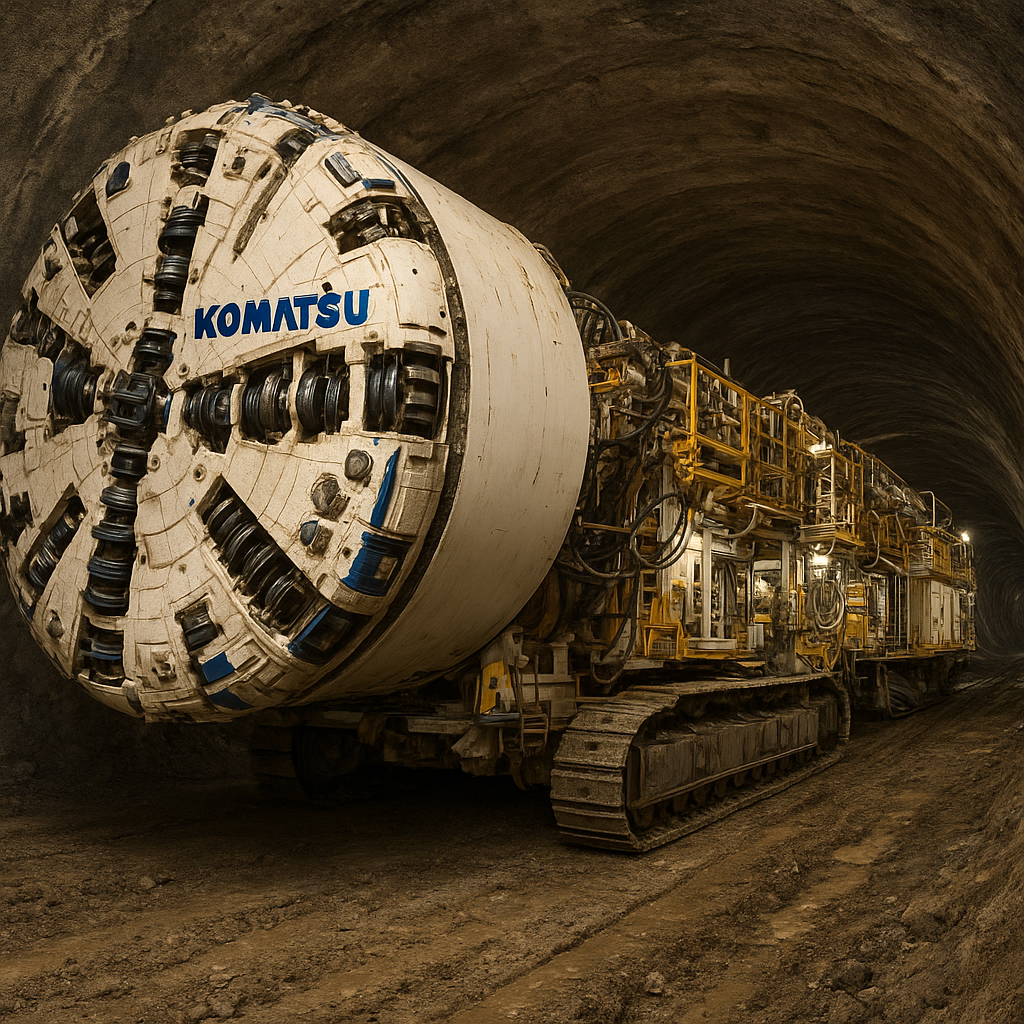
The Komatsu JV TBM represents a class of advanced tunnel boring machines developed through a joint venture involving Komatsu, designed to meet the demanding requirements of modern underground construction. These machines combine mechanized excavation, real-time monitoring, and integrated logistics to deliver high-precision results in a wide range of geological conditions. This article explores design features, typical applications, operational performance, maintenance and safety considerations, and the broader impact of Komatsu JV TBMs on the tunneling industry.
Design and technical features
The core of any Komatsu JV TBM is its cutterhead and supporting drive systems, engineered to provide continuous excavation while controlling ground and face stability. Depending on the project requirements, Komatsu JV TBMs can be configured as Earth Pressure Balance (EPB) machines or slurry machines, and can range from small-diameter microtunneling units to large-diameter mainline boring machines for metro and road tunnels.
Key components
- Cutterhead — a modular, replaceable assembly that carries disc cutters, scrapers and open-type tools depending on geology. Cutterheads are optimized for cutting performance and wear resistance.
- Thrust and drive systems — hydraulic cylinder arrays and electric or hydraulic motors deliver the axial and rotational forces necessary for excavation. Redundancy is often built in to maintain progress under adverse conditions.
- Segment erector and conveyor — integrated systems place precast concrete tunnel segments and remove excavated material via belts or slurry pipelines, enabling continuous operation.
- Grouting and ground support systems — to control surface settlement and stabilize the tunnel lining during assembly.
- Instrumentation and control — real-time sensors for face pressure, torque, advance rate, cutterhead torque, and ground deformation feed into automated control systems to optimize performance and ensure safety.
Design variants and materials
Komatsu JV TBMs are typically available in configurations tailored to specific ground conditions:
- EPB TBMs, best for cohesive soils and mixed-face conditions where the excavated material can be used to balance face pressure.
- Slurry TBMs, suited for granular, water-bearing soils where a pressurized slurry circuit transfers cuttings to a separation plant on the surface.
- Hard-rock TBMs with open or shielded cutterheads and high-torque drives for competent rock, sometimes incorporating disc cutters or roller cutters.
Materials used in critical wear parts (such as cutter disks and scrapers) are selected for high hardness and toughness — typically through heat-treated steels and wear-resistant alloys. The structural shields and conveyor systems employ high-yield steels and corrosion-resistant treatments to extend service life in aggressive environments.
Applications and project types
Komatsu JV TBMs are designed for a wide spectrum of underground projects, delivering solutions wherever long, continuous tunneling works are required. Typical applications include:
- Urban metro and rail tunnels — precise alignment, minimal surface disruption, and rapid segmental lining installation make TBMs ideal for dense city environments.
- Road tunnels and bypasses — large-diameter TBMs create multi-lane road tunnels with reduced ventilation and safety costs relative to drill-and-blast methods.
- Water supply and sewage pipelines — smaller TBMs and microtunneling rigs enable installation of utility conduits beneath rivers, roads, and built-up areas with minimal excavation.
- Hydropower and mining access tunnels — TBMs can safely bore long access drives and pressure tunnels through mixed and hard rock conditions.
- Crossings under waterways and geological hazards — pressurized-face TBMs (EPB or slurry) provide control in high water-pressure zones and unstable ground.
Because Komatsu JV TBMs can be tailored in diameter and support systems, they are frequently selected for projects that require both high precision and high productivity, especially where environmental impact and surface settlement must be tightly controlled.
Operational performance and statistics
Performance of TBMs, including Komatsu JV machines, varies widely with geology, machine diameter, and project logistics. Rather than fixed numbers, a useful way to evaluate TBM capability is through typical ranges and industry benchmarks.
Typical size and power ranges
- Nominal diameters: from approximately 0.6 m for microtunneling up to 17+ m for large-diameter road and metro applications. Custom diameters are common.
- Main drive power: from a few hundred kilowatts for small machines to more than 10 MW for very large TBMs; many metro-sized TBMs operate in the range of 1–6 MW.
- Thrust force: depending on diameter and ground, axial thrust may range from hundreds of tons to several thousand tons.
Advance rates and productivity
Advance rate (typically measured in meters per day) is a primary productivity metric. Typical observed ranges in industry practice are:
- Favorable soil conditions (EPB/slurry): 20–60 m/day on average, with peak shifts reaching higher values for short periods.
- Hard rock TBMs: variable—10–40 m/day common, with higher rates possible in good quality, jointed rock and lower rates in very hard or abrasive rock.
- Microtunneling and small-diameter drives: often less than 10 m/day, due to limited spoil handling rates and high precision requirements.
These numbers depend strongly on non-excavation activities (segment erection, maintenance, cutterhead interventions) and surface logistics. Efficient spoil removal, segment supply and a well-organized worksites are crucial in realizing the upper end of these ranges.
Wear and maintenance statistics
Wear rates for cutter tools depend on rock abrasivity (measured by abrasivity indices such as Cerchar), presence of mixed ground, and operational parameters. Typical operational cycles and maintenance interventions include:
- Cutter replacement intervals ranging from dozens to several hundreds of meters of advance, depending on rock abrasivity and cutter type.
- Planned maintenance and inspection windows every few weeks to months for medium to long drives; emergency interventions can be required sooner under adverse conditions.
- TBM availability targets for major projects often aim for >80–90% operational time excluding planned breaks — achieving this requires robust spare parts logistics and trained crew.
Construction logistics, maintenance, and safety
Successful TBM operation is as much about machine design as it is about site logistics, maintenance planning, and crew management. Komatsu JV TBMs emphasize integrated solutions to reduce downtime and improve safety.
Site setup and logistics
- Launching shafts: TBM assembly and launch require appropriately sized shafts and support infrastructure for segment storage, spare tools, and slurry/separation plants if needed.
- Segment logistics: Just-in-time delivery of precast segments and gaskets minimizes storage needs and speeds up lining installation.
- Spoil handling: Belt conveyors, muck cars, or slurry pipelines must be sized to handle excavation outputs without causing bottlenecks.
Maintenance strategies
Maintenance is planned around predictive, preventive and corrective measures:
- Predictive maintenance uses sensor data (vibration, torque, temperature) to forecast component wear and schedule interventions before failures occur.
- Preventive maintenance follows scheduled inspections and component replacements to avoid unexpected downtime.
- Well-defined spare parts inventory and rapid supply chains are essential — consumables like cutter discs, seals and hydraulics are stocked on-site.
Safety and environmental control
TBM tunneling reduces many risks associated with conventional excavation, but introduces others. Komatsu JV TBMs incorporate safety features such as emergency egress routes, refuge areas inside the machine, remote monitoring, and pressure control systems in pressurized-face machines. Environmental controls focus on:
- Minimizing surface settlement through face pressure control and grouting.
- Managing spoil and slurry water treatment to prevent contamination.
- Noise and vibration reduction by enclosing mechanical systems and optimizing drive cycles.
Case studies and examples of use
Komatsu JV TBMs have been applied across a variety of project types worldwide, from urban metro lines to utility tunnels. While specific project names vary by region and confidentiality, common themes in successful projects include meticulous ground investigation, careful machine selection, and strong project management.
Urban transit projects
In large metropolitan tunneling projects, Komatsu JV TBMs frequently contribute to minimizing disruption at surface level. Typical achievements reported on similar TBM projects include limiting maximum surface settlement to a few millimeters to several centimeters through active face control and compensation grouting — outcomes that are essential when tunneling beneath historic districts, high-rise buildings or transportation hubs.
Water and utility tunnels
Utility tunnels and pressure mains often require long continuous drives under rivers or urban centers. Komatsu JV TBMs configured as slurry machines are commonly used to bore under high groundwater conditions where maintaining a sealed face and continuous slurry handling avoids water ingress and uncontrolled ground loss.
Mining and hydropower access
For long drives in mixed or hard rock, Komatsu JV TBMs deliver predictable production rates and enhanced safety compared with drill-and-blast methods. This is particularly valuable in projects where ventilation, vibration and blasting impacts must be minimized.
Economic and environmental impact
TBM tunneling offers a range of economic and environmental benefits which Komatsu JV machines are engineered to maximize:
- Lower lifecycle costs through reduced surface restoration needs, faster commissioning, and lower social costs related to traffic disruption.
- Improved safety and reduced exposure of workers to hazardous blasting operations.
- Controlled excavation reduces the risk of unplanned ground settlements that can damage surface infrastructure.
- Integration with modern slurry treatment and material recycling systems reduces waste and water consumption on site.
When evaluating project costs, clients often consider the total cost of ownership: procurement, logistics, operational manpower, consumables, and downtime. Komatsu JV TBMs emphasize modularity and serviceability to improve total project economics.
Future trends and innovations
The tunneling industry is evolving rapidly. Komatsu JV TBMs are expected to incorporate or benefit from several key trends:
- Automation and autonomy — increasing use of automated guidance, cutterhead control and segment installation to reduce human error and increase consistency.
- Data-driven optimization — machine learning applied to sensor streams (torque, pressure, vibration) to optimize cutter engagements and predict maintenance needs.
- Advanced materials — improved wear-resistant alloys and coatings to extend cutter life and reduce downtime.
- Hybrid TBM concepts — adaptable cutterheads and support systems that enable quick reconfiguration for mixed-face conditions, reducing the need for multiple specialized machines.
- Sustainability enhancements — lower-energy drives, regenerative systems, and on-site recycling of slurry and excavated materials.
Selection criteria for projects
Choosing a Komatsu JV TBM (or any TBM) for a project involves a multi-factor assessment:
- Geology and hydrogeology — the most important determinant of TBM type (EPB vs slurry vs hard-rock) and cutterhead design.
- Diameter and drive length — affects machine size, power requirements and logistics for assembly and spoil removal.
- Environmental constraints — urban settings, groundwater protection, and noise restrictions influence machine selection and operational strategies.
- Availability of local support and maintenance — established supply chains for spare parts and experienced crews shorten ramp-up time and reduce risk.
- Project schedule and cost targets — faster TBM advance rates can justify higher upfront costs if they significantly shorten overall project duration.
Summary
Komatsu JV TBMs are a flexible and robust choice for modern tunneling projects, combining proven mechanical systems with contemporary control, monitoring and logistics solutions. Their adaptability to different ground conditions, emphasis on safety and environmental control, and the potential for high productivity make them well suited to urban transit, utilities, hydropower, and mining applications. While exact performance figures are highly dependent on site-specific factors, industry benchmarks place typical TBM drive rates and equipment scales in predictable ranges; careful planning, predictive maintenance and modern automation are key to optimizing those outcomes. As tunneling demands grow and technology advances, Komatsu JV TBMs — like other leading TBM platforms — are likely to evolve toward greater automation, improved materials and better integration with project-wide digital systems, enhancing both productivity and sustainability.


)
)