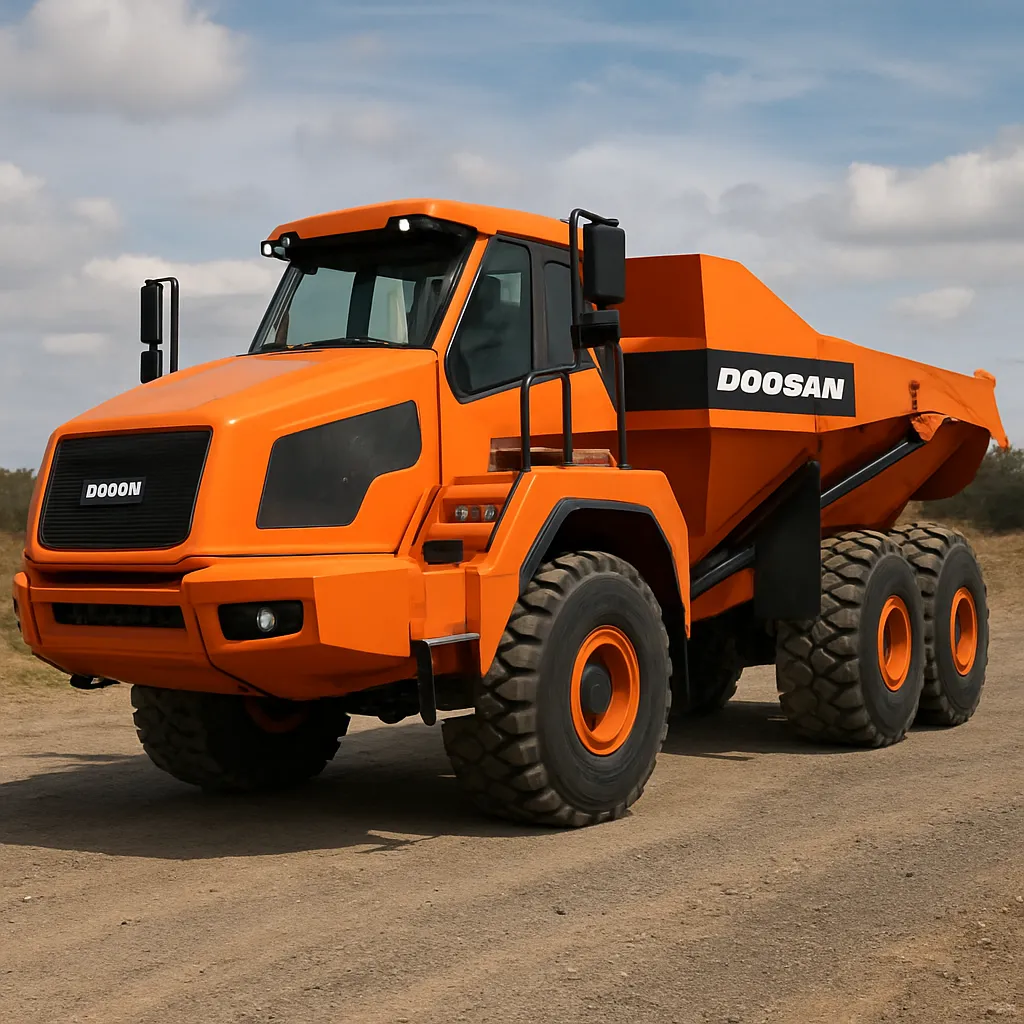
The Doosan DA45-7 is a heavy-duty articulated hauler designed for demanding earthmoving, quarrying and mining tasks where high capacity, off-road mobility and robust construction are essential. In this article you will find an overview of the machine’s design philosophy, typical applications, technical characteristics, safety and operator comfort features, and practical advice for maintenance and procurement. Wherever possible, I include representative specifications and operational figures — note that exact values can vary by market, optional configurations and production year.
Design and key features
The Doosan DA45-7 is built around the principle of delivering high on-site productivity while ensuring low operating costs and ease of service. As an articulated hauler, it features a front power unit connected to a rear dump body by an articulated joint that provides excellent maneuverability over rough, uneven ground. The design priorities for this class of machine are stability on slopes, robust drivetrain components, and a dump body capable of handling large volumes of loose material.
Typical design highlights include:
- Heavy-duty structure and reinforced chassis for long service life in abrasive environments.
- Articulated steering with an oscillating rear bogie, which improves ground contact and traction on uneven surfaces.
- Hydraulically operated dump body with optimized geometry for fast unloading and material flow.
- Powertrains calibrated to balance acceleration, gradeability and fuel consumption under heavy loads.
- Service access points and modular components aimed at shortening routine maintenance time.
The DA45-7 typically competes in the 40–50 tonne payload class and is engineered to accept several body types — standard rock bodies, high-capacity boxes, and wear-resistant liners for abrasive materials. This modular approach lets operators tailor the machine to specific site duties and materials.
Applications and work environments
The Doosan DA45-7 is intended for large-scale earthmoving operations where both capacity and mobility are required. Common application sectors include:
- Quarries and aggregates — hauling blasted rock and crushed aggregate from pit to crusher or stockpile.
- Mines (surface mining) — transporting overburden, ore and waste material, often across long ramps and uneven terrain.
- Major civil engineering and infrastructure projects — highways, dams, airports and large construction sites requiring high daily material throughput.
- Land reclamation and site development — moving large volumes of fill material and preparing foundations.
- Logging and biomass operations — in configurations adapted for non-mineral bulk materials or with protective guarding in forestry sites.
Because of its articulated steering and robust traction capability, the DA45-7 performs particularly well in applications where access is constrained and surfaces are soft, muddy or uneven. It is often chosen over rigid-frame haulers for jobsites with frequent changes of direction, narrow ramps and poor road quality.
Performance and representative specifications
Below are representative specifications for the DA45-7 class; actual values depend on configuration, regional options and whether the machine is sold under different markets or model designations. Treat these numbers as typical ranges rather than exact factory figures.
- Payload: approximately 40–45 tonnes (45,000 kg nominal class)
- Body capacity: typical struck volume 18–22 m³, heaped volume 25–30 m³ depending on body style
- Engine power: in the range of 300–370 kW (approximately 400–500 hp), depending on engine model and emissions package
- Top travel speed: up to 50–55 km/h empty (governed), lower when loaded depending on gearing and site gradients
- Operating weight: roughly 28,000–36,000 kg depending on specification and body option
- Fuel tank capacity: commonly 600–900 liters (varies with options and region)
- Turning radius: compact for the class due to articulation, typically under 10–11 m
- Gradeability: designed to handle steep ramps found in mines and quarries, often greater than 30% when properly configured
- Braking: service brakes typically wet-disc type on all wheels, often supplemented by an engine or retarder braking system for downhill control
Fuel consumption is situational: under heavy working cycles in quarry or mining conditions, typical average fuel burn can range from about 25 to 45 liters per hour. Real-world fuel usage depends on load cycles, operator technique, site gradients and transmission strategy.
Drivetrain, suspension and traction
The drivetrain in machines like the DA45-7 is optimized for torque delivery and reliability. They commonly feature an automatic powershift transmission with multiple gears designed for heavy starting torque and efficient high-speed travel on haul roads. The articulation joint and oscillating rear bogie enhance wheel contact and traction, allowing the truck to maintain momentum across rough ground.
Key mechanical elements typically include:
- Heavy-duty axles with planetary final drives for high torque at the wheels.
- Differential locks or torque proportioning depending on model and options.
- Advanced traction control logic integrated into electronic control units to minimize wheel slip and maximize rimpull.
These components are selected to reduce downtime and extend the service life of wearable items, which is critical in high-hour environments like mining.
Operator comfort, safety and modern technology
Operator environment improvements are a major focus on contemporary articulated haulers, and the DA45-7 follows this trend by incorporating features that boost productivity through reduced fatigue and increased situational awareness.
Cab and operator features commonly include:
- Spacious, climate-controlled cab with ergonomic seat and controls to reduce operator fatigue and improve cycle times.
- High-visibility glazing and camera systems (rear-view and optional side cameras) to support safe maneuvering and reversing.
- Integrated telematics and fleet management systems (for example Doosan fleet connectivity solutions) that allow remote monitoring of machine health, utilization and fuel consumption, improving uptime and maintenance planning.
- Advanced instrument clusters and operator aids such as gear selection logic, payload monitoring and diagnostic displays.
- ROPS/FOPS certified structures and multiple egress points to maximize operator protection.
Safety systems often extend to features like automatic shutdown in critical fault conditions, emergency braking assistance, and stairways/handrails designed for safe access during routine inspections.
Maintenance, serviceability and lifecycle costs
Lifecycle cost management is a central consideration when selecting large articulated haulers. The DA45-7 family emphasizes ease of access to key service points — ground-level filters, wide-opening service doors, centralized lubrication points and modular components that can be changed without pulling the entire machine apart. This reduces downtime and lowers labor costs for scheduled maintenance.
Best practices for minimizing total cost of ownership include:
- Adhering to manufacturer service intervals for oil and filter changes, hydraulic oil sampling, and cooling system checks.
- Using telematics to schedule preventive maintenance before small issues escalate into costly failures.
- Investing in operator training to reduce abusive starts, unnecessary idling, and poor shifting habits that increase wear and fuel use.
- Specifying appropriate body liners and wear packages for abrasive applications to extend component life.
Resale value for this size class tends to be influenced strongly by machine hours, service history, and the condition of critical components such as axles, transmission and body structure. Purchasing extended warranty and service agreements can be cost-effective for high-utilization operations.
Comparisons and market position
The DA45-7 competes with articulated haulers from major manufacturers in the 40–50 tonne class, including models from Volvo, Caterpillar, Bell and Komatsu. Buyers typically evaluate machines on three core axes:
- Productivity: payload capacity times cycle frequency — influenced by machine speed, loading efficiency and operator ergonomics.
- Reliability and uptime: build quality, ease of service, dealer support and availability of parts.
- Total cost of ownership: acquisition cost plus fuel, maintenance and resale value over the machine’s working life.
Doosan’s market approach often emphasizes competitive pricing combined with solid component selection and a broad dealer network in many regions. For operations where initial capital cost is a significant factor but support and parts availability are still required, Doosan machines have been a popular choice.
Sustainability and emissions
Modern articulated haulers, including models in the DA45-7 class, comply with current emissions standards in their respective sales regions. Engines are offered with after-treatment packages (such as SCR and particulate filters where required) to meet EPA or EU stage regulations. Manufacturers are also pursuing improved fuel efficiency through optimized drivetrains and control algorithms.
Operators can further reduce environmental impact by:
- Implementing efficient haul road design to reduce cycle times and fuel burn.
- Using telematics to monitor and reduce idling and unnecessary engine hours.
- Specifying low-rolling-resistance tires and correct tire pressures to minimize fuel use.
Buying advice and configuration tips
If you are evaluating a DA45-7 (or any comparable articulated hauler) for purchase or fleet expansion, consider the following practical tips:
- Analyze your typical load profile and material density to choose the correct body capacity and floor configuration. A larger heaped volume is useful for low-density materials, but heavier materials may require a smaller, higher-strength body.
- Request fleet telematics access during the demo period to verify real-world fuel consumption and cycle times on your site.
- Specify wear packages up front in abrasive applications — retrofits can be expensive and time-consuming.
- Confirm local dealer support, parts availability and the cost of major components (axles, transmission) before purchase — these influence lifecycle economics most.
- Evaluate optional safety and operator comfort packages — these often pay back through improved productivity and reduced downtime.
Summary
The Doosan DA45-7 is a purpose-built articulated hauler classically suited to high-volume material transport in demanding off-road environments. Its strengths lie in robust construction, articulated mobility for difficult terrain, and a set of operator and telematics features that help optimize uptime and reduce operating costs. Typical specifications place it in the 40–45 tonne payload bracket with body volumes and engine power appropriate to quarry and mining duties. When selecting a machine of this class, pay careful attention to configuration, dealer support and fleet management capabilities — these factors determine how effectively the machine will contribute to your project’s productivity and cost control.


)
)