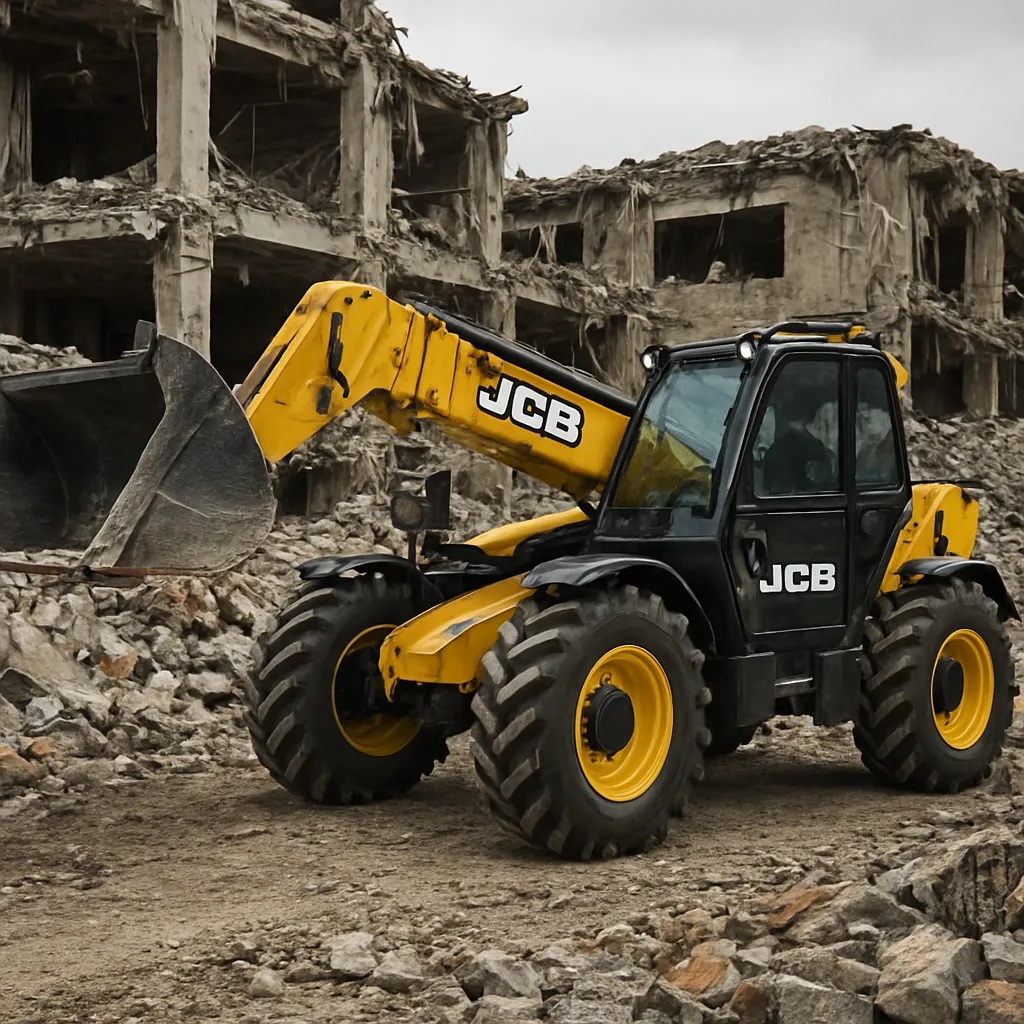
The JCB 555-260 represents a class of heavy, multi-role machines designed to bridge the gap between powerful demolition equipment and high-capacity telehandlers. In environments that demand both reach and brute force — from demolition sites and recycling yards to heavy civil engineering projects and ports — this type of machine delivers versatility, strength and site efficiency. The following article examines where such a machine excels, its main technical and operational characteristics, common attachments and configurations, safety and maintenance considerations, and the broader market context in which it operates.
Overview and Core Capabilities
The JCB 555-260 is positioned as a heavy-duty solution for applications that require both substantial lifting capacity and robust demolition capability. Combining the long reach and load-handling geometry of a telehandler with the structural strength and attachment flexibility of a demolition machine, it is engineered for sites where one machine must perform multiple demanding tasks without frequent swaps.
Design philosophy and structure
At its core, this machine emphasizes rigid undercarriage or heavy-duty chassis options, reinforced booms and high-capacity hydraulic systems capable of operating large demolition attachments. Key elements of the design typically include:
- Reinforced boom and boom pivot points to withstand lateral and compressive forces during demolition and heavy lifting.
- High-flow hydraulic pumps and reinforced hydraulic lines for reliable operation of breakers, shears and grapples.
- Heavy-duty axles or track undercarriage options to provide stability on rough ground and during lifts at height.
- Modular front-end attachment plate or rapid coupler to switch quickly between forks, buckets, grapples, hammers and specialist demolition tools.
- Advanced operator cabin with visibility, climate control and options for enhanced protection such as FOPS/ROPS and demolition guards.
Powertrain and emissions
Machines in this segment are typically powered by turbocharged diesel engines sized to deliver robust low-end torque rather than top-end speed. Emissions compliance is an important design criterion: recent model iterations from major manufacturers such as JCB meet Stage IV / Tier 4 Final or equivalent standards in many markets. Key powertrain attributes include:
- High-torque diesel engine tuned for continuous heavy-duty cycles.
- Hydrostatic or powershift transmissions optimized for precise control during lifting and demolition operations.
- Cooling systems designed for dusty, stop-start demolition environments, often with reversible fans or easy-clean cores.
Applications and Use Cases
One of the main strengths of the JCB 555-260 concept is its adaptability. Because it combines long reach and heavy lifting with demolition-capable hydraulics and structure, it finds application in a wide array of sectors.
Primary application areas
- Demolition and structural stripping — Extended-reach attachments and heavy-duty hydraulic support allow safe removal of structural elements from height, selective dismantling and preparation for material recycling.
- Scrap and recycling yards — Grapples, shears and magnet attachments enable efficient sorting and processing of metals, concrete and mixed demolition waste.
- Port operations and logistics — High-capacity handling of palletised goods, containers’ support tasks or loose bulk materials where reach and lifting power are necessary.
- Quarrying and aggregate handling — Loading trucks, moving coarse materials, and supporting crusher or screening operations with heavy buckets and clamshells.
- Infrastructure and civil engineering — Support for bridge repair, roadworks and heavy utility installations where both reach and excavation/demolition tools are required.
- Industrial maintenance — On-site heavy lifting, rigging and equipment relocation tasks inside large plants.
Specialist scenarios
Beyond these common uses, the machine type also suits specialist roles such as controlled dismantling in congested urban sites (where precision reach reduces collateral damage), emergency response (collapse clearance) and large-scale land reclamation projects where both lift-and-place and material processing functions are needed on the same chassis.
Attachments and Tooling
Versatility depends almost entirely on attachment options. The JCB 555-260 platform supports a wide list of tools that transform it from a telehandler to a demolition powerhouse or a materials handler in minutes.
Common attachments
- Hydraulic breakers — For concrete breaking and heavy demolition. Requires high-flow hydraulics and robust boom mounting.
- Shears and pulverisers — For cutting rebar, steel structures and fragmenting concrete.
- Grapples and orange-peel buckets — For bulk scrap handling, sorting and loading operations.
- Forks and pallet forks — For construction logistics and materials placement when used as a telehandler.
- Clamshell buckets — For bulk material handling in port and quarry settings.
- Winches and lifting beams — To support controlled lifting and rigging operations.
Attachment management and hydraulic considerations
To support such a variety of tools, these machines typically feature:
- High-flow, variable-displacement piston pumps for responsive hydraulic power.
- Multiple auxiliary hydraulic circuits with proportional controls for fine-tuned attachment operation.
- Quick couplers and hydraulic interlocks to minimize downtime during tool changes and to ensure safe attachment locking.
Operator Environment and Controls
Modern heavy-duty telehandler-demolition hybrids place emphasis on ergonomics and safety. Efficient operation reduces fatigue and increases productivity, particularly in long demolition shifts or busy loading cycles.
Cab features
- Spacious cabin with panoramic visibility to monitor both the load and attachment areas.
- State-of-the-art joysticks with multi-function controls and programmable response curves for different attachments.
- Integrated displays showing hydraulic pressures, load radius and optional CCTV feeds for rear or attachment views.
- Climate control, suspension seats and sound-damped cabins to reduce operator fatigue and improve concentration.
Telematics and remote monitoring
Most contemporary JCB machines include the manufacturer’s telematics system (for example, LiveLink on JCB machines) which provides fleet managers with live data on machine location, fuel consumption, hours, service alerts and fault codes. Benefits include improved uptime, predictive maintenance planning and optimized fleet utilization.
Safety Features and Best Practices
Operating a heavy demolition-capable telehandler requires strict safety protocols. The platform’s power and reach multiply hazards if not managed correctly, so manufacturers fit machines with multiple protective and preventative systems.
Built-in safety systems
- Load-sensing and overload protection systems that prevent lifts beyond safe limits and provide alarms when operating near rated capacity.
- Stability control systems that monitor chassis tilt, boom angle and load geometry to prevent tip-over incidents.
- Cab protection options such as ballistic-style screens, FOPS (Falling Object Protective Structures) and reinforced glazing for demolition tasks.
- Emergency stop systems and easily accessible shutoffs for hydraulic power.
Operational best practices
- Always use the proper attachment rated for the machine’s hydraulic flow and lifting capacity.
- Conduct pre-shift inspections focusing on hydraulic lines, boom wear points, couplers and undercarriage condition.
- Adhere to lift charts for the specific attachment and boom configuration—reach increases reduce rated capacity significantly.
- Use taglines, spotters and cameras in congested or low-visibility demolition environments.
Maintenance, Lifecycle and Total Cost of Ownership
For heavy machines that are frequently exposed to abrasive materials, impacts and continuous hydraulic load cycles, a robust maintenance regime is essential to control life-cycle costs and maximize uptime.
Key maintenance areas
- Hydraulic system: Regular fluid and filter changes, inspection of hoses and fittings for wear or damage.
- Boom and pins: Lubrication, non-destructive testing where applicable, and prompt replacement of worn pins/bushes.
- Engine and cooling: Frequent air-filter changes and radiator/charge-air cooler cleaning to avoid power loss in dusty sites.
- Undercarriage/axles: Track tension, tire condition and axle seals must be checked, especially after heavy lifting or travel across rough terrain.
Lifecycle management
Properly maintained machines of this class often retain good resale value, especially when equipped with up-to-date safety features and telematics history. Fleet managers typically evaluate total cost of ownership by considering:
- Acquisition cost and financing terms
- Fuel consumption per operating hour and typical duty cycle
- Planned maintenance intervals and parts availability
- Operator training needs to reduce misuse-related wear
- Residual value and market demand for used heavy demolition/telehandler hybrids
Performance Metrics and Typical Specifications (Class Context)
While exact manufacturer figures for the 555-260 should be confirmed with official data sheets, machines in this heavy telehandler/demolition class commonly exhibit the following performance characteristics:
- Operating weight: often in the multi-ton range designed to provide stability during high-reach lifts.
- Engine power: typically tuned for sustained low-end torque; expected output is in the mid-hundred to low-hundred kilowatt range for machines serving both demolition and telehandler roles.
- Maximum lift capacity: varies with boom length and configuration; capacity declines as reach increases, which is accounted for in detailed load charts.
- Hydraulic flow: high-flow auxiliary circuits to handle breakers and shears, frequently adjustable to match attachment requirements.
Always consult the manufacturer’s rated load charts and specifications for precise numbers on lifting capacities, reach limits and engine outputs for the 555-260.
Market Context and Industry Trends
The segment occupied by heavy telehandlers and demolition-ready machines is shaped by broader trends in construction, recycling and infrastructure investment. Relevant dynamics include:
Demand drivers
- Urban renewal and renovation projects that favor selective demolition and material recycling over total teardown.
- Increased regulation and incentives for recycling demolition material, requiring machines capable of sorting and processing on-site.
- Large infrastructure programs and port expansions that create demand for high-capacity handling equipment with long-reach capability.
Technology trends
- Telematics and fleet connectivity for improved maintenance planning and utilization tracking.
- Attachment intelligence — smart attachments that communicate with the machine to optimize hydraulic flow and safety limits.
- Electrification and hybrid drivetrains under development for specific use cases to reduce local emissions and operating noise in urban environments.
Economic and statistical notes
Precise global statistics for a single model are often proprietary, but some general observations can be made:
- Manufacturers report steady growth in demand for machines that combine handling and demolition capabilities as owners seek to reduce fleet size and improve utilization.
- Used-equipment markets for heavy telehandlers/demolition hybrids remain active in regions with high renovation activity; machines with comprehensive telematics logs frequently command premiums.
- Market analysts tracking the broader telehandler and material-handling segments note moderate year-on-year growth driven by construction and logistics; the emergence of demolition-focused handling machines is a subtrend within this space.
Comparison with Alternatives
Understanding whether a JCB 555-260-style machine is the right choice requires comparing it to other options.
Versus dedicated excavators
- Excavators are purpose-built for earthmoving and heavy demolition; they may offer superior stability and larger attachment mass but lack the same reach-to-payload ratios and telehandler-style quick load-placement agility.
- The hybrid telehandler-demolition machine provides better multi-role flexibility on mixed sites where both material handing and selective demolition are required.
Versus traditional telehandlers
- Traditional telehandlers excel at lifting and placing palletised loads and light construction tasks but may lack the reinforced structure, hydraulic flow and attachment mounting strength for heavy demolition.
- Heavier machines like the 555-260 bridge that gap by offering the lifting geometry of a telehandler and the structural robustness needed for demolition tools.
Procurement and Fleet Integration
For companies considering adding this type of machine to their fleet, several procurement and operational considerations are important:
Selection criteria
- Primary task profile: prioritize rated lift capacity and reach if materials handling dominates, or choose reinforced hydraulic and boom structure for demolition-heavy work.
- Attachment ecosystem: ensure local availability of key tools (breakers, shears, grapples) and spares.
- Service network and telematics support: strong dealer coverage and remote diagnostics reduce downtime risk for critical assets.
- Operator training and safety certification: allocate budget for training to ensure safe, efficient use of multifunctional equipment.
Financing and utilization
Many fleets opt for flexible financing solutions such as leasing or long-term rental to match machine costs with project cycles. Utilization tracking through telematics helps justify ownership by demonstrating hours of productive use and identifying opportunities for redeployment across sites.
Conclusion
The JCB 555-260-style machine is emblematic of a broader move toward multi-role heavy equipment that reduces fleet complexity while delivering powerful performance. By combining robust structural design, high-flow hydraulics, advanced cab ergonomics and a wide attachment range, such machines provide a compelling solution for demolition, recycling, material handling and heavy civil works. Key advantages include operational versatility, reduced need for multiple specialist machines, and improved site efficiency when managed with disciplined maintenance and telematics-driven fleet oversight.
Key words emphasized for quick reference: JCB, telehandler, demolition, lifting, attachments, safety, LiveLink, hydraulics, efficiency, operator.


)
)