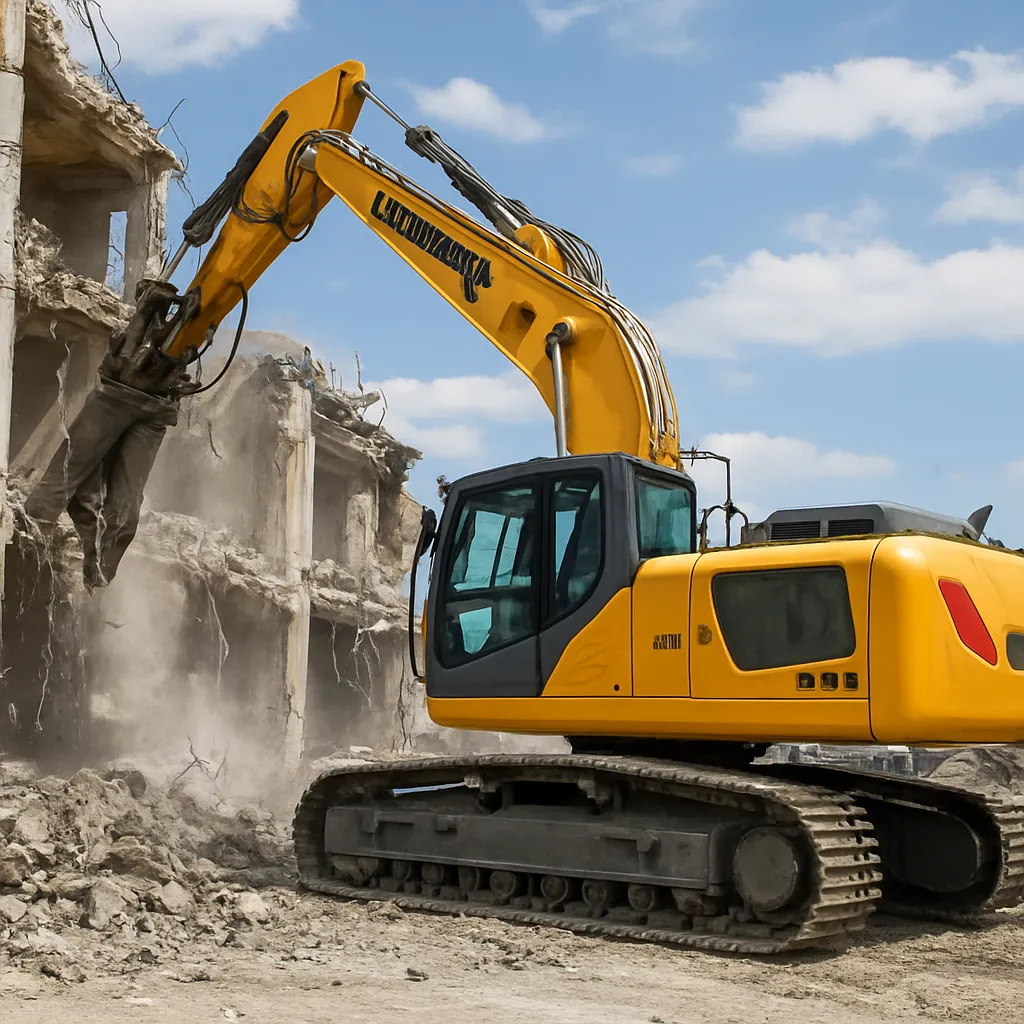
The Liebherr R 930 Demolition is a purpose-built excavator variant designed to meet the demanding requirements of modern demolition projects. Combining reinforced structural components, specialized boom and arm geometries, and advanced hydraulic systems, this machine aims to maximize safety, reach, and productivity on complex dismantling tasks. In the following sections, you will find an in-depth look at the machine’s design philosophy, typical technical parameters and configurations, real-world applications, attachments and customization options, as well as operational, safety and maintenance considerations.
Overview and design philosophy
The R 930 Demolition is part of Liebherr’s R 900 series family tailored specifically for heavy-duty dismantling and deconstruction work. Unlike standard construction excavators, demolition models focus on three central priorities: operator protection, structural reinforcement for impact loads and extended reach for high or difficult-to-access structures. These priorities translate into a reinforced undercarriage, specially designed demolition booms and arms, and cab protection systems that are optimized for falling debris and shock loads.
The machine is engineered to offer high precision in controlled dismantling while maintaining robust resistance to the stresses of repetitive impact. Its hydraulic system is tuned for smooth, predictable motion and for delivering the continuous power required by hydraulic breakers, shears and pulverizers. Liebherr integrates telematics and diagnostics to assist fleet managers and owners in monitoring machine health and utilization, optimizing uptime and lifecycle costs.
Demolition, safety and stability are the central themes of the R 930 Demolition’s design. Additional focuses include operator ergonomics, ease of service, and adaptability to a broad range of attachments — all intended to maximize project efficiency and protect personnel.
Technical characteristics and typical specifications
Specifications for demolition variants often vary depending on model year, regional emissions regulations, and optional equipment chosen for specific tasks (high-reach booms, counterweight packages, undercarriage options). The figures below represent typical ranges and features commonly associated with the R 930 Demolition class. Exact machine specifications should always be confirmed with the manufacturer or dealer for the specific serial number and configuration.
Typical dimensional and weight data
- Operating weight: approximately 28,000 to 36,000 kg (range depends on boom/arm, counterweights and attachments).
- Transport dimensions: typical width and height will vary with protective guarding and cab options; transport planning usually requires detachable counterweights and booms for road mobility.
- Ground pressure and undercarriage: reinforced crawler undercarriage with heavy-duty track frames and optional wider tracks to reduce ground pressure on soft surfaces.
Powertrain and hydraulic system
- Engine power: commonly in the mid-range class (roughly 130–200 kW depending on engine tuning and emissions stage); modern units adhere to regional emissions standards such as Stage V / Tier 4 Final where applicable.
- Hydraulic features: high-flow, variable-displacement pumps for continuous power delivery to attachments; multiple hydraulic circuits to run breaker, shear, grapple and rotation functions simultaneously.
- Hydraulic oil cooling: oversized coolers and robust filtration systems for continuous operation at high loads typical in demolition.
Demolition-specific structural features
- Reinforced boom and arm: thicker steel sections, strengthened welds and gussets to resist bending and impact loads.
- Cab protection systems: heavy-duty FOPS/ROPS frames, front windshield guards, and optionally fully enclosed protection cages for high debris exposure.
- Counterweight systems: modular counterweights to optimize stability for a variety of tasks and reach configurations.
Attachments compatibility is central to the R 930 Demolition’s versatility: hydraulic breakers, shears, sorting grapples, pulverizers, crushers and specialized quick couplers enable a single chassis to perform multiple demolition tasks. The combination of a powerful hydraulic system and reinforced structure allows attachment manufacturers to optimize tool design for high productivity and long life.
Primary applications and environments
The R 930 Demolition is suited to a wide range of deconstruction and site clearance tasks. Its fundamental advantages — reinforced structure, safety systems and attachment versatility — make it a preferred machine in demanding environments where precision and protection are essential.
Building demolition and selective dismantling
- Low- to mid-rise structure demolition: ideal for removing façades, internal walls and superstructures where reach and operator visibility matter.
- Selective dismantling: controlled removal of structural elements (concrete slabs, steel frames) where minimizing collateral damage is required.
Industrial and plant decommissioning
- Safe removal of heavy equipment and building components inside plants, where steel cutting shears and material handling grapples are frequently used.
- Complex sequencing and the need to work around sensitive installations make the R 930’s precision hydraulics and operator protection essential.
Shipbreaking, port and scrap handling
- Scrap processing and ship dismantling tasks often require durable machines with strong hydraulics and robust booms for handling heavy, irregular loads.
- Sorting grapples and rotating attachments increase productivity for material segregation and loading into containers or processing lines.
Urban demolition and renovation
- Working in confined urban sites benefits from compact footprint options, reduced noise and emission packages, and high operator awareness systems to avoid incidental damages.
- Dust-control compatibility and integration with water-spray or vacuum systems are common requirements in city projects.
Across these applications, the R 930 Demolition excels where a balance of mobility, power and protection is needed. Its modularity — changeable attachments, booms and counterweights — reduces the need for multiple machines on a jobsite.
Attachments, customization and job-specific options
A key strength of demolition excavators is the ability to be customized for a project through attachments and optional equipment. The R 930 Demolition supports a broad ecosystem of tools and factory or dealer-installed upgrades to match the machine to the task.
Common demolition attachments
- Hydraulic breakers (hammers): for breaking concrete, rock and heavily reinforced structures; benefit from accumulator-supported hydraulic circuits for consistent impact energy.
- Shears and multi-processors: designed to cut steel beams, rebar and ducting; rotating heads add flexibility and precision.
- Crusher and pulverizers: for secondary demolition and size reduction of concrete for recycling.
- Sorting and demolition grapples: for handling debris, selective sorting and lifting operations.
- Extended reach booms: for safely dismantling taller structures from the ground without erecting scaffolding or towers.
Operator and site safety options
- Advanced cab protection: laminated glass, steel grills, interior padding and emergency egress enhancements.
- Camera systems and proximity sensors: enhancing visibility around the machine and reducing blind spots in crowded sites.
- Remote-control and semi-remote operation: available for high-risk areas where human presence in the cab may be dangerous.
- Dust suppression systems: integrated water lines or on-tool spray systems to limit airborne particulates during breaking operations.
Environmental and efficiency options
- Engine tuning to meet Stage V / Tier 4 Final standards where required, along with DOC/DPF after-treatment systems.
- Eco modes and load-sensing hydraulics to reduce fuel consumption in non-peak phases.
- Telematics systems (e.g., Liebherr LiDAT): for remote monitoring of fuel use, maintenance intervals and machine utilization to improve fleet efficiency.
Custom configurations often require collaboration between the owner, dealer and attachment manufacturers to ensure hydraulic flows, pressure ratings and mechanical interfaces are fully compatible and optimized for the intended operations.
Operational considerations, safety and best practices
Demolition work poses unique hazards: falling debris, structural instability and variable material conditions. To safely and efficiently operate an R 930 Demolition, project teams should adopt industry best practices and leverage the machine’s specialized features.
Planning and risk assessment
- Pre-demolition surveys: identify structural vulnerabilities, hazardous materials (asbestos, lead), and adjacent risks to utilities and neighboring structures.
- Sequence planning: plan a demolition sequence that preserves stability and provides controlled fall zones for debris.
- Transport and logistics: plan for disassembly or transport permits if the machine must be moved with extended reach components attached.
Operator training and certification
- Operators should be trained in demolition-specific techniques, attachment handling and emergency procedures.
- Familiarity with remote-control features, camera systems and the machine’s electronic safety interlocks is essential.
Maintenance regimes and lifecycle management
- Regular inspections of structural welds, pins, bushings and hydraulic hoses are critical due to repetitive impact loads.
- Hydraulic oil sampling and filter changes at recommended intervals prolong component life and maintain attachment performance.
- Use of manufacturer-approved parts and scheduled service by certified technicians helps preserve residual value.
Safety systems such as FOPS and ROPS, along with well-maintained brakes, slew brakes and service brakes, are non-negotiable for demolition sites. The machine’s electronics and telematics should be used to track operating hours and predict maintenance needs to avoid unplanned downtime.
Performance metrics and industry data
Quantifying demolition machine performance can be challenging because productivity depends heavily on attachment choice, operator skill and task complexity. Nonetheless, some commonly tracked metrics and statistics help owners judge effectiveness:
- Hourly fuel consumption: varies by attachment and task; when operating hydraulic breakers or shears continuously, consumption rises significantly compared to routine lifting or sorting. Typical mid-class demolition excavators may average between 12–25 liters/hour depending on load profile.
- Material handling throughput: depends on attachment and job mix; a combination of crusher and sorting grapple on an efficient site can process several tens to hundreds of tons per shift on well-prepared jobs.
- Uptime and availability: modern telematics helps achieve 85–95% availability on well-maintained fleets; predictive maintenance can reduce downtime significantly.
- Return on investment (ROI): owners typically evaluate demolition excavators by cost-per-ton of processed material, integrated fuel and maintenance costs and machine utilization rates over the machine’s service life (often 8–15 years depending on intensity of use).
Manufacturers and rental companies frequently publish utilization and productivity studies on machine classes. For accurate benchmarking of the R 930 Demolition, consult dealer case studies, rental-house reports and project-specific time-and-motion analyses.
Maintenance, lifecycle and resale considerations
Demolition machines endure heavier wear than general-purpose excavators, so proactive maintenance and component management are essential to preserving value and ensuring safety.
Wear parts and inspection focus
- Pins and bushings: frequent greasing and periodic replacement are standard to prevent excessive wear from lateral loads and debris ingestion.
- Hydraulic cylinders and hoses: check for abrasion and pressure-cycle fatigue; protective sleeves help extend hose life in abrasive conditions.
- Undercarriage: track shoes, rollers and idlers wear rapidly on abrasive rubble; track tension and cleaning are important daily checks.
Refurbishment and resale
- Well-documented maintenance histories and OEM refurbishment programs can significantly increase resale value of demolition machines.
- Many demolition machines find secondary careers as general excavators after booms and protective structures are changed or downgraded, expanding useful life and resale markets.
Owners who invest in scheduled inspections, OEM parts and trained service providers often achieve lower total cost of ownership over the machine’s lifecycle. Telematics-driven maintenance planning further helps minimize unexpected failures.
Case uses, practical advantages and limitations
Real-world deployments illustrate the R 930 Demolition’s strengths and the limits to consider when specifying equipment for a project.
Advantages
- High levels of operator protection enable work in hostile environments with reduced risk.
- Attachment versatility lowers the need for multiple dedicated machines on site.
- Robust hydraulics and reinforced structures provide excellent tool compatibility and longevity in abrasive demolition duties.
- Telematics and modern engine controls improve fuel efficiency and fleet management.
Limitations and considerations
- Extended-reach configurations increase transport complexity and may require disassembly for road travel.
- Heavier counterweights and larger booms add mass, which can restrict access in sites with weight or ground-bearing limitations.
- Intense use in abrasive environments demands rigorous maintenance — neglect can significantly shorten component life.
Overall, the R 930 Demolition fits projects requiring a mid-class machine with strong protection and a wide range of attachments. For extremely large structures or very high-reach demolition, larger specialized machines may be more appropriate; for small interior work, compact demolition excavators or remote systems could be preferred.
Conclusion
The Liebherr R 930 Demolition represents a purpose-built solution for many demolition and deconstruction challenges. By combining reinforced structures, advanced hydraulics, a wide attachment ecosystem and enhanced safety features, it addresses the primary needs of demolition contractors — productivity, protection and versatility. Selecting the right configuration and attachments, maintaining a disciplined inspection and service schedule, and employing trained operators ensures the machine delivers value and longevity across diverse demolition environments.
Safety, attachments, hydraulics, stability, telemetry, productivity, maintenance, operator comfort, efficiency and durability are the defining themes to evaluate when considering the R 930 Demolition for a fleet or a specific project. For exact technical data, fuel consumption curves, and variant-specific weights and dimensions, consult the manufacturer’s product sheets or your local Liebherr dealer to ensure the machine matches the particular demands of your demolition work.


)
)