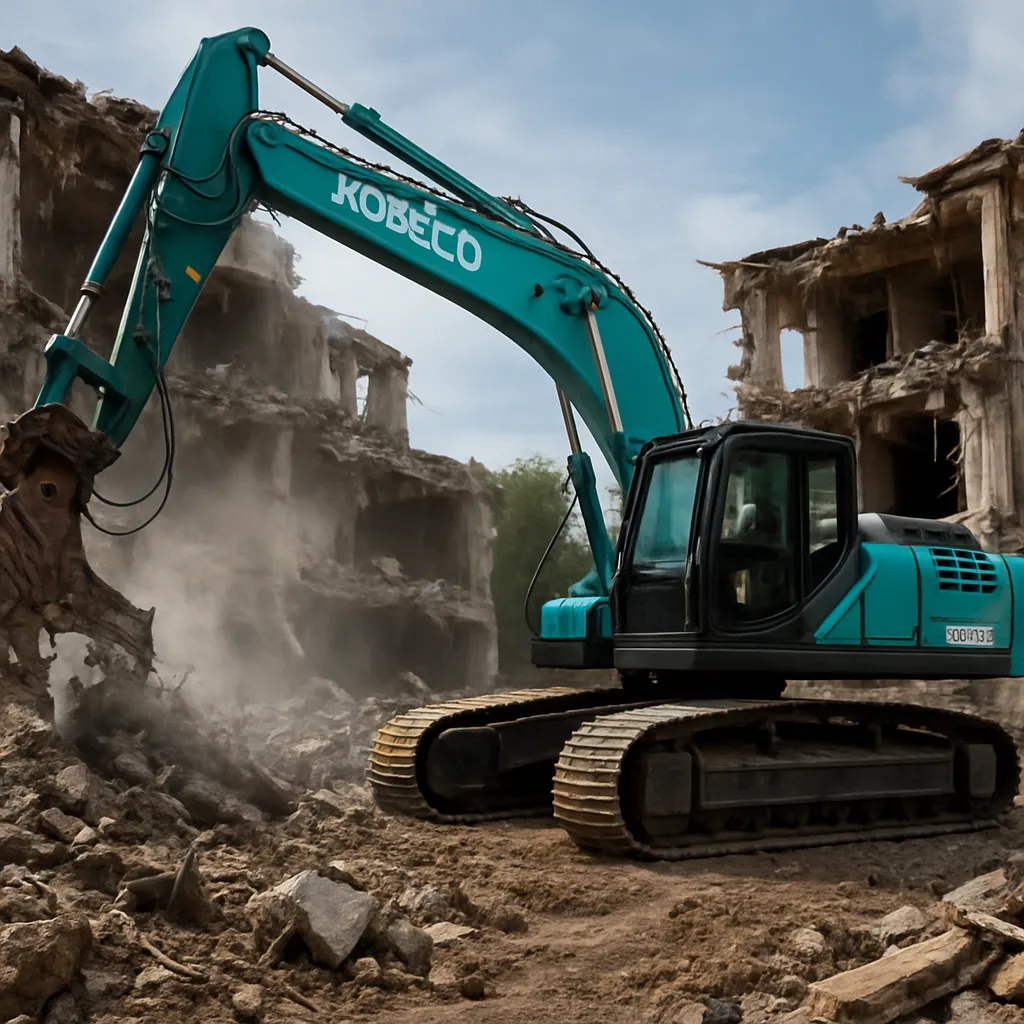
The Kobelco SK300DLC demolition variant is a purpose-adapted mid-class excavator commonly employed where robust tearing-out power, controlled precision and safe high-reach operations are required. Combining the platform of a reliable 30-ton-class base machine with demolition-specific modifications, this model is valued by contractors for its balance between lifting capacity, stability and adaptability to a wide range of attachments. In the sections that follow, we explore the machine’s design highlights, typical jobsite applications, available attachments and safety considerations, as well as performance, maintenance and market context.
Design and key technical features
The SK300DLC demolition configuration builds on the SK300 series’ chassis and hydraulic architecture but is tailored for heavy-duty dismantling tasks. Key design goals are structural reinforcement, improved reach options and enhanced stability to cope with the dynamic loads experienced during demolition work.
- Kobelco SK300DLC base: typically derived from the SK300LC platform, which places the machine in the approximately 30-ton operating weight class (exact mass depends on counterweights and attachments).
- Reinforced structures: boom, arm and upper-structure reinforcements reduce flex and increase fatigue life when used with heavy demolition tools.
- Hydraulic system: flow and pressure are optimized for attachment power and responsiveness; pilot-control systems and proportional auxiliaries allow precise control of breakers, shears and grapples.
- Counterweight options: modular or custom counterweights improve stability for high-reach or heavy-lift tasks; these are critical for safe operation during extended reach demolition.
- Operator station: often modified with additional protection and optional control refinements for demolition-specific operations.
Manufacturers and dealers may offer factory or aftermarket demolition packages that include a long-reach boom, specialized counterweights, protective cages and upgraded hydraulic circuits. These packages affect the overall weight, center of gravity and transport requirements.
Applications and jobsite use
The SK300DLC demolition variant is used across a broad spectrum of demolition and civil works tasks. Its versatility makes it suitable for urban renovation projects as well as industrial teardown operations.
- Structural demolition: selective dismantling of multi-storey concrete and steel structures where precision is needed to protect adjacent buildings or infrastructure.
- Selective deconstruction: interior stripping and removal of finishes, MEP components and non-structural partitions in staged renovations.
- High-reach demolition: with specialized booms, the machine can be equipped to reach higher elevations than a standard excavator while maintaining stability for controlled material dropping.
- Material processing: handling and sorting of demolition debris, including fed operation for mobile crushers and screening plants.
- Industrial demolition and plant dismantling: removal of steel frameworks, pipe racks and equipment using shear and grappling tools.
- Earthworks crossover: where jobs require both demolition and conventional excavation, the SK300DLC can be returned to standard digging roles (with suitable attachment changes).
In confined urban sites the machine’s compact superstructure (relative to larger long-reach units) and good power-to-weight ratio allow effective work where larger high-reach excavators are impractical. It is also common on rehabilitation projects where incremental removal and careful debris management are priorities.
Attachments and modifications for demolition
One of the strengths of the SK300DLC platform is adaptability through a wide range of attachments. Choosing the right tool is central to achieving fast, safe and cost-effective demolition.
Common attachments
- Hydraulic breakers (hammers) — for concrete breaking and primary reduction of reinforced slabs and foundations.
- Concrete crushers and pulverizers — designed to handle reinforced concrete, cut rebar and reduce material to manageable sizes for removal or on-site recycling.
- Shears — for cutting steel sections, rebar, and structural members; heavy-duty rotating shears allow multi-angle cuts.
- Grapples and sorting grabs — for selective material handling, sorting and loading; available in clamshell and multi-tine designs.
- Quick couplers and tiltrotators — to speed attachment changes and improve angle control, especially useful in restricted spaces.
- High-reach booms and extended arms — for reaching higher elevations; these are engineered to maintain hydraulic balance and structural integrity under load.
Demolition-specific modifications
- Operator protection kits: steel FOPS/ROPS cages, laminated windows, and mesh guards for added safety against falling debris.
- Hydraulic upgrades: additional auxiliary lines, flow-sharing valves and specialized cooling to handle prolonged heavy attachment use.
- Undercarriage and track options: reinforced track frames, wider shoes for improved ground pressure distribution when using added counterweights.
- Dust-suppression supports: mount points for water cannons and hoses to reduce dust during cutting and crushing operations.
- Transport considerations: modular boom and counterweight designs to ease road transport of extended-reach assemblies.
Selecting attachments must take into account machine hydraulic capacity, pin forces, reach limitations and the duty cycle expected on the project to avoid overstressing the base machine.
Safety, operator comfort and controls
Demolition work introduces unique hazards — falling debris, unstable structures and dynamic loadings — and the SK300DLC’s demolition configuration addresses these through both mechanical and human-centered design elements.
- Structural protection: reinforced cabin guarding, protective screens and sealed control enclosures reduce the risk of operator injury and equipment damage.
- Visibility and monitoring: optional cameras, proximity sensors and upgraded mirrors provide better situational awareness on congested sites.
- Control ergonomics: precision pilot controls, adjustable seating and climate systems reduce operator fatigue during long shifts, enhancing safety and productivity.
- Stability management: counterweight systems and boom geometry are designed to keep the machine within safe tipping parameters even when using heavy demolition attachments.
- Emergency systems: quick-isolation valves and emergency shut-down procedures are typically integrated for rapid response in the event of hydraulic or structural failure.
Training and site planning are equally important. Operators need demolition-specific certification in many jurisdictions, and pre-work structural assessments and lift plans are essential to avoid uncontrolled collapses.
Performance, efficiency and maintenance
Performance on demolition jobs is measured by cycle times, attachment productivity, fuel consumption and uptime. The SK300DLC aims for a balance between raw power and economical operation.
Performance factors
- Engine output and torque influence breaker impact energy and shear power. In the SK300-class range, engines typically deliver sufficient horsepower for heavy attachments while remaining within mid-weight transport limits.
- Hydraulic circuit efficiency affects response and sustained attachment performance. Efficient pumps and cooled oil circuits prevent overheating during continuous crushing or shearing.
- Undercarriage strength and track footprint determine ground-bearing pressure and mobility on uneven rubble surfaces.
Efficiency measures
- Use of appropriate attachment sizing to match hydraulic flow reduces cycle times and fuel usage.
- Eco and auto-idle engine management systems lower fuel consumption when the machine is not under load.
- On-site logistics and debris segregation improve overall project throughput by reducing remobilization and handling losses.
Maintenance and lifecycle
- Routine checks: daily inspection of hydraulic lines and attachment pins is crucial because demolition places concentrated stresses on these components.
- Wear parts: crushers, shears and grapples have consumable components that require regular replacement; maintaining a spare inventory reduces downtime.
- Structural monitoring: periodic non-destructive testing (NDT) of booms and arms can detect fatigue cracks before catastrophic failure.
- Manufacturer service packages: many contractors adopt OEM preventative maintenance plans to manage total cost of ownership and ensure warranty compliance.
Planned maintenance improves machine availability — a key financial metric on demolition contracts where delays are costly.
Market presence, comparisons and statistics
While specific production figures for the SK300DLC demolition variant vary by year and region, the SK300 family is broadly recognized in global markets for its reliability and suitability in mid-sized demolition tasks. Market demand for demolitions-capable excavators rose in many regions alongside increased urban redevelopment and renovation projects.
- Typical operating weight: approximately 28–34 tonnes depending on attachments and counterweights. This places the SK300DLC in the mid-class excavator bracket suitable for many urban demolition tasks.
- Engine power: machines in this class usually have engines delivering the equivalent of roughly 150–220 horsepower (110–165 kW); exact power depends on model year and emissions configuration.
- Common reach: standard configurations provide arm reach for ground-to-mid-level demolitions; dedicated high-reach kits can extend vertical reach significantly, often by several meters, but exact values depend on the boom/arm geometry chosen.
- Fuel consumption: heavy demolition cycles can increase fuel use relative to general earthmoving by 20–50% depending on attachment and duty cycle; use of eco-modes and optimized attachments can mitigate this.
- Residual values: demolition-adapted machines tend to retain value well when maintained, since robust structures and reinforced components are in demand for resale in the demolition and scrap industries.
Comparatively, the SK300DLC is positioned between lighter 20–24-ton machines that lack sufficient counterweight for heavy shears and larger 40–60-ton long-reach excavators designed for full-building demolition. Its niche is where moderate high-reach capability, mobility and lower transport costs are prioritized.
Case studies, best practices and operational tips
Real-world users of SK300DLC-type demolition machines report that disciplined planning and attachment management produce the best results. Below are common lessons and best practices drawn from contractor experience.
- Perform a thorough structural assessment before starting. Understanding load paths and potential collapse zones allows for a phased and safer approach to dismantling.
- Use the correct attachment for the task: breakers for primary reduction, crushers for secondary processing and shears for steel-cutting. Misuse of attachments increases wear and risk of damage to the base machine.
- Manage counterweight and reach trade-offs. Adding counterweight improves stability but increases transport logistics and ground pressure. Always calculate the machine’s center-of-gravity with the intended attachment and reach configuration.
- Implement dust and noise mitigation strategies on urban sites to comply with regulations and reduce community disruption — water suppression, enclosure of crushers and time-limited noisy operations help.
- Invest in operator training specific to demolition: control finesse, attachment change procedures and emergency response drills are essential for safe, efficient operations.
- Keep a proactive maintenance schedule focused on hydraulic filters, hoses and attachment mounting points to reduce unscheduled downtime.
Contractors using SK300DLC machines have also found value in leasing specialized attachments rather than purchasing them outright for occasional tasks, which optimizes capital expenditure and keeps the attachment fleet aligned with project needs.
Final considerations for buyers and fleet managers
When evaluating the SK300DLC demolition configuration, decision-makers should weigh several practical factors beyond headline specs:
- Lifecycle costs: acquisition price vs. expected maintenance, attachment costs and residual value.
- Transport and site access: extended booms and counterweights can complicate transport permits and on-site maneuvering.
- Attachment ecosystem: availability and compatibility of OEM and aftermarket attachments influence uptime and job versatility.
- Support network: dealer availability for parts, service and technical support is crucial in minimizing downtime on critical demolition timelines.
- Regulatory compliance: emissions standards, noise restrictions and operator certification requirements vary by jurisdiction and should be considered in procurement.
In summary, the Kobelco SK300DLC demolition variant represents a practical middle ground for many demolition contractors: sturdy enough for demanding material processing and selective demolition tasks while remaining agile and economical compared with larger long-reach excavators. Focus on the right attachment match, stable site planning and a disciplined maintenance regime will maximize the machine’s value across diverse demolition projects.


)
)