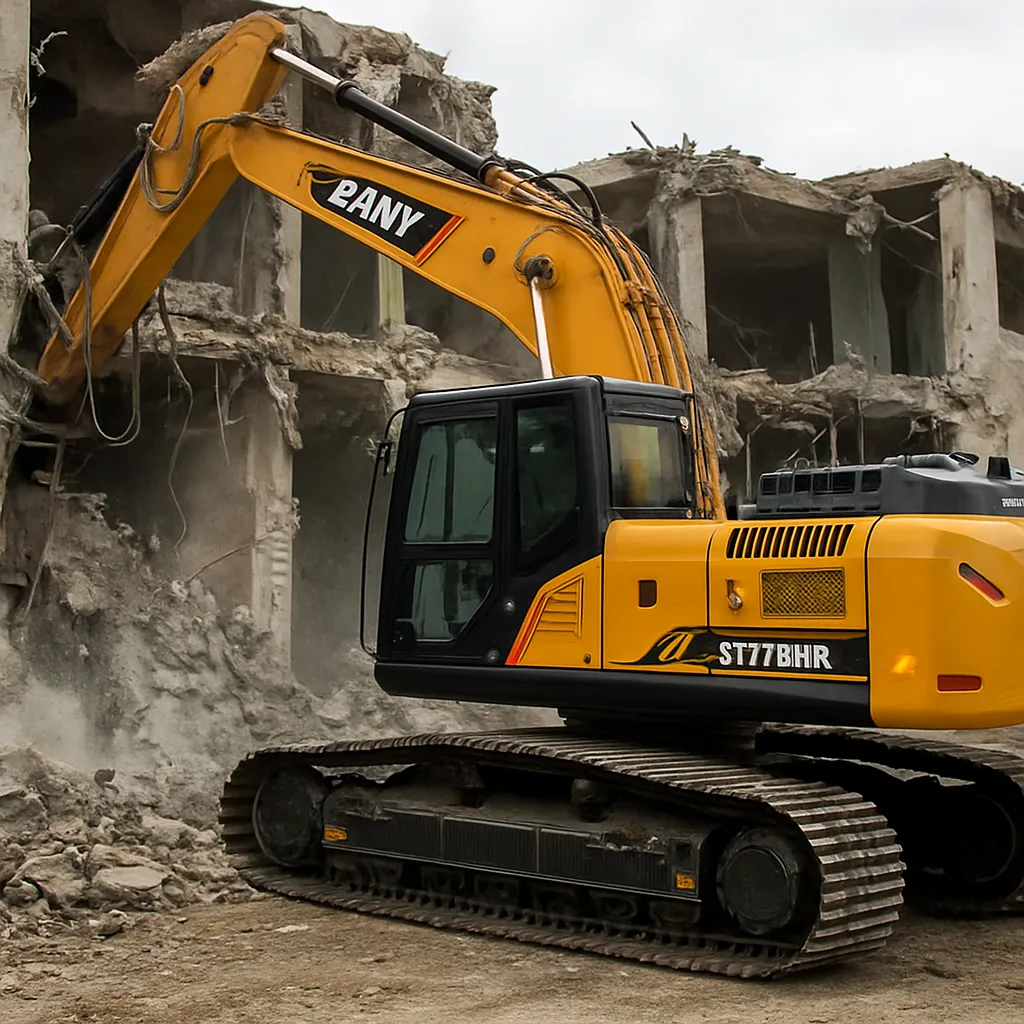
The SANY SY215HR is a purpose-built demolition variant in the medium excavator class, designed to offer a balance of power, reach and versatility for urban and industrial demolition projects. Combining a compact carrier with a reinforced undercarriage and a range of specialized booms and attachments, the SY215HR targets contractors who require a machine capable of safe, efficient dismantling of structures where space, precision and operator visibility are critical. In the following sections, we explore its design, typical applications, technical characteristics, operational advantages, safety features, maintenance considerations and market context.
Overview and role in demolition work
The SANY SY215HR is engineered as a demolition-focused derivative of SANY’s 21-ton class excavators. The designation HR commonly refers to High Reach or Heavy-duty and Retrofit adaptations tailored for demolition tasks. The core concept behind machines like the SY215HR is to provide a mobile platform that can be outfitted with extended-reach booms, reinforced hydraulic systems and dedicated attachments such as hydraulic breakers, shears, grapples and multi-processors.
Demolition projects come in many shapes: selective dismantling of internal structural elements, progressive strip-down of reinforced concrete frames, façade removal, and urban building takedowns where nearby structures, pedestrians and utilities impose strict constraints. The SY215HR targets these segments by offering a machine that is large enough to provide the necessary hydraulic power and stability while remaining nimble enough to operate on congested sites.
Design highlights and construction features
Several design elements make the SY215HR especially suited for demolition:
- Reinforced boom and stick: The boom and arm assemblies are strengthened to resist high bending moments and repeated impacts generated during demolition cycles.
- Hydraulic system: High-flow hydraulics with robust main pumps allow the use of power-hungry attachments such as concrete crushers and high-flow breakers.
- Undercarriage stability: A widened track gauge and heavy counterweight options improve stability during high-reach operations, reducing tip risk when an extended boom is fitted.
- Operator protection: Fitted with optional demolition cabs, protective mesh and guard rails, machines prioritize operator safety and visibility in hazardous environments.
- Modular attachment interface: Quick-coupler compatibility and hydraulic routing make it straightforward to switch between shears, crushers, pulverizers, thumbs and grapples.
Manufacturers typically offer retrofit kits to convert a base SY215 carrier into an HR demolition configuration, including intermediate and high-reach booms, reinforced linkages and specific hydraulic circuits. This modular approach keeps fleet flexibility high and allows contractors to redeploy the machine for conventional excavation when demolition-specific equipment is not required.
Typical technical specifications (approximate ranges)
Exact specifications depend on the factory configuration and optional demolition packages. The following figures reflect typical values for the 21-ton class demolition excavators and common SY215HR setups. Confirm exact numbers with a dealer or the latest manufacturer documentation for the specific machine you consider.
- Operating weight: Approximately 21,000–24,000 kg depending on counterweight and boom configuration.
- Engine power: Roughly 110–140 kW (150–190 hp) depending on engine options and emissions stage.
- Hydraulic flow: Main pump flow in the range of 220–320 L/min for high-flow demolition circuits.
- Maximum reach: With standard demolition boom options, effective dismantling reach commonly spans 8–14 meters; specialized high-reach booms can extend reach to 12–18 meters or more in certain configurations.
- Bucket capacity: For transport and general tasks, buckets usually range 0.8–1.2 m3; demolition attachments replace bucket use.
- Travel speed: Typical travel speeds around 4–5.5 km/h for on-site repositioning.
- Fuel tank: Common capacity around 300–400 liters depending on the package.
These ranges represent the trade-offs manufacturers navigate: increasing reach and protective features adds weight, which in turn affects transport logistics and ground pressure. Contractors must balance reach against mobility and the practicality of transporting a machine between sites.
Primary applications and use cases
The SY215HR is suited to a variety of demolition scenarios, especially where precision and safety matter most:
- Urban building demolition — selective dismantling of mid-rise structures, façade removal and internal strip-outs where adjacent buildings and public spaces constrain demolition methods.
- Industrial dismantling — removal of plant equipment, steel structures, and foundations in factories or refineries, especially when operators need a combination of force and controlled demolition.
- Bridge and infrastructure works — partial demolition of concrete bridge sections and approach works where hydraulic attachments can cut and fragment concrete safely.
- Renovation and retrofit projects — controlled extraction of structural elements without damage to remaining parts of a building.
- Scrap and recycling yards — sorting, shearing and processing structural steel and concrete for recycling operations.
Compared to larger dedicated high-reach demolition machines, the SY215HR’s advantages are its combination of lower operating cost, easier transport and greater agility on confined sites. It fills a niche between small compact excavators used for interior work and large specialized demolition carriers used for very tall structures.
Attachments and tooling commonly used
Demolition productivity depends heavily on the right tooling. SY215HR owners and operators commonly fit the following attachments according to task:
- Hydraulic breakers (hammers) — for concrete and masonry break-out; used with chisel or moil points depending on the target material.
- Hydraulic shears — for cutting structural steel, rebar and smaller sections of beams.
- Concrete crushers and pulverizers — to crush reinforced concrete and separate rebar for recycling.
- Multi-processors — versatile heads that combine shearing and crushing functions in a single unit.
- Grapples and thumbs — for material handling, sorting and selective removal of debris.
- Extended reach booms — either two-piece or telescopic designs to increase working height.
Choosing the correct attachment is as important as selecting the right boom: attachment weight, hydraulic flow requirements and coupling geometry all affect machine stability and cycle efficiency. Properly sized tools reduce cycle times and fuel consumption while improving safety.
Operational advantages and productivity considerations
Several practical advantages make the SY215HR appealing to demolition contractors:
- Versatility — one carrier supports many attachments and roles, from primary demolition to material handling and site cleanup.
- Lower mobilization cost — smaller than large high-reach excavators, the SY215HR often travels on a single trailer without requiring heavy haul permits in many jurisdictions.
- Fuel efficiency — modern engines with electronic controls and efficient hydraulics optimize fuel burn during cycling work.
- Operator ergonomics — improved cabs with climate control, adjustable seats and visibility enhancements reduce fatigue in long demolition shifts.
- Uptime and serviceability — accessible service points and modular components reduce downtime during maintenance and repair.
Productivity in demolition is measured in cubic meters of material removed per hour, tons of structural steel processed, and cycle time per controlled cut or crush. For SY215HR-class machines, typical production rates vary widely: small selective interior demolition might yield 5–20 m3/hour per machine, while external façade removal or systematic floor-by-floor dismantling with an appropriate boom and attachments might achieve significantly higher rates depending on crew skill and logistical setup.
Safety systems and operator protection
Safety in demolition is non-negotiable. On the SY215HR and similar machines, manufacturers and rental outfitter packages emphasize:
- FOPS/ROPS cabs — Falling Object Protective Structures and Roll-Over Protective Structures are common or optional to shield operators from debris.
- Window guards and mesh — heavy-duty metal guards or polycarbonate panels protect glass from flying fragments while maintaining visibility.
- Hydraulic lockouts — allow safe maintenance by isolating hydraulic power during servicing or attachment changes.
- Stability monitoring — sensors and operator aids that warn when load/boom configurations approach unsafe conditions.
- Emergency egress and communication — radios, cameras and escape routes improve reaction time in incidents.
In addition to machine-installed features, safe demolition depends on thorough planning, exclusion zones, traffic and pedestrian management, dust suppression, and coordination with structural engineers to sequence takedowns in a predictable manner.
Maintenance, lifecycle and total cost of ownership
Owning and operating demolition equipment such as the SY215HR requires careful attention to maintenance to maximize lifecycle value and resale prospects. Key maintenance considerations include:
- Attachment wear components — shears, crusher jaws and breaker chisels wear rapidly; keeping spare parts and monitoring consumption are essential.
- Hydraulic oil and filtration — contamination control and timely filter changes protect pumps and valves from abrasive debris and moisture intrusion.
- Undercarriage management — operating on rubble and uneven surfaces accelerates track and roller wear; timely adjustments and component rotation extend life.
- Engine service intervals — oil, fuel and air system service prevent loss of power and preserve fuel efficiency.
- Structural inspections — regular checks of booms, pins and welds detect fatigue and prevent catastrophic failure under cyclic load.
From a cost perspective, demolition machines in the 20–25 ton range often deliver attractive total cost of ownership when compared with renting larger high-reach carriers. Depreciation, attachment fleet investment, operator training and insurance should be included in any project pricing. Well-maintained SY-class machines can provide 10+ years of productive service in a demolition fleet, with strategic rebuilds and component replacements extending value further.
Environmental and regulatory factors
Demolition operations face increasing environmental scrutiny. Machines like the SY215HR contribute by incorporating:
- Tier/Stage-compliant engines — modern diesel engines meet regional emissions standards (e.g., EPA Tier, EU Stage) reducing NOx and particulate emissions.
- Fuel-saving modes — idle-reduction and ECO modes lower fuel consumption and greenhouse gas emissions on long projects.
- Dust suppression compatibility — hydraulic systems and attachment mounts that support water injection or misting systems during concrete breaking.
- Noise abatement — sound-dampening cabs and mufflers help meet urban noise limits during daytime operations.
Contractors often pair machine selection with site plans that include recycling strategies (concrete crushing, steel segregation), hazardous material abatement, and permits that govern working hours and emissions. Thoughtful machine choice can make compliance more straightforward and reduce the risk of costly stoppages.
Market context and usage statistics (general observations)
While exact global production and deployment numbers for the SANY SY215HR model are typically proprietary to the manufacturer and dealers, several general trends shape its market role:
- Growing demand for compact demolition solutions — urbanization and infill development increase demand for machines that can perform controlled demolition in tight lots.
- Platform versatility — many contractors prefer modular carriers that can switch between excavation and demolition tasks to maximize utilization rates.
- Attachment-driven economics — attachment sales and aftermarket support often represent a significant share of lifecycle value; contractors invest in well-matched tooling to improve ROI.
Industry surveys for medium-sized demolition contractors often show fleet utilization rates between 50%–75% annually, with major differences depending on regional construction cycles. Fuel efficiency improvements and reduced downtime due to improved diagnostics have been reported to cut operating costs by up to 10–20% over older-generation equipment in some fleet studies. Resale values for well-documented, maintained excavators in this class remain strong, especially when low-hours units return to secondary markets.
Case examples and real-world considerations
Sample scenarios where the SY215HR excels:
- Townhouse retrofit — selective interior demolition to reconfigure layouts: the SY215HR fitted with a compact breaker and grapple can remove partitions and flooring with minimal disturbance to the façade.
- Concrete slab removal and recycling — paired with a crusher attachment, operators can reduce slab fragments to reusable aggregate on site, lowering disposal costs.
- Industrial plant strip-out — steel shears and grapples enable efficient dismantling of piping and structural members with fast cycle times.
Practical considerations before selecting an SY215HR include transport logistics (weight and width with extended booms), attachment hydraulic requirements, operator training for demolition-specific tasks, and site access limitations. Contractors should schedule trials or rental periods to validate productivity prior to large purchases.
Training, operator skills and best practices
Demolition work places unique demands on operators. Best practices for maximizing SY215HR performance and safety include:
- Specialized operator training — certification in demolition techniques, attachment-specific handling and rescue procedures.
- Pre-shift inspections — daily checks focused on attachment mounts, hydraulic hoses, undercarriage condition and safety systems.
- Clear communication — use of radios, spotters and camera systems where visibility is limited to maintain situational awareness.
- Planned sequences — work with structural engineers to sequence removal to maintain building stability and prevent unintended collapse.
Investing in operator training often produces significant returns through fewer accidents, less machine damage and improved cycle efficiency. Modern SY-series machines also include telematics and diagnostic tools that can be used in training to demonstrate efficient operating patterns.
Conclusion
The SANY SY215HR occupies a strategic niche within demolition fleets, offering a blend of mobility, hydraulic capacity and protection that suits urban and industrial dismantling tasks. Its success depends on matching the correct boom and attachments to project requirements, maintaining rigorous safety and maintenance regimes, and training operators in demolition-specific methods. While precise specifications vary by configuration, the SY215HR class generally delivers strong productivity for medium-scale demolition projects while keeping mobilization and operating costs lower than large dedicated high-reach machines. For contractors seeking a flexible demolition platform, the SY215HR is a compelling option to evaluate.


)
)