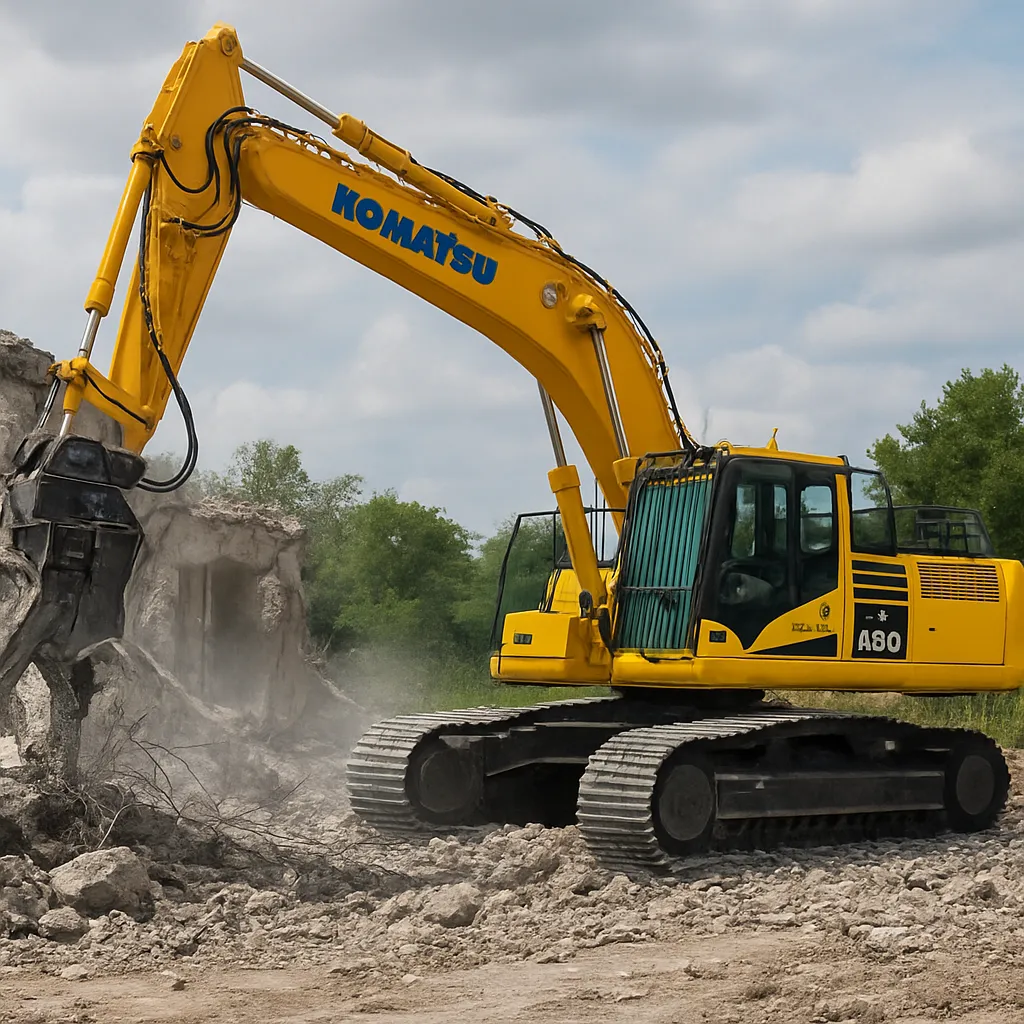
The Komatsu PC390HRD is a heavy-duty, purpose-built machine positioned in the upper medium class of hydraulic excavators and tailored for demanding demolition and structural-recycling tasks. Combining a robust undercarriage, reinforced upper structure, and specialized hydraulic systems, this model is engineered to remove buildings, process recyclable materials, and handle large-scale site clearance operations. In the following sections, we explore the machine’s design philosophy, typical applications, performance characteristics, safety and operator features, maintenance considerations, and commercial aspects that make the PC390HRD a common choice for contractors focused on efficient and safe demolition work.
Design and technical overview
The Komatsu PC390HRD is a derivative of Komatsu’s PC390 platform adapted specifically for the particular stresses and operational profiles of demolition work. Compared with standard excavation variants, the HRD (Heavy-duty / demolition) configuration usually includes a reinforced boom and stick, strengthened boom foot and pedestal areas, upgraded hydraulic piping, and additional protective plating on the house and hydraulic components. These changes improve the machine’s durability and service life under frequent impacts, lateral loads, and abrasive conditions.
Key structural features
- Reinforced boom, stick, and pivot points to withstand high bending moments and shock loads.
- Heavy-gauge armor plating around the cab and critical hydraulic components for improved protection from falling debris.
- High-tensile undercarriage components and track systems designed for stability during high-reach and offset loads.
- Purpose-built counterweights and possible extended counterweight options for balance when using long-reach or shear attachments.
Powertrain and hydraulics
Demolition versions like the PC390HRD are equipped with powerful diesel engines and hydraulic systems calibrated to deliver strong, sustained flow to heavy-duty attachments. Typical machine characteristics include a mid- to high-range engine output and hydraulic flow that supports breakers, shears, crushers, and heavy grapples without significant drop-off in performance. While exact specifications can vary by year and market, machines in this class commonly have:
- Engine power roughly in the range of 200–280 kW (approximately 270–375 HP) depending on configuration and emissions stage.
- Operating weight in the neighborhood of 36–42 tonnes for demolition variants, which balances mobility with stability.
- Hydraulic systems designed for high-pressure operation and auxiliary circuits dedicated to powered attachments.
Applications and typical jobsite uses
The PC390HRD is engineered for a range of challenging demolition and recycling tasks. Its configuration makes it particularly useful where higher reach, impact resistance, and continuous heavy-duty hydraulics are required.
Common applications
- Building demolition — selective dismantling of structural frames, removal of reinforced concrete, and staged deconstruction of multi-story buildings.
- Recycler and material processing — feeding material handlers, crushers, and sorting equipment on demolition and recycling sites.
- Bridge removal and civil works — breaking and handling of concrete spans, abutments, and structural members.
- Industrial dismantling — removal of plant components, steel structures, and heavy machinery in industrial clearance or brownfield redevelopment.
- Port and rail yard clearance — demolition and removal efforts where robust handling of mixed materials is required.
Why demolition-specific machines matter
Demolition environments present hazards and mechanical demands that differ from earthmoving: frequent lateral shocks, falling debris, abrasive dust, and the need to operate specialized tools such as hydraulic shears, pulverizers, and crushers. A model like the PC390HRD is purpose-built to resist wear and accidental damage, minimizing downtime and repair costs. Its reinforced frame and components reduce the likelihood of structural failures that can occur when a standard excavator is used intensively in demolition work.
Attachments and customization options
One of the greatest strengths of a demolition excavator is its adaptability through attachments. The PC390HRD supports a broad suite of tools that transform it into a multifunctional demolition platform.
Primary attachments
- Hydraulic shears — for cutting structural steel, pipes, and rebar.
- Concrete pulverizers and crushers — to break and reduce concrete elements on site for recycling.
- Hydraulic breakers (hammers) — for targeted removal of reinforced concrete and foundations.
- Grapples and multi-processor tools — for sorting, handling, and loading mixed demolition debris.
- High-reach booms and sticks — extend the working envelope for safe dismantling of higher structures.
Customization and optional equipment
Demolition contractors often specify additional options such as:
- Heavy-duty hydraulic oil coolers and upgraded filtration to withstand dusty conditions and continuous heavy use.
- Fire suppression systems and enhanced lighting for work in constrained sites or night operations.
- Remote-control systems for hazardous environments, allowing operators to work at a safer distance.
- Cab armor, reinforced windows (polycarbonate), and enhanced ROPS/FOPS protection for operator safety.
- Quick-coupler systems to speed attachment changes and reduce downtime between tasks.
Performance, productivity and operational statistics
Performance in demolition is not measured solely by cycle times but also by the ability to resist damage, reduce downtime, and maximize safe operating hours. For machines in the PC390HRD category, some practical performance observations and typical operational statistics include:
- Fuel consumption: Under heavy demolition loads, machines of this class often average between 15–30 L/h depending on duty cycle, attachment, and operator practice. When operating lighter demolition attachments or during transit, consumption can be substantially lower.
- Operating weight and balance: With robust counterweights and reinforced undercarriages, demolition machines maintain stability even when using long-reach attachments or heavy grapples. Operating weights for the PC390 family generally fall in the 36–42 tonne range for demolition configurations.
- Attachment hydraulic flow: Hydraulic auxiliary flow is sized to handle high-demand attachments—important for maintaining productivity when using shears or pulverizers that require sustained flow and pressure.
- Utilization rates: In active demolition yards, a well-specified PC390HRD can achieve high utilization rates (6–10+ operating hours per day) across multi-shift operations, assuming consistent maintenance and wear-part management.
Note: Exact factory specifications vary by model year and market emissions packages. For procurement or replacement-part decision-making, always consult the manufacturer’s spec sheet for the exact serial/model number you plan to use.
Safety and operator ergonomics
Demolition is inherently hazardous; therefore, machines like the PC390HRD include numerous safety-oriented features. These are as important as raw power when selecting equipment for complex jobs.
Cab and operator protection
- Armored glass or polycarbonate windows and additional protective screens to reduce the risk of puncture or shattering from falling debris.
- ROPS (Roll-Over Protective Structure) and FOPS (Falling Object Protective Structure) certified cabs where applicable.
- Ergonomic controls, adjustable seats, and climate control systems that reduce operator fatigue and improve productivity over long shifts.
Operational safety systems
- Load-sensing hydraulics and priority flows designed to prevent sudden drops in pressure or unexpected movements while under load.
- Integrated monitoring systems that provide maintenance warnings, abnormal vibration alerts, and hydraulic temperature alarms—helping avoid catastrophic failures.
- Optional camera packages and proximity sensors to improve site visibility, especially in congested demolition environments.
Maintenance, lifecycle costs and fleet management
Durability and ease of maintenance are critical when operating on fast-paced demolition sites. The PC390HRD is designed for straightforward serviceability, but careful lifecycle planning can dramatically reduce total cost of ownership.
Maintenance considerations
- Regular inspection of attachment pivot pins, boom foot connections, and reinforced plates is essential to catch early wear from shock loads.
- Hydraulic system maintenance—frequent oil and filter changes along with regular inspections of hoses and couplings—minimizes downtime and prevents costly ruptures.
- Track and undercarriage wear should be monitored closely; demolition environments often accelerate sprocket and track pad wear due to contamination and high lateral forces.
Lifecycle and cost management
A properly maintained PC390HRD can remain productive for many thousands of machine hours. Factors that influence lifecycle costs include:
- Frequency of heavy impact events and the extent of collision damage.
- Attachment usage profile—some tools wear faster and require faster replacement.
- Preventive maintenance rigor—scheduled inspections and part replacements reduce unplanned downtime.
Environmental impact and fuel efficiency strategies
Environmental regulations and fuel costs are significant considerations for demolition contractors. Newer Komatsu engines and emission control systems often comply with the latest standards and provide improved fuel economy compared with older units.
Emission control and efficiency
- Modern engines are often equipped with aftertreatment systems to meet regional emissions standards, reducing NOx and particulate outputs.
- Eco modes and engine-management systems reduce fuel consumption during light-load operations and idle periods, improving overall jobsite efficiency.
- Operator training and attachment matching help optimize fuel usage—using the correct attachment for the job is as important as machine selection.
Waste reduction and recycling
Demolition machines play a central role in recycling construction materials. Machines like the PC390HRD, when paired with crushers, shears, and sorting grapples, help reclaim concrete and steel for reuse, reducing landfill volumes and improving sustainability metrics for redevelopment projects.
Buying considerations, resale and fleet integration
Investing in a demolition-specific excavator requires balancing purchase cost, attachment ecosystem, operator availability, and resale potential. The PC390HRD class machines tend to retain value because of their specialized nature, but a few commercial points deserve attention:
- Attachment compatibility: Ensure the attachments you plan to operate are supported and that hydraulic flow/pressure meets the tool requirements.
- Service network: Komatsu has a global dealer network; proximity to parts and service can be decisive for minimizing downtime.
- Resale market: Demolition-ready excavators often hold value if documented maintenance records are provided and any structural repairs are professionally performed.
- Insurance and risk: Demolition operations may require enhanced insurance coverage; machine safety features and aftermarket protections can reduce premiums.
Real-world examples and operational tips
Contractors who operate PC390HRD-class machines report several practical tips that improve both safety and productivity on demolition sites:
- Match the attachment to the task: Using a pulverizer where a shear is needed (or vice versa) reduces efficiency and accelerates component wear.
- Use protective guarding and regular inspections of hydraulic lines—many unplanned stops arise from hose failures caused by abrasion.
- Implement a daily pre-shift checklist to catch issues early: visual checks of pins, hoses, track tension, and fluid levels prevent more serious failures.
- Schedule periodic training for operators on advanced attachment use and safest practices for high-reach dismantling to reduce the risk of structural collapse during work.
Conclusion
The Komatsu PC390HRD represents a class of specialized demolition excavators designed to meet the demanding requirements of structural dismantling, material processing, and site clearance. With reinforced structures, robust hydraulic systems, and compatibility with a wide range of heavy-duty attachments, this machine balances productivity, safety, and long-term durability. While specific technical specifications vary by model year and regional configuration, operators and fleet managers can expect a reliable performer in the 36–42 tonne class with sufficient engine power and hydraulic capacity for most medium-to-large demolition projects. For contractors considering a purchase, careful attention to attachment needs, maintenance planning, and the local service network will maximize uptime and return on investment.


)
)