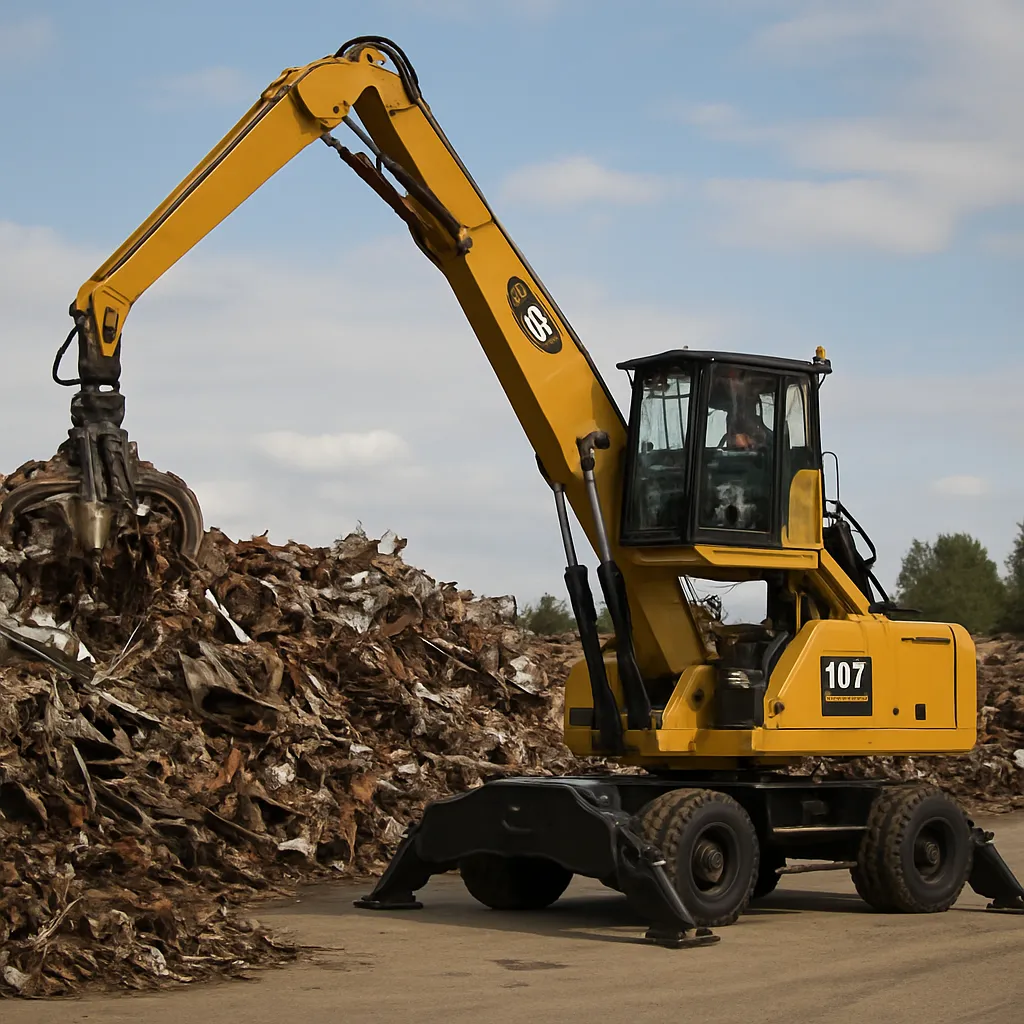
The CAT MH3049 stands out as a purpose-built heavy-duty machine designed specifically for bulk material handling. Combining the robustness of Caterpillar engineering with configurations tailored for lifting, sorting, and loading operations, this class of material handler is widely used where high reach, rotation, and specialized attachments are required. The following article explores the design, applications, operational advantages, attachments, safety and maintenance aspects, and economic and environmental considerations surrounding the CAT MH3049 and comparable material handlers.
Design and core features
The CAT MH3049 is engineered around the core principle of stable, precise material handling rather than traditional earthmoving. Key design elements distinguish it from standard excavators and forklifts, making it ideal for continuous loading, sorting, and stockpiling tasks.
- Chassis and stability: Material handlers such as the MH3049 typically have a reinforced undercarriage and counterweight system to maintain stability during high-reach operations. The design often incorporates an optimized center of gravity to enable safe operation with heavy loads at extended reaches.
- Hydraulic system: A high-flow, purpose-tuned hydraulic system delivers smooth, controlled movements for lifting and rotating heavy loads. The hydraulics are optimized for continuous cycle work rather than short, high-impact digging cycles.
- Superstructure and rotation: 360-degree rotation with low-speed, high-torque slew drives enables quick material handling around a fixed point. The superstructure is often reinforced to withstand lateral stresses from grapples and magnets.
- Cab and ergonomics: Operator comfort and visibility are critical. Elevated or wide-view cabs, ergonomic joystick controls, adjustable seats, climate control, and optional camera systems help reduce operator fatigue and increase precision.
- Powertrain and emissions: Engines in this class meet contemporary emissions standards and are tuned to balance fuel economy with the power demands of continuous handling cycles. Options may include engine configurations to satisfy local regulatory requirements.
Typical applications
Material handlers like the CAT MH3049 find use in a variety of industries where moving large volumes of bulk or scrap material with precision and speed is essential. Their adaptability comes from tailored attachments and modular configurations.
- Ports and terminals: Loading and unloading bulk cargo—coal, ores, aggregates, and timber—requires high reach and rapid cycle times. The MH3049 can be configured with long-reach booms and specialized grabs to increase throughput at quay and yard operations.
- Scrap yards and recycling facilities: Sorting, demagnetizing, and loading scrap metal demands robust grapples and magnet systems. The MH3049’s stability and rotation capability allow safe and efficient handling of irregular loads and heavy bundles.
- Demolition and dismantling: For controlled demolition and material separation, the MH3049 offers precise hydraulic control and a selection of attachments—shears, pulverizers, and multi-tine grabs—enabling selective dismantling and sorting of recyclable components.
- Forestry and biomass handling: Handling logs, chips, and biomass feedstock involves specialized grapples and high-capacity feeding cycles. Material handlers provide the reach and gentle handling needed to preserve material quality while maintaining high throughput.
- Aggregate and bulk material stockpiling: In quarries and aggregate processing plants, the MH3049 helps create and reclaim stockpiles, load trucks, and feed crushers with stable, continuous operation.
Attachments and customization
One of the MH3049’s principal strengths is its broad compatibility with specialized attachments, allowing a single base machine to address diverse tasks.
- Grapples: Orange-peel and mechanical grapples for general bulk handling; specialized multi-tine grapples for scrap.
- Electromagnets: Powerful electromagnets for rapid separation and movement of ferrous scrap, often integrated with remote control and auto-release features.
- Clamshell buckets: Designed for bulk loading of loose materials such as soil, sand, and grain.
- Demolition tools: Hydraulic shears, crushers, and pulverizers for selective dismantling and material segregation.
- Sweeps and rakes: For sorting and cleaning yard areas, improving site housekeeping and safety.
- Quick couplers and tooling interfaces: Allow fast switching between attachments to maximize uptime and flexibility on site.
Operational performance and productivity
Performance of material handlers is measured not only by lifting capacity and reach but also by cycle times, reliability, and the ability to operate continuously in high-throughput environments.
- Reach and lift characteristics: Depending on boom configuration, machines in this class provide extended reach to load high-sided vessels or create large stockpiles. The MH3049 is optimized for balanced reach and lifting stability rather than maximum digging force.
- Cycle efficiency: Hydraulic and control systems are tuned for predictable and repeatable cycles. In many operations, material handlers can load trucks, railcars, or hoppers at rates measured in hundreds of tons per hour; actual throughput depends on material density, attachment, and operator technique.
- Fuel economy and total cost of ownership: Continuous operation makes fuel efficiency and routine maintenance costs critical. The MH3049’s engine and hydraulic tuning aim to reduce fuel consumption per tonne moved through features like load-sensing hydraulics and idle management.
- Telematics and remote management: Modern Caterpillar machines often include fleet connectivity systems (e.g., Cat Product Link equivalents) that provide data on fuel use, idle time, operating hours, and maintenance alerts—helping managers optimize utilization and reduce downtime.
Safety, operator comfort, and site integration
Safety is central to the design of material handlers, since these machines frequently work in congested yards and close to personnel. The MH3049 incorporates multiple features intended to protect both operators and ground workers.
- Visibility and cameras: Elevated and panoramic cabs, combined with multi-camera systems, reduce blind spots and improve situational awareness.
- ROPS/FOPS-certified cabs: Reinforced structures protect operators in rollover or falling object scenarios.
- Operator aids: Proportional joystick controls, anti-two-block systems, and load moment indicators help prevent overloads and unsafe operations.
- Ground-level access: Well-positioned maintenance points and safe access ladders/handrails minimize risks during servicing.
- Site integration: Working in tandem with conveyors, cranes, and screening equipment, the MH3049 can be integrated into automated or semi-automated material handling lines to improve safety and throughput.
Maintenance and lifecycle considerations
Reducing downtime and extending component life are priorities for owners of heavy material handlers. The MH3049’s design focuses on ease of service and long intervals between major interventions.
- Service access: Wide service doors, ground-level maintenance points, and centralized daily check panels simplify routine checks and fluid top-ups.
- Wear parts and undercarriage: Track or wheel systems and wear-prone components are designed for straightforward replacement. Monitoring undercarriage wear and maintaining correct track tension extend component life.
- Hydraulic and filtration systems: High-quality filtration and planned replacement intervals help preserve hydraulic component life, which is essential for maintaining precise control in material handling cycles.
- Predictive maintenance: Telemetry and diagnostic tools enable predictive maintenance scheduling, allowing parts to be ordered and downtime to be planned rather than reactive emergency repairs.
Economic and environmental factors
Purchasing and operating a machine such as the CAT MH3049 involves evaluating capital and operating expenses, resale value, and environmental footprint.
- Capital costs and financing: Material handlers are a significant investment but provide specialized capability that can replace multiple smaller machines or manual processes, improving labor efficiency and throughput.
- Operating cost drivers: Fuel consumption, hydraulic oil life, wear parts, and operator efficiency primarily determine operating costs. Optimized hydraulics and efficient engine mapping help reduce fuel use per tonne moved.
- Resale and lifecycle value: Well-maintained machines from established manufacturers often retain strong resale value, especially when supported by documented service history and modern telemetry records.
- Emissions and sustainability: Modern material handlers are produced to meet regional emissions standards and can be optimized for lower idle emissions, smart shutdown, and fuel-efficient operation. Some operators explore alternative powertrains or hybrid systems in material handling applications to further reduce carbon footprint.
Performance benchmarks and typical statistics
While exact specifications vary by configuration and optional equipment, some typical performance benchmarks for machines in the MH3049 class can be summarized as follows. These are representative ranges intended to help contextualize capabilities rather than definitive manufacturer specifications.
- Operating weight: Machines in this category often fall into the medium-to-large material handler range, where operating weights commonly range from several tens of tonnes depending on undercarriage and counterweight options.
- Engine power: Power ratings for similar machines typically range from medium to high outputs to sustain continuous hydraulic demands—sufficient to drive high-flow pumps and onboard auxiliary systems.
- Reach: Boom and arm combinations can provide extended lateral and vertical reach suited for quay-side loading or tall stockpiles; reach varies from compact yard models to long-reach variants for port operations.
- Throughput: Loading rates vary widely by material: for example, loose aggregates might be handled at hundreds of tonnes per hour under ideal conditions, while heavy bundled scrap is measured in lower tonnes per hour due to handling limits.
- Fuel consumption: Continuous handling operations typically result in steady fuel consumption; optimizing cycle times and minimizing idle helps reduce fuel use per tonne moved. Fuel burn rates vary by configuration, attachment, and duty cycle.
Integration with modern fleet management and automation
Integration with digital fleet management systems has become a differentiator for modern material handling fleets. The MH3049 supports features that improve decision-making, uptime, and operational transparency.
- Telematics and remote monitoring: Live data on hours, fuel use, and fault codes enables proactive maintenance and efficient asset allocation across sites.
- Operator training and simulation: Virtual training modules and in-cab assistance help operators develop efficient handling patterns, enhancing productivity and reducing wear.
- Semi-automation and process control: In high-throughput environments, material handlers can be linked with conveyors, weighbridges, and dispatch systems to create smoother, more predictable workflows.
Choosing the right configuration
Selecting the appropriate MH3049 configuration depends on the intended primary use, site constraints, and desired balance between reach and lifting capacity.
- Yard handling vs. port operations: Yard equipment may prioritize compact footprint and maneuverability, while port machines emphasize extended reach and higher stability for quay-side work.
- Attachment needs: The choice between electromagnetic systems, clamshell buckets, or demolition tools drives hydraulic requirements and counterweight decisions.
- Mobility: Tracked machines provide site stability and lower ground pressure, whereas wheeled undercarriages facilitate relocation and faster travel between worksites.
- Serviceability and parts support: Consider manufacturer and dealer network strength in your region, as strong parts and service support significantly reduce lifecycle costs.
Summary and outlook
The CAT MH3049 represents a class of machines focused on efficient, reliable bulk material handling across diverse industries—ports, recycling, demolition, forestry, and aggregates. With robust hydraulics, specialized attachments, and operator-centric design, such material handlers deliver high throughput, improved safety, and adaptable performance. Key decision factors for buyers include the mix of attachments required, reach versus lifting capacity, mobility needs, and total cost of ownership. Advances in telematics, operator assistance, and emissions-compliant powertrains continue to refine the value proposition of modern material handlers, making them central assets in efficient bulk-material operations.
Key advantages: versatility, precision, safety, and fleet-level intelligence.


)
)