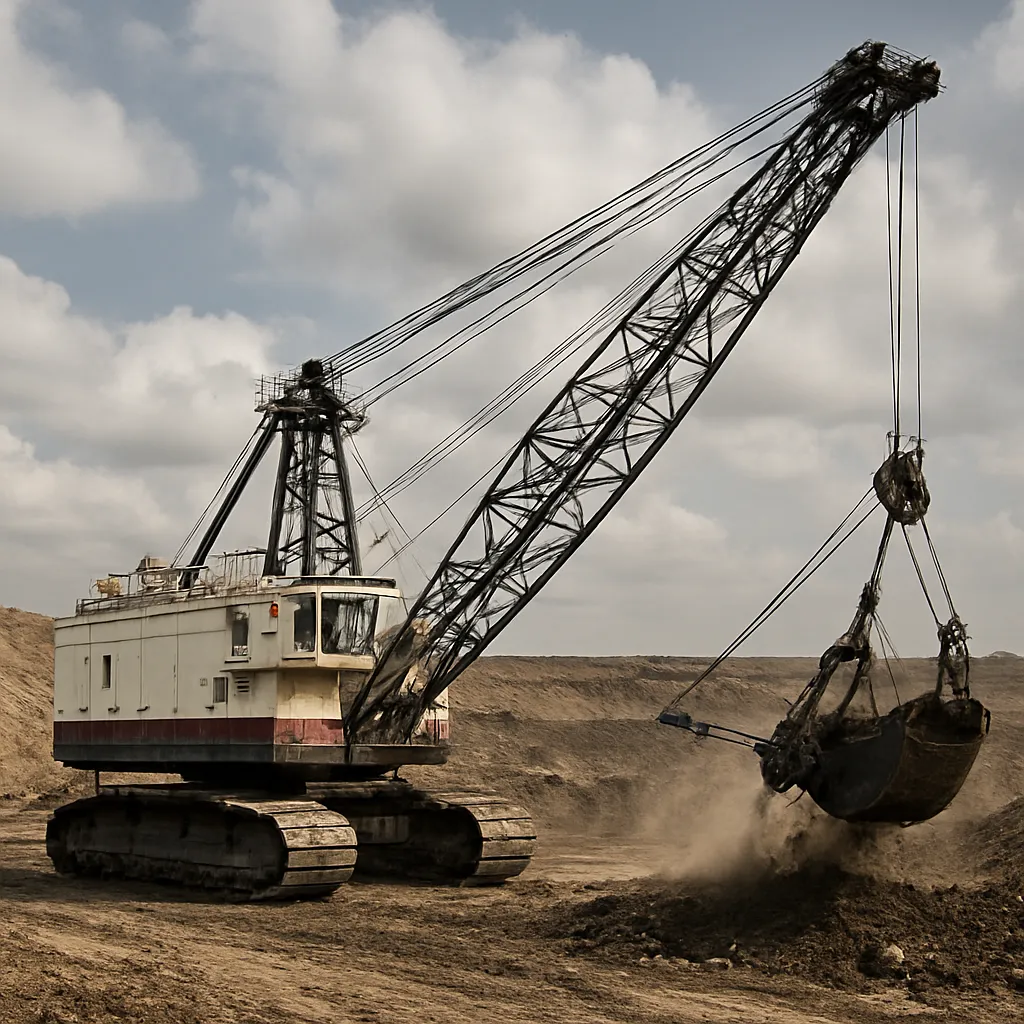
The Bucyrus 1570S dragline is a heavy-duty excavation machine designed primarily for large-scale surface mining and civil earthmoving projects. Combining enormous reach and lifting capacity with a relatively simple mechanical principle, this class of dragline has been used to strip overburden, expose ore and coal seams, and perform major earthworks where continuous, high-volume material removal is required. Below you will find a detailed overview of its design, typical applications, operational principles, maintenance needs, environmental and safety considerations, and its place in the history of large-scale mining equipment.
Design and technical characteristics
At its core, the Bucyrus 1570S is a rope-operated excavator built around a long, lattice-style boom that supports a large bucket. The machine operates by dragging the bucket along the ground with a set of drag ropes and then hoisting it to dump the load into spoil piles or onto haulage equipment. While specific published specifications for the 1570S model can vary by customer configuration and retrofit options, the general architecture and major subsystems are consistent with large Bucyrus draglines.
Major components
- Boom: A rigid, trussed member that determines reach and digging depth. Typical booms for machines in this class may extend dozens of meters, allowing banks and benches to be worked at significant distance from the machine body.
- Bucket: Large steel bucket attached to drag and hoist ropes. Bucket sizes for draglines comparable to the 1570S typically range from medium to very large capacities, optimized for the balance between fill time and liftability.
- Drag and hoist ropes: Heavy wire ropes transfer the forces needed to pull (drag) and raise (hoist) the bucket. Rope care and monitoring are crucial for both safety and productivity.
- Swing mechanism: Enables the superstructure to rotate so the bucket can be dumped or the work face repositioned without moving the entire machine.
- Walking mechanism or crawlers: Many large draglines use a walking system to reposition the machine in the mine rather than traditional tracks, allowing movement of massive weights across prepared pads.
- Power systems: Historically diesel-electric and, increasingly, fully electric drive systems supply the high torque and fine control required for operations.
Typical specifications and performance ranges
Exact values for the 1570S vary by build and era, but the following ranges represent the typical performance envelope for machines of this size class:
- Bucket capacity: approximately 40–120 cubic yards (roughly 30–90 m3), depending on configuration and intended use.
- Boom length: typically in the order of 50–120 meters (160–400 ft) for large mining draglines — the final choice balances reach against structural weight and transport considerations.
- Operating weight: these machines are extremely heavy; weights can range from a few thousand to many thousands of tonnes depending on attachments and counterweight.
- Production rates: a single large dragline can move several thousand to tens of thousands of cubic meters of overburden per day. Actual productivity depends on bucket size, cycle time, bench conditions, and operational schedule.
- Power demand: hydraulic and electric systems can require multi-megawatt power inputs during peak operation (often supplied by on-site substations in large mining complexes).
Note: Manufacturer datasheets or refurbishment records should be consulted for exact model-specific figures—these numbers are intended as indicative ranges, not absolute model specs.
Applications and operational roles
Draglines like the Bucyrus 1570S are purpose-built for tasks that demand high-volume, continuous excavation at relatively shallow depths but vast lateral extent. Their advantages lie in cost-effective movement of large volumes of material and minimal fuel or wear per unit of material moved compared with fleets of smaller shovels and trucks for certain operations.
Primary applications
- Surface coal mining: Draglines are commonly used to remove overburden above coal seams in open-cast mines worldwide, especially where seams are thick and continuous.
- Open-pit metal mining: Where large, contiguous overburden removal is needed, draglines can be applied to expose ore zones or to perform reclamation work.
- Large civil earthworks: Construction of major dams, canals, harbor deepening and reclamation projects can take advantage of a dragline’s reach and bulk-moving capability.
- Rehabilitation and reclamation: Because draglines can place overburden and profile spoil heaps effectively, they play roles in final pit rehabilitation and landform re-creation.
Operational advantages
- Very low unit operating cost for continuous, large-scale overburden removal when compared against truck-and-shovel combinations in suitable geologies.
- Long reach allows the machine to work large benches without frequent relocations.
- Ability to create large spoil placement patterns efficiently, reducing earthmoving cycle complexity.
Limitations and conditions for effective use
- Best suited to soft-to-medium ground conditions; very hard rock requires other excavation methods.
- High capital investment and complex logistics for initial siting, foundations and power supply.
- Lower flexibility than fleets of trucks and hydraulic excavators for highly variable or discontinuous ore bodies.
How the 1570S operates — cycle and control
Although dragline designs vary, the operational cycle is broadly consistent: drag, hoist, swing, and dump. The operator controls sequence and rope tensions to maximize fill factor and minimize spillage.
Typical digging cycle
- Positioning: The operator positions the bucket at the toe of the bank using swing and walking movements if needed.
- Drag-in: Drag ropes pull the bucket across the surface into the material; proper technique ensures efficient filling and long rope life.
- Hoist-up: Hoist ropes lift the bucket clear of the material, with coordinated rope tension to preserve bucket geometry and reduce spill.
- Swing & dump: The superstructure swings and the bucket is dumped into a spoil heap or transfer point; modern controls allow smooth, precise dumping cycles.
- Return: The empty bucket is returned to the digging position via controlled lowering and drag-in for the next cycle.
Control systems and automation
Modern draglines can be fitted with advanced control systems, including load monitoring, rope tension sensing, and partial automation of repetitive sequences. These improvements increase safety, reduce operator fatigue, and can raise production consistency. The 1570S, depending on its refurbishment or upgrade status, may feature electronic monitoring or retain more traditional mechanical/electrical controls.
Maintenance, lifecycle and refurbishment
Given the heavy loads and cyclic stresses, maintenance is paramount for a dragline’s economical life. Many historic Bucyrus machines have been refurbished and modernized, in some cases extending operational life for decades.
Key maintenance tasks
- Routine inspection and replacement of wire ropes (drag, hoist, and pendants).
- Structural inspections for boom fatigue, pin wear and lattice corrosion.
- Lubrication and overhaul of winches, gearboxes and slewing bearings.
- Electrical and powertrain testing, especially in electric-drive conversions.
- Monitoring and replacement of wear parts on buckets and liners.
Refurbishment and upgrades
It is common for operators to invest in major rebuilds that can include re-engining, conversion to modern electric drives, installation of new control electronics, and structural reinforcement. Upgrades can significantly reduce energy consumption, improve precision, and extend service life. Because the capital cost of a large dragline is substantial, thorough refurbishment programs often yield a favorable cost-per-ton when compared with new-equipment acquisition.
Typical lifecycle considerations
With diligent maintenance and occasional major rebuilds, a dragline like the 1570S can remain productive for several decades. Critical factors determining lifecycle are the intensity of use, environmental exposure (corrosion), and the availability of spare parts and skilled maintenance personnel. When reuse at other sites is desired, disassembly and transport require heavy-lift logistics and planning, but many draglines have been successfully relocated across continents.
Environmental and safety aspects
Large-scale excavation inherently carries environmental and safety challenges. Draglines mitigate some impacts (e.g., fewer diesel emissions per cubic meter if electrically powered) but create landform and habitat changes that must be managed.
Environmental management
- Proper spoil placement and progressive rehabilitation reduce long-term landscape impacts.
- Electric-drive systems reduce on-site diesel usage and associated emissions compared with diesel-hydraulic fleets.
- Water management and sediment control are crucial around dragline operations to avoid downstream impacts.
Safety practices
- Strict exclusion zones around swinging booms and bucket trajectories prevent personnel exposures to collapse or impact.
- Rope inspection protocols and load-limiting controls reduce the risk of catastrophic rope failure.
- Operator training, fatigue management and emergency procedures are central to safe operation.
Economic and strategic value
From an economic perspective, large draglines such as the Bucyrus 1570S create value where continuous, bulk overburden removal is needed. The machine’s ability to move enormous volumes reduces per-ton excavation costs in the right geological and operational context.
Cost drivers
- Capital cost versus life-cycle cost: High upfront investment is balanced against decades of service and low operating cost per cubic meter.
- Power supply and infrastructure: Availability of robust electrical supply lines or efficient on-site power generation is a major project determinant.
- Local labor skill and maintenance organization: Skilled crews lower downtime and extend component lives.
When a dragline is the right choice
Operators typically select draglines for very large mines with laterally extensive deposits and stable benches. In such scenarios, the efficiency and continuous nature of dragline excavation often outperform truck-and-shovel systems on cost per cubic meter and overall simplicity of material handling.
Historical context and notable installations
Bucyrus, the company behind the design lineage of the 1570S, has a long history in mining machinery. The original Bucyrus Foundry (founded in the 19th century) evolved into a major manufacturer recognized for large walking draglines and shovels. After mergers and industry consolidation, Bucyrus assets and expertise have been integrated into later manufacturing lines, and many classic models continue in operation after refurbishments. The 1570S typifies the evolution of dragline engineering toward higher capacity, better operator ergonomics and increased reliability.
Examples of dragline deployment worldwide
- Australia: Large open-cut coal mines often use very large draglines for overburden removal; dragline fleets remain a common sight in the Bowen Basin and Hunter Valley regions.
- United States: Historical deployment in Appalachian and Midwestern coalfields demonstrated long productive lives for Bucyrus draglines.
- Other regions: Africa, Asia and Eastern Europe have seen both new purchases and relocations of major draglines to large surface mining projects.
Practical considerations when specifying or buying a 1570S
When evaluating a Bucyrus 1570S—whether as new, used or rebuilt—procurement and engineering teams typically focus on:
- Exact bucket capacity and matching to desired production targets.
- Verified documentation of structural inspections, rope history and major component overhauls.
- Power requirements and site infrastructure adequacy (transformers, switchgear, and distribution).
- Availability of spare parts, skilled technicians and supplier support for long-term maintenance.
- Relocation logistics: cost and feasibility of transporting or walking the machine to the work site.
Summary
The Bucyrus 1570S represents a class of large, efficient excavation machinery optimized for continuous, high-volume overburden removal in surface mining and major civil works. Its core strengths are reach, bulk-moving capability and relatively low operating cost per cubic meter when applied in suitable geological and operational settings. While exact technical parameters vary by configuration and upgrades, the general performance envelope includes substantial bucket capacities, long booms and multi-megawatt power demands. Proper maintenance, refurbishment programs and careful site planning can deliver decades of productive life from these iconic machines. For precise specification and operational planning, consulting manufacturer datasheets, refurbishment records and experienced dragline engineers is essential to match a 1570S to a specific project’s needs.
)
)