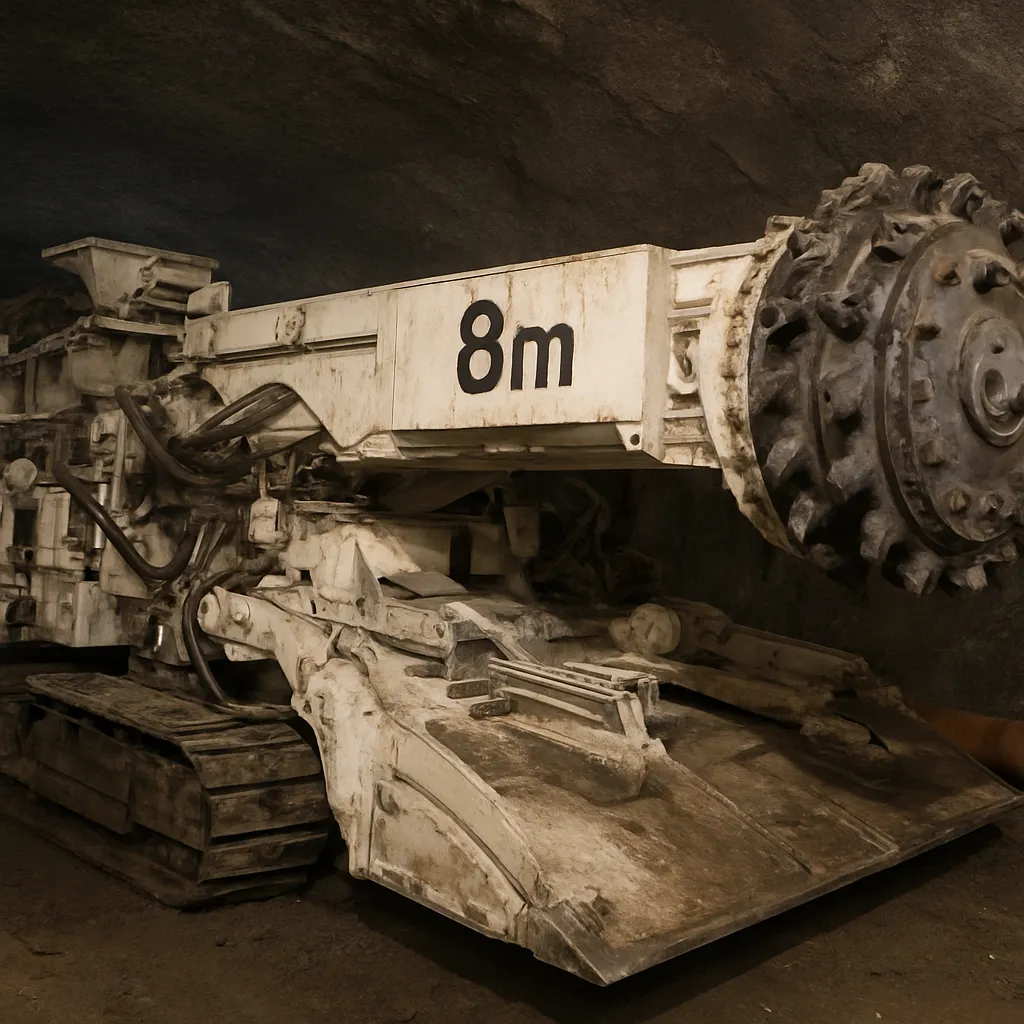
The Robbins Main Beam 8m is a specialized structural component used in mechanized tunneling and underground excavation systems. While the name itself highlights the distinctive 8-meter length, the significance of this beam lies in its role as a primary support and interface between heavy tunneling machinery and the structural systems that control ground support, conveyance, and machine stability. This article examines the Main Beam 8m in detail, presenting its design features, typical applications in tunneling environments, operational considerations, safety and maintenance practices, and its broader role in modern underground construction.
Design and technical characteristics
The Robbins Main Beam 8m is designed to serve as a robust, modular backbone for various tunneling machines and associated equipment. Although detailed manufacturer specifications vary by project and machine type, several common design features can be outlined:
- Length and geometry: The designation “8m” signals an approximate span of eight meters, which allows the beam to bridge equipment bays, support cutterhead reaction frames, or hold heavy hydraulic and electrical assemblies between main machine segments.
- Material and fabrication: Main beams are typically fabricated from high-strength structural steels (for example, modern equivalents to S355 or higher grades), often with welded box-section construction to maximize stiffness while controlling weight. Corrosion protection (paint systems, galvanizing, or specialized coatings) is commonly applied for longevity in harsh underground environments.
- Load-bearing capacity: The beam is engineered to carry concentrated loads from cutterhead thrust cylinders, suspension systems, conveyor take-offs, and temporary jacking points. Design loads depend on machine class, but the beam must accommodate both static and dynamic loads including shock loads from rock impacts and cyclical loading during jacking and thrust operations.
- Connection and modularity: Drillings, flanges, and bolted splice points are provided so beams can be connected to adjacent machine segments, shield rings, or back-up frames. Modularity allows rapid replacement and reuse on multiple projects or with different machine configurations.
- Integration of services: Many main beams incorporate pathways and mounting provisions for hydraulic lines, high-voltage cables, ventilation ducts, and instrumentation. Cable trays and protective conduits within or alongside the beam reduce the risk of damage in confined spaces.
- Precision and alignment: Tunneling requires tight positional tolerances. Beams are machined and field-aligned to maintain cutterhead concentricity, ensure conveyor alignment, and preserve tunnel profile during excavation and lining operations.
Manufacturing considerations
- Quality control: Non-destructive testing (NDT) methods such as ultrasonic inspection and radiography verify weld integrity, especially at high-stress regions.
- Transportation and assembly: Eight-meter sections are sized to balance transportability (road/rail/ship limits) and on-site handling by cranes or gantries typical in launch sites.
- Weight optimization: Finite element analysis (FEA) is used extensively in design to remove unnecessary material while avoiding fatigue-prone stress concentrations.
Primary applications in tunneling
The Main Beam 8m finds use across a variety of mechanized underground works where a long, strong structural member is required. Primary applications include:
- Shield tunneling and TBM back-up systems: In shield TBMs, main beams can form part of the back-up frame that carries conveyors, slurry/waste pumps, and support platforms. Their span is suited to distribute loads across the width of the machine and to provide mounting for heavy auxiliaries.
- Segment erectors and lining systems: Where precast concrete segments are handled mechanically, main beams provide the backbone for segment handling cranes, rotators, and placement devices.
- Drill-and-blast mechanized rigs: In combined mechanized drill rigs used for rockfall protection and probe drilling, beams support long-range hydraulic cylinders and boom assemblies.
- Temporary support and bridging: During tunnel excavation and lining, beams are used as temporary bridges in the excavation area to support access platforms, ventilation trunks, and piping runs.
- Specialty tunneling machines: Customized excavators—such as microtunneling setups, pipe-jacking rigs, or slurry systems—may employ main beams for task-specific mounting and to meet space and service integration needs.
Geological contexts
The suitability of a main beam design depends on ground conditions. In soft ground (clays, silts, water-bearing soils), beams must accommodate high water pressures and corrosion risks, while in hard rock they must absorb higher impact and cyclical loading. Robust main beams are essential in mixed-face conditions where loading changes rapidly during excavation.
Installation, operation, and on-site logistics
Installing and operating an 8-meter main beam in a tunneling environment requires careful planning, specialized lifting equipment, and coordination between machine crews and engineers. Key stages include:
- Preassembly: Shops preassemble the beam with integrated features—mounting brackets, cable trays, and access steps—then perform dimensional checks before shipping to site.
- Lift and placement: On-site, beams are raised with crawler cranes, gantry systems, or jacks. Confined access in tunnel portals or shafts may necessitate sectional assembly with bolted splices.
- Alignment and grouting: Final alignment is verified with laser systems. Grout or shims may fill gaps to ensure continuous load paths and to prevent local bending under concentrated loads.
- Commissioning: Systems attached to the beam—hydraulics, electrical distribution, sensors—are tested under static and dynamic conditions before full excavation begins.
- Operational monitoring: Strain gauges, laser alignment systems, and vibration sensors are commonly installed to monitor beam performance and detect early signs of fatigue or misalignment.
On-site challenges
- Space constraints inside tunnels impact assembly sequencing and handover operations.
- Environmental factors such as dust, water ingress, and abrasive particulates demand protective measures for beams and attached services.
- Logistical coordination with other heavy deliveries (conveyor sections, segment erectors, spoil-handling equipment) is critical to avoid delays.
Performance, productivity, and typical statistics
While specific numeric data for a “Robbins Main Beam 8m” as a standalone product are not typically published separately from overall machine specifications, the influence of such a beam on tunneling performance can be assessed through related machine metrics and industry norms:
- Advance rates: Mechanized TBMs in soft ground commonly achieve averages from 5 to 20 meters per day in favorable conditions. In hard or mixed ground, daily advances can range from less than 1 meter to 10+ meters, strongly influenced by cutter design, thrust power, and support systems that main beams help to hold in place.
- Machine uptime: Structural reliability of main beams contributes to high uptime. Well-designed beams with integrated monitoring help reduce unscheduled maintenance; top-performing TBM projects report availability above 85–90% across favorable stretches.
- Service life: Main beams designed from modern steels and protected coatings typically last for the lifetime of the TBM back-up (often several years), and can be refurbished for reuse on multiple projects. Refurbishment cycles depend on fatigue exposure but are common after major projects.
- Typical mass and weight considerations: An 8-meter structural beam with box-section construction can weigh from a few tonnes to tens of tonnes depending on wall thickness and integrated hardware. Transport and handling plans are sized accordingly.
- Safety metrics: Robust beams reduce mode of failure that could lead to dangerous collapses or equipment drop. Monitoring systems help maintain low incident rates when combined with proper procedures.
These figures are indicative and vary by project. The beam itself is a component within a larger system—the TBM or back-up—so its contribution to statistics like advance rate is indirect but essential.
Safety, inspection, and maintenance
Given the high loads and safety-critical role of main beams, rigorous inspection and maintenance regimes are standard:
- Regular inspections: Visual inspection at defined intervals (daily walk-arounds and weekly thorough inspections) checks for deformation, weld cracks, paint/coating damage, and fastener integrity.
- Non-destructive testing: Periodic NDT (ultrasonic testing, magnetic particle, dye penetrant) targets high-stress areas such as flange welds, splice bolts, and lifting points.
- Fatigue management: For beams subjected to cyclical jacking or impact loads, fatigue life is tracked. If monitoring indicates initiation of cracks, repairs or component replacement is scheduled before failure occurs.
- Corrosion control: Maintaining protective coatings, drainage for water, and isolation from aggressive chemicals (slurries, grout) is essential to preserve beam strength.
- Spare parts and redundancy: Projects typically keep spare splice plates, bolts, and small beam sections on-site to allow rapid field repairs and reduce downtime.
Safety culture and procedures
Safe handling of large beams requires trained rigging crews, certified lifting equipment, and formalized lockout/tagout procedures when beams are being adjusted or when personnel work beneath them. Safety design features like certified lifting lugs, designated walkways, and handrails are often integrated into the main beam design.
Case studies and project examples
The Robbins name is associated with many landmark tunneling projects worldwide. While project reporting usually focuses on TBM diameter, advance rate, and geological challenge, the role of structural components such as main beams is implicit in successful outcomes. Representative project types where Main Beam 8m-style components are key include:
- Urban metro tunnels where back-up frames must carry conveyors and support complex utility routing within a narrow machine profile.
- Hydropower tunnels where long-distance spoil handling systems are mounted on robust beam networks spanning machine sections.
- Mixed-face large-diameter tunnels where modular beams allow for quick reconfiguration as excavation progresses through variable geology.
In many high-profile Robbins projects, the emphasis on modular, maintainable structural systems contributed to consistent advance rates and predictable maintenance intervals—critical for meeting project schedules and budgets.
Environmental and economic considerations
Main beams play an indirect but notable role in the sustainability and economics of tunneling projects:
- Durability reduces lifecycle cost: A well-designed main beam minimizes the need for mid-project replacement, saving both direct material costs and indirect costs associated with downtime.
- Reuse and refurbishment: Main beams are often refurbished and reused across projects, supporting circular economy principles and lowering embodied carbon compared to single-use components.
- Operational efficiency: Beams that provide reliable support for conveyors and utilities help maintain steady spoil removal and reduce the energy consumption associated with stop-start operations.
- Local impact: Properly designed beams that integrate services reduce on-site assembly time and can lower the duration and footprint of construction activities, mitigating noise and traffic impacts around portals and launch sites.
Future developments and innovations
The evolution of main beam design follows broader trends in tunneling technology. Anticipated developments include:
- Advanced materials: Use of higher-strength steels, composite reinforcements, and hybrid structures to reduce weight while maintaining stiffness.
- Integrated monitoring: Increased adoption of embedded sensors (strain gauges, fiber-optic sensing, vibration transducers) to enable real-time condition-based maintenance and predictive analytics.
- Modular, reconfigurable designs: Faster assembly/disassembly systems and standardized splices to speed machine reconfiguration and redeployment between projects.
- Digital twin integration: Beam models integrated into digital twins of tunneling machines to simulate loading scenarios and optimize maintenance schedules.
- Sustainability-focused fabrication: Greater emphasis on recyclable materials, lower-carbon steel production processes, and longer-lasting protective coatings.
Conclusion
The Robbins Main Beam 8m represents more than a dimensional label: it is a central structural element that supports machine performance, safety, and maintainability in mechanized tunneling. By combining strong materials, careful fabrication, modular connections, and integrated services, such beams enable TBMs and other tunneling systems to operate reliably in diverse geological settings. While raw statistical figures specific to a single beam model are rarely published in isolation, the design and upkeep of main beams directly influence measurable outcomes—advance rates, machine availability, and lifecycle costs—making them a key consideration for engineers, contractors, and project owners in underground construction.


)
)