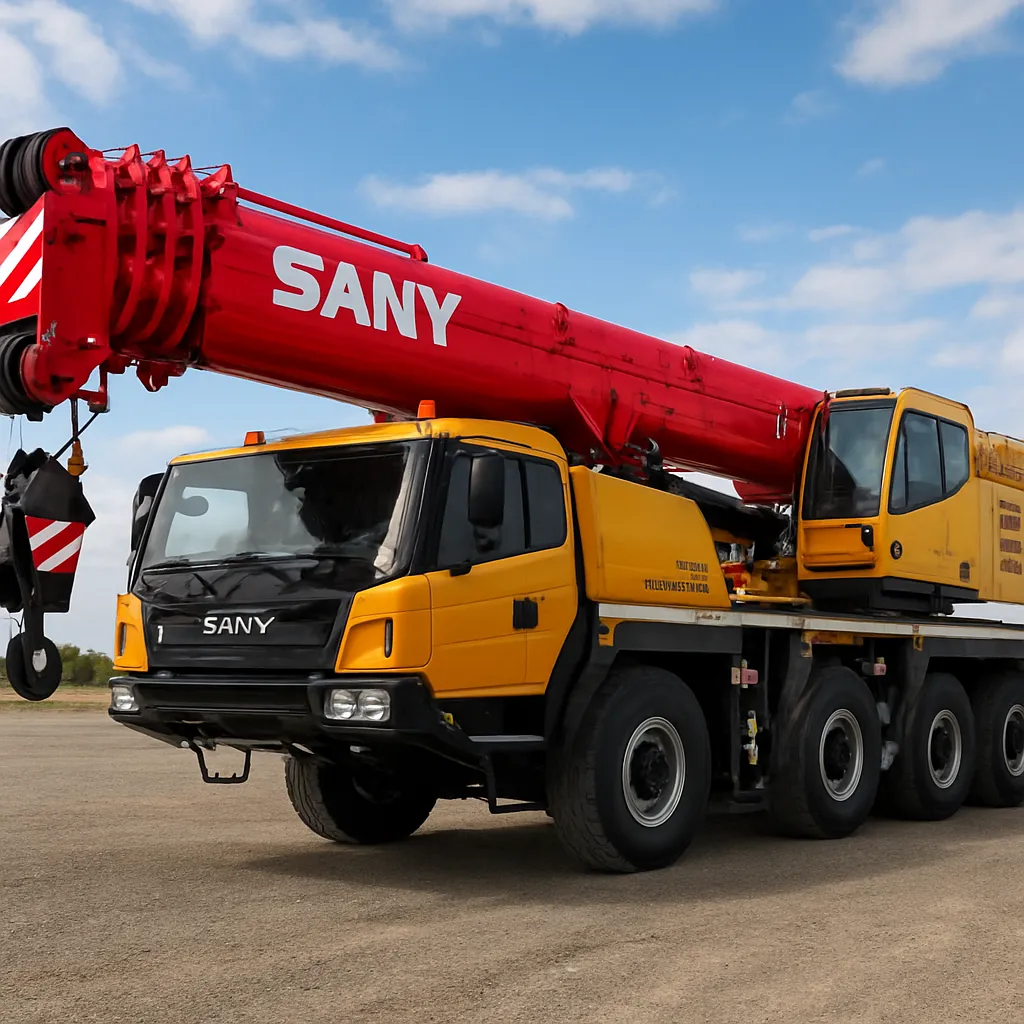
The SANY SAC2200S all-terrain crane represents a modern solution for heavy lifting in complex environments where road mobility and off-road capability are both required. Combining a robust carrier chassis with a powerful telescopic boom and advanced electronic controls, this model is designed to deliver reliable performance across construction, energy, industrial, and infrastructure projects. The following article explores the SAC2200S in detail — its design principles, typical specifications and capabilities, real-world applications, operational considerations, maintenance and safety features, market context, and practical tips for operators and fleet managers.
Overview and key characteristics
The SANY SAC2200S is part of SANY’s lineup of all-terrain cranes that bridge the gap between rough-terrain specialists and highway-capable mobile cranes. All-terrain cranes are built to be driven on public roads at legal speeds while retaining superior off-road and on-site mobility. The SAC2200S emphasizes a balance of mobility, lifting capacity, and electronic intelligence to handle demanding lifting tasks with precision and safety.
Typical defining characteristics of this class and model include:
- Gross rated lifting capacity in the 200–250 tonne class — commonly cited as a 220-tonne maximum for SAC2200S variants.
- A multi-section telescopic boom offering a combination of reach and compact transport length.
- An all-wheel drive and steering carrier designed for mixed on-road and off-road operation, often in an 8×8 or 6×6 axle configuration depending on specification.
- Advanced control and safety systems including load-moment indicators, electronic stability monitoring, and remote diagnostics/telematics.
- Modular counterweight systems and optional lattice jibs for increased height and radius capability.
Technical specifications and performance (typical and notable)
Exact specifications can vary by market and configuration, but the SAC2200S generally offers competitive features for its class. Below are typical figures and descriptions; confirm final numbers with the manufacturer or sales specification sheet for a particular unit.
Capacity and boom
- Rated maximum lifting capacity: approximately 220 tonnes (metric tons) at minimum radius.
- Main telescopic boom length: commonly in the range of 40–60 meters (depending on number of sections), with hydraulic extension for fine positioning.
- Optional lattice or sectional jib: can extend lifting height substantially — in some configurations adding 20–40 meters of height depending on modular jib sections.
- Full-power hoist winches and planetary gearboxes designed for continuous heavy-duty operation.
Chassis, driveline and mobility
- Carrier: purpose-built multi-axle chassis with heavy-duty suspension, designed to balance load distribution and road legality.
- Drive: selectable 6×6 or 8×8 drive systems are common in this capacity range to provide traction off-road.
- Travel speed: highway-capable speeds, permitting rapid relocation between job sites without specialized transport.
- Outriggers: hydraulically extendable with large footprint for stability on uneven terrain; full-circle deployment for flexibility.
Power, hydraulics and controls
- Engine: diesel power unit tuned to provide high torque for both travel and crane functions; power output typically sufficient to operate hoists and hydraulic pumps under load.
- Hydraulic system: high-pressure variable-displacement pumps for smooth boom extension/retraction and hoisting control.
- Control systems: integrated electronic control with load moment limiter (LML), anti-two-block protection, and user interfaces for safe operation.
- Telematics and diagnostics: factory-available remote monitoring tools for fault codes, usage logging, and preventive maintenance scheduling.
Applications and industry uses
The SANY SAC2200S is designed for heavy lifting tasks where mobility and flexibility are critical. Its use spans many industries:
Construction and civil engineering
- High-rise and mid-rise building construction where heavy modules, structural steel, or precast elements must be lifted to significant heights.
- Bridge assembly and maintenance tasks requiring precise placement of girders and sections over large radii.
- Infrastructure projects such as highway interchanges, where on-site maneuverability and rapid setup reduce downtime.
Energy sector
- Wind-turbine erection and maintenance: the SAC2200S can be used for tower segment installation, nacelle lifting, and nacelle replacements with appropriate jib extensions and counterweight configurations.
- Power plant installation and heavy equipment handling during installation or refurbishment of turbines, generators, and transformers.
Industrial and mining
- Installation and relocation of heavy process equipment, reactors, and compressors.
- Maintenance tasks in refineries, steel plants, or mining sites where terrain varies and mobility is required.
Utilities and emergency response
- Utility companies use all-terrain cranes for pole setting, substation work, and restoration after storms when roads may be damaged.
- Emergency heavy-lift operations such as clearing accidents involving large vehicles or structural collapses.
Design features that improve productivity
Several engineering decisions and systems integrated into the SAC2200S aim to enhance operator productivity and reduce total cost of ownership:
- Modular counterweight systems: allow quick changes to adapt lifting charts to the job while easing transport logistics.
- Rapid telescoping mechanisms with synchronized section movement to speed up boom deployment.
- Multi-mode steering and assisted maneuverability for tight job-site positioning.
- Ergonomically designed operator cabin with climate control, excellent visibility, and intuitive controls to reduce fatigue and improve precision.
- Remote-control options for certain functions to permit safe positioning in confined or hazardous areas.
Safety systems and operator aids
Safety is critical in heavy lifting. SANY equips its all-terrain cranes with electronic and mechanical systems to prevent accidents and protect equipment.
- Load moment indicator (LMI) with real-time display of boom angle, radius, and allowable load, automatically limiting operations if limits are exceeded.
- Anti-two-block devices that prevent the hook block from contacting the boom tip, reducing the risk of boom damage and load drop.
- Stability monitoring systems that alert the operator to uneven outrigger loads or ground conditions that compromise stability.
- Emergency stop and fail-safe hydraulic locks to secure the crane in the event of system failure.
- Comprehensive operator training and certification recommendations provided by manufacturers and dealers to ensure safe operation.
Maintenance, serviceability and lifecycle considerations
For fleet managers and owners, ease of maintenance and total lifecycle cost are significant drivers in purchasing decisions. The SAC2200S has been engineered with serviceability in mind:
- Accessible service points for routine checks on hydraulics, filters, and driveline components reduce downtime during preventive maintenance.
- Modular component layout simplifies replacement of major items — pumps, valves, and winches — minimizing heavy disassembly.
- Telematics-enabled predictive maintenance: remote diagnostics can flag wear patterns and impending failures before they become critical, allowing planned repairs.
- Availability of OEM spare parts through SANY’s global dealer network ensures quicker turnarounds for critical components.
Attachments, customization and optional equipment
One strength of all-terrain cranes is their modularity. The SAC2200S can be configured with various options to match job requirements:
- Different jib types: fixed lattice jibs or sectional lattice extensions to increase height and reach for wind or industrial lifts.
- Variations in counterweight packages to optimize setups for transport versus maximum capacity lifts.
- Specialized rigging packages and hook blocks for multi-part reeving and heavy loads.
- Environmental and site-specific options such as cold-weather kits, dust-protection seals, and corrosion-resistant coatings for offshore or corrosive environments.
Market context, ownership costs and statistics
All-terrain cranes in the 200–250 tonne class occupy an important niche: they are large enough for most heavy construction tasks yet compact and mobile enough to be cost-effective compared with larger crawler or tower crane solutions. While specific global sales numbers for the SAC2200S are proprietary to SANY, several general market observations apply:
- The global all-terrain crane market has grown steadily with infrastructure investment and renewable energy projects; demand for models in the 100–250 t segment is particularly strong.
- Ownership costs generally include financing, insurance, regular maintenance, and periodic major inspections such as crane certification and load testing. Telematics and predictive maintenance can reduce unscheduled downtime and overall cost per operating hour.
- Resale values for well-maintained all-terrain cranes remain robust due to their versatility and long service life measured in tens of thousands of operating hours.
Operational best practices and tips for managers
Maximizing the performance and longevity of an SAC2200S involves attention to training, planning and preventive care.
- Ensure operators are certified and familiar with the crane’s electronic load charts and safety interlocks. Simulators or vendor-led training courses accelerate proficiency.
- Conduct thorough site assessments including ground-bearing capacity analyses — the performance of outriggers depends on proper ground support and mats when needed.
- Use manufacturer-recommended lubricants and hydraulic fluids and adhere to scheduled filter and fluid changes.
- Document all lifts with lift plans for critical operations, including rigging arrangements, center-of-gravity checks, and contingency procedures.
- Leverage telematics data to monitor fuel consumption, engine hours, and unusual vibration or temperature signatures to prevent failures.
Advantages and limitations
Understanding both strengths and constraints helps in selecting the right lifting platform for the job.
Key advantages
- Versatility: drives on public roads and handles rough terrain, reducing transport logistics and setup time.
- Speed of deployment: telescopic booms and hydraulic outriggers enable rapid assembly compared with lattice crawler alternatives.
- Integrated safety systems reduce operator error and provide clear real-time data for safe planning.
Limitations
- All-terrain cranes typically carry higher initial capital costs than small rough-terrain cranes, though they often replace multiple pieces of equipment.
- For extremely heavy lifts or when repeated lifts at very large radii are required, larger crawler cranes may offer higher capacity and stability.
- Transport of very large counterweights or long lattice jibs may still require auxiliary vehicles and planning for road permits.
Case examples and typical job scenarios
Examples illustrate how the SAC2200S performs in real-world tasks.
- On a bridge construction project the SAC2200S was used to lift 30–40 tonne precast deck segments into position at radii up to 25 meters, reducing the need for extensive temporary supports and speeding the construction schedule.
- In a wind farm installation, the unit equipped with a sectional lattice jib and maximum counterweight configuration hoisted nacelles and upper tower sections, enabling erection in sites with limited road access and uneven ground.
- Industrial plant maintenance projects have used the SAC2200S to remove and replace heavy rotating machinery directly from foundations, minimizing downtime and crane rental complexity.
Buying considerations and rental vs. purchase
Deciding whether to rent or buy an SAC2200S depends on project frequency, geographic spread, and capital availability.
- Short-term projects or one-off heavy lifts often favor rental from a specialist fleet operator. Rentals include transport, certified operators, and sometimes rigging crews.
- Long-term usage, repeat projects, or operation within a company’s fleet often justify purchase, especially when amortized across multiple projects.
- Consider total cost of ownership: purchase price, maintenance, crew training, insurance, and downtime risks versus rental hourly/daily rates and included services.
Summary and outlook
The SANY SAC2200S all-terrain crane is a practical, capable platform for a wide range of heavy lifting tasks. Its combination of highway mobility, off-road driveability, telescopic boom versatility, and integrated electronic safety systems make it suitable for construction, energy, industrial and emergency-response applications. While specific numerical data can vary by configuration and market, the general performance envelope places this model firmly in the 200–250 tonne class with boom and jib options to match most medium-to-large lifting requirements.
When considering the SAC2200S, prioritize a careful match between the crane’s configuration and project demands, ensure rigorous operator training, and adopt preventive maintenance practices supported by telematics for the best long-term outcomes. With proper use, this type of all-terrain crane can significantly reduce project complexity and improve scheduling flexibility on demanding sites.


)
)