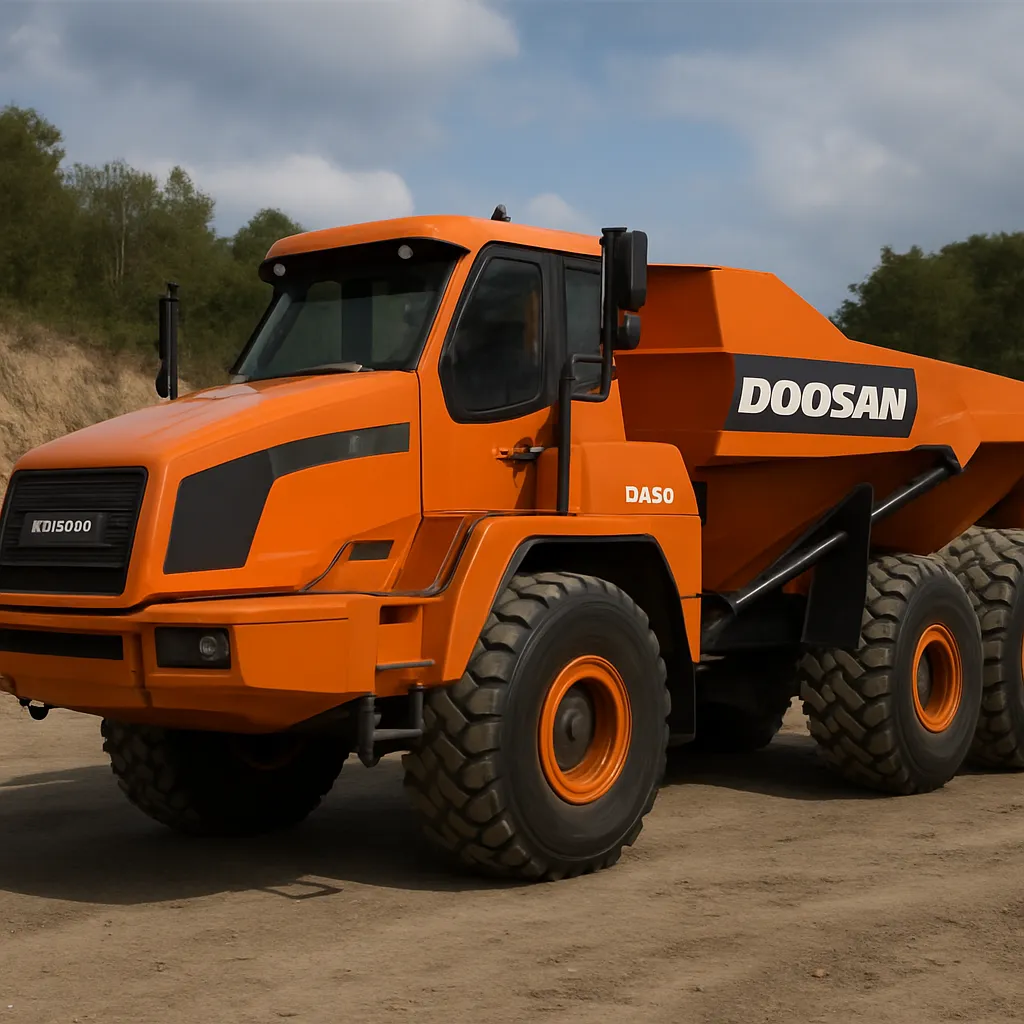
The Doosan DA30 articulated hauler is a heavy-duty machine designed to move large volumes of material across rough, uneven terrain. Combining robust construction, operator-oriented features and powerful drivetrain components, the DA30 is commonly deployed in construction, mining, quarrying and infrastructure projects where reliability and mobility are essential. This article examines the DA30’s design, typical specifications, areas of application, operational advantages, maintenance considerations and safety features, offering a comprehensive view for fleet managers, operators and procurement specialists.
Design and technical overview
The Doosan DA30 follows the common architecture of modern articulated haulers: a two-module layout with a front power module (engine, cab and transmission) and a rear dump body connected by an articulated joint that allows frame articulation and vertical oscillation. This configuration gives the machine excellent maneuverability and traction on slopes, soft ground and irregular surfaces. Key design priorities are durability, ease of service and operator comfort.
- Chassis robustness: Heavy-gauge steel frames, reinforced pivot areas and well-protected driveline components are standard to resist fatigue and impact in harsh working conditions.
- Drivetrain: The DA30 is delivered with a high-torque diesel engine matched to a multi-speed automatic transmission and heavy-duty axles with planetary final drives. These elements combine for strong tractive effort and the ability to maintain momentum on grades and in mud or loose material.
- Suspension and steering: Oscillating rear suspension and articulated steering provide continuous ground contact for all wheels, improving traction and ride quality. Many configurations include limited-slip or lockable differentials to enhance off-road capability.
- Operator environment: The cab is designed with ergonomics in mind — panoramic windows, adjustable seating, climate control and intuitive controls reduce operator fatigue and increase productivity. Modern variants include digital displays for machine monitoring and diagnostics.
Typical specifications (representative values)
Exact values depend on the model year and regional configuration. The following figures are representative ranges frequently associated with 30-ton class articulated haulers such as the DA30:
- Payload: approximately 28–32 tonnes
- Engine power: roughly 200–300 kW (270–400 hp) depending on emission stage and tuning
- Operating weight: around 28,000–34,000 kg (machine empty)
- Body volume: 12–16 m³ (heaped capacities vary by body style)
- Top travel speed: up to 50–55 km/h on road
- Fuel capacity: typically 300–500 litres
- Turning radius: very compact for its class due to articulated steering, enabling tight maneuvers on job sites
These figures give a practical expectation of the DA30’s capabilities. For procurement and planning, consult the manufacturer’s datasheets for the exact configuration and local emission-compliance package.
Applications and operational environments
The Doosan DA30 is a versatile machine suited to many heavy-material transport tasks. Its principal applications include:
- Quarrying and mining — hauling blasted rock, overburden and waste between faces, crushers and stockpiles. The DA30’s high payload and robust axles suit short-cycle, high-frequency tasks common in these sectors.
- Large civil construction — earthmoving for roadworks, dams, tunnelling support and site preparation. The articulated design eases access to restricted or sloped zones.
- Infrastructure and utilities — transporting aggregate, fill, and modular components in airport, rail and bridge projects where stability and predictable payload delivery are required.
- Landfill and waste management — moving refuse and daily cover material; optioned bodies and wear packages increase service life in abrasive environments.
- Forestry and pipeline projects — when fitted with appropriate tires and guarding, the DA30 can operate in soft soils and remote corridors, supplying equipment and removing spoil.
The machine’s combination of high mobility, considerable load volume and durability makes it a cost-effective choice where site conditions penalize rigid-frame trucks or where frequent turns, variable ground conditions and slope work are common.
Performance advantages and productivity
When assessing an articulated hauler like the DA30, productivity is driven by payload, cycle time and machine uptime. Several features contribute to strong field performance:
- Cycle efficiency: Fast acceleration, responsive transmission shifts and strong engine torque reduce load-haul-return cycle times. High top-speed capability on haul roads shortens transit time between load and dump points.
- Traction control: Axle locks, limited-slip features and correct tire selection maintain momentum in slippery conditions, lowering the risk of bogging and downtime.
- Heaped body capacity: Generous body volumes allow larger loads per trip, boosting material moved per operating hour when matched to site constraints.
- Operator assistance systems: Modern models may include payload weighing systems, slope monitoring and onboard diagnostics, allowing operators to work closer to optimal load targets and avoid overloading, which reduces wear and fuel consumption.
Fuel consumption per tonne-kilometre and maintenance intervals are important economic metrics. Typical working-cycle fuel use varies widely with terrain and operator behavior, but in many deployments a well-maintained articulated hauler in this class will offer competitive life-cycle costs versus alternatives due to lower tire wear, simpler driveline components and high commonality of parts across fleet types.
Safety features and operator comfort
Safety and operator wellbeing are integral to modern hauler design. The Doosan DA30 typically integrates multiple elements that protect personnel and reduce incident risk:
- ROPS/FOPS-certified cab — Roll-Over Protective Structure and Falling Object Protective Structure levels provide critical protection in hazardous work zones.
- Visibility and lighting — large glazing, well-placed mirrors and LED work lights improve sightlines during loading, travel and dumping operations.
- Braking systems — service and emergency brakes sized for the machine’s mass, often with retarder functions integrated into the transmission for downhill control.
- Access and egress — wide platforms, anti-slip surfaces and grab handles minimize slip-and-fall risks during service and operation.
- Monitoring and alarms — cameras, proximity sensors and audible alerts reduce collision risk in busy yards or tight corridors.
Ergonomics are addressed through adjustable seating, climate control and low-vibration cab mounts. These features reduce operator fatigue and support longer productive shifts.
Maintenance, serviceability and telematics
High uptime stems from a design that simplifies routine maintenance and from support systems that plan service interventions before failures occur. The DA30’s design emphasizes:
- Accessible service points — grouped filters, easy-to-open panels and ground-level grease points reduce time required for daily checks and routine servicing.
- Durable components — long-life hydraulic hoses, robust articulation bearings and reinforced dump-body wear plates extend the intervals between major interventions.
- Telematics — Doosan and many dealers offer fleet-monitoring platforms (often branded solutions such as DoosanCONNECT or equivalent) that transmit engine hours, fuel use, fault codes and GPS position. These systems enable remote diagnostics, preventive maintenance scheduling and improved fleet utilization analysis.
Planned maintenance schedules and operator training greatly influence lifecycle cost. Using OEM-recommended oils, filters and service intervals, plus proactive wear-part replacement, keeps the DA30 productive and resale value strong.
Environmental standards and emissions
Diesel engines powering articulated haulers must comply with regional emissions regulations. Over the past decade manufacturers have introduced exhaust aftertreatment systems (SCR, DPF and DOC) to meet standards such as EU Stage V / EPA Tier 4 final. Advantages of modern emissions systems include:
- Lower NOx and particulate emissions supporting permit compliance on regulated sites
- Improved fuel efficiency through optimized combustion and electronic engine management
- Integration with telematics to monitor regeneration cycles and DPF status
Machine selection should consider future regulatory changes, especially for projects in urban or protected areas where stricter emissions limits may be enforced.
Variants, options and customization
Manufacturers commonly offer a range of options to tailor machines to job-specific needs. For the DA30 these may include:
- Different dump-body designs: standard, wear-lined, ejector or rock bodies for abrasive materials
- Powertrain options tuned for fuel efficiency or maximum hauling speed
- Heavy-duty tires and rims for rock and quarry applications, or flotation tires for soft ground
- Additional lighting packages, camera systems and protection kits for dump-body and undercarriage
- Cold-weather packages with engine block heaters, battery warmers and insulated hydraulic lines
Customization enhances performance in specific environments and can significantly improve total cost of ownership when aligned with the operational profile.
Economic considerations and lifecycle costs
When evaluating an articulated hauler purchase or lease, consider:
- Acquisition cost vs. productivity: A higher-spec machine may yield lower cost per tonne through faster cycles and reduced downtime.
- Fuel economy: Engine tuning and operator training reduce fuel burn; telematics data can be used to coach operators and optimize routes.
- Resale and residual value: Maintaining documented service records and using OEM parts retain higher value at trade-in.
- Parts availability and dealer network: A broad service network reduces transport time for spare parts and supports emergency repairs.
For many mid-size and large projects, the DA30-class machine presents favorable economics relative to smaller fleets of dump trucks when factoring in fewer trips, lower tire change frequency and simplified operator training across a standardized model range.
Summary and practical recommendations
The Doosan DA30 articulated hauler is a capable machine for moving heavy loads across difficult terrain. Its design emphasizes durability, operator comfort and serviceability — qualities that matter in quarrying, mining and large-scale civil works. When specifying a DA30 or similar articulated hauler, consider the following practical steps to maximize value:
- Match payload and body type to the material density and cycle distances to avoid over- or under-sizing.
- Choose tires and differential options appropriate for ground conditions to reduce traction-related delays.
- Implement telematics early to monitor utilization, fuel use and diagnostic codes for predictive maintenance.
- Prioritize operator training — skilled operators reduce fuel consumption, lower component stress and extend service intervals.
- Plan for emissions compliance if operating in regulated regions; select the correct emissions package at purchase.
With correct specification, maintenance discipline and operator support, the DA30 delivers consistent shifts of material with competitive operating costs, making it a suitable choice for contractors and mine operators seeking a balance of performance and reliability.


)
)