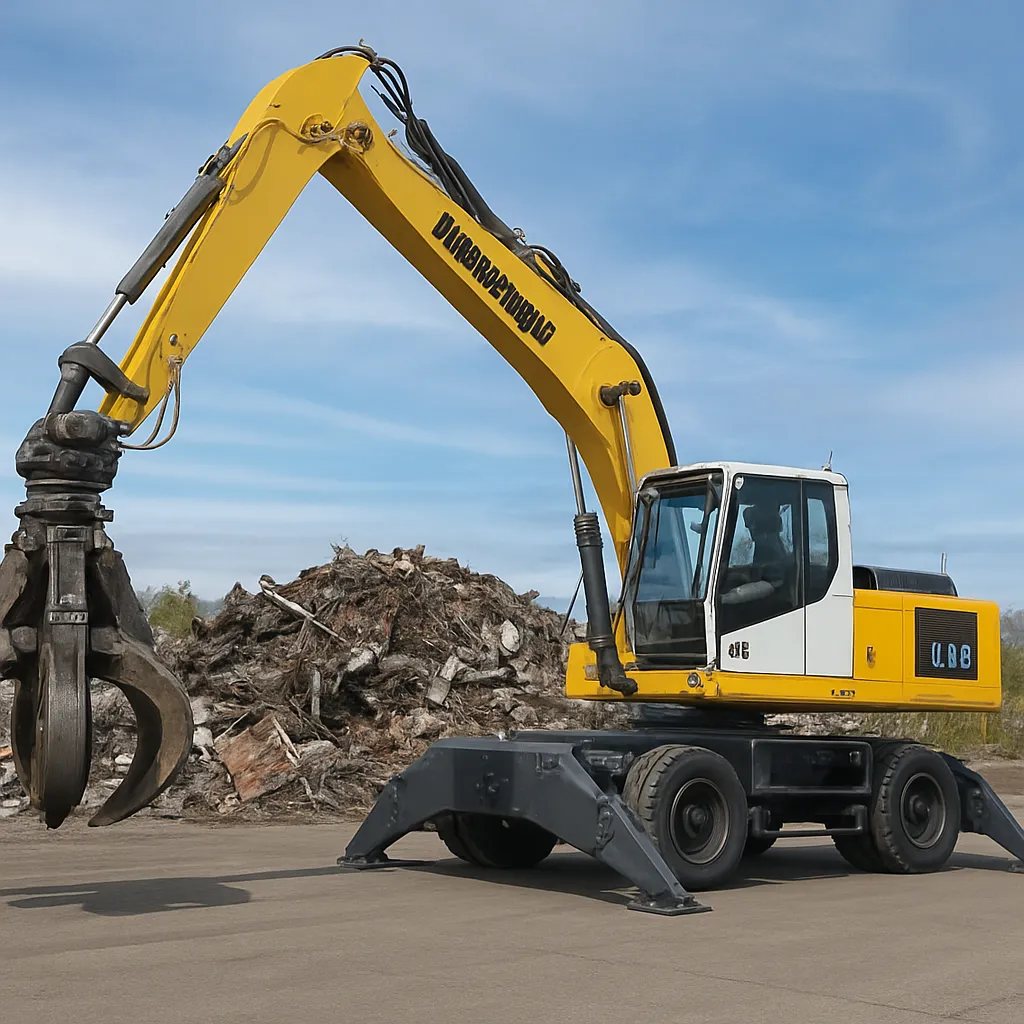
The Liebherr LH 80 is a versatile mid-size material handler designed to meet the demands of industries that require precise, efficient and heavy-duty bulk handling. Built by Liebherr, a global manufacturer known for robust construction equipment, the LH 80 series blends proven hydraulic performance, ergonomic operator environments and a range of attachment options to handle scrap, recycling, port operations, timber, demolition and general material handling tasks. This article presents an in-depth overview of the machine, its typical applications, noteworthy technical and operational features, maintenance considerations and market context. Wherever specific numerical data is used, it is noted as approximate to reflect variations across configurations and production years.
Design and core features
The Liebherr LH 80 is designed as a dedicated material handler rather than a conventional excavator. That distinction influences several design choices: an elevated operator cab for superior visibility, a boom and stick geometry optimized for reach and load control, and hydraulic systems tuned for frequent, precise manipulations rather than continuous digging cycles. The machine is commonly offered on multiple undercarriage options—wheeled, tracked or even pedestal/portal undercarriages—depending on the intended use case. This flexibility helps tailor the LH 80 to jobsite mobility and ground conditions.
Key structural elements include a rigid main frame that supports counterweights sized for lifting stability, a reinforced boom connection with heavy-duty pins and bushings and boom and dipper designs that allow a wide variety of attachments to be fitted, from grapples and clamshell buckets to magnets and shears. Liebherr typically emphasizes serviceability in its designs; service points like filters, hydraulic test points and fluid fill areas are arranged for relatively straightforward access during routine maintenance.
The operator environment is an important differentiator on material handlers. The LH 80 usually features a cab with elevated positioning, large glazed surface area for 360-degree visibility, adjustable seating and controls, and options for climate control, heating and sound insulation. Modern variants or retrofitted machines may include camera systems, operator-assist displays and joystick controls calibrated for smooth, proportional response and reduced operator fatigue.
Hydraulics, powertrain and control systems
A defining characteristic of any material handler is its hydraulic system. The LH 80 is typically equipped with a hydraulically powerful, load-sensing system designed to deliver rapid cycle times and consistent flow to multiple simultaneous functions. Hydraulic oil cooling and filtration systems are designed to withstand continuous operations in scrap yards, ports or recycling facilities.
The powertrain usually consists of a diesel engine meeting contemporary emission standards for the period of manufacture. Liebherr engines and drive systems are selected to provide a balance between responsive hydraulic power and fuel efficiency. Modern machines may include electronic engine management and Tier-stage-compliant engines, which reduce emissions while retaining torque characteristics optimized for heavy-handling tasks.
Control systems vary with machine age and specification. Newer LH 80 handlers may include electronic control units (ECUs) managing hydraulic flow distribution, boom damping, and integrated safety features. Optional telematics systems, such as Liebherr’s LiDAT, allow fleet managers to monitor location, utilization, fault codes and maintenance intervals remotely—an increasingly important feature for optimizing uptime and reducing life-cycle costs.
Common applications and industry use cases
The LH 80 finds its place across several industries thanks to its mid-size footprint and flexible configuration options. Primary applications include:
- Scrap yards and metal recycling: Sorting, moving and loading scrap, with hydraulic grapples and magnets for ferrous materials.
- Ports and terminals: Handling bulk cargo like timber, recyclable materials and secondary raw materials for vessel and truck operations.
- Forestry and timber yards: Handling logs and timber bundles using specialized grapples or clamps.
- Construction and demolition: Sorting demolition debris, loading trucks and feeding processing equipment.
- Waste and recycling centers: Managing municipal solid waste, bulky waste and recyclables for sorting lines.
- Aggregate and bulk material handling: Loading/unloading aggregates, coal or similar materials where reach and frequent pick-and-place cycles are required.
The machine’s adaptability through a range of attachments—orange-peel grapples, hydraulic shears, clamshells, multi-tine grapples and rotary magnets—makes it a valuable asset where job types change or multifunctional handling is needed.
Typical technical specifications (approximate ranges)
Specification values for the LH 80 can vary by year and configuration. The following figures are offered as typical approximations based on comparable mid-sized Liebherr handlers and reported specifications from used-machine listings and manufacturer literature for similar models:
- Operating weight: approximately 16–24 tonnes depending on undercarriage and counterweight configuration.
- Engine power: roughly 80–120 kW (110–160 HP) in many configurations, with variations tied to emission stage and market-specific engines.
- Maximum reach: commonly in the 8–12 meter range for standard booms; specialized boom packages can extend reach further.
- Lifting capacity at close radii: capacity can exceed several tonnes at short reach; rated lifting charts vary by configuration and attachments.
- Hydraulic flow and pressures: high-flow main pumps providing the necessary liters-per-minute for simultaneous operations; nominal pressures typically align with industrial hydraulic standards for heavy material handlers.
- Fuel tank capacity: sized to provide a full working shift under typical workloads, often in the few hundred-liter range depending on fuel economy and optional tanks.
These values are illustrative; buyers should consult specific machine serial-number documentation or manufacturer specification sheets for exact numbers on a given unit. Nevertheless, these ranges highlight the LH 80’s position as a capable, mid-weight handler suitable for a broad swath of material handling tasks.
Attachments and customization options
One of the LH 80’s strengths is its compatibility with a wide range of attachments, enabling quick role changes and maximizing return on investment. Typical attachments and customization options include:
- Grapples (orange-peel, multi-tine, sorting grapples) for scrap and recycling.
- Clamshell buckets for bulk loading/unloading of loose materials.
- Sorting grapples and magnet attachments for metals handling in yards and ports.
- Hydraulic shears for cutting and processing demolition and scrap material.
- Rotating couplers and slew systems that allow attachment rotation and precise placement.
- Cab protection packages, reinforced undercarriages and heavy-duty boom components for extreme-duty operations.
Many customers specify quick-coupler systems to reduce attachment-change time and increase machine utilization. Electrical or hydraulic quick connections and fitted lines for powered attachments simplify switching between roles on complex sites.
Operational performance and efficiency
Performance of the LH 80 is a product of hydraulic responsiveness, operator skill and machine configuration. In typical recycling and scrap yard cycles—lift, swing, drop and reposition—the handler’s precise hydraulic control and stability are crucial. Liebherr’s hydraulic tuning emphasizes smoothness and proportional response to joystick inputs, which reduces material spillage and accelerates loading cycles while reducing operator fatigue.
Fuel efficiency is an important operating cost factor. Modern units incorporate engine management strategies, load-sensing hydraulics and standby modes to reduce idling consumption. Operators can also influence fuel use via practical measures: matching boom reach to task, avoiding unnecessary high-rev periods and using proper attachment sizing.
For fleet managers, telematics integration provides measurable performance data: hours of operation, idle time, fuel consumption patterns and fault logs. Using this information, managers can optimize shifts, schedule proactive maintenance, and quantify utilization to decide on redeployment or acquisition of additional machines.
Maintenance, lifecycle and total cost of ownership
An important consideration for any buyer is total cost of ownership (TCO). Key factors influencing TCO for the LH 80 include initial acquisition price, fuel consumption patterns, maintenance intervals and component wear rates (particularly under heavy scrap or demolition conditions).
Liebherr’s reputation for durable components and a global support network helps control maintenance downtime. Regular preventive maintenance tasks—hydraulic oil and filter changes, grease points, track or wheel inspections and boom pin lubrication—are essential to protect resale value and prevent costly failures. Components such as hydraulic pumps, main control valves and pins/bushings represent potential high-repair-cost items if allowed to degrade.
Resale values for well-maintained LH 80 machines remain respectable in regional markets due to the machine’s versatility. Lifecycle extension strategies include scheduled rebuilds of undercarriage components, proactive hydraulic system overhauls and ensuring structural components remain within manufacturer tolerances.
Safety features and operator ergonomics
Safety on material handling sites is paramount. The LH 80 typically incorporates features aimed at reducing operator risk and improving site safety:
- Elevated cab and large glazing for comprehensive sightlines over work areas.
- ROPS/FOPS certified cabs in many configurations for protection from rollovers and falling debris.
- Operator restraint systems, emergency stop functions and lockout systems for hydraulics during servicing.
- Optional camera systems or proximity sensors to mitigate blind spots in congested yards.
- Stabilizers or outriggers on certain undercarriage types to increase lifting stability for heavy lifts.
Ergonomics are addressed via adjustable seating, climate control and intuitive control layouts. Less operator fatigue results in improved productivity and fewer incidents caused by human error.
Environmental considerations
Modern material handlers are designed with evolving environmental regulations in mind. Liebherr engines are offered to meet various emission stages (Tier, Stage) depending on the market. Noise control measures, improved combustion efficiency and hydraulic system optimizations reduce emissions and environmental impact.
For operators in urban or noise-sensitive environments, options such as acoustic cab packages, engine covers and lower-noise hydraulic pumps can be specified. Additionally, efficient loading cycles and proper machine sizing for tasks reduce fuel consumption and CO2 emissions per tonne moved.
Market positioning and economics
The LH 80 occupies a mid-market niche—larger than compact handlers used for light-duty tasks but smaller and more maneuverable than very large port or scrap handlers. This positioning makes the machine attractive for medium-sized yards, regional ports and contractors who require serious capacity without the footprint and capital cost of the largest handlers.
From an acquisition standpoint, used LH 80 machines are often sought after due to availability of parts and the model’s adaptability. New units command a premium for factory-warrantied purchases and modern compliance packages. Leasing and rental options exist and can be attractive for project-based needs, allowing operators to match capacity to project duration without large capital outlay.
Practical tips for operators and fleet managers
To maximize the value of an LH 80 in daily operations, consider the following practical guidelines:
- Choose the undercarriage and boom package that matches primary tasks—wheeled for mobile yard work, tracked for rough terrain or pedestal for stationary port cranes.
- Match attachment sizing to material and cycle times; oversized attachments increase wear and fuel use.
- Implement telematics monitoring to reduce idle time and detect faults early.
- Follow manufacturer-recommended lubrication and inspection intervals to prevent expensive repairs.
- Train operators on efficient handling techniques: smooth joystick use, minimizing excessive swing and using hold functions to stabilize loads.
Case examples and real-world contexts
In scrap yards, the LH 80 excels when equipped with a heavy-duty orange-peel grapple and a magnet. Operators report higher throughput when visibility and hydraulic responsiveness are optimized—factors where the LH 80’s cab design and hydraulic tuning contribute substantially. In port operations handling timber or bundled materials, the machine’s reach and stable lifting platform enable efficient vessel and truck loading cycles while reducing damage to cargo.
Recycling centers benefit when the machine is configured with sorting grapples and camera guidance, enabling fast separation of materials and feeding of processing lines. In demolition sites, shears and sorting grapples can be combined to process debris efficiently while the dealer-installed protective packages extend machine life.
Summary and outlook
The Liebherr LH 80 is a flexible and capable mid-size material handler that combines hydraulic performance, operator comfort and attachment versatility to serve a broad set of industries including scrap and recycling, ports, timber yards and demolition. While specific technical numbers vary by configuration and manufacture year, the general strengths of this model are consistent: good balance of reach and lifting capacity, service-friendly layout and the ability to adapt to many tasks through attachments and optional systems.
For fleet managers and operators evaluating equipment, the LH 80 represents a practical middle ground—large enough for demanding work but compact enough for many yards and terminals. With appropriate maintenance, operator training and telematics-driven utilization practices, this model can deliver strong operational performance and favorable lifecycle economics.


)
)