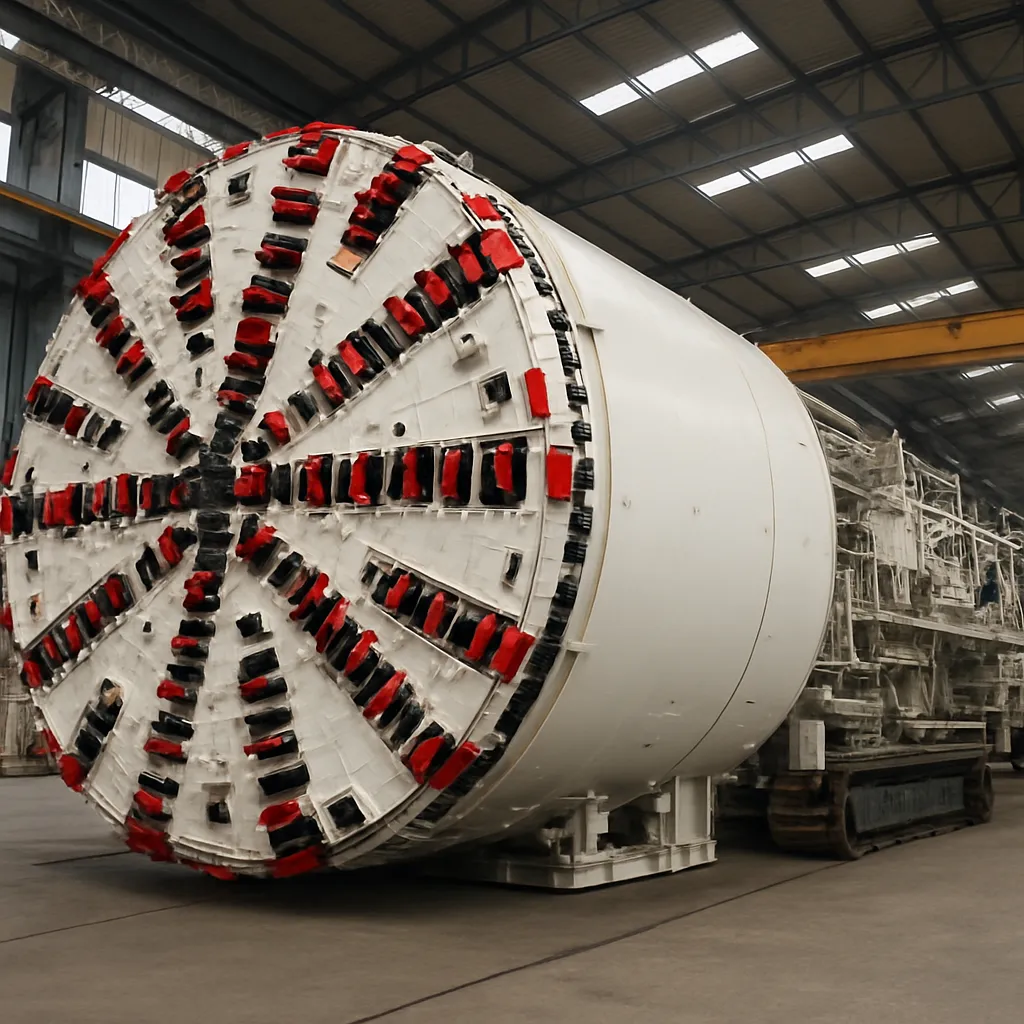
The CRCHI 15.8m Giant TBM represents a class of modern mechanized tunneling equipment designed to create very large diameter tunnels for a wide range of infrastructure applications. Produced by China Railway Construction Heavy Industry (CRCHI), machines of this scale combine advanced mechanical, hydraulic and electronic systems to deliver controlled excavation, ground support, and segment installation in challenging geological and environmental conditions. This article explores the machine’s design, typical specifications, applications, operational methods, logistical challenges, environmental and safety aspects, and real-world performance indicators.
Design and core technical features
The heart of any large tunnel boring machine is its cutterhead and supporting systems. The CRCHI 15.8m Giant TBM is engineered to tackle mixed-face, soft ground and rock conditions by combining rugged mechanical design with adaptable soil-handling systems.
Cutterhead and excavation systems
- The 15.8m diameter cutterhead is custom-configured with interchangeable tools—disc cutters for rock, carbide picks or scrapers for softer strata, and openings for soil conditioning and slurry exchange when required.
- The cutterhead is supported by a powerful drive motor and gearbox assembly that provides the rotational torque needed to break diverse ground types while maintaining smooth operation.
- For soft or saturated soils, the machine can be configured as a slurry TBM or an Earth Pressure Balance (EPB) TBM; mixed-face cutters and soil conditioning ports improve performance where geology changes along the alignment.
Shield, cutterhead support and segment handling
- A robust cylindrical shield protects the excavation face and provides a stable platform for internal systems including hydraulic cylinders that provide the thrust to push the TBM forward.
- Behind the cutterhead, a segmented shield area houses conveyor belts or slurry pipelines to remove excavated material and an erector mechanism to place precast concrete segments that form the tunnel lining.
- Automatic segment erectors, gaskets and grout systems enable rapid ring installation and immediate primary support, critical in high groundwater or weak ground conditions.
Power, propulsion and control
- Giant TBMs of this class typically incorporate multiple high-capacity electric drives to power cutterhead rotation, hydraulic systems, and conveyor belts. Typical installed power ranges from several megawatts up to over 10 MW depending on configuration and project needs.
- Advanced control systems monitor torque, thrust, face pressure, slurry properties (if applicable), and machine alignment; on-board instrumentation enables real-time response to changing ground conditions.
- Redundant systems, remote diagnostics and modular components increase operational availability and shorten maintenance intervals.
Applications and typical use cases
The primary applications for a machine with a 15.8m cutterhead include a variety of large-bore tunnels where space, safety and continuity favor mechanized excavation over drilling and blasting or cut-and-cover methods.
Road and rail tunnels
- High-capacity metro and rail lines: Large-diameter bored tunnels can accommodate twin-track metro lines or road-rail combined cross-sections, reducing the need for multiple parallel bores.
- Motorway and highway tunnels: For urban bypasses and mountain crossings, a single large-bore tunnel can be more economical and have lower surface disruption than multiple smaller bores.
Undersea and river crossings
- Underwater tunnels benefit from mechanized boring when depth, water pressure and soft sediments complicate immersed-tube or bridge solutions. A sealed slurry TBM configuration provides excellent control of face pressure and contamination mitigation in these environments.
- Crossings that require large utility corridors or futureproofed transport capacity frequently employ large-diameter TBMs to provide a single robust tunnel.
Utility and multi-service tunnels
- Large tunnels can host multiple utility lines—water mains, power cables, fibre optics, district heating—in a single accessible corridor, improving maintenance safety and reducing future digging impacts.
- Urban logistical needs, such as bus or tram tunnels, can also be served by large TBMs when surface disruption must be minimized.
Operational workflow and construction logistics
Operating a giant TBM is a complex, multidisciplinary activity that extends beyond the machine itself to encompass site works, material supply, spoil handling and tunnel lining installation.
Spoil management and muck removal
- In EPB mode, excavated material is conditioned with foams or polymers and conveyed out on belt systems or muck cars. For slurry TBMs, a closed-loop slurry system transports cuttings to separation plants at the receiving shaft.
- Large machines produce substantial muck volumes—typical excavation cross-sectional areas for a 15.8m diameter tunnel exceed 195 m², so daily volumes can reach hundreds to thousands of cubic metres depending on advance rate.
Segment logistics and ring erection
- Precast segment production must match TBM advance to avoid delays. A well-coordinated supply chain—casting yards, QA/QC, transport and storage—is essential.
- Ring installation is semi-automatic: segments are lifted, positioned by the erector, gasketed and grouted. For rings in large bores, segment weights and handling equipment are significantly larger than for conventional metro TBMs.
Assembly, launch and retrieval
- Delivery and assembly of a giant TBM require large shaft or portal facilities, heavy-lift cranes and significant temporary works. The TBM is typically assembled near the launch shaft and tested before cutting.
- Depending on project design, the TBM may be retrieved at an end shaft, refurbished and re-used on another drive, or disassembled underground—both options require careful planning and additional cost/time allowances.
Performance indicators and statistical ranges
Exact performance varies widely by ground conditions, alignment, machine configuration and logistics. However, general statistical ranges used to plan projects with a CRCHI 15.8m-class TBM include the following:
- Diameter: 15.8 m (cutterhead)
- Excavation area: approximately 195–200 m²
- Typical drive power: several MW to >10 MW depending on options
- Advance rate: average 5–20 m/day; peak short-term rates in favorable ground may exceed 30 m/day
- Segment ring installation time: a few hours per ring under well-optimized conditions (ring geometry and logistics dependent)
- Spoil handling: hundreds to thousands of m³ per day depending on progress
- Total machine length (with trailing gear): often 80–150 m depending on configuration
- Machine weight: several thousand tonnes in assembled form
These figures are indicative and should be adapted to site-specific geotechnical reports and contractual requirements. Project planners commonly generate estimate ranges from pilot tunnelling, probe drilling and comparison with similar completed drives.
Geotechnical adaptability and machine configurations
One of the key strengths of a CRCHI 15.8m-class TBM is configurational flexibility to match the ground conditions along the alignment.
EPB vs. slurry configurations
- EPB mode is typically used in cohesive soils, silts and mixed-ground with controlled water content. The excavated muck supports the face and is removed via conveyors after conditioning.
- Slurry mode is preferable in saturated sands, gravels or highly permeable strata where maintaining face pressure and preventing inflows is critical. Slurry systems require separation plants and provide superior face pressure control in high-water-pressure situations.
- Some large TBMs are built as convertible machines that can switch between EPB and slurry mode either on-site or via pre-drive configuration changes.
Cutterhead tooling and wear management
- Tooling selection—disc cutters, picks, chisels—depends on rock strength and abrasivity. Large-diameter disc cutters are used where hard rock is anticipated; cutters and discs are designed for fast replacement and on-board storage of spares.
- Wear patterns and cutter consumption are monitored continuously; major maintenance interventions are planned at pre-determined meterages or when instrumentation indicates deterioration.
Environmental, safety and community considerations
Giant TBMs offer significant advantages for minimizing surface disruption and improving worker safety, but they also introduce specific environmental and community considerations.
Reduced surface disturbance and urban impacts
- Compared with cut-and-cover techniques, mechanized boring using a large TBM minimizes excavation at surface level, reducing traffic disruption, noise and dust in urban cores.
- Long continuous drives enable tunneling beneath sensitive structures with careful control of settlement and ground movements monitored by an array of geotechnical instruments.
Noise, vibration and spoil management
- TBM operations generate noise and vibration at launch and retrieval sites and from conveyors and ancillary equipment. Mitigation includes acoustic enclosures, focused working hours, and vibration monitoring near heritage or sensitive structures.
- Spoil storage and transport must be managed to avoid dust, odour or traffic impacts; slurry dewatering or conveyor trucking schedules are planned to minimize community disturbance.
Worker safety and automation
- Modern TBMs are increasingly automated to reduce the need for personnel at the cutterhead and other hazardous locations. Remote controls, CCTV and interlocks protect workers during high-risk operations like cutter replacement and segment erection.
- Emergency systems include ground support reserve supplies, face-sealing capabilities and rapid decompression strategies where pressurized-face operations are needed.
Case studies, industrial context and economic considerations
While many projects worldwide have used large-diameter TBMs, the adoption of a CRCHI 15.8m-class machine is typically driven by the economics of a single large bore versus multiple smaller tunnels, alignment constraints, and geological risk allocation.
When a giant TBM is the preferred solution
- Project briefs that require a large internal cross-section—twin tracks with clearance, roadways with large cross-section utilities, or multi-level service corridors—often favor a single large TBM to simplify ventilation, drainage and maintenance.
- Urban contexts with restricted surface access where minimizing cut-and-cover is a priority will frequently justify the higher mobilization cost of a large TBM.
Cost drivers and schedule impacts
- Key cost elements include TBM manufacture or lease, shaft construction, segment production, spoil handling systems, and specialized launching and retrieval works. While TBM unit rates can be high, overall programmatic benefits—reduced surface reinstatement, faster uninterrupted tunnelling—can offset initial capital.
- Time risks are often associated with unforeseen geology, variable water inflows, and logistical bottlenecks for segment supply or spoil disposal. Contingency planning, probe drilling and flexible contractual clauses are commonly used to allocate and mitigate these risks.
Future trends and innovations
The tunneling industry continues to evolve. Several trends are particularly relevant for giant TBMs like the CRCHI 15.8m-class.
- Greater automation and condition-based maintenance reduce downtime and improve safety; machine learning applied to sensor data is being piloted to predict cutter wear and optimize advance rates.
- Modular design and component standardization reduce transport and assembly costs while enabling faster re-deployment across multiple drives.
- Environmental technologies—closed-loop slurry management, enhanced spoil recycling and low-emission power systems—help projects meet stringent regulatory and community expectations.
Practical considerations for project teams
For engineers and project managers considering a CRCHI 15.8m Giant TBM, several practical recommendations support successful delivery:
- Invest in comprehensive ground investigation including oblique boreholes and geophysical surveys to reduce geological uncertainty.
- Plan segment production and logistics early; casting yard location, mould capacity and transport routes often govern the achievable advance rates.
- Ensure interface management between TBM supplier, erector teams, and geotechnical monitoring to enable rapid response to face behaviour changes.
- Build detailed contingency plans for cutter changes, slurry plant failures and emergency retrieval scenarios.
Key words and concepts to emphasize for stakeholders: the machine’s CRCHI origin, its large 15.8m diameter enabling unique cross-sectional capacity, the role of the cutterhead, EPB vs slurry configurations, the importance of segments for lining, and the interplay of thrust, shield support and modern control systems. The combination of these features makes the 15.8m-class TBM a powerful option where a single, large, uninterrupted tunnel offers the best balance of operational and urban benefits.


)
)