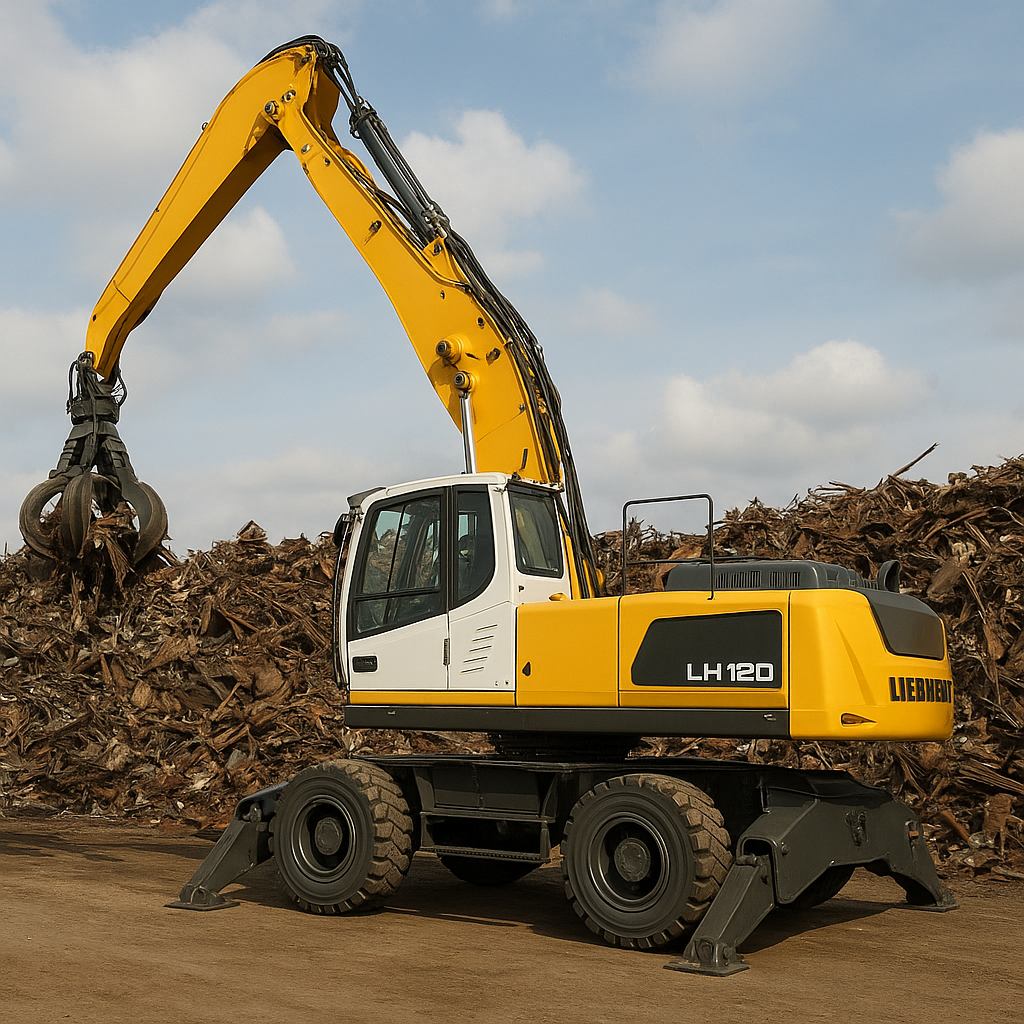
The Liebherr LH 120 is a versatile and purpose-built material handling machine designed for high productivity in demanding bulk-material and scrap-handling operations. Combining robust mechanical design with modern hydraulic controls and operator-focused ergonomics, the LH 120 is deployed across a wide range of industries — from ports and recycling yards to demolition sites and timber terminals. This article examines the machine’s design, typical applications, technical highlights, operational advantages, maintenance considerations, and market role, providing both practical insights and usable specifications where available.
Design and Technical Highlights
The LH 120 is built around a rigid, purpose-oriented chassis and an upper structure optimized for stability and visibility during material-handling tasks. Central to its performance is a carefully tuned hydraulic architecture and an ergonomically designed operator station. In many configurations, the LH 120 prioritizes a low center of gravity, counterweight options, and reinforced attachment points to handle heavy grapples or shear tools.
Key technical focus areas include engine performance, hydraulic power delivery, structural strength of the boom and stick, and cab visibility. Newer variants or updated production runs often meet current emission standards (for instance, EU Stage V or equivalent Tier levels in other markets) through engine selection and aftertreatment systems. Depending on the chosen configuration and market, the LH 120 typically features engines and drivetrains tuned for continuous duty cycles found in scrap, recycling, and port operations.
The machine’s hydraulic system enables precise and responsive control of attachments and slewing operations. Liebherr’s engineering emphasis on hydraulic efficiency helps reduce cycle times and improves fuel economy in real-world handling tasks. The boom geometry and stick options are available to balance reach and lifting capability for specific work sites.
- Hydraulic system: High-flow, load-sensing hydraulics for smooth attachment operation and energy efficiency.
- Boom and stick: Multiple configurations for short-reach heavy-lift or long-reach stockpiling roles.
- Operator comfort: Spacious cab with optimized sightlines, climate control, and ergonomic controls tailored to long shifts.
- Chassis options: Wheeled or tracked undercarriage variants to suit yard mobility or site stability requirements.
Typical Specifications and Performance Ranges
Liebherr offers multiple options across the LH family, and specifications for the LH 120 can vary depending on attachments, undercarriage, and market-driven emission upgrades. The following ranges are representative and intended to provide a practical picture rather than an exact factory sheet for every variant:
- Operating weight: approximately 18–26 tonnes depending on configuration and counterweight.
- Engine power: commonly in the range of 100–140 kW (roughly 135–190 HP), though exact figures depend on engine choice and emissions package.
- Maximum working reach: typically 10–14 metres in standard material-handling configurations; longer reach booms are sometimes available.
- Lift capacity at close range: varies widely with boom and counterweight but generally allows efficient movement of multi-tonne loads when fitted with appropriate attachments.
- Typical grapple capacities: for scrap and bulk handling, grapples range from roughly 1.0 m³ to 3.5 m³, depending on design and material density.
Operational metrics such as throughput (tons per hour) are highly job dependent. For example, efficient scrap-handling setups with a skilled operator can achieve several dozen tonnes per hour, while high-volume port stockpiling or recycling operations with optimized cycles can significantly exceed that, depending on material characteristics and site logistics.
Primary Applications and Industry Uses
The LH 120 is engineered for flexibility across multiple heavy-material handling domains. Below are the most common applications:
- Scrap yards and metal recycling — Handling, sorting, and loading scrap bundles, briquettes, and shredded metal with grapples, magnets, or shears.
- Port terminals — Bulk loading and unloading, container-side handling of loose cargo, and stockpile management where reach and maneuverability are essential.
- Demolition sites — Equipped with demolition shears or hydraulic breakers for selective dismantling and feeding of debris into processing lines.
- Timber yards and forestry operations — Moving logs and sorting timber using specialized grapples that protect the load and improve cycle times.
- Waste and materials recovery facilities (MRFs) — Feeding shredders, sorting lines, and managing mixed-waste or recyclable streams.
- Steel mills and foundries — Charging furnaces, handling heavy scrap, and moving ingots or raw materials within the yard.
Each sector emphasizes different machine characteristics: scrap yards prioritize grapple strength and cab protection; ports require reach, rotation speed, and mobility; demolition needs robust attachment interface and machine protection features.
Attachments and Configurations
One of the LH 120’s strengths is its compatibility with a wide range of attachments, which allows a single base machine to be adapted to many tasks. Common attachments include:
- Grapples (orange peel/sorting grapples) for scrap, bulk, and recycling materials.
- Magnetic lifting systems for ferrous metal handling in scrapyards and steel plants.
- Shears and shearing booms for cutting structural steel and demolition tasks.
- Clamshell and clamshell buckets for bulk loading and unloading.
- Boom-mounted hydraulic breakers for concrete and rock demolition.
- Demolition rotating houses and extended booms for selective deconstruction.
Quick-change couplers and integrated hydraulic circuits simplify attachment changes and maximize uptime. Properly matched attachments enhance productivity and reduce fuel consumption by optimizing each cycle to the material handled.
Operator Environment and Controls
Ergonomics and operator visibility are central to the LH 120’s design, since material handlers often run long shifts and require precise control. Typical features include:
- High-visibility cab glazing and raised seating position for an unobstructed view of the work area and attachments.
- Joystick controls with proportional hydraulic response for fine manipulation of grapples and slewing.
- Climate control, noise insulation, and adjustable seating to reduce fatigue and maintain productivity.
- Optional camera systems and sensors that supplement direct sightlines, particularly for operations involving magnets or raised loads.
Modern control systems often include customizable hydraulic response curves, which allow operators to tune responsiveness for delicate sorting or rapid bulk movement. This capability increases both safety and throughput in mixed-duty environments.
Maintenance, Serviceability, and Lifecycle Costs
Reliability and ease of maintenance are crucial considerations for operators choosing a material handler. Liebherr designs the LH 120 to provide accessible service points, long component life, and modular systems to keep downtime low. Typical maintenance and lifecycle considerations include:
- Planned maintenance intervals for engine, hydraulic filters, and grease points to protect the hydraulic system and extend component life.
- Wear parts such as grapple tines, pins and bushings, hoses, and teeth need scheduled inspection and replacement based on duty cycles.
- Hydraulic oil and filtration systems play a major role in reducing component wear and are part of cost-of-ownership calculations.
- Availability of OEM parts and dealer support affects machine uptime and resale value; Liebherr’s global network generally ensures parts availability in most markets.
When assessing total cost of ownership, buyers should factor in fuel consumption, maintenance intervals, operator training, and the resale market for used material handlers. Properly maintained LH 120 machines typically retain strong resale value due to their robust construction and versatility.
Safety Features and Best Practices
Safety is a priority for material handlers operating in dynamic yards and busy terminals. The LH 120 incorporates several design and optional features to enhance operator and site safety:
- ROPS/FOPS-certified cab structures to protect operators from rollovers and falling objects.
- Load-moment limitation systems and overload warnings to prevent tipping or structural overload during lifts.
- Emergency shutoffs and easy-to-access service isolation valves to protect maintenance personnel.
- Optional rear-view cameras, turn-assist systems, and proximity sensors to minimize collisions in congested areas.
Best operational practices include regular pre-shift inspections, adherence to lifting charts, use of rated attachments, and operator training specific to the equipment and attachments in use. Implementing a site-specific lift and access plan reduces risk when working near people, structures, or powerlines.
Environmental Considerations
Modern material handlers like the LH 120 are subject to increasingly stringent environmental regulations and customer expectations about emissions and fuel consumption. Liebherr responds by offering engines and exhaust aftertreatment systems that meet current emissions standards, and by continuing to improve hydraulic efficiency and machine systems to lower fuel use.
- Emission compliance: newer LH 120 variants are commonly equipped to meet Stage V or equivalent standards where required.
- Fuel-efficiency measures: load-sensing hydraulics, automatic idle and shutdown features, and optimized hydraulic circuits reduce fuel consumption during variable duty cycles.
- Noise reduction: cab insulation and engine enclosures help lower audible footprint — important in urban or port settings where local regulations limit noise.
Some users are beginning to evaluate electrification or hybrid solutions for material handlers where site power and duty cycles permit. While fully electric large material handlers are still emerging, hybrid systems and electrified components (e.g., electric swing drive or hybrid propulsion) are areas of active development across the industry.
Market Position, Resale, and Comparative Strengths
The LH 120 sits in a competitive tier of medium-weight material handlers that combine reach, hydraulic power, and attachment versatility without the footprint and fuel burn of larger class machines. Its strengths are:
- Versatility — One base machine can service multiple roles with the right attachments.
- Operator-centric design — Cab comfort and control systems improve productivity across long shifts.
- Serviceability — Accessible maintenance points and global dealer support lower lifecycle costs and improve uptime.
Compared to compact excavators retrofitted for material handling, a purpose-built LH 120 typically offers better load charts, more robust attachment integration, improved visibility, and optimized hydraulics for continuous handling duties. Against larger machines, it provides a balance between purchase and operating cost and the capacity required for midsize yards and terminals.
Practical Tips for Buyers and Fleet Managers
When evaluating an LH 120 for purchase or lease, consider the following:
- Match the boom and stick configuration to your most common job — prioritize reach for stockpiling or lift capacity for bulk loading.
- Specify attachments based on material density and cycle type; an over-sized grapple can increase fuel use and reduce cycle efficiency for light materials.
- Request a fuel-consumption estimate for your duty cycle from dealers, and compare expected tons-per-hour productivity rather than just engine ratings.
- Factor in cab options and camera systems if the machine will operate in tight or congested environments.
- Plan a maintenance schedule and parts supply route — availability of critical wear parts will directly affect yard throughput.
Conclusion
The Liebherr LH 120 is a capable, adaptable material handler designed for demanding industrial tasks across scrap yards, ports, timber terminals, demolition sites, and recycling facilities. Its balance of power, reach, hydraulic efficiency, and operator-friendly features make it a strong choice for fleets needing a machine that can be reconfigured with different attachments for varied duties. While exact specifications vary by configuration and market, the LH 120’s modularity, serviceability, and compliance with modern emissions rules support its practical value in medium-to-high duty-cycle operations. For buyers, aligning boom and attachment choices to the predominant application and planning for maintenance and operator training will maximize the unit’s productivity and lifecycle value.


)
)