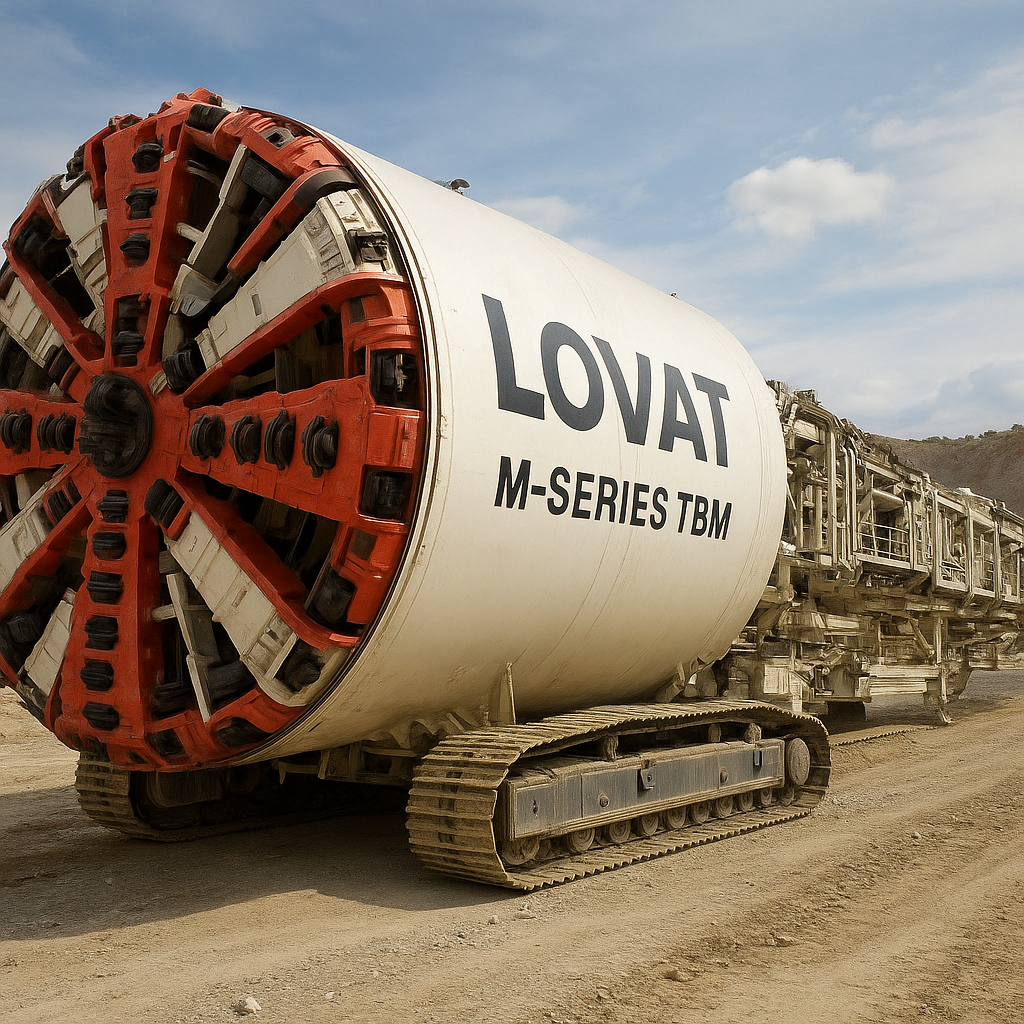
The Lovat M-Series TBM represents a family of modern tunnel boring machines designed to meet the diverse demands of contemporary tunneling projects. Combining modular engineering, advanced cutting and excavation systems, and modern control technologies, the M-Series is intended for installations ranging from utility conduits and sewer upgrades to medium-diameter transport and service tunnels. This article offers a detailed look at the M-Series’ design principles, technical features, typical applications, operational practices, safety and environmental considerations, and trends shaping its future development.
Overview and design philosophy
The Lovat M-Series is engineered around a few clear principles: modularity, adaptability, and reliability. Rather than a single-purpose machine, the M-Series is conceived as a family of configurable units that can be tailored to a particular job site through choices of cutterhead type, ground support system, and muck removal method. This flexibility allows the machines to be used across a wide range of projects and ground conditions.
- Modularity: The machines are built in sections that facilitate transport, assembly on constrained urban sites, and reconfiguration between jobs.
- Adaptability: Configurable as shielded TBMs, microtunnelers, or slurry/EPB variants, the M-Series suits different ground types from stable rock to soft alluvium.
- Reliability: Emphasis on proven mechanical systems, robust cutterhead designs and redundant systems for critical components to minimize downtime.
Although specific M-Series configurations vary by project, the common thread is a design that aims to reduce surface disruption in built environments while delivering accurate alignment and efficient spoil handling. The M-Series is typically positioned for medium and small-diameter tunnels and is frequently used where conventional cut-and-cover methods would be too disruptive or costly.
Technical features and typical specifications
The M-Series integrates a suite of mechanical and electronic systems that together define its performance envelope. Below are the key technical elements found across typical M-Series configurations.
Cutterhead and excavation systems
At the front of the TBM, the cutterhead is adapted to ground conditions. For cohesive soils, Earth Pressure Balance (EPB) cutterheads with soil conditioning ports and internal conveyors are common. In abrasive or mixed face conditions, hard-rock disc cutters or mixed-face hybrid assemblies are used. The cutterhead design emphasizes ease of accessing wear parts and quick replacement of cutting tools to keep maintenance windows short.
Ground support and lining
The M-Series can operate as a fully shielded TBM that installs pre-cast segments as it advances, or as an open-face microtunneller for smaller service ducts where jacking pipes are employed. Segment erection systems are integrated with the backup train for automated placement, grouting, and alignment correction. Typical lining diameters for the M-Series family range from small microtunnelling sizes (sub-1 m) up to medium bore tunnels (commonly several meters), offering a broad operational range that suits water, sewer, and urban transport applications.
Muck handling and hydraulics
Muck removal can be handled via conveyors (belt or chain), slurry pipelines, or auger systems depending on the chosen excavation method. Slurry systems include surface separation plants for solids recovery and water recycling, while EPB setups use screw conveyors feeding spoil to surface conveyor belts or skip systems. The hydraulic and electrical drive systems are sized to match cutterhead torque/rotation requirements and to deliver consistent performance in variable ground.
Control, instrumentation and automation
Modern M-Series units integrate advanced control systems for process monitoring and steering. Typical instrumentation includes face pressure sensors, torque and thrust monitoring, alignment sensors (inclinometers and gyroscopic systems), and environmental sensors for gas, groundwater and ventilation. Remote monitoring and diagnostic tools enable predictive maintenance and real-time optimization of operational parameters. These capabilities increase machine automation, improve productivity and support safer tunneling operations.
Power, size and performance figures
Specific machine metrics depend on configuration, but typical M-Series performance characteristics fall within these general ranges:
- Nominal diameter range: from microtunnelling sizes (0.6 m) up to several meters (commonly 2–6 m for medium bores).
- Cutterhead drive power: from several hundred kW for smaller units up to 1,500 kW or more for larger variants.
- Thrust capacity: tens to thousands of tonnes depending on jacking requirements and lining type.
- Typical advance rates: highly variable — from under 5 m/day in difficult mixed-face conditions to 20–30 m/day or more in favorable ground; microtunnelling advance rates can be lower but more continuous.
- Spoil handling throughput: matching the advance rate and tunnel cross-section, often hundreds of cubic meters per day on medium-sized drives.
These figures are indicative: final selections and project performance depend on geology, tunnel alignment, logistics and the chosen excavation method.
Applications and project types
The Lovat M-Series is intended for a broad set of applications, and its modularity enables it to be tailored for specific sectors. Below are the most frequent uses.
Urban utilities and microtunnelling
For installation of water mains, wastewater pipelines, district heating ducts and telecommunications conduits under urban streets, the M-Series microtunnelling variants minimize surface disruption. These machines are often used in conjunction with hydraulic jacking frames to push precast pipes from a launch shaft to a reception shaft, enabling installation beneath busy roads and buildings without open trenches.
Sewer and water transmission tunnels
Medium-diameter M-Series TBMs are commonly chosen for sanitary sewer upgrades and water transmission tunnels where continuity, environmental protection and minimal service interruption are priorities. The capability to install precast concrete segmental lining simultaneously with excavation reduces temporary ground support needs and accelerates project timelines.
Transport tunnels and light rail
While very large metro and mainline rail tunnels typically use large-diameter TBMs beyond the typical M-Series envelope, smaller cross passages, service tunnels, and some urban tram or light-rail bores may be economically driven by M-Series machines. Their accuracy and reduced surface impact make them suited to constrained city centers.
Hydropower and mining access
In hydropower and mining contexts, the M-Series can be used for pressure shafts, penstocks, access tunnels and exploration drifts. Depending on rock strength, the machines are modified with rock-cutting heads and heavier-duty support systems.
Special installations
M-Series TBMs are also used for cross passages between larger tunnels, underpasses beneath rivers, and for the installation of ducts for power transmission and fiber optics. Their ability to work in confined spaces and with strict alignment requirements makes them valuable for precision tunneling tasks.
Operational considerations and logistics
Successful M-Series deployments depend not only on machine capability but also on careful planning and site logistics. Key operational aspects include shaft design, assembly and launch, spoil management, and maintenance planning.
Site assembly and launch
M-Series machines are shipped as discrete modules to facilitate over-the-road transport. Urban sites often require staged assembly within a launch shaft. The modularity reduces the need for oversize transports and allows launching in tight spaces. Proper launch shaft design must account for thrust reaction blocks, jacking frames and safe access for maintenance crews.
Spoil handling and environmental control
Spoil management is a major logistic element. Slurry-based excavations require separation plants to recover fines and recycle water, while EPB and conveyor systems need continuous conveyor belts, muck skips or barges (for river-based sites). The design of spoil flow minimizes haulage costs and environmental footprint. Dust suppression, odor control and dewatering arrangements are integral to permit compliance in urban settings.
Maintenance and wear management
Cutter wear, screw conveyor abrasion and hydraulic system upkeep are recurring maintenance demands. Predictive maintenance supported by the machine’s control system and condition monitoring reduces unplanned stoppages. Standardized wear components and quick-change tool systems reduce downtime during cutterhead servicing.
Labour, training and crew safety
TBM operations require trained operators, mechanics and survey teams. Modern M-Series control suites simplify many tasks, but skilled personnel are necessary to interpret geotechnical feedback, perform alignment corrections and conduct safe maintenance in confined spaces. Safety regimes often include lock-out/tag-out procedures, confined-space protocols and emergency recovery plans.
Advantages and limitations
The M-Series offers several compelling advantages balanced by predictable limitations that must be managed by project teams.
- Advantages: Reduced surface disruption and traffic impact; high alignment accuracy; integrated spoil handling; safer working environment compared to conventional methods; adaptability across a wide range of ground types and project scales.
- Limitations: Higher capital cost compared to open-cut methods for shallow and simple alignments; logistical demands for launch/reception shafts and spoil handling; potential difficulties in highly variable mixed-face conditions and in extremely hard rock without specialized cutters.
Many limitations can be mitigated by choosing appropriate machine configurations (e.g., switching to slurry-mode), pre-conditioning soils, and employing tailored operational strategies including real-time torque and face pressure adjustment.
Safety, environmental and regulatory aspects
Tunneling with M-Series machines must meet strict safety and environmental standards, particularly in urban projects where public impact is significant. The following considerations are central to planning and execution.
Ground and groundwater control
Ground settlement and groundwater drawdown are key risks during tunneling. Pressure-balance approaches (EPB or slurry) are often used to stabilize the face and reduce settlement risk. Detailed hydrogeological modeling and continuous monitoring are used to protect adjacent structures and utilities.
Emissions, noise and vibration
TBMs produce less above-ground noise and dust than open-cut operations, but underground operations still create vibrations and noise. Enclosures, mufflers on diesel generators (where used), and selection of electrically powered drives can lower environmental impact. Vibration monitoring near sensitive structures is common practice.
Spoil disposal and recycling
Evolving environmental regulations require careful spoil management. Slurry separation plants and soil stabilization for reuse reduce the need for landfill disposal. Reuse options include landscaping, backfill material, or processing into construction aggregates where feasible and permitted.
Innovation, digitalization and future trends
The M-Series reflects a broader shift in tunneling toward smarter, greener and more automated machines. Several innovations affect current and future designs:
- Digital twin and predictive analytics: Real-time data streams from sensors feed digital models enabling predictive maintenance and performance optimization.
- Greater automation: Automated steering, segment installation and face conditioning minimize human error and improve consistency.
- Hybrid cutter technologies: Improved mixed-face cutterheads and conditioning systems allow smoother operation across geological transitions.
- Electrification and low-emission powertrains: Electrically driven systems and integration with site power reduce local emissions and reliance on diesel generators.
- Green lifecycle approaches: Emphasis on recyclable materials, low-impact spoil handling and reduced energy consumption over the TBM lifecycle.
These trends are likely to continue as city authorities and contractors demand faster project delivery, lower environmental impact and higher safety standards.
Case examples and statistical context
While specific project statistics depend on many variables, several general benchmarks help set expectations for M-Series deployments:
- Project durations for medium-length urban utility tunnels (hundreds to a few thousand meters) commonly run from several months to a few years, including shaft construction and site works.
- Average daily advance on moderate geology: often between 6 and 25 meters per day for medium-diameter EPB or slurry TBMs under favourable conditions.
- Machine availability rates (planned uptime vs calendar time) for well-maintained modern TBMs typically exceed 70–80% during production phases, with planned stoppages for cutter replacement and maintenance.
- Typical lining installation rates can favor integrated TBM/segmental systems since lining is simultaneous with excavation, reducing temporary ground support needs.
Notable M-Series deployments have occurred across diverse geographies where constraints of urban density or environmental sensitivity precluded open-cut solutions. Project teams have repeatedly highlighted the advantages of modular assembly, predictable tunnel alignment and reduced community disruption.
Maintenance, refurbishment and lifecycle cost considerations
The lifecycle cost of an M-Series TBM extends beyond the initial purchase price. Key cost drivers include transport and assembly, site preparation, cutter wear consumables, labor, and disposal/recycling of spoil. Modern project planning incorporates whole-life cost modeling to decide between purchasing, leasing or subcontracting TBM services.
Refurbishment and resale
Because the M-Series is modular, many components can be refurbished and reused on subsequent projects. Refurbishment pathways often include reconditioning cutterheads, upgrading control electronics, and replacing hydraulic elements, which can substantially lower capital expenditure for future projects.
Parts logistics and aftermarket support
Reliable supply chains for wear parts and responsive technical support are essential to maintain production rates. OEM and authorized service networks typically provide planned spare parts packages, on-site training and emergency repair support.
Conclusion
The Lovat M-Series TBM family represents a flexible, modern approach to tunneling, designed for applications where minimizing surface disruption, ensuring accurate alignment and maintaining high safety standards are paramount. Its modular architecture, combined with contemporary control and monitoring systems, positions it well for urban utility works, medium-diameter tunnels and specialized installations. Successful deployment relies on careful matching of machine configuration to ground conditions, rigorous planning for site logistics and spoil handling, and investment in skilled teams and maintenance practices. With ongoing innovations in automation, digitalization and environmental performance, machines like the M-Series remain central to the evolution of efficient and sustainable tunneling in the decades ahead.


)
)