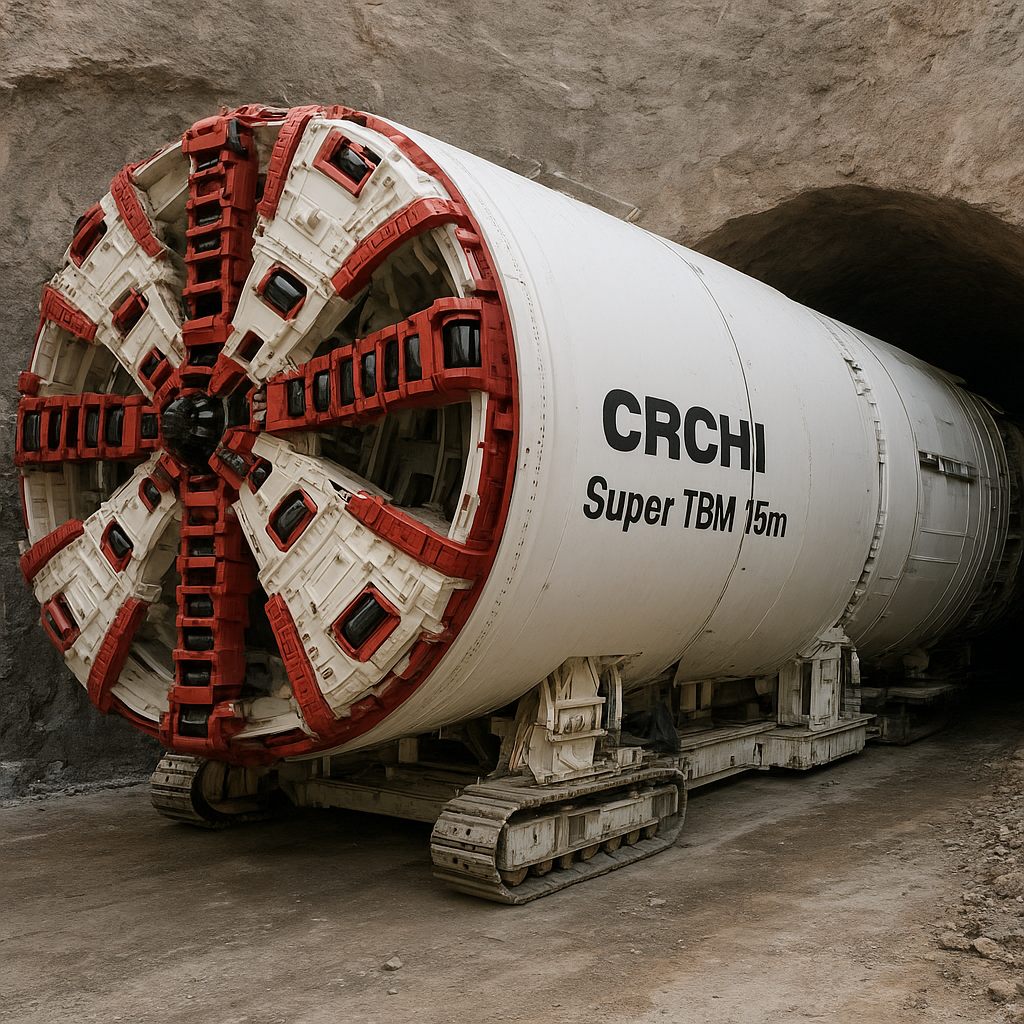
The CRCHI Super TBM 15m represents a class of large-diameter tunnel boring machines designed to tackle demanding urban, water conveyance and transport tunneling projects. Built by China Railway Construction Heavy Industries (CRCHI), these machines combine heavy-duty mechanical engineering with modern control systems to excavate large tunnels with a high degree of precision, safety and environmental control. Below you will find a detailed overview of the machine’s design, typical applications, operational considerations, and performance characteristics, together with general statistics and practical insights relevant to engineers, planners and decision-makers.
Overview and main characteristics
The CRCHI Super TBM 15m is a purpose-built shield machine for excavating tunnels with a nominal external diameter around 15 meters, which corresponds to an excavation area of approximately 176.7 m². Such a diameter places this machine in the category of large-diameter TBMs suitable for multi-lane road tunnels, heavy-rail and metro caverns, large sewer/water conveyance tunnels and other major underground structures. The machine is typically delivered in modular sections and assembled on site inside a launching shaft or cavern.
Key components
- Cutterhead — specially designed for the ground conditions (open, mixed-face, or slurry/EPB configurations).
- Shield — steel cylinder that supports the face and provides protection for personnel and equipment.
- Thrust system — large hydraulic jacks that push the TBM forward against the installed lining.
- Backup system — modular platform behind the cutterhead housing conveyors, slurry pumps (if applicable), hydraulic power units, control cabin and workshops.
- Muck handling — conveyors, belt presses, slurries pipelines or muck cars depending on the chosen spoil removal strategy.
- Segment erection equipment — automated or semi-automated erectors that position and bolt precast concrete segments for the permanent lining.
- Instrumentation and automation — real-time monitoring for steering, face pressure, torque and ground deformation.
Because CRCHI machines are often customized to project requirements, the 15m variant can be configured either as a full-face Earth Pressure Balance (EPB) machine, a slurry-shield TBM, or a mechanical/open cutterhead machine depending on geology and groundwater conditions.
Design features and engineering adaptations
Large-diameter TBMs like the CRCHI Super 15m incorporate design solutions to manage the unique mechanical and logistical challenges posed by the scale of excavation and the complex ground conditions often encountered. Key design and engineering features include:
- Cutterhead design adaptability: Cutterheads for a 15m machine can be arranged with disc cutters, mixed cutters, scrapers or muck-scoops. For soft, water-bearing soils, a slurry-shield cutterhead is typically used to maintain face stability and control pore pressures. For cohesive soils, an EPB cutterhead with soil conditioning ports is common.
- High-capacity hydraulics: Thrust cylinders and torque motors are sized to provide the high forces needed to push the shield forward and to rotate a large cutterhead under heavy loads.
- Power and drive systems: A 15m TBM requires substantial electrical power for cutterhead drives, hydraulic pumps and backup systems. Designs often include redundancy for critical systems to maximize uptime.
- Segmental lining integration: The TBM is designed to integrate with a precast concrete segmental lining, with automatic erection units capable of handling the large segment weights and positioning tolerances necessary for safe, watertight linings.
- Soil conditioning and slurry treatment: For EPB machines, additive injection and mixing systems are provided to condition the muck. For slurry TBMs, full slurry treatment plants are part of the surface installation.
- Environmental and noise control: Modern large TBMs include dust suppression, sealed cabins, vibration dampeners and other measures to reduce the urban impact of tunneling operations.
The engineering challenge for a 15m shield often extends beyond the machine itself to include the logistics of assembling the TBM in confined launch shafts, the storage and handling of large segments, and the provision of sufficiently large muck disposal or slurry circulation systems.
Typical applications and project types
Due to its large excavation diameter, the CRCHI Super TBM 15m is well suited to projects that require substantial clear cross-sections or that benefit from a single-bore solution rather than multiple smaller bores. Common applications include:
- Road and highway tunnels — enabling multi-lane carriageways and multi-modal cross-sections in congested urban corridors.
- Rail and metro tunnels — accommodating double-track sections or large station cavern approaches where large internal volumes are preferable.
- Hydropower diversion tunnels and penstocks — large-diameter conveyance tunnels for water transfer in hydroelectric and irrigation schemes.
- Large sewer and stormwater tunnels — gravity or pressure main tunnels sized to manage urban runoff and wastewater.
- Cross-river and subsea tunnels — where a single large-bore tunnel can simplify structural design and reduce interfaces.
Single-bore solutions with 15m TBMs can deliver savings in construction time and long-term maintenance compared with multiple smaller bores, but they require higher initial capital, more complex logistics and more substantial launch and reception works.
Operational considerations and site logistics
Operating a 15m TBM requires meticulous planning and robust site logistics. Some of the most important operational factors are:
Launch and assembly
- Launch shafts, caverns or temporary assembly halls must be large enough to accommodate TBM assembly and staging of heavy components and segments.
- Assembly may take weeks to months and requires heavy lifting equipment, skilled technicians and sequential testing before excavation can begin.
Spoil management
- For a 15m excavation area, spoil volumes are substantial: roughly 176.7 m³ of material excavated per linear meter (plus allowance for overbreak and muck conditioning). Efficient removal strategies—conveyor belts, muck trains or slurry pipelines—are essential.
- On long drives, spoil handling plants, temporary stockpiles and off-site disposal arrangements must be planned well in advance.
Segment production, delivery and storage
- Precast segments for 15m linings are heavy and large in size; factories must be capable of producing the required precision and quantity. On-site storage and handling systems must support continuous assembly operations to avoid TBM downtime.
Maintenance and turnaround
- Wear parts such as disc cutters, scraper plates and sealing elements require regular inspection and replacement. Long drives require planning for cutter changes and scheduled maintenance windows.
All of these logistical components influence the achievable progress rates and overall project economics.
Performance, productivity and statistical indicators
Performance of a 15m TBM varies significantly with geology, groundwater, contract logistics and operational discipline. The following metrics provide a general orientation rather than exact figures for a specific project:
- Excavation area: ~176.7 m² for a 15.0 m diameter bore (π × (7.5 m)²).
- Advance rate: Highly variable. In favourable ground and efficient logistics, large TBMs have recorded average advance rates of several meters per hour for short periods and daily averages from a few meters up to 30–40 m/day in exceptional conditions. Typical long-term averages on complex projects are often in the single to low double digits of meters per day.
- Power: Cutterhead and hydraulic power demands are significant; a large TBM may require multiple megawatts of electrical power depending on cutter torque and support systems. Exact power depends on cutterhead design, ground conditions and auxiliary systems.
- Muck volume: Approximately 176.7 m³ per meter of tunnel (theoretical), so a 1 km drive corresponds to around 176,700 m³ of excavated material before allowances for swell and conditioning.
- Segment quantities: Number and size of precast segments depend on lining thickness and ring width. For a large 15m bore, ring diameters and segment weights can be substantial and must be engineered for handling by segment erectors on the TBM backup.
CRCHI’s experience manufacturing and supplying large TBMs for domestic and international projects has produced a track record of robust machines for a variety of ground conditions. While exact delivery and performance statistics vary by customer and project, CRCHI is known for producing high-tonnage TBMs and associated underground construction equipment in large volumes.
Safety, environmental and urban impact
Large TBMs help minimize surface disruption relative to cut-and-cover alternatives, which is a crucial advantage in dense urban settings. Specific safety and environmental considerations include:
- Ground control and settlement — Modern machines incorporate face pressure control (in EPB and slurry modes) and real-time monitoring to limit settlements and protect existing buildings and utilities.
- Air quality and noise — Sealed systems, dust extraction and mufflers reduce the impact at the surface and in the working environment.
- Worker safety — Operator cabins, remote controls and automated routines reduce the need for personnel in hazardous zones; rigorous emergency egress plans are required for large shields.
- Wastewater and slurry disposal — For slurry TBMs, treatment plants and safe disposal routes for used slurry are essential to prevent environmental contamination.
When properly planned and executed, a 15m TBM can deliver a high level of environmental protection compared to open excavation, particularly in preventing traffic disruption, preserving urban landscapes and limiting noise over long project durations.
Practical case considerations and examples
While specific project references depend on public disclosures and procurement records, typical scenarios where a CRCHI Super TBM 15m would be chosen include:
- Single-bore highway tunnels under constrained urban corridors, where the large diameter enables multi-lane carriageways with emergency and service galleries inside one bore.
- Water supply tunnels for major cities requiring high flow capacities; a single large-diameter tunnel can be simpler to maintain and less susceptible to blockages than multiple small-diameter lines.
- Metro station approaches and crossovers that require expanded internal volumes without the cost and disruption of open excavation for station caverns.
- Hydropower headrace tunnels that must move large volumes of water with minimal energy losses and robust structural lining.
Project owners considering a 15m TBM solution usually weigh capital cost versus lifecycle benefits, urban impact reduction, and schedule advantages. Large-bore machines are most attractive when: site access and staging areas can support the machine logistics, the geology is reasonably predictable or controllable, and there is a premium on minimizing surface disruption.
Advantages, limitations and procurement considerations
Advantages of the CRCHI Super TBM 15m and similar large TBMs:
- Single-bore efficiency — One large tunnel instead of multiple small bores can reduce interface complexity and long-term maintenance.
- Reduced surface impact — Compared with cut-and-cover, underground boring preserves surface infrastructure and landscapes.
- Enhanced safety — Modern TBMs bring automation, sealed environments and remote monitoring that improve worker safety.
Limitations and challenges:
- High initial cost and logistics — Purchase, transport, assembly and launch shaft construction are capital-intensive.
- Site footprint — Large segment storage areas, muck handling and slurry plants require significant surface area.
- Geology sensitivity — While TBMs can be adapted for mixed-face conditions, sudden or highly variable geology increases risk and can slow progress.
Procurement considerations include specifying geotechnical risk allocation, acceptance criteria for settlement, warranties for machine performance, and clear interfaces for segment supply and spoil handling.
Conclusion
The CRCHI Super TBM 15m is a powerful engineering solution for projects demanding a large internal tunnel cross-section combined with the benefits of mechanized boring. Its suitability spans road, rail, water conveyance and other large infrastructure needs, especially in urban contexts where minimizing surface disruption is a priority. Success with a 15m TBM project depends as much on thorough planning, geotechnical investigation, and logistics as on the machine’s specification. When these elements align, a large TBM can deliver efficient excavation, high safety standards and long-term value for major underground works.
)
)