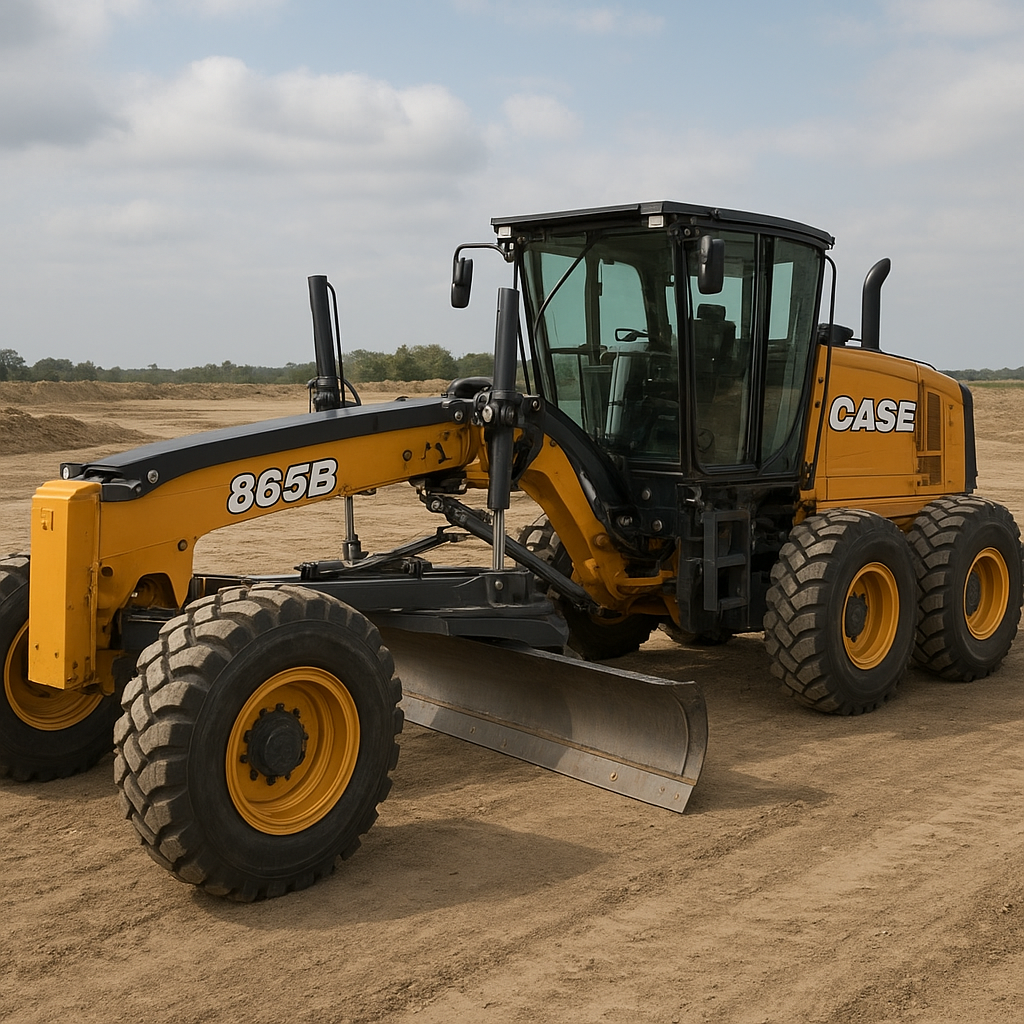
The CASE 865B motor grader is a heavy-duty earthmoving machine widely used in road construction, site preparation, and maintenance of large unpaved areas. Combining robust mechanical systems with a design focused on versatility, the 865B has earned a place among contractors, municipalities, and industrial users who require precise grading, material spreading, and surface finishing. In the sections that follow, you will find a comprehensive look at the machine’s typical technical characteristics, common applications, operation and maintenance advice, and market and safety considerations. The text highlights practical details and useful statistics where available, and emphasizes the operational strengths that make the CASE 865B a valuable asset on many projects.
Technical characteristics and design features
The CASE 865B is built around a rigid frame and a centrally mounted moldboard (blade) that provides the main cutting and finishing capability. While specific factory options and local configurations vary, the machine typically belongs to the medium-to-large grader class and shares common elements characteristic of graders designed in the 1980s–1990s era. Below are the main technical areas to consider when evaluating or operating a CASE 865B.
Engine and powertrain
- Engine: The 865B usually features a robust diesel engine tuned for steady low-end torque required for grading tasks. Engine power for a machine in this class typically ranges from approximately 150 to 230 horsepower (≈110–170 kW), depending on configuration and market.
- Transmission: A heavy-duty, multi-speed transmission provides a wide range of forward and reverse speeds, enabling both high-travel speeds and low, high-torque grading gears. Power delivery is arranged to allow smooth blade work without excessive stalling.
- Drive train: The machine generally uses a conventional rear-wheel drive or optional all-wheel-drive configurations on some versions, with a durable final drive and differential suited for heavy loads and continuous operation.
Blade, circle and articulation
- Moldboard: The central moldboard (often 12–14 feet / 3.6–4.3 m in older models of this class) performs cutting, spreading and finishing. Blade radius and range of motion allow for a wide variety of cutting angles and side-tilt actions.
- Circle drive: A hydraulically operated circle with locking mechanisms enables the operator to set precise blade angles for shaping and finishing surfaces. The circle drive is a critical component for achieving accurate grade work.
- Scarifier and front tools: Many units can be equipped with a rear ripper or a front-mounted scarifier to break up compacted material before grading.
Weights, dimensions and capacities
- Operating weight: Machines in this category typically have operating weights that range from roughly 18,000 to 28,000 kg (≈40,000–62,000 lb), depending on attachments and options.
- Ground clearance and wheelbase: Graders are designed with a long wheelbase and high ground clearance for stability and for working over uneven surfaces. Exact dimensions depend on chassis options but the design prioritizes stability during fine grading.
- Fuel and hydraulic systems: Fuel tank capacity and hydraulic oil volume are sized to support full work shifts; typical fuel consumption can range from about 15 to 35 liters per hour under load depending on work intensity, engine tuning and attachments.
Primary applications and practical uses
The CASE 865B shines where controlled, accurate grading is required. Its capabilities make it indispensable across a variety of sectors. The following list outlines the most common and valuable applications.
- Road construction and maintenance: Establishing subgrade profiles, creating crown and cross slopes, finishing gravel and asphalt surfaces, and routine maintenance of rural and municipal roads.
- Site preparation: Leveling building pads, drainage channels, and preparing large construction sites for foundations or paving.
- Agricultural and forestry access roads: Creating and maintaining farm tracks, logging roads and service lanes where surface regularity is key to equipment access.
- Airport runways and taxiways: Fine grading for base layers and shoulders where smooth, precise surfaces are necessary for safety and function.
- Industrial yards, mining, and quarries: Grading stockpile areas, haul roads and working surfaces to ensure proper drainage and vehicle safety.
- Snow removal and winter maintenance: Equipped with front blades or wing plows, graders are effective for clearing snow from wide surfaces such as airport aprons and long rural roads.
In each of these applications the combination of blade control, engine torque and operator skill determines the productivity. The CASE 865B, when well maintained and operated by experienced crews, can deliver consistent surface results over long shifts.
Operation techniques and productivity tips
Effective use of a motor grader like the CASE 865B depends as much on operator technique as it does on machine capability. The following operational techniques help maximize quality and productivity.
Pre-operation checks
- Verify fluid levels (engine oil, transmission, hydraulics and coolant) and inspect for leaks.
- Check cutting edges, moldboard wear strips and scarifier teeth for excessive wear.
- Confirm tire condition, inflation and steering components for wear or damage.
Grading techniques
- Establish grades by setting reference stakes or using GPS/laser controls for precision. Modern retrofit kits allow legacy machines to achieve sub-centimeter tolerances.
- Work in passes to avoid overloading the moldboard; multiple shallow passes produce better surface quality than aggressive single passes.
- Blade angle and pitch control is essential—use side-shifts, tilt and circle rotation to manage material flow and achieve the desired slope and finish.
- Balance traction and speed: Maintain low gear when grading for torque; increase speed only for travel or light finishing passes.
Advanced productivity tools
- Modern GPS and laser-grade systems can be retrofitted to older graders to increase accuracy and reduce rework.
- Telematics systems help monitor fuel usage, idle time and maintenance intervals, improving fleet management.
Maintenance, common issues and lifecycle considerations
Maintenance practices have a direct impact on machine availability and long-term value. Routine care and early intervention on common wear items will extend service life and reduce downtime.
Routine maintenance schedule
- Daily: Visual inspections, fluid level checks, blade and cutting edge condition, and basic safety checks.
- Every 250–500 hours: Change engine oil and filters, inspect hydraulic hoses and fittings, grease pivot points and circle bearings.
- Every 1,000 hours: Transmission and final drive services, coolant checks, and review of engine tune-up items.
- Major overhaul intervals vary by use and load, but heavy graders often need major service or component rebuilds between 8,000 and 12,000 hours depending on maintenance rigor and operating conditions.
Common wear items and failure points
- Cutting edges and end bits: Frequent replacement is normal; steel wear parts are consumables in grading applications.
- Circle drive and pitch mechanisms: These components are subject to wear and require proper lubrication and inspection.
- Hydraulic hoses and cylinders: Exposure to dirt and impact can cause leaks or failures; routine checks prevent many issues.
- Electrical components: Older machines may develop faults with alternators, starters, or wiring harnesses—especially in harsh environments.
Longevity and remanufacturing
With regular maintenance, a CASE 865B can serve reliably for many thousands of hours. Remanufactured engines, reconditioned transmissions and rebuilt hydraulic pumps are common repairs that restore performance at a lower cost than replacement. For fleets, planned rebuilds extend service life while maintaining productivity and resale value.
Attachments, upgrades and modern retrofits
Adaptability is one of the grader’s strengths. The CASE 865B supports a variety of attachments and modern upgrades to extend its utility and increase accuracy on precision jobs.
- Rippers or multi-shank rear rippers for breaking hardpan or compacted layers.
- V-plows, wings and snow equipment for winter maintenance applications.
- Laser and GPS grade control retrofits that add real-time guidance for high-precision grading.
- Front-mounted blades and scarifiers to increase versatility.
- Cab upgrades including improved seating, HVAC retrofits and soundproofing for operator comfort on long shifts.
Economics, fuel use and market considerations
Decisions to buy, rent or keep a grader hinge on operational economics. Fuel consumption, uptime, maintenance costs and resale value all factor into total cost of ownership.
Fuel and operating cost estimates
- Fuel consumption depends on the engine size, load and working pattern. Typical figures for graders in this class are in the ballpark of 15–35 liters per hour under working conditions; light travel consumes less.
- Hourly operating costs (including fuel, maintenance and operator) vary widely by region and utilization but often match or exceed similar heavy equipment costs—contractors should benchmark local rates to estimate true ownership costs.
- Parts and servicing availability influences downtime and cost; CASE parts are generally obtainable through dealer networks and aftermarket suppliers.
Resale and lifecycle value
Well-maintained graders retain reasonable resale values. Machines that have been updated with GPS control, have documented service histories and have recently had major overhauls command higher prices on the used market. Conversely, units with neglected maintenance, severe frame wear or hydraulic leaks can see markedly reduced values.
Safety, operator environment and regulatory considerations
Safe operation is paramount. The grader’s size and the nature of worksites pose hazards that are manageable with proper practices and equipment.
- Cab structure and visibility: ROPS-certified cabs, wide glass areas and mirrors help operators maintain awareness. Regular cleaning of windows and mirrors is essential on dusty sites.
- Operator training: Competent operators reduce material waste, improve finish quality and lower the risk of accidents. Training should include machine controls, site hazards and emergency procedures.
- Worksite coordination: Graders often operate in proximity to trucks, compactors and other heavy equipment; clear communication, signaling and traffic management are required.
- Emissions and noise: Older engines may not meet current emissions standards without retrofit; operators should be aware of local regulations concerning noise and exhaust emissions when operating in sensitive areas.
Comparisons, variants and how to choose
When comparing the CASE 865B with other graders, consider the following decision drivers:
- Size and power: Match the grader size to the job—larger graders handle heavy material and long-span grading faster, but consume more fuel and are less nimble.
- Attachment needs: If you require rippers or snow equipment, choose a machine with compatible mounting and hydraulic capacity.
- Operator comfort: Cab ergonomics and climate control matter for long shifts and productivity.
- Service and parts network: Local dealer support makes a significant difference for downtime and maintenance costs.
Choosing used vs new
A used CASE 865B can be a cost-effective choice for contractors who can inspect machine history and verify condition. Newer machines offer modern emissions compliance, efficiency and comfort features, but at a higher capital cost. Consider total cost of ownership, task frequency, and expected operational life when choosing between new and used options.
Summary and final considerations
The CASE 865B motor grader represents a durable, versatile tool for contractors and public works departments engaged in road construction, site preparation and maintenance. Its fundamental strengths—reliable engine torque, adaptable moldboard control, and compatibility with a range of attachments—make it well suited to many heavy grading tasks. Key success factors in using and owning a CASE 865B include rigorous maintenance, skilled operators who apply effective grading techniques, and thoughtful investment in upgrades such as GPS control or improved cab comfort. Statistically, machines of this class commonly see operating weights in the range of 18,000–28,000 kg, blade widths around 3.6–4.3 meters, and fuel consumption varying from 15–35 liters per hour depending on work intensity. When these factors are managed correctly, the CASE 865B continues to deliver reliable performance and strong value across many years of demanding use.
)
)