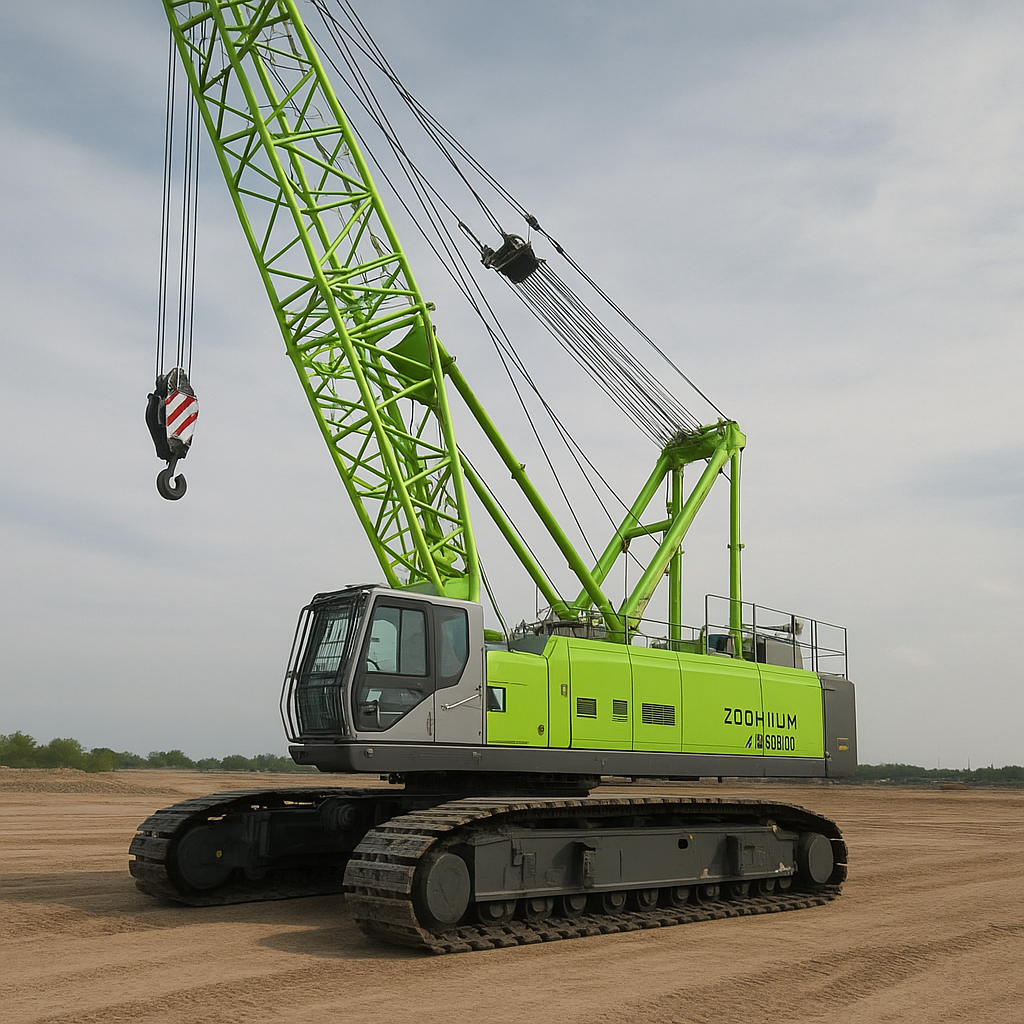
The Zoomlion ZCC26000 is a landmark in the world of heavy lifting — a purpose-built crawler crane engineered to tackle the largest, most challenging lifting assignments in construction, energy, and industrial sectors. This article explores the machine’s core characteristics, typical applications, operational challenges, and the broader context of ultra-heavy lifting solutions. It is intended for engineers, project managers, and anyone interested in the capabilities and role of modern super-heavy crawler cranes in large-scale projects.
Overview and key specifications
The ZCC26000, produced by Zoomlion Heavy Industry, belongs to the class of ultra-heavy lattice crawler cranes designed for tasks requiring massive single-lift capacities. The model name itself signals its headline figure: a maximum rated capacity around 2,600 tonnes. As an ultra-large crane, it combines a lattice boom and a crawler undercarriage to provide both exceptional lifting power and onsite mobility under load-bearing conditions.
Headline technical characteristics
- Rated maximum lifting capacity: approximately 2,600 tonnes (manufacturer rating).
- Configuration: lattice boom with various main boom and jib assemblies for long reach and heavy lifts.
- Undercarriage: multi-section crawler tracks for stability and weight distribution on site.
- Counterweight: modular counterweight system that can be configured depending on lift radius and lift weight.
- Control and instrumentation: electronic load moment indication, PLC-based controls, and modern safety interlocks.
Because the crane is modular by nature, specific parameters such as maximum boom length, reach at capacity, and transportation split depend on the chosen configuration and project requirements. The crane is designed to be assembled and disassembled into transportable modules to allow movement between job sites — a critical factor for cranes operating at this scale.
Design and technical features
The ZCC26000 integrates a number of design choices common to ultra-heavy cranes, with engineering focused on strength, modularity, and reliability. Key design components include a large lattice boom, a robust carriage and hoist system, a sophisticated counterweight arrangement, and a crawler base engineered to distribute enormous loads safely across the ground.
Lattice boom and jib systems
The lattice boom offers a favorable strength-to-weight ratio compared with solid booms, enabling both extended reach and the structural stiffness required for heavy lifts. A variety of boom and jib combinations can be assembled, allowing operators to trade off reach and height against the maximum permissible load. Typical configurations permit the crane to handle very heavy loads at moderate radii and lighter loads at very extended radii.
Hoist and rope systems
High-capacity hoisting drums and ropes are necessary to lift and control multi-thousand-tonne loads safely. The ZCC26000’s hoist systems are engineered for both static capacity and reliable duty cycles in continuous heavy lifting operations. Redundant braking and multiple-part reeving configurations are used to control descent and provide safety margins.
Modular counterweight and structural design
A modular counterweight system allows accurate tuning of the crane’s center of gravity for individual lifts. Counterweight modules are transported separately and installed as required. The crane’s superstructure and track frames are similarly sectionalized for logistical practicality. This modularity reduces the need for dedicated heavy-transport vehicles for single-purpose components and allows the crane to be reconfigured according to lift charts.
Systems integration and operator aids
Modern safety systems are integral to the crane’s operation. These include load moment indicators, anti-two-block protection, wind and boom angle sensors, and electronic monitoring that provides data for lift charts and maintenance planning. Remote diagnostics and telematics functionality — increasingly common in new heavy cranes — support predictive maintenance and minimize downtime.
Primary applications and case examples
Ultra-heavy crawler cranes like the ZCC26000 are not general-purpose construction equipment: they are deployed where very large single lifts are needed or where modularization and heavy prefabrication call for extreme lifting capacity. Typical sectors and applications include:
- Power generation — installation of turbine generators, reactor vessels, and large heat exchangers in thermal, nuclear, and hydroelectric power plants.
- Petrochemical and refining — lift and place of process modules, fractionation towers, and heavy pressure vessels.
- Offshore and marine — onshore assembly and load-out of offshore platform modules, and fabrication yard tasks for FPSO and platform construction.
- Wind energy — assembly of very large offshore wind turbine nacelles and monopile or jacket foundations (particularly for large offshore turbines).
- Bridge and infrastructure — placement of heavy bridge segments, arch components, and large prefabricated elements where single-lift installation is desired.
- Industrial plant construction — handling extremely large compressors, pressurized vessels, and fabricated modules in heavy industrial projects.
Because of the crane’s capacity, projects that would otherwise require complex multi-crane lifts or disassembly of components often select an ultra-heavy crane to reduce schedule risk and improve safety by enabling a single controlled lift. The crane’s ability to lift large modules reduces the need for on-site weld-up and fabrication, accelerating commissioning and minimizing exposure to hazardous work at height.
Operational planning, logistics, and site requirements
Deploying a ZCC26000-scale crane is a major logistical undertaking. Planning must cover transport, assembly, ground preparation, lift engineering, and crew coordination. Typical considerations include:
Transport and assembly
- Components are shipped as large modules requiring heavy-haul trucks, specialized trailers, and sometimes temporary road modifications for oversized loads.
- Assembly can take days or weeks depending on site access, required counterweight, and boom configuration.
- Nearby staging areas are usually required for counterweight blocks and boom sections.
Ground and foundation requirements
The load imposed by the crane and its counterweights demands careful geotechnical evaluation. Matting, grillage, or specially prepared foundations are often needed to distribute loads and prevent settlement. Lift plans always include bearing pressure calculations and contingency measures for wet or uncertain ground conditions.
Lift engineering and safety planning
- Every heavy lift requires detailed engineering: load charts, rigging plans, crane configuration, and step-by-step lift procedures.
- Wind, rain, and temperature conditions have significant impact on allowable lifts; project timelines must account for weather windows.
- Permitting and coordination with local authorities are frequently needed for road closures, heavy hauling, and on-site safety zones.
Economic and project considerations
Using an ultra-heavy crane represents a major cost item in a construction project, but it can yield savings by reducing assembly time, lowering the number of lifts, and minimizing scaffolding and temporary works. The economic decision is commonly based on:
- Comparative cost of multiple smaller crane lifts vs single ultra-heavy lift.
- Schedule risk reduction—single lifts typically require fewer interfaces and less cumulative lift time.
- Availability and mobilization costs; because these cranes are specialized, lead times and rental or purchase costs can be high.
Project managers must balance the crane rental and mobilization costs against savings achieved by modular construction and faster project completion. For very large modules, the ZCC26000-class crane is often the only practical choice.
Market position and competitors
The ZCC26000 competes in a field where only a handful of manufacturers offer cranes in the multi-thousand-tonne class. European manufacturers, particularly Liebherr, have long held market share with their LR super-large crawler series, while Chinese makers have increased presence and capability in recent years. Key competitive factors include lifting capacity, transportability, assembly time, availability of spare parts, and after-sales support.
Competitors in the ultra-heavy market typically include well-known European and Chinese crane builders. Buyers consider the global service network, track record on similar projects, and local support when selecting a crane for a mission-critical lift.
Safety, maintenance, and regulatory considerations
Safety is the foremost concern in ultra-heavy lifting. The ZCC26000 is equipped with modern safety systems, but safe operation depends equally on competent rigging, a trained crew, and disciplined adherence to lift plans. Maintenance programs for cranes of this scale involve periodic inspection of wire ropes, hydraulic systems, pins and bushings, and structural welds.
- Scheduled non-destructive testing (NDT) of critical structural components is standard practice.
- Wire rope replacement intervals and brake inspections are closely managed due to the extreme loads involved.
- Regulatory compliance varies by jurisdiction, often including certification of crane assemblies and inspections before major lifts.
Environmental and social impacts
Large cranes have environmental footprints that project planners must consider: fuel consumption during mobilization and operation, noise during assembly and lifts, and land use for staging and counterweights. Modern initiatives focus on improved fuel efficiency of power packs, use of hybrid power systems, and planning lifts to reduce idle time. Social impacts — road disruptions, local workforce engagement, and temporary changes to landscape during mobilization — also require stakeholder management.
Future trends and technological developments
The landscape for ultra-heavy lifting is evolving with digitalization, automation, and improved materials. Expected trends include:
- Greater use of telematics and digital twins for predictive maintenance and lift planning.
- Enhanced operator aids and semi-autonomous functions that reduce human error during complex sequences.
- Materials and structural improvements that may increase strength-to-weight ratios for booms and superstructures, improving transportability.
- Hybrid or lower-emission power units to address environmental concerns and regulatory pressures.
These advances will make large cranes like the ZCC26000 safer, more reliable, and more cost-effective over their lifecycle.
Practical advice for project teams
For teams considering mobilizing a crane of this class, the following practical tips help reduce risk and optimize outcomes:
- Engage lift engineers early — concept lifts often reveal significant design changes that save cost and time.
- Plan logistics and permits well in advance; transport of modules requires detailed route surveys and sometimes temporary infrastructure adjustments.
- Allocate sufficient time and resources for ground preparation and counterweight staging areas.
- Ensure a qualified and experienced rigging crew familiar with ultra-heavy lifts — training and rehearsal lifts can prevent costly surprises.
- Factor in weather risk with contingency days in the project schedule.
Conclusion
The Zoomlion ZCC26000 is a flagship example of how engineering pushes the limits of what can be moved and installed in modern construction and industry. With a rated capacity of roughly 2,600 tonnes, modular configuration, and capabilities tailored for the heaviest lifts, it enables single-lift solutions that can dramatically reduce project complexity and schedule risk. Successful use depends on meticulous planning, geotechnical preparation, qualified personnel, and modern safety systems. As technology advances, these cranes will continue to evolve with better digital integration, safety enhancements, and environmental performance — maintaining their role as indispensable tools for major industrial, energy, and infrastructure projects.
Zoomlion ZCC26000 crawler crane 2,600 tonnes lifting capacity modular design boom counterweight heavy lifts safety systems
)
)