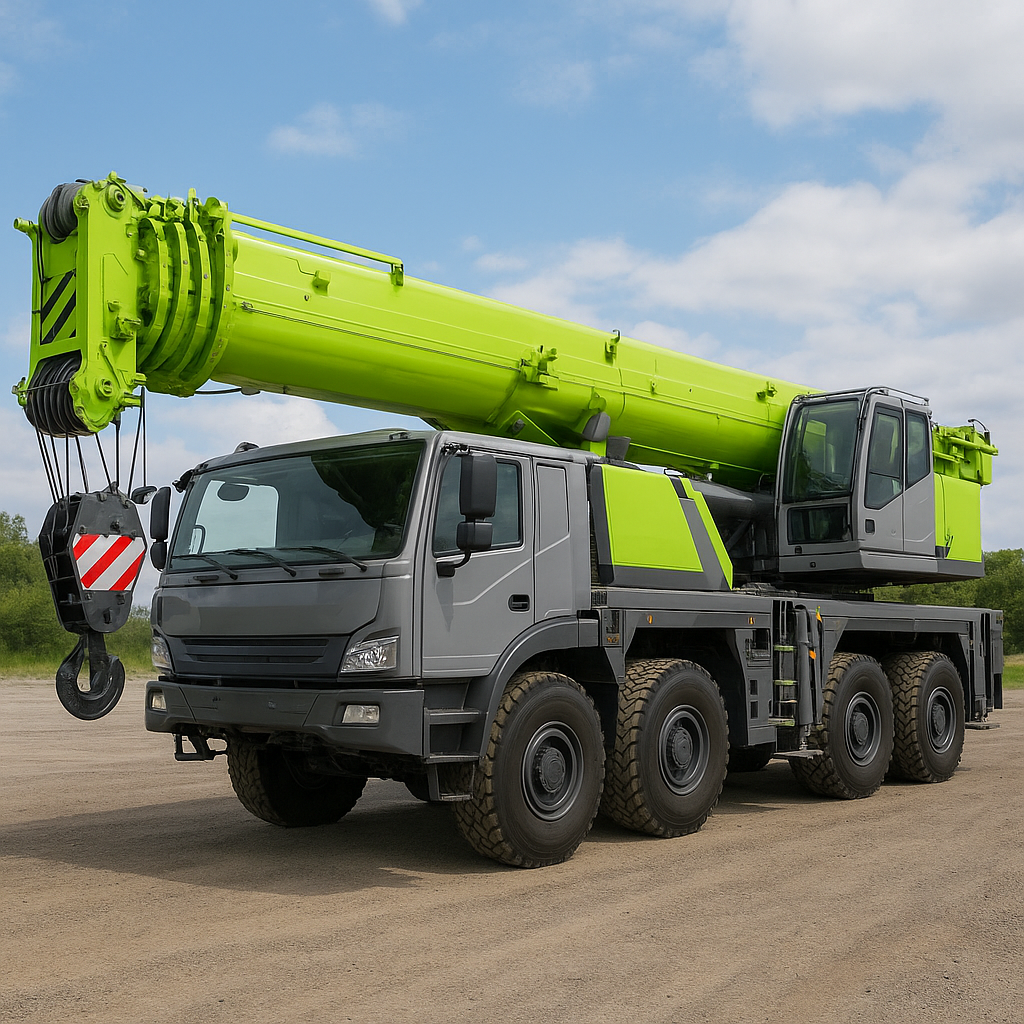
The Zoomlion ZAT18000H is an all-terrain mobile crane designed to combine high lifting capability with on-road mobility and off-road performance. Engineered for a wide range of lifting tasks—from construction and infrastructure projects to industrial assembly and energy sector installations—this crane aims to deliver a balance of **power**, **versatility**, and **operator-focused features**. In the sections that follow, we examine the machine’s design principles, typical technical characteristics, real-world applications, operational considerations, maintenance and safety aspects, and its place in the market. Wherever specific numerical data is stated it reflects the machine’s class and typical manufacturer claims for similar models; please verify exact figures with the supplier or technical documentation before planning lifts.
Design and core technical features
The Zoomlion ZAT18000H is built around the concept of an integrated carrier and superstructure suited to both highway travel and rough-site access. As an all-terrain crane, it blends the roadability of a truck crane with the off-road capability of a rough-terrain unit. Key design priorities include structural strength, hydraulic performance, stability under load, and compact transport dimensions relative to its lift class.
Chassis and mobility
- Multi-axle carrier: The crane typically uses a multi-axle configuration to meet legal road weight limits and to provide axle-load distribution for transporting heavy crane components. This arrangement supports greater gross vehicle mass while maintaining maneuverability.
- All-wheel steering: To enhance maneuverability on confined sites and during road travel, the ZAT18000H class cranes generally offer multiple steering modes, including crab and coordinated axle steering.
- Off-road capability: Robust suspension, high ground clearance, and powerful drive trains ensure the crane can reach semi-prepared sites where fixed installations or tower cranes cannot go.
Superstructure, boom and jib
- Telescopic boom: The ZAT18000H is based on a telescopic boom system that allows for rapid extension and retraction. Typical cranes in the 180-ton class offer main booms that extend to several dozen meters; auxiliary lattice jibs or swing-away jibs add height and outreach for more challenging lifts.
- Hydraulic systems: Load handling and boom functions are controlled by a high-pressure hydraulic system providing precise movement control, quick cycle times, and reliable load-holding characteristics.
- Counterweight: Modular counterweight systems allow the crane to be configured for different lift radii and capacities, optimizing transport weight and on-site performance.
Powertrain and propulsion
- Diesel engine: The carrier and crane superstructure are powered by robust diesel engines providing the torque necessary for travel and hydraulic generation. Emissions and fuel efficiency reflect modern engine control and after-treatment technology where applicable.
- Auxiliary power units (APU): Some configurations can be fitted with an APU to provide hydraulic and electrical power for site operations without running the main engine continuously, reducing fuel use and emissions.
Cabins and ergonomics
- Driver cabin: Designed for long highway journeys and daily operation, with ergonomic controls, climate control, and visibility features to enhance safety and comfort.
- Operator cabin: The crane operator’s cab typically includes intuitive joysticks, load moment indicators, and good all-around visibility. Modern models often offer adjustable seating, climate control, and vibration reduction for operator endurance.
Applications and typical use cases
The versatility of an all-terrain crane like the Zoomlion ZAT18000H makes it suitable across multiple industrial sectors. The unit is intended to bridge the gap between purely on-road truck cranes and heavy rough-terrain cranes that lack long-distance mobility.
Construction and civil engineering
- High-rise and mid-rise building assembly: Installing precast elements, structural steel, and MEP modules where significant reach and rated capacity are required.
- Bridge and viaduct work: Lifting girders, deck segments, and formwork where staged, accurate placement is essential.
- Urban infrastructure: Road-side installations and utility works where maneuverability and reduced setup time are beneficial.
Energy and utilities
- Wind energy: Erecting towers and handling nacelles, especially in locations where access roads are narrow and ground conditions vary.
- Power stations: Installing heavy transformers, boilers, and heat-exchange equipment during plant builds or retrofits.
Industrial assembly and petrochemical
- Plant maintenance: Equipment removal and repositioning inside processing plants where heavy lifts and controlled boom movement are required.
- Modular skids and equipment: Transport-to-install scenarios where the crane lifts large pre-assembled modules into place.
Special projects and emergency response
- Salvage: Recovery operations for damaged or overturned vehicles and equipment in difficult-to-access locations.
- Temporary structures: Rapid deployment for event staging, temporary bridges, or emergency repairs.
Performance characteristics and statistical data
While exact specifications vary by model year and optional configuration, machines in the ZAT18000H class are typically positioned around a nominal 180-ton rated lifting capacity on the main boom. Below are typical performance metrics and statistical points to help planners and fleet managers evaluate suitability.
- Rated capacity: Approximately 180 tonnes (metric) as the nominal main rating; actual capacity varies with radius, boom length, and counterweight configuration.
- Boom reach: Telescopic main boom lengths for this class commonly extend into the range of several dozen meters; combined with lattice or hydraulic jibs, effective tip heights often exceed 50–60 meters depending on configuration.
- Outriggers: Full outrigger spread is required for maximum capacity; outrigger load pads and extensions enable safe load distribution on varying ground conditions.
- Travel performance: Designed for highway travel at legal speeds with load distribution across multiple axles; off-road travel capability is enhanced but subject to site conditions and local regulations.
- Fuel consumption: Fuel use is driven by engine size, use case (travel vs. lifting), and hydraulic load; modern cranes emphasize efficiency improvements and may include standby APUs to lower consumption during idle periods.
- Set-up time: All-terrain cranes are valued for relatively fast setup compared to lattice crawler cranes; outreach and lifting capacity can be adapted quickly through telescoping booms and modular counterweights.
Manufacturers of cranes in this class typically publish capacity charts (load charts) showing permissible lifts at varying radii and boom/jib configurations. It is critical to consult the certified load chart for the specific ZAT18000H unit and configuration prior to any lift planning. Differences in counterweight, hook block, boom length, and ground conditions will materially affect allowable capacities.
Operation, safety systems, and modern controls
Safety and precise control are central to modern mobile crane operation. The ZAT18000H platform integrates several systems to protect personnel, the machine, and the load.
Electronic control and monitoring
- Load Moment Indicator (LMI): Real-time monitoring of tipping moment, boom angle, extension, and payload to prevent operations beyond safe limits.
- Onboard diagnostics: Systems that monitor hydraulic pressures, engine performance, and temperature to reduce downtime and preempt failures.
- Telematics: Many modern cranes include remote monitoring for fleet management—tracking hours, positions, running states, and maintenance alerts.
Safety features and operator aids
- Automatic overload protection: Prevents operator-induced overload situations by limiting function or providing warnings when approaching limits.
- Anti-two-block systems: Prevents harmful contact between the load block and boom tip by triggering alarms or automatic cutouts.
- Stability and ground-sensing aids: Systems that calculate outrigger bearing pressures and recommend or prevent actions based on ground condition data.
- Visibility and camera systems: Rear and side cameras, as well as load-view cameras, improve situational awareness during lifts in confined areas.
Operator training and certification
Competent operation requires certified operators familiar with the crane’s control logic, load charts, and site-specific hazards. Proper training reduces the risk of accidents and improves lift efficiency. Manufacturers and rental companies often provide familiarization and training programs for new operators.
Maintenance, lifecycle and total cost of ownership
For fleet managers the Total Cost of Ownership (TCO) extends beyond initial purchase price to include maintenance, fuel, downtime, and resale value. The ZAT18000H is engineered to minimize lifecycle costs through modular design and accessible maintenance points.
Scheduled maintenance
- Hydraulic system care: Periodic fluid and filter changes, hose inspections, and component checks help prevent unexpected failures and maintain lifting precision.
- Engine and driveline: Regular servicing in line with manufacturer intervals sustains fuel efficiency and reduces emissions.
- Structural inspections: Boom sections, pins, and hook blocks require periodic non-destructive testing and visual inspection for fatigue, wear, and corrosion—particularly in heavy-use or harsh-environment deployments.
Spare parts and dealer network
Availability of authorized spare parts, counterweights, and specialist service is a major factor in downtime and lifecycle costs. Zoomlion provides a global service network in many markets; however, fleet owners should verify local dealer capabilities and lead times for major components.
Resale and utilization management
Well-maintained cranes in popular lifting classes tend to hold residual value. Utilization tracking via telematics helps owners decide between rental, purchase, or fleet sizing adjustments to maximize return on investment.
Market positioning, environmental aspects and trends
As construction and energy projects increasingly demand flexible lifting solutions, all-terrain cranes like the ZAT18000H occupy an important market niche. Their ability to travel on public roads at legal speeds while offering significant on-site lifting capacity reduces the need for multi-stage transports or temporary infrastructure.
Competitive advantages
- Flexibility: Quickly switch from road travel to lift-ready status with minimal setup time compared to crawler-based solutions.
- Cost-effectiveness: Lower transport and rigging costs on many jobs due to integrated carrier design.
- Reduced permitting complexity: In many jurisdictions, single-unit movement is simpler to permit than multi-vehicle transports required by crawler cranes.
Environmental and regulatory trends
- Emissions regulations: Stringent local emissions standards encourage engine upgrades and after-treatment systems, and influence fleet replacement cycles.
- Noise and site disturbance: APUs and improved hydraulic control reduce noise and idling times, a benefit for urban and night-time operations.
- Fuel efficiency and electrification: Hybrid systems and electric drives are emerging trends that may appear in future all-terrain crane generations to lower operating costs and emissions.
Practical considerations for procurement and deployment
Selecting the right crane depends on job profiles, travel distance, ground conditions, and the most frequent lifts the machine will perform. When evaluating a Zoomlion ZAT18000H or similar model, consider these practical factors:
- Load chart analysis: Match the crane’s capacity at relevant radii to the site’s heaviest lifts. Do not assume nominal capacity equals capability at the needed radius or boom length.
- Transport logistics: Confirm axle loads, permit requirements, and transport restrictions for the planned routes.
- Ground preparation: Even with strong outriggers, adequate ground bearing needs assessment. Mats or cribbing may be required to distribute loads on soft soils.
- Support equipment: Ensure availability of appropriate hook blocks, slings, rigging, and trained riggers to match the crane’s capabilities.
- Service and warranty: Clarify warranty terms, local service capabilities, and parts lead times prior to purchase or long-term rental.
Conclusion
The Zoomlion ZAT18000H class all-terrain crane offers a compelling mix of **mobility**, **lifting power**, and operational flexibility for contractors and plant operators who need heavy-lift capability combined with highway travelability. Its design supports a wide range of industries—construction, energy, petrochemical, and emergency response—where quick deployment and reliable performance matter. For exact specifications, certified load charts, and configurations (boom length, counterweight kits, optional jibs, and engine choices), consult Zoomlion’s official technical documentation or an authorized dealer to ensure the chosen machine matches project requirements and local regulatory conditions.
)
)