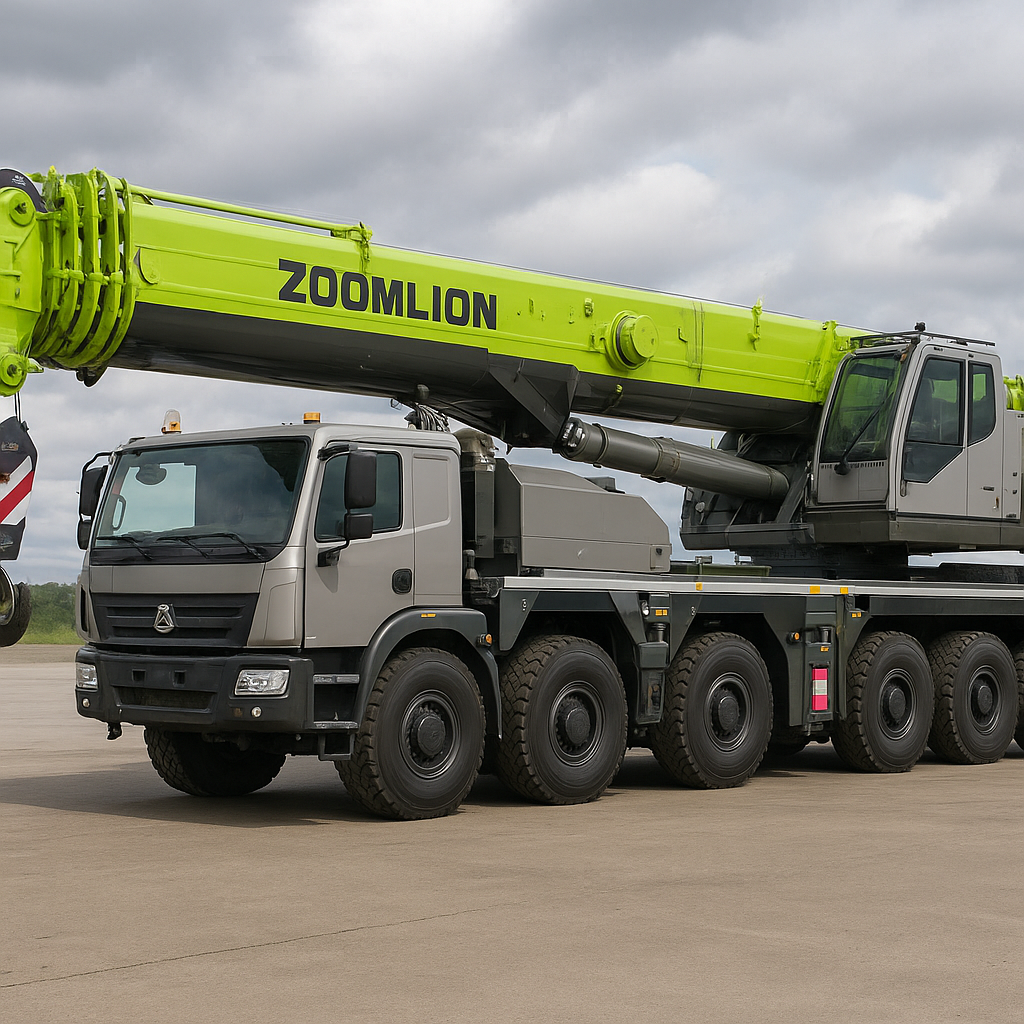
The Zoomlion ZAT15000H is a modern all-terrain crane designed to combine high lifting performance with road mobility and off-road capability. Built for demanding construction, energy and industrial projects, this machine aims to deliver precise lifting, flexible setup and rugged reliability. In this article we explore the ZAT15000H’s design philosophy, typical technical parameters, practical applications, safety and maintenance aspects, and its place on the global market. Wherever exact numbers can vary by configuration, ranges and typical values are provided to give a realistic picture of performance and use.
Design and technical overview
The Zoomlion ZAT15000H belongs to the class of multi-purpose mobile cranes known as all-terrain cranes. These cranes are engineered to travel on public roads at legal speeds while also featuring enhanced suspension and drive systems that allow limited cross-country movement on construction sites. The ZAT15000H blends a compact carrier profile with a telescopic boom and advanced hydraulic and electronic systems.
Chassis and mobility
The carrier of the ZAT15000H is built to provide a compromise between road compliance and site mobility. Typical features include robust axles with independent steering on some wheelsets, all-wheel drive options, and heavy-duty suspension. The carrier is engineered to meet regional regulations for axle loads and transport widths while offering a high maximum travel speed for a crane of this class.
- Drive: multi-axle driven chassis with selectable drive modes for on-road and off-road travel.
- Steering: multi-wheel steering for tight turning radii and improved maneuverability on congested sites.
- Suspension: reinforced for load-bearing and site durability.
Boom, superstructure and lifting components
The lifting equipment centers on a telescopic boom composed of several sections that extend hydraulically. The boom is designed for a balance of length, strength and compact stowage. Most units are offered with optional lattice or telescopic jibs to increase outreach and hook height.
- Boom: multi-stage telescopic boom with hydraulic extension; materials and section profiles optimized for stiffness-to-weight ratios.
- Jib: auxiliary jibs (fixed or swing-away) available to extend outreach or provide higher pick points.
- Winch system: variable-speed hoists with multiple falls for fine control and rated load handling.
Powertrain and hydraulics
Power and control systems on the ZAT15000H integrate diesel engine output with hydraulic power units and electronic controls. Modern variants often comply with current emissions standards (e.g., Stage V / Tier 4F in many markets), support engine power management, and include electronic load moment indicators (LMI).
- Engine: high-torque diesel engine sized for mobility plus hydraulic power; power ratings vary by configuration.
- Hydraulics: closed-loop hydraulic circuits for boom extension, winches and slewing with electronic proportional control.
- Controls: joystick-driven operator controls integrated with load-sensing and anti-two-block protection.
Applications and typical use cases
The ZAT15000H is suited for a wide range of tasks where a mid-size all-terrain crane is desirable. Its combination of transport speed and site adaptability makes it a common choice for contractors who need a single machine to move between urban roadways and rough job sites without requiring heavy transport logistics.
Construction and civil engineering
In building and civil projects, the ZAT15000H performs tasks such as lifting precast concrete elements, installing steel structures, placing heavy mechanical equipment and assisting with bridge components. The crane’s ability to travel under its own power between sites reduces downtime and logistical costs compared with crawler cranes that require dedicated transport.
Energy sector — wind, power and oil & gas
For the energy industry, the crane’s lifting capacity and reach are valuable for erecting medium-sized wind turbines, installing transformers and handling heavy components in refineries or petrochemical plants. The ability to operate on unpaved surfaces while providing precise control makes it useful for assembly and maintenance tasks.
Industrial installation and maintenance
Manufacturing plants, shipyards and factories use mid-class all-terrain cranes for equipment installation, maintenance turnarounds and routine lifts. The ZAT15000H can be transported between facilities and used where overhead cranes are absent or unavailable.
Municipal works and emergency response
Municipal utilities and emergency services sometimes rely on mobile all-terrain cranes for recovery operations, infrastructure repairs and disaster response. The relative compactness and rapid deployment of the ZAT15000H make it suitable for situations that require both speed and reliable lifting capacity.
Performance, specifications and statistics
Specific data for any crane model can vary depending on the chosen configuration, optional packages and regional adaptations. The following figures represent typical or indicative values for a 150-ton-class all-terrain crane such as the ZAT15000H. Always consult the manufacturer’s technical documentation for certified load charts for a particular unit and configuration.
Typical technical parameters (indicative)
- Maximum rated lifting capacity: approximately 150 metric tons (150 t) at the main hook in optimal crane configuration.
- Main boom length: telescopic boom length commonly in the range of 40–60 meters depending on extension stages.
- Telescopic sections: typically 4–6 sections for balanced extension and compact stowage.
- Auxiliary jib: fixed or swing-away jib options that can add 10–25 meters of outreach in modular sections.
- Counterweight: modular counterweight systems typically ranging from several tonnes up to 20–40 tonnes installed as needed for rated lifts.
- Carrier configuration: multi-axle chassis with 4–8 axles depending on regional transport rules and model variants; many units in this class use 5–7 axles.
- Engine power: diesel engine outputs commonly fall between 250–400 kW (roughly 340–540 hp), tuned to meet mobility and hydraulic power requirements.
- Maximum travel speed: on-road speeds up to 60–85 km/h depending on gearing and legal limits.
- Slewing radius: compact superstructure design aimed at maximizing lifting envelope while minimizing tail swing.
- Operational hydraulics: multi-circuit hydraulic systems with proportional control and electronic safety interlocks.
Load chart behavior and practical lifting examples
Load charts detail how rated capacity decreases with increasing outreach and boom angle. Typical behavior for a 150-ton class crane might include:
- Maximum 150 t near the crane’s minimum radius with main counterweight installed.
- At medium outreach (for example 20–30 m) rated capacity often drops to a fraction of maximum, commonly in the 30–80 t range depending on boom angle and counterweight.
- At long outreach with jib extensions, capacities can fall below 10–20 t, requiring careful planning and outriggers to achieve rated conditions.
These performance characteristics emphasize the importance of proper site setup, outrigger placement and adherence to the load moment indicator (LMI) data. On-site charts and software help operators compute safe configurations quickly.
Operation, safety and maintenance
Safety is paramount in crane operations. The ZAT15000H incorporates both passive and active safety systems to protect personnel and equipment while optimizing performance.
Key safety systems
- Load moment indicator (LMI): continuously monitors load, boom angle and radius to warn and prevent overloads.
- Anti-two-block: prevents the hook block from contacting the boom tip, which can cause cable failure or structural damage.
- Slew and boom limiting: electronic limits to prevent unsafe motions or collisions with an operator-defined envelope.
- Emergency stop and fail-safe modes: allow rapid shutdown and safe condition establishment in case of malfunctions.
Operator ergonomics and controls
Modern Zoomlion cabs include ergonomic seating, clear displays for load and operating parameters, joystick controls and climate control options. Visibility and camera systems may be offered as options to aid precise positioning and enhance safety when working in constrained environments.
Maintenance and lifecycle
Routine inspection and maintenance regimes are essential to maximize uptime and service life. Typical maintenance activities include:
- Daily visual and functional checks (hydraulics, ropes, brakes).
- Scheduled hydraulic fluid and filter changes according to operating hours.
- Wire rope inspections and replacement intervals based on wear and usage.
- Periodic structural inspections and non-destructive testing (NDT) for boom and critical components.
Manufacturer support, parts availability and regional dealer networks affect total cost of ownership. Zoomlion typically provides service agreements, spare parts distribution and technical training to help owners maintain machines in line with OEM specifications.
Market position, procurement and economics
The Zoomlion ZAT15000H competes in the mid-range all-terrain segment against models from established global manufacturers. Buyers look at several factors when selecting a crane:
- Acquisition cost versus long-term operating expense.
- Fuel efficiency and emissions compliance to meet local regulations.
- Resale value and brand service network.
- Operational versatility—the ability to perform many types of lifts with minimal reconfiguration.
Financing options, rental market demand and fleet standardization also influence purchasing decisions. For rental fleets, machines that can quickly travel between sites and serve diverse contract types are particularly attractive. The ZAT15000H’s target customers typically include construction contractors, rental companies, energy firms and industrial maintenance providers.
Comparative advantages
Advantages often associated with Zoomlion machines in this segment include:
- Competitive pricing relative to some European-brand alternatives.
- High feature density—many standard safety and control features bundled into base models.
- After-sales support improving in many regions as the manufacturer expands its dealer network.
Considerations and limitations
Potential buyers should evaluate:
- Availability of certified load charts and local homologation for road legal travel.
- Service and parts lead times in their region.
- Operator familiarity and training requirements to ensure safe and efficient use.
Real-world examples and operational tips
Operators and fleet managers often share practical tips to get the most from mid-class all-terrain cranes like the ZAT15000H:
- Plan lifts using digital crane planning tools and verify configurations against manufacturer load charts to avoid capacity surprises.
- Invest in operator training—skilled operators will maximize lift efficiency and reduce wear on components.
- Use modular counterweights smartly to keep transport weights within legal limits while optimizing on-site lift capacity.
- Apply preventative maintenance discipline—small issues spotted early avoid costly downtime during critical projects.
Case studies in similar crane classes often highlight how mobility reduced jobsite mobilization time by days compared with crawler cranes and helped complete multiple short-duration lifts across sites in a single week. Rental companies report high utilization rates when machines are used across mixed applications—construction, infrastructure and industrial maintenance—thanks to the combination of road speed and lifting capability.
Environmental and regulatory aspects
Environmental regulations increasingly influence crane design and operation. Modern units like the ZAT15000H are often offered with engines that meet contemporary emissions standards. Additional environmental considerations include noise control, fuel efficiency and the potential to integrate hybrid or alternative energy systems in future variants.
- Emissions: Many models can be specified to meet Stage V / Tier 4F standards where required.
- Noise: Acoustic insulation and engine management strategies reduce site noise during idling and operation.
- Fuel management: Efficient hydraulic systems and engine power management lower fuel consumption over the crane’s duty cycle.
Summary and outlook
The Zoomlion ZAT15000H represents a versatile entry in the 150-ton all-terrain crane category, intended for customers who need a balance of mobility and lifting power. Its design emphasizes operator ergonomics, integrated safety systems and modular configurations to meet a variety of lifting tasks. While specific figures depend on chosen options and regional variants, typical traits of this class include telescopic booms in the 40–60 m range, multi-axle carriers, and modular counterweight systems that enable rated lifts up to approximately 150 t in optimal configurations.
For procurement and operational decisions it is important to consult certified load charts, confirm local service and parts support, and plan lifts with attention to ground conditions, outrigger setup and environmental constraints. When used appropriately, the ZAT15000H can reduce logistics overhead, increase fleet versatility and deliver dependable performance across construction, energy and industrial applications.
)
)