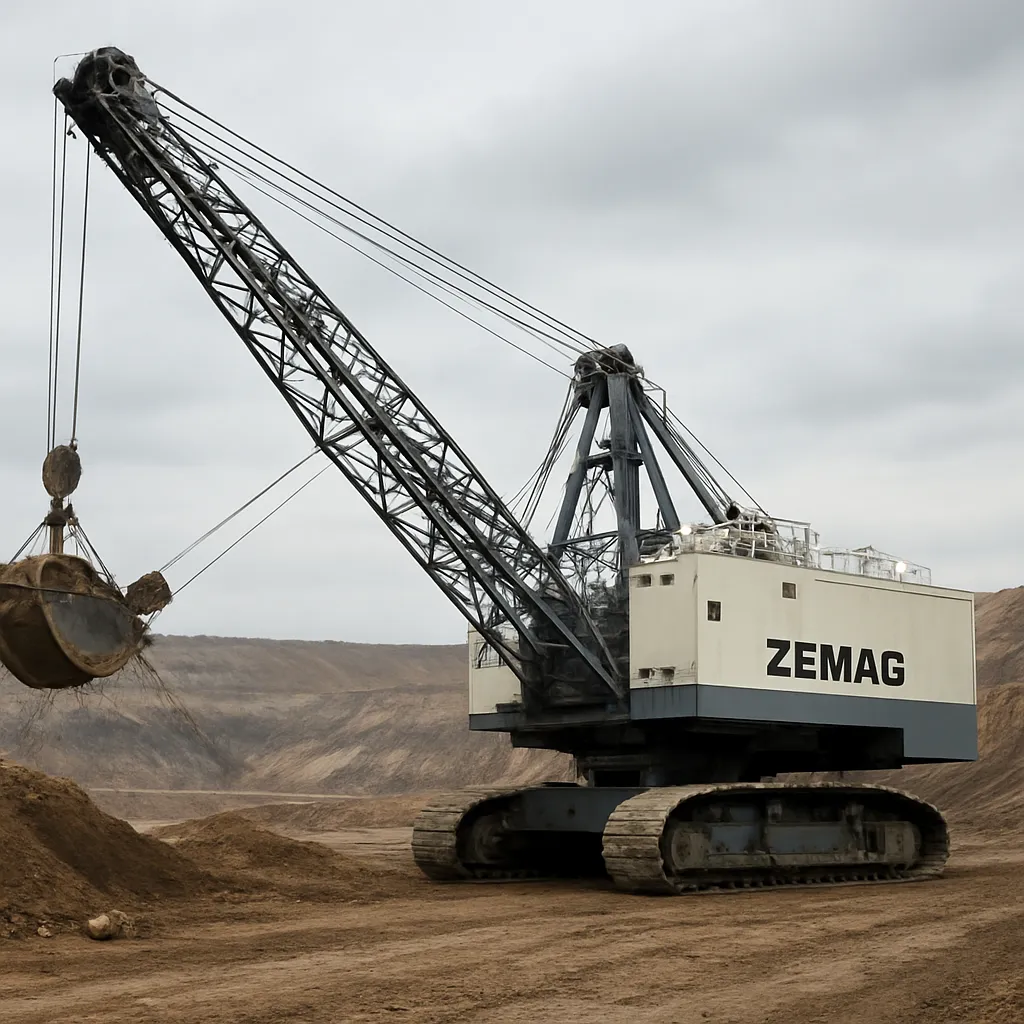
The ZEMAG ED1600 is a heavy-duty rope dragline designed for large-scale surface mining and bulk material handling. Combining robust structural engineering with electric drive systems and a proven rope-and-bucket excavation method, the ED1600 has been used where high productivity, long reach, and operational reliability are required. This article describes the machine’s design and technical characteristics, typical applications, operational considerations, maintenance and logistics, and its role in the wider context of modern surface mining.
Design and core components
The ED1600 is built around a few fundamental subsystems that together define the machine’s capabilities: the supporting superstructure and undercarriage, the lattice boom, the rope-and-pulley system, the large excavation bucket, and the electric power and control systems. Each of these components is engineered to withstand sustained heavy-duty cycles typical of open-cast mining.
Superstructure and undercarriage
- The superstructure houses the drive motors, winches, operator cabin, winch drums, electrical cabinets and counterweight systems. It rotates on a massive slewing ring to enable swing motions across the work area.
- The undercarriage is designed to support the whole assembly and to provide limited mobility. In many installations, the dragline is periodically relocated by crawler tracks or by disassembly and reassembly, depending on the mining plan and the geological layout.
Boom and rigging
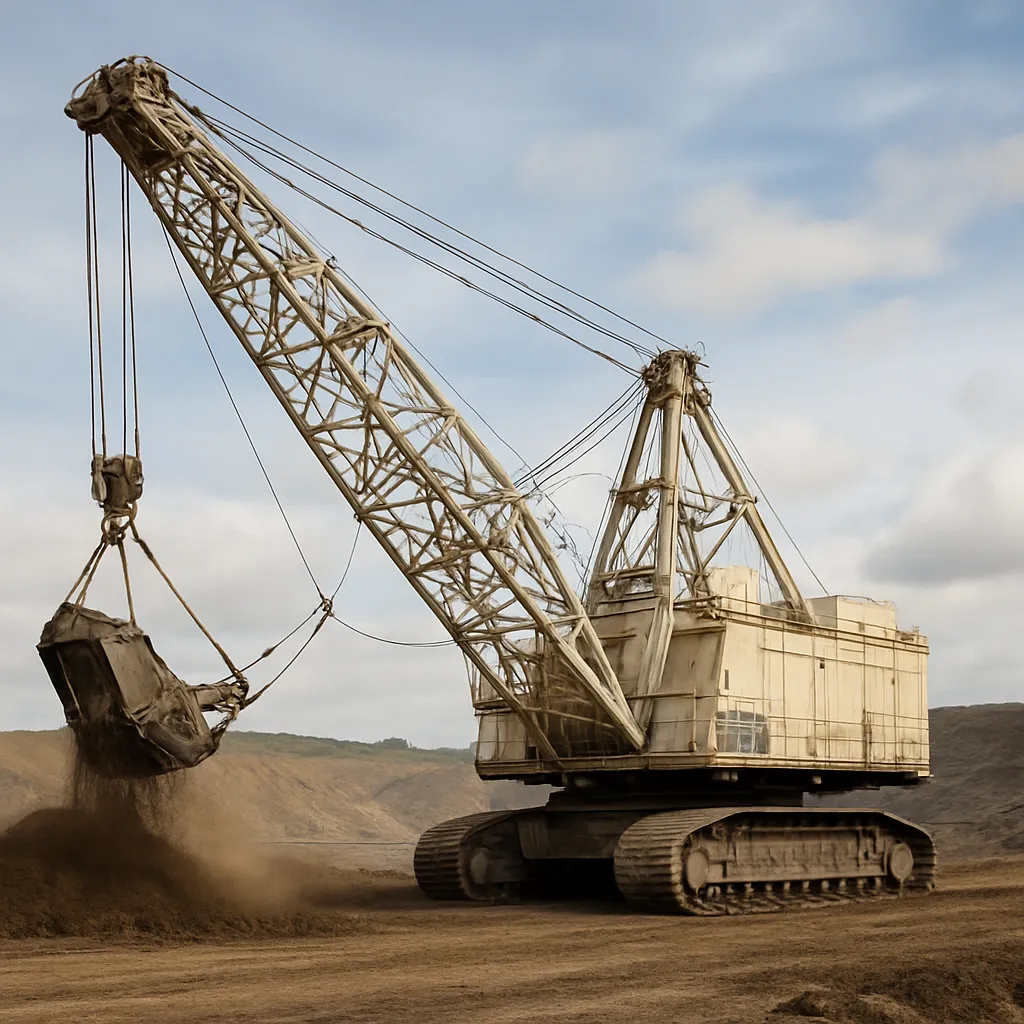
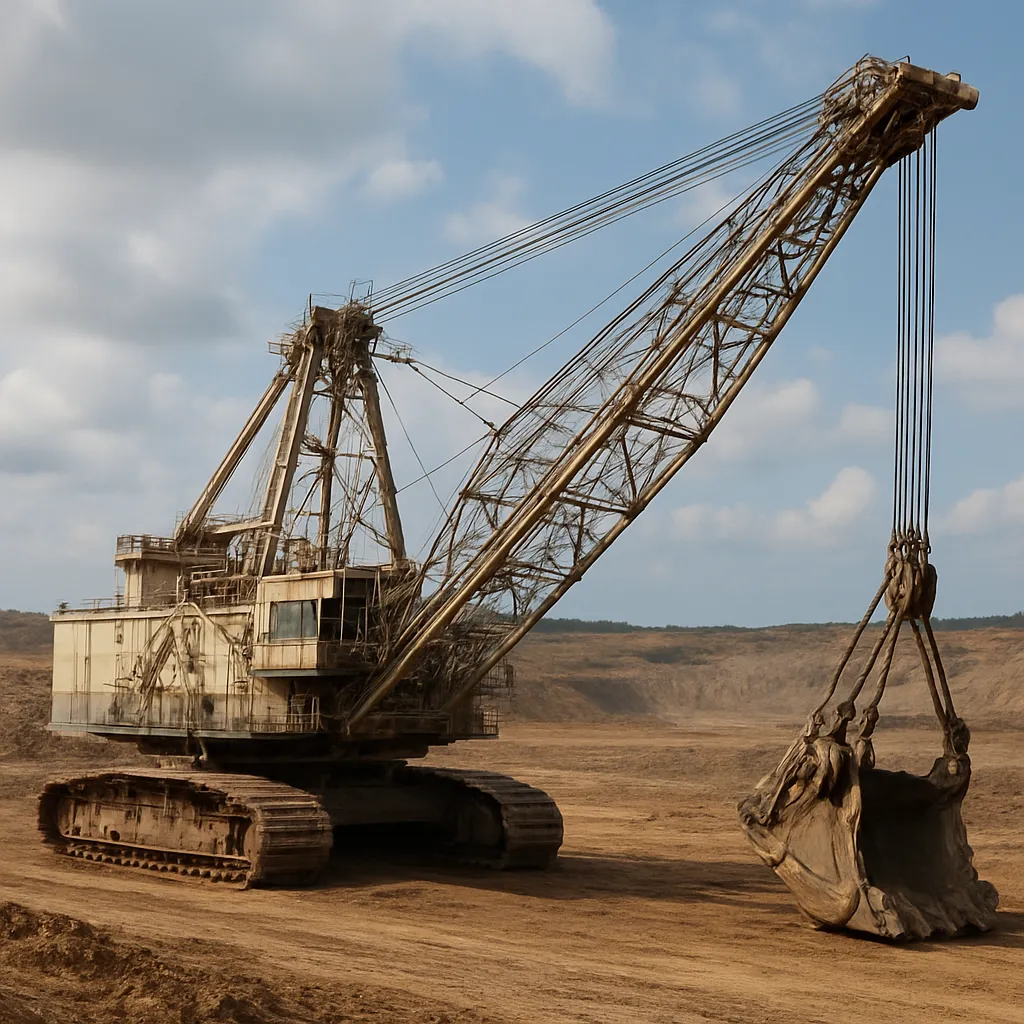
The ED1600 employs a long lattice boom that provides the reach necessary to remove overburden and reach bench faces at safe stand-off distances. The boom’s geometry, bracing and material selection are optimized to balance structural strength and weight. The dragline’s performance depends heavily on the boom length, the angle of operation and the capacity/stroke of the hoist and drag winches.
Rope systems and bucket
At the heart of the dragline’s excavation method is the rope-and-bucket system. A set of high-strength steel ropes controls the bucket’s drag, hoist and crowd motions. The bucket itself is a large, often single-piece, heavy steel shell designed for repeated impact, abrasion and large payloads. The bucket is dragged along the surface to fill, then hoisted, swung and dumped into a spoil pile or conveyor. The ED1600 is engineered to use ropes and buckets rated for intense cyclical loading and long service lives when maintained correctly.
Electrical and control systems
Modern units of this class typically use three-phase electric motors for hoists and swing drives, often coupled with sophisticated variable frequency drives (VFDs) or soft-start mechanisms to control torque and reduce mechanical shock. Control cabins provide operators with instrumentation for cohesion between winches, swing and crowd motions, often including diagnostic and safety interlocks that protect equipment and personnel.
Applications and operational contexts
Draglines like the ZEMAG ED1600 are primarily applied in large-scale open-pit mining and major earthmoving projects. Their strength lies in moving enormous volumes of overburden efficiently and from a distance, enabling cost-effective access to underlying mineral seams.
Mining of coal and lignite
One of the most common uses of large rope draglines is the removal of overburden in surface coal and lignite mines. The ED1600 is well-suited to strip-mining benches where a wide horizontal reach and high bucket fill factor reduce the need for repositioning and allow continuous cycles of drag, hoist, swing and dump. Its ability to work at a distance from the pit edge improves safety and reduces rehandle costs.
Bulk earthworks and reclamation
Beyond mineral extraction, draglines are used for major bulk earthworks such as creating large terraces, dredging or building spoil containment systems, and in reclamation works where large spoil redistribution is necessary. The ED1600’s long boom and heavy bucket make it valuable for such tasks when the scale justifies its mobilization.
Advantages in the right context
- High productivity in moving large volumes per cycle when ground and material conditions are favorable.
- Low unit energy cost per tonne moved for continuous long-reach operations compared with multiple smaller excavators and trucks.
- Robustness and longevity: designed for years or decades of heavy service when properly maintained.
Performance characteristics and practical metrics
Performance of any dragline depends on machine configuration, operator practice, geology, and site layout. Rather than fixed values, realistic expectations for the ED1600 should be expressed as typical ranges and influential factors.
Key performance indicators
- Production rate: For draglines in the mid-to-large category, routine production rates can range from several thousand to tens of thousands of tonnes per day, depending on bucket size, cycle time and material characteristics. The ED1600 is positioned to deliver consistent high-volume outputs in continuous shift operations.
- Bucket fill factor and swing time: Efficient operation requires high bucket fill factors (achieved through correct drag technique) and minimized idle swing periods. A well-tuned ED1600 operation emphasizes synchronized winch control to maximize effective payload per hour.
- Availability and utilization: Long-term productivity hinges on mechanical availability – the percentage of time the machine is operational when scheduled. With planned maintenance and good spares support, availability for machines like the ED1600 can be maintained at high levels, but exact figures vary by operator practice.
Power and energy consumption
Electric rope draglines are energy-intensive while in cycle, primarily due to hoist and swing motor operation. However, their per-tonne energy consumption compares favorably to truck-and-shovel fleets when moving large continuous volumes over similar distances. Power requirements must be sized to ensure stable supply and to avoid frequent starts that stress drives and mechanical systems.
Logistics, installation and relocation
Deploying an ED1600 requires careful logistic planning. These are large machines with significant mass and dimensional constraints that impact transport, assembly and site access.
Transport and assembly
- Typically delivered in modules: boom sections, superstructure, counterweight, ropes and bucket are transported separately and assembled on site by heavy lifts and jacking systems.
- Assembly and commissioning period depends on site conditions and contractor experience; well-managed projects can complete reassembly in weeks, whereas complex mobilizations require months of planning and execution.
Relocation strategies
Relocation occurs either by limited crawler movement (if the undercarriage is designed for it) or by partial disassembly and transport to another pit sector. The long useful life of draglines means that mine plans are often designed around several years of single-site operation before major relocations.
Maintenance, spares and lifecycle management
Because draglines operate under severe dynamic and abrasive conditions, a rigorous maintenance program is essential to maintain performance and safety. The ED1600 follows the same discipline: scheduled inspections, rope and bucket checks, lubrication, structural inspections and electrical system diagnostics are routine.
Critical maintenance areas
- Wire rope health: ropes are subject to fatigue, abrasion and corrosion; routine non-destructive testing and replacement schedules are crucial.
- Bucket and lip wear: wear liners, replaceable lips and regular inspections extend service life and avoid catastrophic failure.
- Winch and gearbox upkeep: because winches handle enormous cyclical loads, periodic oil analysis, bearing checks and vibration monitoring help predict failures and schedule interventions.
- Structural inspections: boom bolts, pins, lattice bracing and slewing rings must be monitored for cracks, loosening or corrosion.
Spares and supply-chain considerations
Long-term availability depends on spare parts inventory and supplier relationships. For older machines, custom fabrication of parts or the involvement of third-party specialists can be necessary. Operators often keep critical spares on site to minimize downtime given the remote locations and the lead times for heavy components.
Safety, environment and regulatory issues
Operating a machine of the ED1600’s scale brings specific safety and environmental responsibilities. Proper planning and controls reduce risks to personnel, equipment and the surrounding environment.
Safety best practices
- Defined exclusion zones and active supervision during swing, hoist, and crowd operations prevent accidental striking of personnel or vehicles.
- Redundant interlocks and emergency stop systems are standard to prevent uncontrolled motions in case of component failure.
- Operator training and simulator practice where available improve response to atypical conditions and reduce human-error incidents.
Environmental considerations
While draglines are efficient at moving overburden, site planning must mitigate dust, noise and water runoff. Rehabilitation and progressive reclamation plans are often incorporated to reduce long-term environmental footprints. The electric drive nature of the ED1600, when powered from relatively clean grids, reduces on-site combustion emissions compared with diesel-heavy fleets.
Historical use, case examples and market role
Draglines have historically been central to large-scale surface mining since the early 20th century. The ZEMAG ED1600 continues that tradition by providing an intermediary capacity between smaller power shovels and the largest specialized draglines used in the world’s most massive pits. Typical case examples include operation in brown-coal basins, where extensive lateral stripping is required, and in large mineral open pits where reach and continuity of operation are paramount.
Operational case notes
- In longwall strip operations, draglines are valued for continuous stripping over multiple benches without frequent repositioning of primary earthmoving fleets.
- In reclamation or landforming projects where large spoil volumes must be relocated, the ED1600 provides an economical single-machine solution when access and staging allow.
Economic considerations and lifecycle cost
Choosing a dragline like the ED1600 is primarily an economic decision: capital cost versus operational savings over the machine’s service life. Evaluations typically consider the cost per tonne of overburden removed, life-cycle maintenance, transport and relocation costs, and the expected useful life (often measured in decades for such investments).
When a dragline makes sense
- Long-term mining plans where continuous, high-volume stripping is the core activity.
- Sites with predictable geology and a layout that benefits from the dragline’s reach (minimizing rehandle and truck haulage).
- Where electrical infrastructure can support high power demand reliably.
Future prospects and modern developments
Draglines remain relevant where their unique combination of reach and economy per tonne is unmatched. Modern improvements focus on smarter controls, improved rope materials, condition monitoring, and integration with mine planning software to optimize cycle efficiency. Electrification and grid improvements also enhance the environmental profile of large electric rope draglines like the ED1600.
Technological trends
- Condition-based maintenance built on sensor telemetry and predictive analytics reduces unplanned downtime.
- Advanced control systems and automation can reduce cycle times and improve bucket fill factors while enhancing safety.
- Materials engineering improvements in ropes, wear parts and structural alloys extend component life and lower lifecycle costs.
Summary and practical guidance for operators
The ZEMAG ED1600 is a specialized tool designed to deliver efficient large-scale earthmoving in the right operational context. Its successful deployment depends on detailed planning, robust electrical supply, disciplined maintenance and skilled operators. For mines with long-term stripping requirements and the logistical capacity to support a large machine, the ED1600 offers a compelling combination of reach, productivity and durability.
Key operator recommendations:
- Invest in operator training and simulation where possible to optimize cycle efficiency.
- Implement a rigorous rope inspection and replacement policy to prevent catastrophic failures.
- Keep a critical spares inventory and maintain strong relationships with component suppliers or fabricators.
- Integrate condition monitoring and predictive maintenance to maximize availability.
- Consider environmental controls—dust suppression and progressive reclamation—to meet regulatory and community expectations.
In sites where its strengths align with mining strategy, the ED1600 remains an effective and economical choice for large-scale surface excavation. Properly managed, it can provide decades of reliable service and play a central role in achieving high-volume production targets while controlling unit costs.
)
)