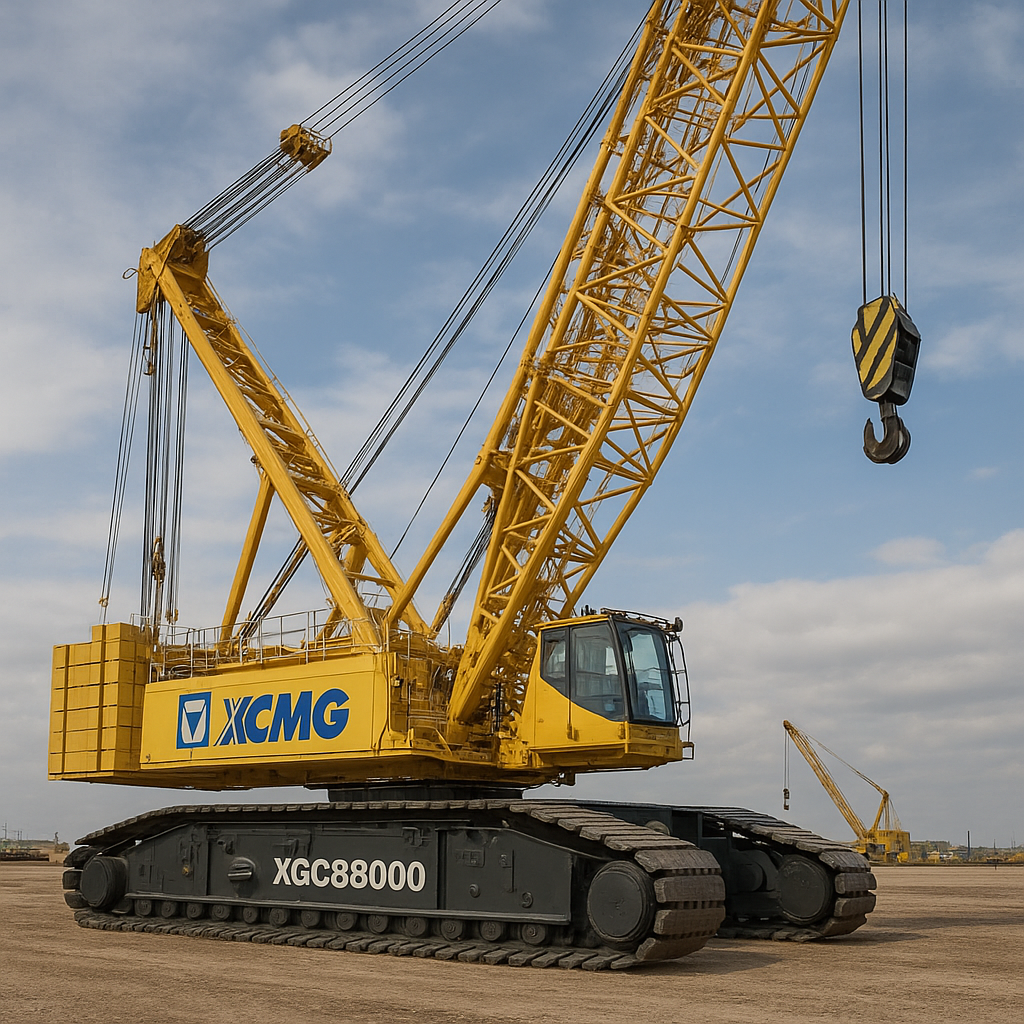
The XCMG XGC88000 is a flagship heavy-lift crawler crane that represents a major step in the evolution of ultra-large lifting equipment. Combining advanced engineering, modular transportability and specialized adaptations for the heaviest industrial projects, the XGC88000 is positioned for large-scale construction, energy and infrastructure tasks where conventional cranes cannot perform. This article explores the machine’s key features, typical applications, technical characteristics (where available), operational considerations and market impact.
Design, engineering and distinctive features
The XGC88000 was developed to address demand for a crawler crane able to handle extremely heavy lifts while remaining relatively flexible in terms of transport and erection on site. From a design perspective, the machine emphasizes structural robustness, modularity and integrated systems for safe and efficient operation.
- Heavy-duty mainframe: The carrier and upperworks are engineered to carry large loads and absorb the tremendous bending moments that occur during very heavy lifts.
- Crawler mobility: Tracks provide stability and the ability to reposition under its own power on prepared surfaces, which is crucial for large project sites where fixed cranes or lifting frames would be impractical.
- Modular counterweight and boom sections: The crane’s counterweights and boom/jib segments are broken into transportable modules to facilitate logistics and allow tailored configurations for specific lifts.
- Modern control systems: Electronic control and monitoring systems improve precision, reduce operator workload and enhance safety by providing real-time data on load, radius and machine condition.
- Redundancy and safety features: Multiple load-sensing systems, fail-safe brakes, and interlocks are typical of cranes in this class to protect personnel and assets during complex lifts.
These design choices make the XGC88000 attractive for projects where both sheer capacity and reliable on-site performance are required. The combination of heavy structural elements with sophisticated hydraulics and controls reflects the trend in the industry to merge mechanical strength with digital assistance.
Specifications and performance (overview and notes)
Providing exact numerical specifications for an ultra-large crane like the XGC88000 requires referring to the manufacturer’s technical sheets, because capacities and available configurations may vary by market, regulatory environment and optional packages. That said, the XGC88000 is widely described as belonging to the class of cranes capable of multi-thousand-tonne lifts and configured for the most demanding industrial applications.
- Lifting capacity: The XGC series sits in the high-capacity bracket — commonly reported as being capable of lifting several thousand tonnes in optimum configurations. Exact rated capacities depend on boom/jib combinations and counterweight arrangements. For any critical lift, operators must consult the XCMG load charts specific to the configuration in use.
- Boom and jib options: This type of crane offers multiple boom lengths and lattice jib options. Combined main boom plus superlift or luffing jib extensions enable lifts at large radii and increased hook heights suited to tall structures.
- Operating radius and heights: Depending on assembly, hook heights can reach beyond typical construction crane heights, and radii can extend to tens of meters, again varying by configuration and counterweight.
- Transport and assembly metrics: Weight-per-module and dimensions are intentionally limited to feasible truckable sizes in many cases, but special transport arrangements may be necessary for the largest sections. Assembly typically requires an initial smaller crane or modular erector and can take days to weeks depending on site conditions.
- Power and drive systems: Powertrain options tend to include high-output diesel engines coupled with hydraulic systems optimized for precise torque delivery during heavy lifts and for energy efficiency during repositioning and lowering operations.
Please note: for precise figures — such as the exact maximum rated capacity in a given configuration, maximum boom length, minimum breakdown weight, travel speed and fuel consumption — always refer to the official XCMG technical documentation or an authorized dealer. Lifting capacity charts (load charts) are the authoritative resource for planning any lift.
Primary applications and industry sectors
The XGC88000 is engineered for sectors that require extraordinary lifting capability, a broad range of boom configurations, and reliable operation in complex environments. Typical applications include:
- Energy sector: Installation of heavy equipment in thermal power plants, nuclear facilities and large-scale renewable energy plants (e.g., assembly of offshore platform components onshore, installation of heavy transformers and generator components).
- Petrochemical and refining: Lifting and placing large process vessels, columns and heavy piping modules that are often multi-hundred-tonne items.
- Large infrastructure projects: Bridge sections, dam components and large precast elements for major civil engineering projects.
- Heavy equipment manufacturing: Moving and installing furnaces, presses and other machine tools which can be extremely heavy and require precise placement.
- Shipbuilding and maritime construction: Handling ship blocks, port gantries, and offshore module integration on quaysides or fabrication yards.
Because of its scale and flexibility, the XGC88000 is particularly useful where lifts are too heavy or dimensions too awkward for conventional lattice crawler cranes and where the cost of constructing specialized lifting frames would be prohibitive in time or money.
Transport, assembly and site logistics
Deploying an ultra-large crawler crane is a complex logistics operation. The XGC88000’s design takes this into account by using modular components, but significant planning is still required.
Transport considerations
- Module sizing: Counterweights, boom sections, track assemblies and upperworks are divided into pieces sized for heavy-haul trailers, but local transport regulations (permits, escorts, bridge limits) govern routing and scheduling.
- Specialized carriers: Oversize and overweight shipments commonly require lowboy trailers, multi-axle platform trailers and, sometimes, temporary road reinforcement on weak or narrow routes.
Assembly and rigging
- Initial set-up: Assembly typically starts with positioning the crawler base and installing hydraulic systems, followed by adding the superstructure, boom sections and final counterweights.
- Auxiliary cranes and equipment: A combination of smaller mobile cranes, gantries and specialized rigging is commonly used to erect the main boom and fix major modules, particularly in constrained yards.
- Timeframes: Depending on site preparedness and available rigging equipment, assembly can range from several days for a minimal configuration to multiple weeks for the most extensive set-ups.
Good site planning, early coordination with transportation authorities and pre-fabricated foundation pads or crane mats substantially reduce delays and risks associated with mobilisation.
Operation, safety and maintenance
Operating a crane of this class requires experienced personnel, robust procedures and a disciplined maintenance program.
- Operator skills: Operators must be certified for heavy cranes and trained on the specific control and safety systems used by the XGC88000. Simulation training and supervised initial operations are recommended.
- Lift planning: Every heavy lift should be engineered with detailed lift plans, load charts, structural analyses of pick points, and contingency plans for adverse weather or equipment issues.
- Ground preparation: Because the loads are enormous, ground bearing capacity is critical — engineers typically design bearing mats or pile-supported foundations to distribute loads and prevent sinking.
- Maintenance regimes: Regular inspection of structural welds, rigging gear, hydraulic systems, tracks and engine systems is mandatory. Predictive maintenance using sensors and telematics (if fitted) can reduce downtime by identifying wear before failure.
- Safety systems: Overload protection, anti-two-block devices, wind-speed monitoring and emergency descent procedures are typical safety features to protect both personnel and the crane.
Adherence to local and international lifting standards — for example, ISO standards, EN standards and local occupational safety regulations — is essential when operating such equipment.
Case studies and notable projects
Large crawler cranes like the XGC88000 are commonly used across the globe for headline-grabbing lifts. While specific project attributions vary, there are recurring application themes where these cranes are chosen:
- Power plant installations: Installing turbine-generator sets and heavy transformers that cannot be broken down for transport.
- Modular construction and offshore platforms: Assembly of heavy modules onshore prior to transportation to offshore sites.
- Bridge and arch placement: Erecting massive spans and arch rings that are prefabricated off-site and then lifted into final position.
Project teams typically publish lift reports that document the procedures and lessons learned; these reports are an important resource for future planning and continuous improvement in heavy lifting methodologies.
Market position and competition
XCMG competes in the global heavy lifting market alongside several well-known manufacturers. The presence of machines such as the XGC88000 signals Chinese manufacturers’ increasing ability to design and produce extreme-capacity lifting equipment.
- Competitive features: Price competitiveness, after-sales support, localized service networks and the ability to supply complete packages (transport, assembly, operator training) are key competitive factors.
- Global adoption: While Western and Japanese brands have long dominated the ultra-large crane segment, manufacturers from other regions are expanding their footprints by offering cost-effective alternatives and by tailoring machines to regional logistics constraints.
Customers often weigh total lifecycle cost, availability of parts and service, and the supplier’s track record on major projects when selecting equipment for high-value lifts.
Environmental and regulatory considerations
Large crane operations have environmental and regulatory implications that affect project planning:
- Emissions and fuel use: High-output diesel engines create substantial fuel consumption during mobilisation and heavy lifting. Operators may adopt fuel management plans or use low-sulfur fuel to comply with local regulations.
- Noise and local impact: Construction noise, traffic for heavy transports and temporary changes to local infrastructure require stakeholder engagement and permits.
- Site restoration: After demobilisation, sites must often be restored to pre-construction conditions, including removal of crane mats and repair of any temporary road modifications.
Regulatory compliance often requires close coordination with local authorities for route permits, vibration and noise monitoring, and adherence to environmental management plans.
Trends, technological developments and the future
The heavy lifting sector is experiencing trends that affect machines like the XGC88000:
- Digitalisation and telematics: Increasing use of monitoring systems to capture load cycles, predict maintenance needs and improve operational transparency.
- Hybridisation and emissions reduction: Research into hybrid power systems and cleaner engine technologies seeks to reduce fuel use and emissions for large mobile equipment.
- Modularity and faster rigging: Engineering advances focus on reducing assembly time and complexity through smarter modular design and standardised interfaces between sections.
- Autonomous assistance: While fully autonomous heavy lifting is still nascent, augmented operator aids (collision warnings, automated slew limits, digital lift planners) are becoming more common.
These developments will likely make future iterations of ultra-large cranes safer, more efficient and easier to integrate into congested industrial sites.
Summary and practical advice for potential users
The XCMG XGC88000 is designed for the most demanding heavy lifting tasks across energy, petrochemical, infrastructure and heavy-manufacturing sectors. Its strengths are in sheer lifting capability, modularity for transport, and suitability for complex, heavy-duty projects. Key practical points for project teams considering this crane include:
- Engage early with the manufacturer or an authorized dealer to obtain configuration-specific load charts and transport data.
- Plan logistics, permits and ground preparation well in advance to avoid costly delays.
- Ensure qualified operators and rigging personnel are available and that lift plans and risk assessments are completed by competent engineers.
- Consider maintenance contracts and remote monitoring options to maximise uptime and manage lifecycle costs.
For any project that involves multi-thousand-tonne lifts, selecting the right crane is only one element of a complex engineering and logistics challenge. The XGC88000 offers a powerful option within the toolbox of heavy lifting solutions, but success depends on meticulous planning, experienced crews and an integrated approach to safety and site management.
Important note: For authoritative technical specifications, certified load charts, and configuration options, consult official XCMG literature or an authorized XCMG distributor. They will provide the definitive data necessary for safe and compliant lift planning.
)
)