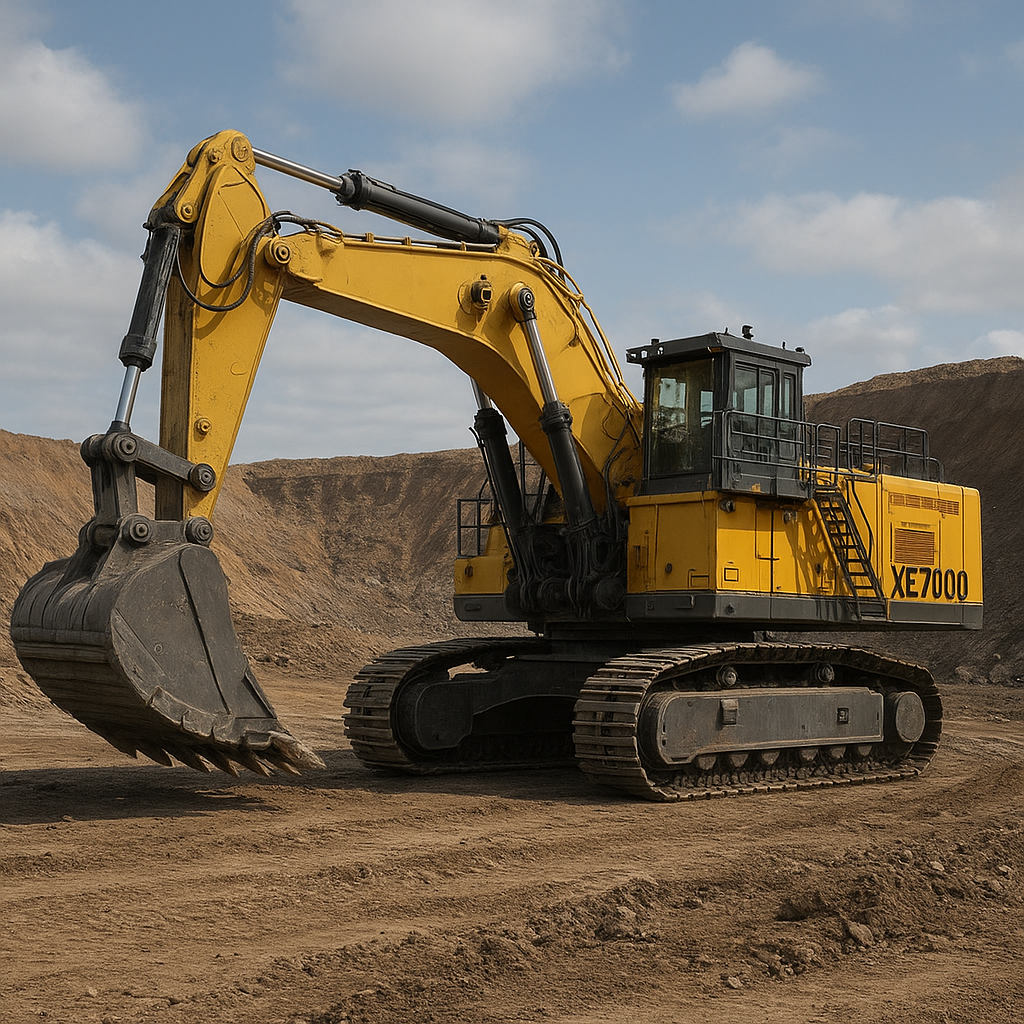
The XCMG XE7000 is a heavyweight example of the modern large-scale mining excavator platform developed by one of China’s largest construction equipment manufacturers. Designed for continuous, high-output open-pit and quarry operations, the XE7000 exemplifies the ongoing shift toward greater automation, improved fuel efficiency, and enhanced operator ergonomics in the mining sector. This article examines the machine’s design principles, typical applications, technical characteristics, operational considerations, environmental and safety features, and its place in the global market.
Overview and Positioning
The manufacturer XCMG (Xuzhou Construction Machinery Group) has steadily expanded from its domestic market roots into global heavy equipment markets. The XE7000 is positioned as a large mining excavator intended to compete in the upper tiers of rope-shovel and hydraulic-excavator classes used for primary stripping, ore loading, and bulk material handling.
As a product, the XE7000 targets mining companies, large contractors, and governments operating large-scale open-pit mines or infrastructure projects that require sustained, high-volume earthmoving. Typical tasks include stripping overburden, loading haul trucks, stockpile management, and working in conjunction with shovels and draglines where digging depth and bucket capacity are key.
Design and Technical Features
Core Architecture
The XE7000 is built around a heavy-duty undercarriage and a reinforced upper structure that supports a powerful house engine, hydraulic system, and a reinforced boom and stick assembly. The combination of structural rigidity and modular components aims to provide durability under continuous heavy-cycle loading. Major design priorities typically include frame strength, thermal management, and service access.
Powertrain and Hydraulics
Large mining excavators rely on robust powertrains. The XE7000 is commonly offered with high-output diesel engines, supported by advanced hydraulic pumps and cooling systems to maintain performance during long shifts. Typical systems emphasize fuel economy while delivering high bucket breakout forces and fast cycle times. Modern control electronics enable adaptive hydraulic flow control that optimizes power use according to the digging cycle, thereby improving overall power utilization and lowering operating cost per ton moved.
Buckets, Booms and Attachments
Bucket sizing and design determine the machine’s productivity profile. The XE7000’s boom and stick can be configured for a range of bucket capacities and tooth systems to match application needs: from large coal and ore buckets for maximum payloads to smaller, reinforced buckets used in high-abrasion rock conditions. Interchangeable attachments (rippers, hammer attachments for secondary breakup) increase versatility. A well-matched bucket and stick geometry yield efficient fill factors and cycle times, reducing wasted motion and fuel use.
Operator Station and Controls
Operator comfort and control precision in large excavators are critical for sustained productivity and safety. The XE7000 typically features a climate-controlled cab, ergonomic seating, multi-function joysticks, and digital displays for machine diagnostics. Advanced models integrate telematics for remote monitoring and optional semi-autonomous systems for consistent digging patterns, helping to reduce operator fatigue and variability.
Applications and Use Cases
The XE7000 is tailored for applications that demand high cycle throughput and robust reliability. Typical deployment scenarios include:
- Open-pit mining — primary ore and overburden loading for haul trucks (especially 100–400+ tonne haul trucks).
- Large-scale quarry operations — continuous rock and aggregate excavation.
- Bulk earthmoving for large infrastructure projects — dam construction, major road cuttings, and airport works.
- Loading and stockpile operations — paired with conveyor systems or loading directly into haulage fleets.
In these roles, the XE7000 must balance rate of penetration, bucket fill factor, and cycle time. Proper matching to truck fleets is essential: too large a bucket relative to truck capacity increases truck waiting time, while too small a bucket underutilizes machine potential.
Performance and (Typical) Statistics
Manufacturers often publish specific metrics for machines in this class. Exact figures for any individual XE7000 configuration vary by customer specification (engine choice, bucket size, undercarriage type, auxiliary equipment), but typical performance characteristics for a machine in the upper-large class include:
- Nominal operating weight range: commonly in the higher-tonnage class for large mining excavators (configurations that place it among the heavy hydraulic mining machines).
- Bucket capacities: commonly configurable across a wide range to match material density and truck pairing (from tens to several dozen cubic meters for large mining buckets).
- Engine power: typical large mining excavators have high-output engines designed to deliver sustained power over long shifts; power is scaled to match hydraulic flow and cooling capacity.
- Digging force and breakout torque: engineered to handle high-abrasion media and compact materials; hydraulic systems are tuned for sustained high-force cycles.
- Fuel consumption: large models prioritize fuel efficiency per ton moved; telematics and engine management systems help lower fuel burn while maximizing productivity.
Because configurations differ, operators specify the XE7000 to match local geology and production targets. When estimating productivity, mining engineers consider bucket size, cycle time, and fill factor to calculate theoretical hourly production and then apply realistic efficiency factors (typically 70–85% of theoretical) to account for operational delays and variability.
Operation, Maintenance and Lifecycle Costs
Planned Maintenance
Maintenance is a critical determinant of machine availability. For machines of the XE7000’s scale, planned maintenance schedules include daily greasing points, periodic hydraulic oil and coolant checks, filter replacements, and wear-part inspections (teeth, lips, pins and bushings). Major intervals involve engine overhauls, hydraulic pump servicing, and undercarriage component replacement. Effective predictive maintenance programs—using telematics and vibration/temperature sensors—reduce unplanned downtime and total cost of ownership.
Wear Parts and Consumables
Wear parts (bucket teeth, cutting edges, bushes) are the most frequently replaced items and can substantially affect operating cost. The XE7000’s design generally emphasizes ease of replacement and use of high-strength wear materials. In abrasive conditions, operators should plan for accelerated wear and inventory spare parts accordingly.
Telematics and Fleet Integration
One of the important features for modern large excavators is integrated telematics. Telemetry provides live data on fuel usage, operating hours, load cycles, and location. Integrating the XE7000 into a fleet management system allows operators to track productivity KPIs, identify maintenance needs early, and optimize truck-shovel match-ups to reduce idle times.
Safety, Ergonomics and Environmental Considerations
Large-scale excavation introduces significant safety and environmental responsibilities. The XE7000 typically includes several safety-oriented design elements:
- Cab protection and ROPS/FOPS-certified structures to protect the operator from rollovers and falling objects.
- Visibility aids: large mirrors, cameras, and proximity detection systems to reduce collision risk in congested pit floors.
- Emergency stop systems and remote shutdown for rapid response to hazardous conditions.
- Noise and emissions controls: modern engines and exhaust aftertreatment reduce particulate and NOx emissions to meet regulatory requirements in many jurisdictions.
Environmental optimization includes engine tuning for lower fuel consumption and the potential for hybrid systems or electrified auxiliary systems in some excavator lines. Water- and dust-suppression measures are also important when excavating fine particulates. While the XE7000’s specific environmental technology depends on the model year and configuration, modern units increasingly incorporate emissions reduction and monitoring technologies to meet stricter regulations.
Economic Factors and Return on Investment
Purchasing a large excavator like the XE7000 is a capital-intensive decision that must be justified by productivity gains and lower operating costs per ton. Key economic factors to assess include:
- Initial purchase price and financing terms.
- Operating cost per hour (fuel, consumables, maintenance labor).
- Availability and uptime projections driven by maintenance strategy and local support.
- Compatibility with existing truck fleets and material handling systems.
- Resale and residual value in secondary markets.
Operators often calculate a machine’s break-even production threshold: the tonnage at which the excavator’s contribution margin offsets the capital and operating costs. A well-matched XE7000 can reduce the number of machines required for a given output, providing economies of scale, but risks include higher absolute downtime impact and greater initial outlay.
Comparisons and Competitive Landscape
In the large-excavator segment, international players such as Komatsu, Caterpillar, Liebherr, and Hitachi have long-established products. XCMG competes by offering competitive pricing, increasing levels of local support in emerging markets, and rapid development cycles that integrate technologies often borrowed from global leaders. The XE7000 aims to balance acquisition cost and lifecycle support while meeting performance metrics comparable to its international peers.
When selecting among brands, buyers evaluate fleet commonality, dealer support, parts logistics, and proven reliability. Emerging markets often favor XCMG due to competitive pricing and improving service networks, while tier-one markets weigh long-term support and proven field performance heavily.
Deployment Examples and Field Practices
In real-world deployments, operators tailor XE7000 configurations to site-specific needs. Common field practices include:
- Mapping bucket geometry to truck box dimensions to optimize payload balance and minimize truck cycle inefficiencies.
- Using layered digging techniques — pre-splitting or secondary breakage — to improve bucket fill rates and reduce stress on the boom and stick.
- Implementing shift-based maintenance windows and using telematics to monitor unusual vibration or temperature signatures.
- Training programs for operators to standardize cycle techniques, reduce swing time, and minimize fuel consumption.
These practices allow a large excavator to sustain reliable throughput over multi-year contracts, especially when ambient conditions and abrasive materials are accounted for in maintenance plans.
Future Trends and Upgradability
As mining operations pursue lower operating costs and higher sustainability, excavator designs are trending toward electrification, improved autonomy, and integration into broader mine automation systems. Potential upgrades relevant to the XE7000 class include:
- Electrified swing and travel drives or electric rope-assist systems to reduce diesel consumption.
- Increased use of sensors and machine-learning models to predict component failure and optimize digging cycles automatically.
- Enhanced tele-remote operation for high-risk environments, enabling operators to work from secure control centers.
- Modular attachments for rapid role changes and reduced downtime between tasks.
While full electrification at the very largest sizes remains constrained by energy storage technologies and site power infrastructure, hybrid systems and electric auxiliaries are practical near-term paths to reduce fuel usage and emissions.
Concluding Remarks
The XCMG XE7000 represents a class of large hydraulic excavators designed for the rigors of heavy mining and bulk material handling. Its value proposition relies on robust structural design, powerful hydraulic and engine systems, and modern operator and telematics features that together aim to deliver high availability and strong productivity. For mine planners and fleet managers, the key considerations when evaluating an XE7000 include machine configuration, bucket-truck matching, maintenance planning, and integration into existing operations.
Choosing a machine in this class should be guided by a holistic assessment of operating environment, expected production rates, parts and service availability, and the total cost of ownership over the machine’s operational life. Properly specified and maintained, a large excavator such as the XE7000 can be a cornerstone asset in achieving sustained high-output mining performance while meeting increasingly stringent safety and environmental standards.
)
)