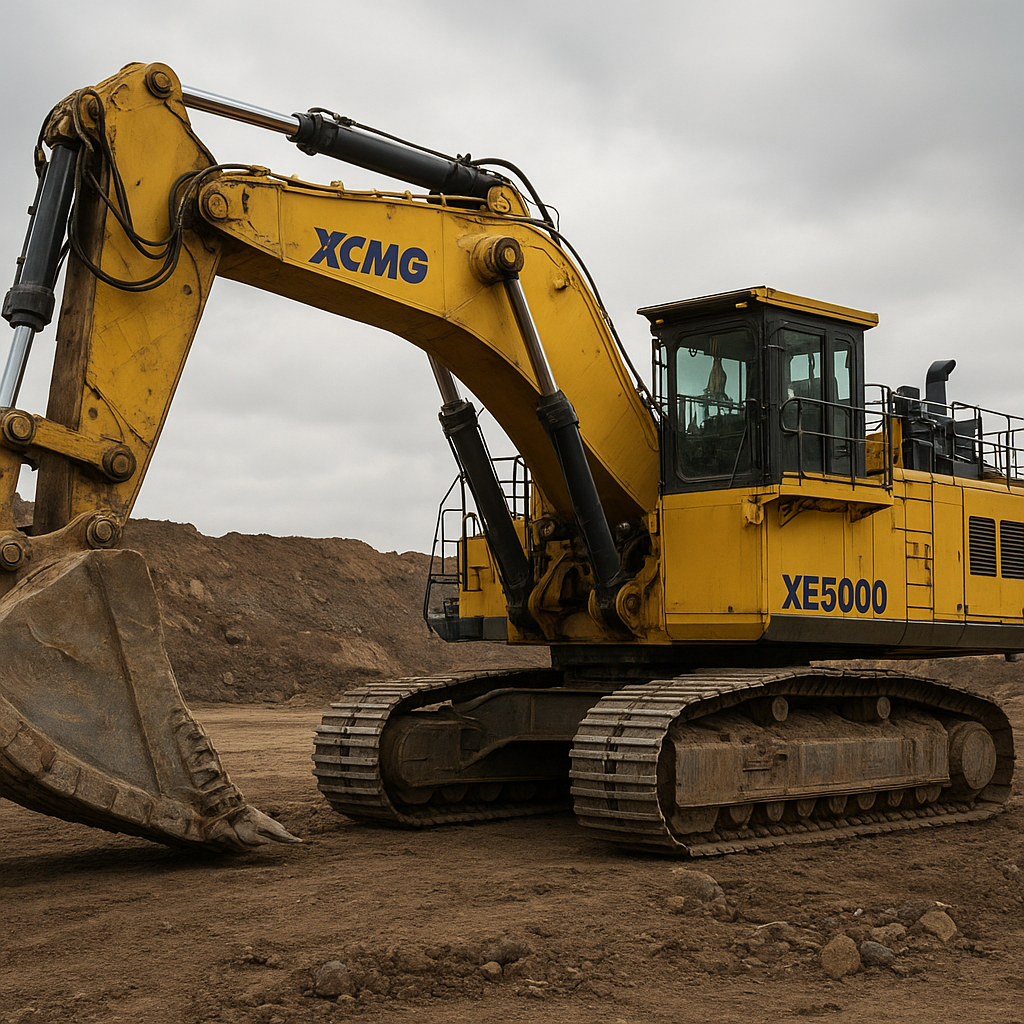
The XCMG XE5000 is a heavy-duty mining excavator designed for the most demanding open-pit and large-scale earthmoving operations. Combining robust structural design, advanced hydraulic systems and modern operator interfaces, this machine targets mining companies and contractors who require high daily production, long component life and relatively low operating cost per tonne. In the sections below, we examine the XE5000’s design philosophy, typical applications, technical and operational highlights, maintenance considerations and economic and environmental aspects relevant for buyer and operator decision-making.
Design and Technical Features
The XE5000 from XCMG is engineered as a purpose-built mining excavator with a focus on delivering consistent cycle times and long service intervals. Its primary structural components — boom, arm, house and undercarriage — are engineered to withstand continuous heavy-duty loading and abrasive conditions typical of large-scale mining. The machine brings together modern manufacturing techniques and component sourcing aimed at maximizing life expectancy and ease of repair.
Hydraulic and powertrain systems
At the heart of the XE5000 is an advanced hydraulic system designed for high flow and pressure to support large bucket forces and fast cycle times. The hydraulic configuration typically includes variable-displacement pumps, electronically controlled valves and heat management systems to maintain performance during long shifts. The integration between engine and hydraulics allows for improved fuel management and load-sensing control strategies.
- High-capacity hydraulic pumps and large hydraulic oil coolers improve thermal stability during continuous operation.
- Power management systems coordinate power delivery to hydraulics, swing and travel systems to optimize fuel use.
- Heavy-duty final drives and reinforced slew bearings improve reliability in abrasive environments.
Operator environment and controls
To improve productivity, the XE5000 features an operator cabin that balances comfort, ergonomics and visibility. The cab is typically climate-controlled, with adjustable seating, noise insulation and a panoramic view to the front and sides. Modern control layouts and optional joystick controls reduce operator fatigue and improve cycle efficiency.
- Ergonomic controls with multi-function joysticks reduce unnecessary operator movement.
- Integrated cameras and proximity sensors enhance visibility and site safety.
- Onboard displays provide diagnostics, fuel consumption readouts and recommended maintenance alerts.
Structural design and attachments
Heavy-duty booms and arms, made from high-tensile steel with optimized welds and reinforcements, enable the XE5000 to handle large buckets for bulk loading of mining haul trucks. Attachment options typically include different bucket sizes and shapes, hydraulic breakers, grapples and quick couplers to adapt the machine for multiple tasks.
- Bucket options allow operators to trade off between payload and digging cycle speed depending on material density.
- Reinforced attachment points and pin designs increase component life under high shock loads.
- Quick access plates and service points for hydraulic lines and bucket linkages simplify field repairs.
Primary Applications and Use Cases
The XE5000 is primarily intended for large open-pit mines and heavy civil projects where high-volume excavation, stripping and loading are key. Its design makes it suitable for continuous, multi-shift operations where durability and predictable maintenance schedules are critical.
Open-pit mining
When deployed in open-pit operations, the XE5000 is used for:
- Overburden removal: stripping waste rock ahead of ore extraction, where high volumes and wide-area reach are required.
- Ore loading: loading large rigid and articulated haul trucks (e.g., trucks with capacities of 100+ tonnes).
- Bench cleaning and secondary digging: finishing benches and excavating around high-value ore zones.
Bulk earthworks and infrastructure
Beyond mining, the XE5000 is suitable for large-scale civil construction tasks such as dam building, harbor dredging support (from shoreside operations), and major highway or rail corridor earthworks where significant cut volumes must be moved reliably.
Specialized roles
With appropriate attachments the machine can also be used in demolition, material handling and ship-loading applications where heavy lifts and extended reach are needed. Retrofit packages — such as heavy-duty buckets, hydraulic breakers and custom booms — expand the machine’s versatility.
Performance, Productivity and Operational Considerations
High uptime and predictable hourly output are critical metrics for mining excavators. The XE5000 is engineered around these objectives by combining robust components, easy maintenance access and onboard monitoring systems that guide preventive service.
Cycle time and production
Production for a machine like the XE5000 depends mainly on bucket capacity, material density, operator skill, and site layout. In general terms, machines in this performance class are designed to maximize bank cubic meters per hour by minimizing swing time and maximizing fill factor on each pass. Optimized hydraulic response and smooth operator controls contribute to fast, repeatable bucket-fill cycles.
Downtime reduction and maintenance strategy
An effective maintenance strategy aims to reduce unplanned downtime — a major cost driver in mining operations. The XE5000 supports this through:
- Modular components for rapid replacement of wear items and hydraulic modules.
- Accessible grease points, filter locations and inspection hatches to speed daily checks.
- Onboard fault codes and service reminders to schedule preventive maintenance before failures occur.
Additionally, OEM and dealer networks typically offer service contracts, spare parts packages and operator training to ensure machines operate near peak availability.
Fuel efficiency and emissions
Modern excavators are designed to balance maximum digging forces with improved efficiency. The XE5000 incorporates engine and hydraulic tuning to lower specific fuel consumption per tonne moved. Emissions control packages (exhaust after-treatment, particulate filters) may be fitted to meet regional regulations without compromising performance.
Safety, Environmental and Regulatory Aspects
Safety and environmental performance are increasingly important in mining equipment procurement. The XE5000 includes features and options intended to reduce risk and environmental impact while meeting statutory requirements.
Operator and site safety
- Fall-protection systems, handrails and anti-slip surfaces on walkways aid safe access during inspection and service.
- Proximity detection, camera systems and audible alarms reduce collision risk during loading and maneuvering.
- Load moment indicators and work-range limiters can be integrated to prevent tipping and over-reaching incidents.
Environmental controls
For operations in sensitive areas or regions with strict emissions rules, the XE5000 can be configured with emissions-compliant engines and systems to reduce noise and dust generation. Engine idle management, auto-shutdown and optimized hydraulics help lower fuel consumption and emissions achieved over the machine lifecycle.
Logistics, Transport and Site Integration
Large mining excavators require careful planning for transport and deployment. The XE5000’s scale typically necessitates disassembly for road or rail transport, use of low-loader trailers and coordination with site infrastructure for assembly and commissioning.
- Standard transport modules: boom, arm and counterweight often removed to meet dimension and weight regulations for roads or rail.
- On-site assembly tools and lifting frames provided or specified by the OEM to simplify erection.
- Site requirements: adequate pad strength for assembly, refuelling and maintenance zones, and safe swing radius clearances.
Ownership Costs, Lifecycle and Resale Considerations
When evaluating a capital investment such as the XE5000, total cost of ownership (TCO) — not just purchase price — should guide decision-making. Key components of TCO include initial acquisition cost, consumables and wear parts, fuel consumption, maintenance labor, downtime costs and eventual resale or disposal value.
Consumables and wear parts
Wear components (buckets, teeth, pins, bushings, undercarriage links and sprockets) represent a significant ongoing cost in abrasive mining settings. The XE5000’s design emphasizes replaceable wear components and service access to minimize labor time and downtime when parts are replaced.
Resale and residual value
Resale value depends on global demand for large excavators, condition, service history and the availability of spare parts. Machines with documented service records, OEM upgrades and remaining useful life on major components typically fetch higher prices on the secondary market.
Maintenance Best Practices and Operator Training
To preserve machine health and maximize availability, structured maintenance and operator training are essential. Best practices encompass routine daily inspections, scheduled preventive maintenance, condition monitoring and operator education focused on efficient digging techniques and early fault detection.
- Daily checklists for hydraulic leaks, tracks, bucket wear and coolant/oil levels help catch issues early.
- Implement condition-based maintenance using oil analysis, vibration monitoring and thermal imaging where available.
- Operator training improves steadiness, reduces unnecessary stress on hydraulics and extends component life.
Technology Integration: Telematics and Fleet Management
Modern mining operations benefit from telematics and fleet management tools. The XE5000 is able to integrate with fleet systems that record hours, fuel usage, location, fault codes and productivity metrics. Such data allows fleet managers to:
- Optimize shift patterns and dispatch to reduce empty travel and non-productive time.
- Schedule parts procurement and service windows based on real usage rather than fixed intervals.
- Benchmark machine performance across sites or against OEM standards for continuous improvement.
Telematics also support remote diagnostics and over-the-air updates, enabling faster troubleshooting and potentially reducing the need for immediate site visits for minor software or configuration issues.
Common Questions Buyers Ask
Potential buyers frequently inquire about expected operating life, parts availability, fuel consumption and compatibility with existing mine fleets. While exact numbers depend on operating conditions and machine configuration, typical considerations include:
- Service life: Heavy mining excavators are expected to provide many thousands of operating hours (often in the range of 20,000+ hours over major rebuilds) with appropriate maintenance.
- Parts and dealer network: Local dealer support and parts availability are vital; buyers should verify spares lead times and the availability of wear items.
- Compatibility with haul fleet: Bucket sizing and material handling strategy should be matched to truck sizes to optimize fill factors and cycle efficiency.
Summary
The XCMG XE5000 is positioned as a robust solution for heavy mining and large-scale earthmoving projects, offering a combination of durable structures, high-capacity hydraulics and modern operator aids. Its strengths lie in reliable daily production, manageable maintenance regimes and the ability to integrate with fleet management systems for data-driven operations. When considering the XE5000, prospective owners should evaluate site-specific needs, total lifecycle costs and local support infrastructure to ensure long-term success. Emphasizing operator training, preventative maintenance and telemetry-driven decision-making will maximize the machine’s productivity and overall return on investment.
)
)