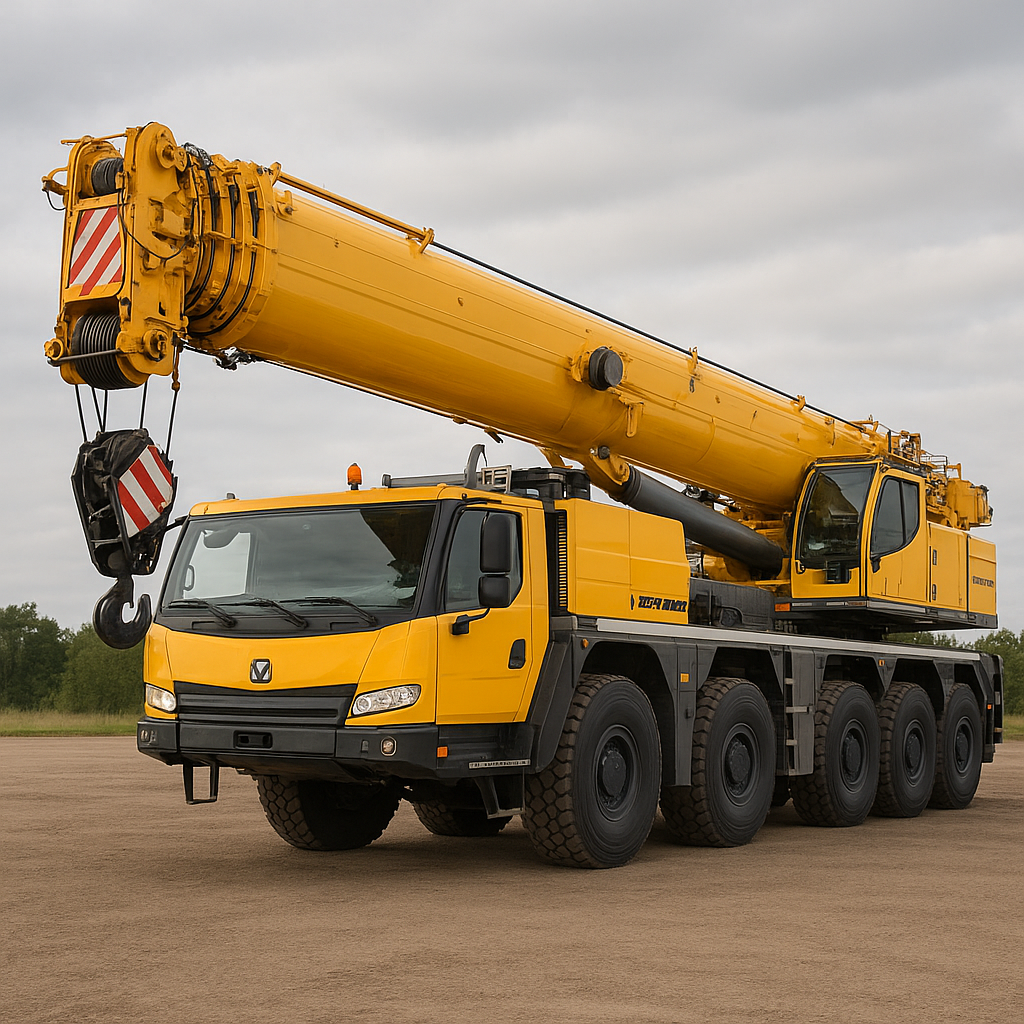
The XCMG XCT1300-2 is a heavyweight representative of modern all-terrain cranes designed to combine on-road mobility with robust off-road capability. Built by XCMG — one of the world’s largest construction equipment manufacturers — the XCT1300-2 targets sectors that require high lifting performance together with flexible travel and rapid setup. This article reviews the machine’s principal characteristics, typical applications, operational considerations, maintenance and safety features, and market context. It also highlights practical tips for maximising performance and lowering operating costs. Wherever specific figures are presented, they reflect commonly published specifications and industry norms for this model class.
Design and technical features
The XCT1300-2 has been engineered to balance lifting power with transportability and versatility. Its core design philosophy focuses on providing a reliable, user-friendly crane that can handle demanding lifts while moving between jobsites without the need for special permits or complex transport arrangements in many regions.
Structural layout and lifting system
At the heart of the XCT1300-2 is a robust chassis and a multi-section telescopic boom that offers reach and lifting flexibility. The boom sections are designed for rapid extension and retraction with hydraulic control, enabling the operator to adapt quickly to the lift envelope required. A flanged boom design and high-strength steels commonly used in this class provide the necessary strength-to-weight ratio for both heavy lifts and long reach operations.
The crane typically features a main winch and an auxiliary winch arrangement to provide both speed and fine control when handling loads. Sheave configurations and reeving options allow operators to configure the crane for higher capacity, extended reach, or faster handling, depending on the lift plan. Standard systems include load moment limiting, automatic overload protection and real-time lifting charts integrated into the operator console, aiding precise and safe lift execution.
Mobility, chassis and outriggers
One of the XCT1300-2’s defining traits is its integrated carrier that brings high-speed road travel together with off-road capability. The chassis is built to handle highway speeds typical of all-terrain cranes while offering a compact setup for maneuvering in tighter sites. The carrier usually includes multiple driven axles with steering systems to reduce turning radius and improve stability when travelling.
The crane’s outriggers are hydraulically extendable and designed to create a wide and stable footprint quickly. Modern outriggers on this model class incorporate safety interlocks and sensors that verify full extension and proper ground contact before lifting operations commence. Depending on site conditions, the outriggers can be used with pads or cribbing to distribute loads on soft ground.
Powertrain and auxiliaries
Power is supplied by a robust diesel engine driving both the carrier (for travel) and the superstructure functions (hoists, slewing, telescoping). The engine and hydraulic systems are tuned for efficient power delivery across a range of demands — from heavy lifts to long periods of idling during setup. Auxiliary hydraulic circuits supply services such as outriggers and swing brake release. Modern versions of the XCT1300-2 may also include electronic engine management and diagnostics systems that provide fault codes and service reminders.
Cabin ergonomics and control
The operator’s cabin on the XCT1300-2 emphasizes operator comfort and situational awareness. It typically has climate control, adjustable seating and intuitive joystick controls. The control layout integrates digital displays that present load charts, crane configuration, and diagnostic information. Visibility is enhanced by large glazed surfaces and optional camera systems for blind-spot coverage. Ergonomics and control logic help reduce operator fatigue during long shifts and improve overall safety.
Applications and industries
The versatility of the XCT1300-2 lends itself to a wide array of applications. Its combination of mobility, payload capacity, and reach makes it suitable for tasks across heavy construction, infrastructure, energy, industrial maintenance and emergency response.
Construction and civil engineering
In building construction and civil engineering projects, the XCT1300-2 is often used for placing precast concrete elements, installing large structural steel components, lifting building services modules, and assembling large façade units. Its capacity to travel between urban sites without special long-haul arrangements makes it popular for contractors working on multiple inner-city projects.
Energy sector — wind and power plants
The crane’s reach and lifting profile make it well-suited for wind turbine assembly, especially for medium-sized turbine nacelles and hub components. It is also applied in the construction and maintenance of power plants, where heavy transformers, boilers and other equipment must be placed with precision. All-terrain mobility proves advantageous for accessing rural and semi-prepared foundations typical of renewable energy projects.
Oil & gas and petrochemical facilities
Within refineries and petrochemical sites, the XCT1300-2 performs equipment installation, piping module placement, and maintenance lifts. Its ability to handle chunky, awkward loads and to operate in confined, sometimes congested, industrial yards is a practical advantage for plant turnaround and retrofit projects.
Infrastructure and utilities
Utility companies deploy cranes like the XCT1300-2 for substation equipment installation, bridge component placement, and the erection of transmission towers. Rapid setup and high mobility are helpful during emergency repairs and time-sensitive operations such as restoring power after storms.
Emergency response and recovery
Heavy-duty recovery operations — such as removing overturned heavy vehicles or clearing collapsed structures — benefit from the XCT1300-2’s lifting range and stability. The crane’s onboard systems aid quick configuration for lifts that often require adaptive slewing and complex load handling in difficult site conditions.
Performance, capacities and typical specifications
When discussing performance, the most important metric is the crane’s rated lifting capacity and the envelope within which that capacity can be applied. The XCT1300-2 is classed as a 130‑ton machine, which defines its general capability, but actual lifting charts determine the safe working loads at specific boom lengths and radii.
- Rated capacity: 130 tonnes (commonly listed as the nominal maximum).
- Maximum boom length: typical configurations in this class range from approximately 40 to 60 metres for the main boom; auxiliary jibs can extend this reach further for light loads.
- Operating weight: often in the range of tens of tonnes (varies by equipment and optional counterweights).
- Slewing and hoist speeds: designed for efficient cycle times and precise positioning; multi-speed winches are standard.
- Travel speed: all‑terrain designs enable highway-capable speeds suitable for moving between sites without escorts in many jurisdictions.
Actual performance data — such as the load chart at a particular radius and boom extension — should be consulted directly from the crane’s operator manual or the manufacturer’s technical documentation before planning any lift. Load moment indicators and onboard control systems usually integrate these charts and restrict lift operations that would exceed safe parameters.
Operational considerations and best practices
Proper planning and execution are essential to obtaining safe and efficient performance from an XCT1300-2. The following operational considerations illustrate how operators and site managers can get the best results.
Lift planning and site assessment
Every lift should start with a comprehensive lift plan. This includes ground-bearing calculations, outrigger placement, wind assessments, travel route planning (for moving the crane between sites), and contingency plans. Ground conditions are critical: soft or uneven surfaces require cribbing or mats to distribute loads and prevent differential settlement.
Transport and access
Although the XCT1300-2 is designed for road travel, certain components such as counterweights or extended jibs may require special transport or partial disassembly. Planning includes assessing bridge limits, road height clearances, and local transport regulations. Site access should be surveyed for turning radii and approach grades to avoid surprises on arrival.
Operator competency and training
Skilled operators who understand the crane’s control systems, load charts and safe rigging practices are indispensable. Regular refresher training on the XCT1300-2’s specific systems — including its diagnostics and safety interlocks — reduces the risk of errors. On-site riggers must also be competent in slinging and tag-line management to control loads safely.
Weather and environmental factors
Wind is a major limiting factor for tall or extended lifts. Operators must apply the manufacturer’s wind-speed limits and monitor conditions continuously. Rain and snow affect ground-bearing capacity and visibility, requiring adjustments to outrigger setup and operational pace.
Maintenance, lifecycle and reliability
Routine maintenance is a principal driver of both safety and cost-effectiveness. The XCT1300-2, like other modern cranes, benefits from proactive service schedules, condition monitoring and the use of genuine parts for major components.
Preventive maintenance
Daily inspections typically include hydraulic hoses, wire ropes, hooks, brakes, and indicators. Scheduled services — such as hydraulic fluid changes, engine servicing and slewing system inspections — should follow manufacturer-prescribed intervals. Early replacement of wear items like wire rope and sheave bearings reduces the risk of costly downtime and enhances safety.
Diagnostics and telematics
Many contemporary XCMG cranes include electronic diagnostics and can be equipped with telematics packages that transmit operating hours, fault codes and location data to fleet managers. Telematics enable predictive maintenance strategies, helping owners optimise uptime and extend component life.
Component reliability and spare parts
Key wear components include winches, hydraulic pumps, electric control units and the boom telescoping mechanism. Owners should maintain an inventory of critical spare parts or secure expeditious supply channels with local dealers to reduce repair lead times. The global footprint of XCMG provides reasonably accessible parts networks in many regions, though lead times vary by market.
Safety systems and regulatory compliance
Safety features on the XCT1300-2 are designed to protect operators, ground personnel and nearby infrastructure. Integrated systems reduce operator error and ensure compliance with international lifting standards.
- Load moment indicators and overload protection systems that prevent unsafe lift configurations.
- Automatic interlocks for outriggers and travel functions to ensure the crane is secure before lifting.
- Redundant braking systems on slewing and hoist functions to arrest unintended motion.
- Optional camera systems and proximity sensors to help avoid collisions with obstacles and provide better all-around awareness.
Adhering to local regulatory requirements — including periodic inspections, certifications and operator licensing — is essential. Cranes should also be operated in line with international standards such as those published by ISO, EN and local authorities.
Economics: purchase, ownership and rental considerations
Deciding whether to purchase, lease or rent an XCT1300-2 depends on mission profile, utilization rates and capital availability. Acquisition costs for new 130-ton class all-terrain cranes are significant, and total cost of ownership includes depreciation, maintenance, insurance and operator training. Rental is common for companies that need such capacity intermittently, while owners with steady workloads may find purchase economical over the long term.
Utilization and return on investment
High utilisation rates are necessary to justify purchase. Fleet managers should analyse job types and lifting requirements across projects to ensure that a 130-ton class crane is the best fit. Multi-region contractors often value the crane’s mobility, reducing transport costs and downtime between projects.
Rental market and typical rates
Rental rates vary widely by region, demand, and contract duration. Short-term daily rates may be relatively high compared to a monthly or long-term hire. Additional costs can include transport to site, setup fees, and operator charges. For accurate budgeting, always request a comprehensive quote from rental providers that includes all associated services.
Market context and comparisons
XCMG has positioned the XCT1300-2 as a competitive alternative to similar models from established European and global manufacturers. The value proposition often emphasises competitive pricing, comprehensive standard equipment, and local dealer support in many markets.
Comparative strengths
- Cost competitiveness vs. some Western brands.
- Range of standard features and options aimed at reducing the need for aftermarket modifications.
- Global manufacturing scale that supports parts availability in many regions.
Comparative considerations
When comparing cranes, buyers should look beyond headline capacity and evaluate load charts at working radii, travel configuration, service networks, and total cost of ownership. Brands differ in resale values, dealer service quality and the availability of optional equipment tailored to local use cases.
Tips for buyers and fleet managers
For procurement and fleet decisions, consider the following practical tips:
- Match crane capacity to the most frequent job rather than peak one-off lifts; over-sizing reduces utilisation and raises costs.
- Inspect local dealer capabilities: spare parts lead times and service technician availability are critical.
- Specify telematics and diagnostic packages to enable predictive maintenance and lower downtime.
- Consider resale value and regional demand for 130-ton class cranes when calculating lifecycle costs.
- Budget for operator training and regular certifications from day one to ensure safe, compliant operations.
Environmental and regulatory trends
Environmental regulations and a general industry move toward lower emissions are influencing crane design and operation. While the XCT1300-2 primarily uses diesel propulsion, advances in engine technology, emissions aftertreatment and hybrid systems are trends to watch. In some markets, electrification of superstructure functions or purely electric cranes for indoor yards is gaining ground. Fleet managers should track regulatory developments in emissions and noise, as these can affect operating permissions in urban environments.
Conclusion
The XCMG XCT1300-2 represents a pragmatic offering in the 130-ton all-terrain segment, combining mobility, lifting capability and a feature set designed for diverse industrial needs. Its strengths are most evident where operators require a balance of on-road travel, off-road access and substantial lifting performance without the logistical complexity of dedicated mobile or crawler cranes. Effective use of the machine depends on planning, skilled operators, rigorous maintenance and alignment with project requirements. For contractors and rental companies operating in infrastructure, energy and industrial sectors, the XCT1300-2 can be a versatile tool that supports demanding projects while offering cost and performance attributes that compete well in global markets.
)
)